


Introduction: Why This Matters
In a world saturated with advertisements and sales pitches, the most powerful way to build a lasting connection with your audience is not to shout at them, but to provide genuine value. This is the essence of content marketing. It’s the strategic approach of creating and distributing valuable, relevant, and consistent content to attract and retain a clearly defined audience — and, ultimately, to drive profitable customer action. However, without a clear content marketing strategy, you’re just creating content for content’s sake—a scattered effort that yields little result. A well-defined strategy transforms your content from random acts of publishing into a systematic engine for growth. It ensures every blog post, video, or social media update serves a specific purpose in moving your audience closer to your business. For any business looking to build trust, authority, and a loyal community, a content strategy is not a luxury; it’s the core of modern marketing.
Background/Context
The concept of using content to attract customers isn’t new. John Deere’s “The Furrow” magazine, launched in 1895 to educate farmers, is a classic example. However, the term “content marketing” was coined in 2001 by John O. Petersen and gained mainstream traction with the rise of the internet and the publication of Joe Pulizzi’s book “Get Content, Get Customers.”
The 2000s saw the rise of blogging as a core business strategy, followed by the explosion of social media platforms, which provided new channels for content distribution. The pivotal “Panda” Google update in 2011 penalized low-quality content farms and rewarded high-quality, original content, forcing businesses to take content quality seriously. Today, content marketing is a multi-billion dollar industry. It has evolved from simple blog posts to encompass a vast array of formats—including videos, podcasts, webinars, and interactive tools—all driven by a strategic understanding of the customer journey.
Key Concepts Defined
- Content Marketing: A strategic marketing approach focused on creating and distributing valuable, relevant, and consistent content to attract and retain a clearly defined audience.
- Content Strategy: The high-level vision that guides content creation and distribution to achieve a specific business goal. It answers the why, for whom, and how.
- Buyer Persona: A semi-fictional representation of your ideal customer based on market research and real data about your existing customers.
- Buyer’s Journey: The active research process a person goes through leading up to a purchase, typically broken into three stages: Awareness, Consideration, and Decision.
- Content Pillar: A core topic or theme that is central to your business, from which multiple pieces of related content (cluster content) are derived.
- Content Calendar: A schedule that outlines when and where you plan to publish upcoming content pieces across different channels.
- Lead Magnet: A valuable piece of content (e.g., an ebook, checklist, or webinar) offered for free in exchange for a prospect’s contact information.
How It Works (Step-by-Step)
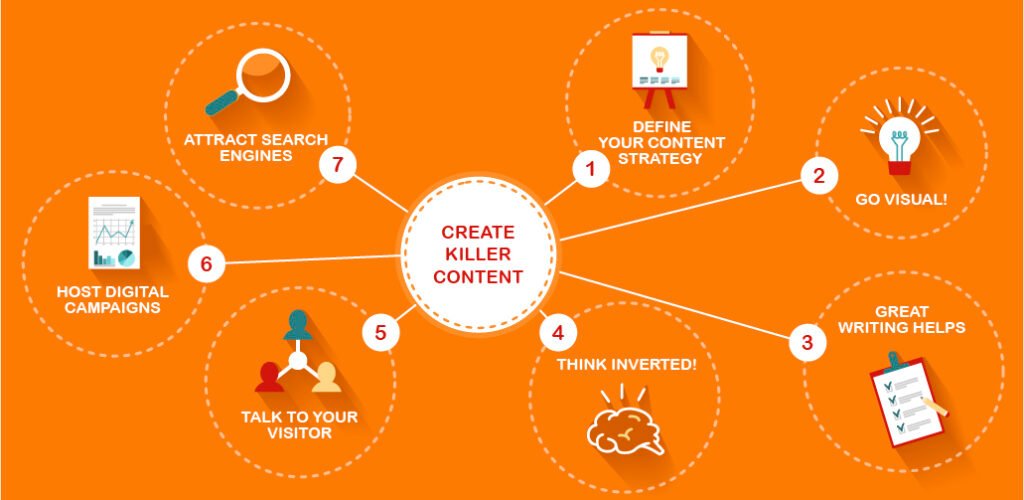
Building a robust content marketing strategy involves a clear, multi-stage process:
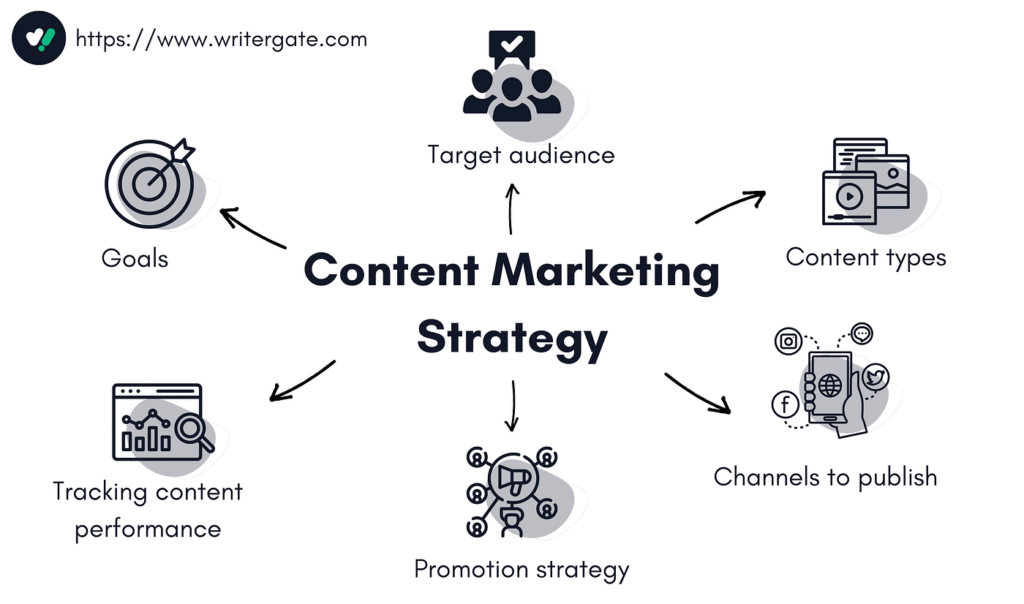
- Define Your Goals: Start with the end in mind. What do you want to achieve? Common goals include brand awareness, lead generation, customer retention, or sales. Ensure your goals are SMART (Specific, Measurable, Achievable, Relevant, Time-bound).
- Know Your Audience Inside and Out: Develop detailed buyer personas. Understand their demographics, pain points, challenges, goals, and where they seek information online. This is the most critical step, as your entire strategy hinges on this understanding.
- Audit Your Existing Content: If you have existing content, assess its performance. What topics resonate? What formats work best? Identify gaps and opportunities for improvement or repurposing.
- Choose Your Content Pillars: Select 3-5 broad, core topics that are fundamental to your business and relevant to your audience. For a digital marketing agency, pillars might be SEO, Social Media, and Email Marketing.
- Map Content to the Buyer’s Journey:
- Awareness Stage: Create educational content that addresses top-of-funnel pain points (e.g., blog posts, “how-to” videos, infographics).
- Consideration Stage: Create content that showcases your solution and expertise (e.g., case studies, comparison guides, webinars).
- Decision Stage: Create content that helps the buyer choose you (e.g., free trials, demos, testimonials, product sheets).
- Choose Your Channels and Formats: Decide where you will distribute your content. Your website blog is your hub, but you’ll also use channels like LinkedIn, YouTube, email newsletters, etc. Match the format (blog, video, podcast) to the channel and your audience’s preferences.
- Create a Content Calendar: Organize your plan. Schedule your content pillars, topics, formats, publishing dates, and responsible team members. This ensures consistency, which is key to success.
- Create, Distribute, and Promote: Execute your plan. Create high-quality content and then actively promote it through your chosen channels, email lists, and social media—don’t just “publish and pray.”
- Measure and Analyze: Use analytics to track KPIs like website traffic, engagement, social shares, and lead conversions. Use these insights to refine your strategy and double down on what works.
Why It’s Important
A strategic approach to content marketing delivers profound business benefits that traditional advertising cannot match:
- Builds Trust and Credibility: By consistently providing value without asking for anything in return, you position your brand as a helpful expert, not just a seller.
- Generates Organic Traffic: High-quality, SEO-optimized content is the primary driver of sustainable organic traffic from search engines, as detailed in our guide to SEO fundamentals.
- Cost-Effective Lead Generation: Compared to paid advertising, content marketing generates 3x more leads per dollar spent. A single high-performing blog post can generate leads for years.
- Nurtures Customers Throughout the Funnel: Content allows you to build a relationship with prospects at every stage of their journey, gently guiding them toward a purchase decision.
- Creates a Sustainable Asset: Unlike a Facebook ad that disappears, a library of quality content is a business asset that accumulates value over time.
Common Misconceptions
- Misconception 1: “Content marketing is just blogging.”
- Reality: Blogging is a key tactic, but content marketing is the overarching strategy that includes videos, podcasts, social media posts, emails, ebooks, and more.
- Misconception 2: “It’s free marketing.”
- Reality: While it can be more cost-effective than paid ads, it requires a significant investment of time, skill, and sometimes money for tools, freelancers, or promotion.
- Misconception 3: “You need to be on every platform.”
- Reality: A “spray and pray” approach is ineffective. A strong strategy focuses on the 2-3 channels where your target audience is most active and engaged.
Recent Developments
The content marketing landscape is evolving rapidly. Key trends include:
- Interactive Content: Quizzes, calculators, and interactive infographics drive higher engagement and provide personalized value to users.
- Video-First Strategy: With the dominance of TikTok, Reels, and YouTube Shorts, creating snackable, valuable video content is no longer optional for most brands.
- User-Generated Content (UGC): Brands are leveraging content created by their customers (reviews, unboxing videos) to build authenticity and social proof.
- AI-Assisted Content Creation: AI tools are being used for brainstorming, research, and drafting, but the human touch for strategy, editing, and adding unique insights remains irreplaceable.
- Focus on E-A-T: Google’s emphasis on Expertise, Authoritativeness, and Trustworthiness means content must demonstrate deep subject-matter knowledge to rank well.
Success Stories
HubSpot: This is perhaps the most famous content marketing success story. HubSpot built an entire multi-billion dollar company by giving away their core knowledge for free. Their blog, academy, and extensive library of free tools and templates established them as the undisputed leader in the inbound marketing space. They effectively created the market they now dominate through a relentless focus on valuable, educational content.
Conclusion & Key Takeaways
A content marketing strategy is your roadmap to building a meaningful and profitable relationship with your audience. It aligns your marketing efforts with your business objectives and ensures that every piece of content you create has a purpose.
Key Takeaways:
- Strategy Before Tactics: Never create content without a clear understanding of your goals, audience, and the journey you’re guiding them on.
- Consistency Trumps Frequency: A regular, reliable publishing schedule builds audience trust and momentum far more effectively than sporadic bursts of content.
- Quality and Relevance are Non-Negotiable: Your content must be genuinely useful and tailored to your audience’s specific needs and interests.
- Promotion is as Important as Creation: The best content in the world is useless if no one sees it. Have a distribution plan for every piece you publish.
- It’s a Long-Term Game: The full benefits of content marketing compound over time. Patience and persistence are essential.
For more tools and templates to build your strategy, visit our Resources page.
FAQ’s
- How is content marketing different from social media marketing?
- Content marketing is the creation and strategy behind the asset (the blog post, the video). Social media marketing is one channel used to distribute and promote that asset.
- What is the most effective type of content?
- It depends entirely on your audience. The most effective format is the one your target audience prefers consuming. This is why audience research is crucial.
- How often should I publish new content?
- Focus on a consistent schedule you can maintain. Publishing one high-quality article per week is better than three mediocre ones. Quality and consistency are more important than volume.
- How do I measure the ROI of content marketing?
- Track metrics tied to your goals: organic traffic, time on page, lead conversions (from gated content), and, ultimately, sales revenue attributed to content. Use UTM parameters and analytics to connect the dots.
- What is a content cluster?
- A model where a comprehensive “pillar” page covers a broad topic, and multiple “cluster” pages covering subtopics link back to the pillar page. This helps signal topic authority to search engines.
- How can a small business with a limited budget compete?
- Focus on a hyper-specific niche (a “micro-topic”) where you can become the leading authority. Repurpose one long-form piece of content (like a blog post) into multiple social media posts, an email newsletter, and a short video script.
- Should I outsource content creation?
- This depends on your internal resources and expertise. Many businesses hire freelance writers or agencies for specific tasks, allowing them to scale their content production while maintaining a strategic vision internally.
- How does content marketing support other business partnerships?
- High-quality content establishes your authority, making you a more attractive partner for strategic alliances and joint ventures. It’s a demonstration of your value and expertise.
- Can content marketing be stressful to maintain?
- Yes, the pressure to consistently create can lead to burnout. It’s important to plan ahead, batch-create content, and prioritize mental wellbeing, as discussed in this guide to mental health.
- Where should a beginner start with content marketing?
- Start with a single, well-defined buyer persona and one primary content channel (like a blog or a YouTube channel). Create 3-5 pieces of high-quality content that directly address their biggest pain point before worrying about a complex calendar. For a broader business context, our guide on starting an online business can be very helpful.
Thanks for sharing. I read many of your blog posts, cool, your blog is very good.
Your article helped me a lot, is there any more related content? Thanks!
Thanks for sharing. I read many of your blog posts, cool, your blog is very good.
Your article helped me a lot, is there any more related content? Thanks!