

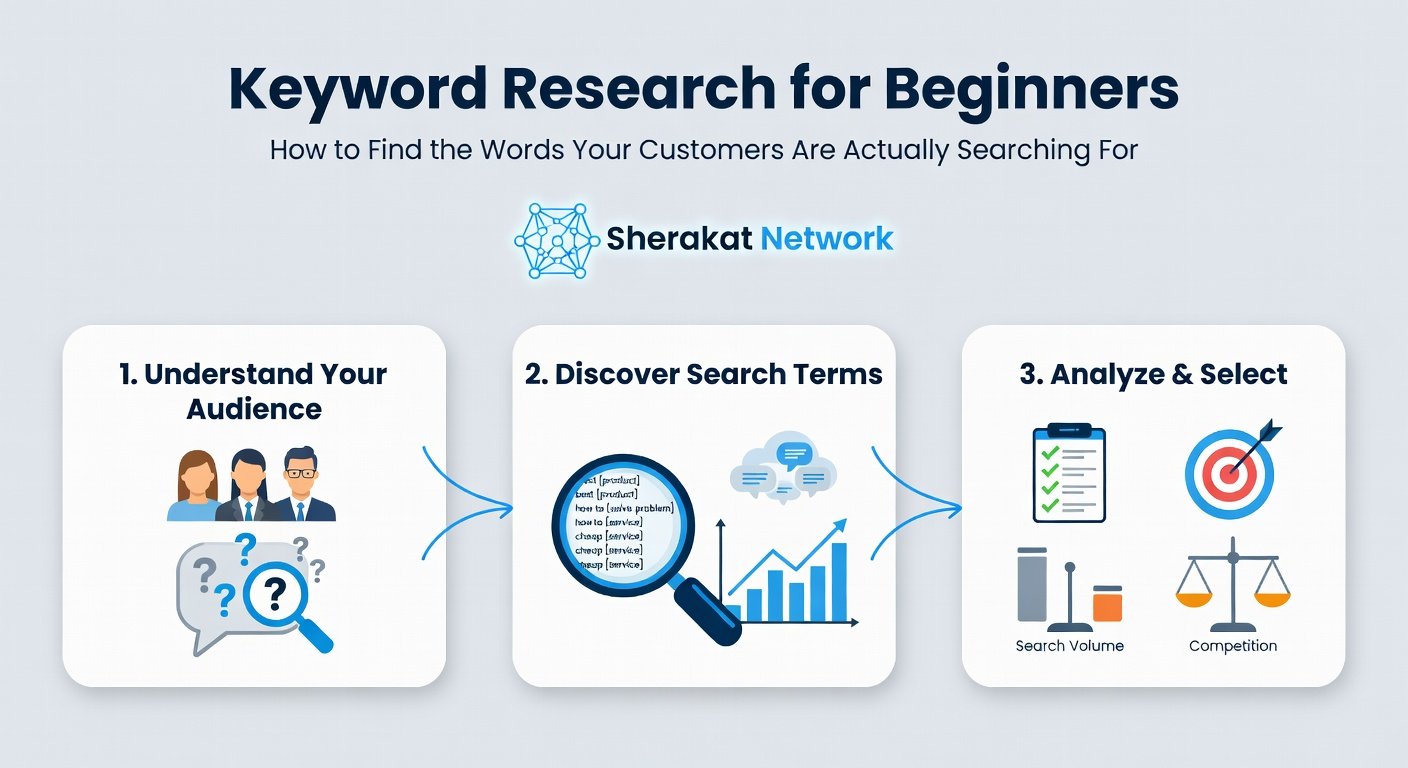

Introduction – Why This Matters
In my experience, the single biggest mistake beginners make in SEO is falling in love with their own words. They write content based on what they think their audience wants to hear, using the terminology they use internally. Then they wonder why the traffic never comes. What I’ve found is that the gap between what businesses say and what customers search for is often a chasm—and keyword research is the bridge that spans it.
Here’s a truth that took me years to fully appreciate: Your customers don’t care about your products or services the way you do. They care about their problems, their questions, and their goals. The words they type into Google are the raw, unfiltered expression of those needs. If your content doesn’t speak their language—literally, the exact phrases they use—you remain invisible, no matter how brilliant your offerings are.
According to 2025 data from Backlinko, the first page of Google captures over 90% of all web traffic. But here’s what that statistic doesn’t tell you: even if you make it to page one, if you’re targeting the wrong keywords, you’re attracting the wrong visitors—or worse, no visitors at all.
When I first started in digital marketing, I helped a client who sold handmade leather journals. They wanted to rank for “leather notebook.” After months of effort, we did it—page one, position four. But sales didn’t increase. Why? Because people searching for “leather notebook” were mostly students looking for a cheap spiral-bound option. Our target customers were searching for “leather journal for men,” “leather writing journal,” and “handmade leather diary.” We were ranking for the wrong words.
That painful lesson taught me that keyword research isn’t just an SEO tactic—it’s market research. It’s eavesdropping on your customers’ conversations with Google. And when you get it right, everything else becomes easier: content creation, on-page optimization, and ultimately, conversions.
In our previous guides, we covered the SEO Fundamentals for Beginners and the practical steps of On-Page SEO. Now it’s time to dive into the skill that makes both of those efforts effective: finding the right keywords to target in the first place.
Background / Context
To understand keyword research in 2026, we need to look at how search has evolved. In the early days of the internet, keyword research was simple: find popular words, stuff them into your content, and rank. Search engines were literal-minded machines that matched query words to page words.
Then Google introduced semantic search capabilities with algorithms like Hummingbird (2013), RankBrain (2015), and BERT (2019). Suddenly, Google wasn’t just matching words—it was understanding concepts, context, and user intent. The keyword “apple” could mean the fruit or the technology company, and Google could tell the difference based on your other search terms.
Today, in 2026, we’re in the era of entity-based search and generative AI. Google’s algorithms understand not just keywords but the relationships between people, places, things, and concepts. When you search for “best yoga mats for beginners,” Google understands that “beginners” implies “easy to use,” “affordable,” and “non-slip.” It’s not just matching words—it’s matching meaning.
This evolution hasn’t made keyword research obsolete. Quite the opposite. It’s made it more sophisticated and more valuable. Keyword research in 2026 isn’t about finding words to repeat. It’s about understanding your audience’s language, intent, and the conceptual landscape of their needs.
Keyword research is the systematic process of discovering, analyzing, and selecting search terms that people enter into search engines, with the goal of using those terms to optimize content and attract targeted traffic.
Key Concepts Defined
Before we dive into the how-to, let’s establish the vocabulary you’ll need.
- Seed Keyword: The starting point for your research—a broad term related to your business or topic. For a bakery, seed keywords might be “cake,” “bread,” or “pastries”.
- Target Keyword (Primary Keyword): The main search phrase you want a specific page to rank for. Each page should have one primary keyword that defines its core topic.
- Secondary Keywords: Related terms and variations that support your primary keyword. They help search engines understand your content’s depth and relevance.
- Long-Tail Keywords: Longer, more specific search phrases (typically 3-5 words). “Running shoes” is short-tail; “best running shoes for marathon training flat feet” is long-tail. Long-tail keywords have lower search volume but higher conversion rates because they indicate specific intent.
- Search Intent: The goal behind a user’s search query. The four main types are:
- Informational: Seeking knowledge (“how to tie a tie”)
- Navigational: Looking for a specific website (“Facebook login”)
- Commercial: Researching before a purchase (“best noise-canceling headphones”)
- Transactional: Ready to buy (“buy iPhone 15 Pro Max online”)
- Keyword Difficulty (KD): A metric (usually 0-100) that estimates how hard it is to rank for a keyword. Higher scores mean more competition.
- Search Volume: The average number of monthly searches for a keyword. Higher volume means more potential traffic but usually more competition.
- Click-Through Rate (CTR): The percentage of searchers who click on a result after seeing it. Position #1 typically gets around 27-30% CTR, dropping dramatically for lower positions.
- Topic Cluster: A group of interlinked content pieces centered around a “pillar” page that covers a broad topic comprehensively. This structure signals topical authority to search engines.
- Semantic Search: Search engines’ ability to understand the contextual meaning of terms, not just the literal keywords.
- Search Engine Results Page (SERP) Features: Non-standard results like featured snippets, “People also ask” boxes, image packs, and local packs that appear on search results pages.
- Zero-Volume Keywords: Search terms that don’t appear in keyword tools but represent real user queries. Often, these are very specific long-tail questions.
How It Works (Step-by-Step Breakdown)
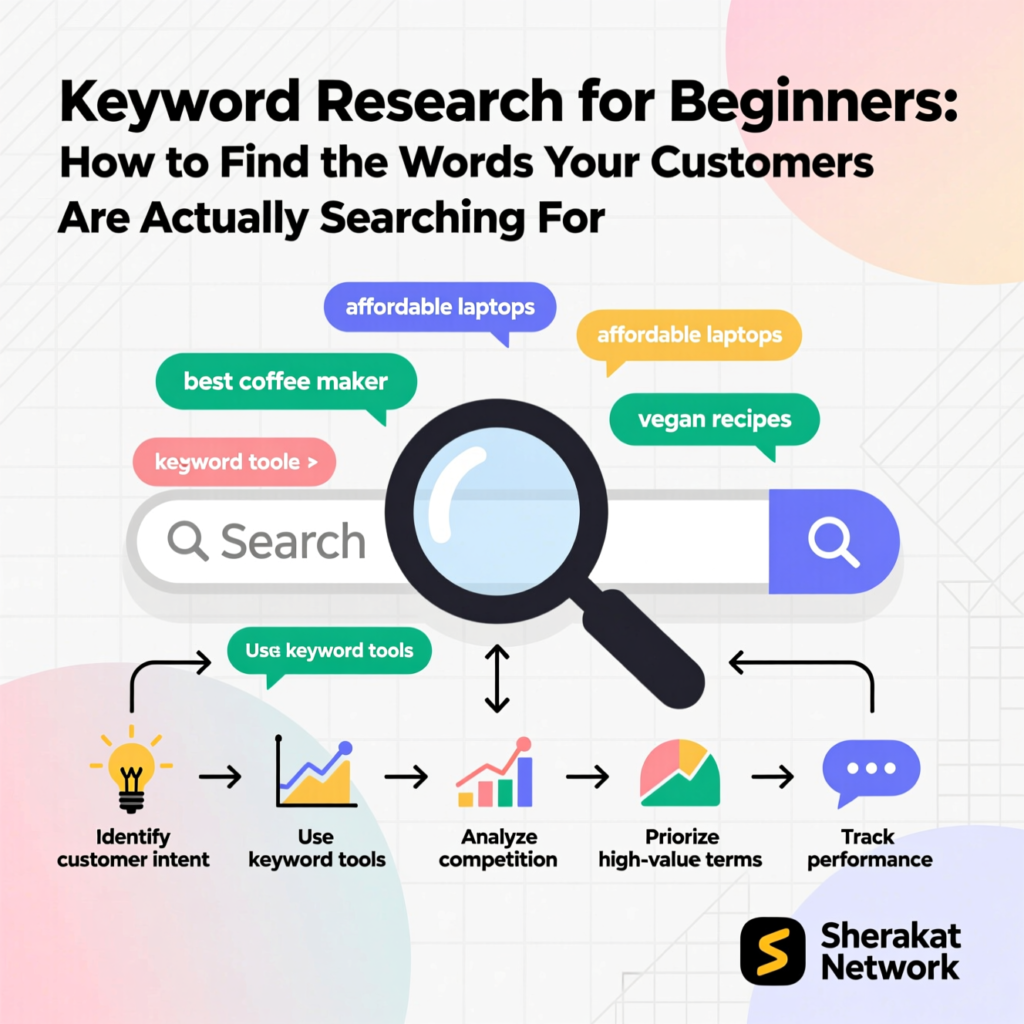
Now let’s walk through the complete keyword research process from start to finish. I’ve organized this into a sequence you can follow for any topic or business.
Step 1: Brainstorm Your Seed Keywords
Every keyword research journey starts with seed keywords—the fundamental terms that describe your business, products, services, or content topics. These aren’t necessarily the keywords you’ll target; they’re the starting points for discovery.
How to brainstorm effectively:
Put yourself in your customer’s mindset. If they had never heard of your business, what would they type into Google to find what you offer? Consider:
- Products/services: What do you sell? A plumber might list “pipe repair,” “drain cleaning,” and “water heater installation.”
- Problems you solve: What pain points do your customers have? “Leaky faucet,” “clogged toilet,” “no hot water.”
- Questions they ask: What do customers frequently ask you? “How often should I flush my water heater?” “Why is my toilet running?”
- Industry terminology: What terms do professionals use that customers might also know?
- Synonyms and variations: What other ways might someone describe what you offer?
For a yoga instructor, seed keywords might include: “yoga classes,” “yoga for beginners,” “hot yoga,” “yoga poses,” “meditation,” “stress relief.”
Pro tip from experience: Don’t overthink this step. List 10-20 seed keywords that feel obvious and natural. You’ll expand them in the next steps.
Step 2: Expand Your List with Keyword Research Tools
Now take your seed keywords and use tools to expand them into a comprehensive list of potential target keywords. This is where you discover what people are actually searching for, which often differs from what you assume.
Free tools to use:
- Google Keyword Planner: Requires a Google Ads account but provides reliable search volume data (even if you don’t run ads).
- AnswerThePublic: Visualizes search questions and phrases related to your seed keywords.
- Ubersuggest: Offers keyword ideas, volume, and competition data for free with limitations.
- Google Autocomplete: Start typing your seed keyword into Google and note the suggestions that appear. These are real, popular searches.
- People Also Ask boxes: Search for your seed keyword and mine the “People also ask” section for question-based keywords.
- Related searches: Scroll to the bottom of Google’s search results for your seed keyword and note the “Searches related to…” section.
Paid tools (worth considering as you grow):
- Ahrefs
- SEMrush
- Moz Keyword Explorer
- KWFinder
How to use these tools:
Enter each seed keyword and collect every relevant suggestion. Don’t filter yet—just gather. You’re looking for:
- Keywords with decent search volume
- Long-tail variations
- Question-based keywords (what, how, why, when, where)
- Related terms you hadn’t considered
For our yoga instructor example, entering “yoga for beginners” might generate: “yoga for beginners at home,” “yoga for beginners free,” “easy yoga poses for beginners,” “yoga for beginners over 50,” “yoga for beginners youtube,” and dozens more.
Step 3: Analyze Search Intent for Each Keyword
This is the most critical step—and the one beginners most often skip. Before you decide whether to target a keyword, you must understand why people are searching for it.
How to analyze intent:
For each keyword, search it yourself and examine the top-ranking pages. Ask:
- What type of content is ranking? Are they blog posts, product pages, category pages, or videos?
- What format dominates? Are they listicles, how-to guides, reviews, or comparison posts?
- What angle do they take? Is the content educational, promotional, or informational?
- What questions do they answer? What subtopics do they cover?
The four intent types with examples:
| Intent Type | Goal | Example Keyword | Expected Content Type |
|---|---|---|---|
| Informational | Learn something | “How to do downward dog.” | Blog post, tutorial video |
| Navigational | Find a specific site | “yoga with adriene” | Homepage or specific channel |
| Commercial | Research before buying | “best yoga mat for beginners” | Comparison post, review |
| Transactional | Make a purchase | “how to do downward dog.” | Product page, category page |
If the top results for “yoga mats” are all comparison blog posts, creating a product page won’t satisfy searcher intent—and you’ll struggle to rank.
Real example from my work:
A client wanted to target “email marketing software.” The top results were all comparison pages reviewing multiple tools. We could have created a page about our specific software, but it would have fought against the dominant intent. Instead, we created a comprehensive comparison guide that positioned our tool alongside competitors. It ranked on page one within three months.
Step 4: Evaluate Keyword Metrics
Now that you have a list of intent-aligned keywords, it’s time to evaluate them using available metrics.
Key metrics to consider:
- Search Volume: How many people search for this term monthly? Higher volume means more potential traffic but usually more competition. Tools typically show averages, so remember that seasonal fluctuations exist.
- Keyword Difficulty (KD): An estimate of how hard it will be to rank. For beginners, target keywords with low-to-medium difficulty (typically under 30-40 on most tools). As your site gains authority, you can target harder terms.
- Click-Through Rate (CTR) Potential: Some keywords trigger SERP features that reduce organic clicks. For example, if a keyword triggers a featured snippet that answers the question immediately, fewer people click through to websites. Tools like Ahrefs can show estimated CTR.
- Traffic Potential: Instead of looking at individual keywords, consider the total traffic the #1 ranking page receives. This accounts for the fact that a single page ranks for hundreds or thousands of related keywords.
- Commercial Intent: For business keywords, assess whether the keyword indicates purchase readiness. “Best” keywords (commercial intent) often convert better than “what is” keywords (informational intent), though both are valuable at different funnel stages.
How to balance these factors:
There’s no perfect formula, but here’s my approach:
- For new sites: Prioritize low-difficulty, specific long-tail keywords with clear intent
- For growing sites: Mix in medium-difficulty keywords with decent volume
- For established sites: Go after competitive head terms while maintaining long-tail coverage
Step 5: Identify Keyword Gaps and Opportunities
Now look at what your competitors are ranking for that you aren’t. This “keyword gap analysis” reveals opportunities you might have missed.
How to perform gap analysis:
If you have access to paid tools like Ahrefs or SEMrush, they have dedicated gap analysis features. If not, you can do manual research:
- Identify 3-5 competitors who rank well in your space
- Visit their top-performing pages (use tools like SimilarWeb for estimates, or just look at their content)
- Note which keywords they’re targeting and what topics they cover
- Compare with your own content to find gaps
Look for:
- The keywords they rank for that you don’t
- Topics they’ve covered that you haven’t
- Question-based keywords, they’re answering
- Long-tail variations they’ve missed
These gaps represent content opportunities.
Step 6: Map Keywords to Content
Now comes the strategic part: matching your keywords to specific pieces of content. This is where you plan your content strategy.
Mapping principles:
- One primary keyword per page: Each page should target one main keyword. This focuses your optimization efforts and prevents keyword cannibalization (multiple pages competing for the same term) .
- Group related keywords: Secondary keywords should naturally support the primary keyword. For example, a page targeting “yoga for beginners” might also cover “easy yoga poses,” “yoga for beginners equipment,” and “how often should beginners do yoga.”
- Consider the buyer’s journey: Map keywords to different funnel stages:
- Top of funnel (awareness): Informational keywords (“what is yoga,” “benefits of yoga”)
- Middle of funnel (consideration): Commercial keywords (“best yoga mats,” “yoga vs pilates”)
- Bottom of funnel (decision): Transactional keywords (“buy yoga mat,” “yoga classes near me”)
- Plan topic clusters: Group related content around pillar pages. For example, a “yoga for beginners” pillar page might link to supporting content about poses, equipment, breathing techniques, and common mistakes.
Step 7: Prioritize Your Keywords
You can’t target every keyword at once. Prioritization ensures you focus your efforts where they’ll have the most impact.
Factors to consider when prioritizing:
- Relevance: How closely does this keyword match your business offerings?
- Volume: How much potential traffic exists?
- Difficulty: Can you realistically rank for it?
- Intent alignment: Does it match what you can offer?
- Business value: Will traffic from this keyword lead to your desired outcomes (sales, leads, email signups)?
- Seasonality: Is this keyword consistently searched, or does it spike at certain times?
My prioritization framework:
- Tier 1 (High priority): Keywords with clear commercial intent, moderate volume, achievable difficulty, and strong business relevance. Target these first with dedicated, comprehensive content.
- Tier 2 (Medium priority): Informational keywords that build authority and attract top-of-funnel traffic. These support your tier 1 efforts and build trust.
- Tier 3 (Low priority): Very great difficulty keywords you can’t yet compete for, or very low volume keywords that may not justify content investment. Revisit these as your site grows.
Step 8: Create Content Around Your Keywords
With your prioritized keywords in hand, it’s time to create content. This is where your keyword research pays off.
For each target keyword:
- Analyze the current top content: What makes it rank? How comprehensive is it? What’s missing? Can you create something better?
- Outline your content: Use your primary keyword in the title, H1, and naturally throughout. Use secondary keywords in H2s and H3s.
- Write comprehensively: Cover the topic thoroughly. If the top results are 1,500 words, aim for 2,000+ if you can add genuine value. Don’t pad; expand.
- Include different formats: Add images, videos, infographics, or tables where they enhance understanding.
- Optimize on-page elements: Follow our On-Page SEO Checklist for title tags, meta descriptions, headings, and image optimization.
- Plan internal links: Link to related content on your site, especially pillar pages and other relevant resources.
Step 9: Track and Measure Performance
Keyword research isn’t a one-time task. It’s an ongoing process of refinement based on real-world performance.
What to track:
- Rankings: Where do your pages appear for target keywords? Use tools like Google Search Console or rank tracking software.
- Organic traffic: Are your optimized pages attracting visitors? Monitor in Google Analytics.
- Engagement metrics: Do visitors stay on your pages? What’s your bounce rate? Are they visiting other pages? Good engagement signals quality to search engines.
- Conversions: Are visitors taking desired actions? Ultimately, traffic means nothing if it doesn’t support your goals.
How to refine:
- If you’re not ranking, reassess keyword difficulty and intent alignment. You may need to target less competitive variations.
- If you’re ranking but not getting clicks, improve your title tags and meta descriptions to boost CTR.
- If you’re getting clicks but visitors leave quickly, improve your content quality and user experience.
- Update content regularly based on performance data and new opportunities.
Why It’s Important
You might be wondering: with all the other SEO tasks demanding attention, why invest so much time in keyword research? The answer is simple: keyword research is the foundation that makes everything else work.
Without the Right Keywords, Your Content Is Invisible
Think of keywords as the addresses of your content. You can build the most beautiful house in the world, but if it doesn’t have a correct address, no one can find it. Keyword research ensures your content has the right “address” for search engines to deliver visitors.
Keyword Research Reveals Your Customers’ True Needs
When you research keywords, you’re not just finding search terms—you’re uncovering the language your customers use when they have problems your business solves. This insight is gold for product development, messaging, and understanding your market.
It Prevents Wasted Effort
How many blog posts have been written, published, and forgotten because no one ever searched for the topics they covered? Keyword research ensures you’re creating content that has demand. You’re not guessing; you’re responding to actual search behavior.
It Informs Your Entire Content Strategy
Once you understand which keywords matter in your space, you can build a content strategy that systematically addresses your audience’s needs. You’ll know what topics to cover, what questions to answer, and what formats to use.
It Helps You Compete Smarter
If you’re a small business or new website, you can’t out-muscle established competitors on head terms. But you can out-smart them by targeting specific long-tail keywords they’ve overlooked. Keyword research reveals these opportunities.
Sustainability in the Future
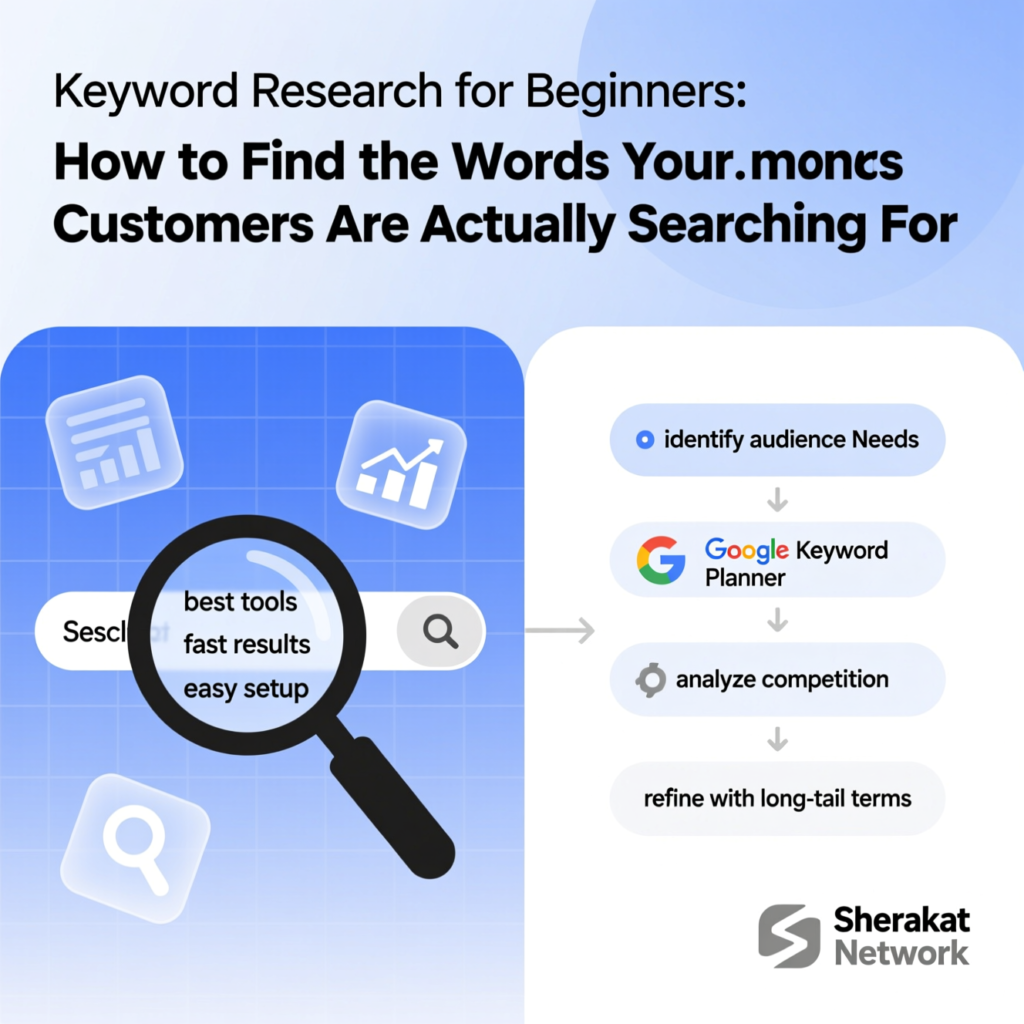
As search continues to evolve, keyword research must evolve with it. Here’s what sustainability looks like for keyword research in 2026 and beyond.
The Shift from Keywords to Topics
Search engines increasingly understand topics, entities, and relationships—not just keywords. Sustainable keyword research means thinking in terms of topic clusters rather than individual terms. You’re not just targeting “yoga for beginners”; you’re establishing authority on the broader topic of “beginner yoga.”
The Rise of Zero-Click Searches
More searches than ever end without a click, thanks to featured snippets, direct answers, and AI overviews. Sustainable keyword research includes identifying opportunities to appear in these zero-click results. Question-based keywords are especially valuable for featured snippet targeting.
Voice and Conversational Search
With the proliferation of smart speakers and voice assistants, conversational, natural-language queries are growing. Sustainable keyword research includes long-tail, question-based phrases that mirror how people speak: “what’s the best yoga mat for someone with bad knees?” rather than “best yoga mat knee pain.”
Visual and Video Search Optimization
Platforms like YouTube, Pinterest, and Google Images are search engines in their own right. Sustainable keyword research extends to these platforms, considering how people search visually and for video content.
Generative AI and Search
As AI-powered search experiences (like Google’s Search Generative Experience and standalone chatbots) become more common, the nature of search visibility changes. Sustainable keyword research means optimizing for AI citation—creating content so authoritative and well-structured that AI models use it as a source.
Common Misconceptions
Let’s clear up some myths that can derail your keyword research efforts.
Myth 1: “High search volume keywords are always better.”
Reality: High-volume keywords are often broad, competitive, and low-converting. A keyword with 1,000 monthly searches and clear commercial intent is often more valuable than one with 10,000 searches and vague intent.
Myth 2: “You should target one keyword per page and ignore others.”
Reality: Modern SEO is about topical authority. Your page should target one primary keyword but naturally cover many related terms. Search engines understand semantic relationships.
Myth 3: “Keyword difficulty scores are absolute.”
Reality: KD scores are estimates based on available data, not guarantees. A “hard” keyword might be achievable if you create exceptional content and have reasonable authority. Use KD as guidance, not gospel.
Myth 4: “Exact-match keywords in URLs and titles guarantee rankings.”
Reality: While including keywords in these elements helps, it’s no substitute for comprehensive, high-quality content that satisfies search intent. Google is sophisticated enough to understand synonyms and context.
Myth 5: “Once you choose your keywords, you’re done.”
Reality: Search behavior changes. New keywords emerge. Competitors target your terms. Effective keyword research is ongoing, with regular reviews and updates.
Myth 6: “Free keyword tools give you everything you need.”
Reality: Free tools are great starting points, but they have limitations. They often sample data, miss long-tail variations, and provide estimates rather than exact numbers. As you grow, consider investing in paid tools for deeper insights.
Recent Developments
Keyword research in 2026 has been shaped by several significant developments.
Google’s Search Generative Experience (SGE)
Google’s AI-powered search experience, now widely rolled out, changes how keywords trigger results. SGE generates AI overviews for many queries, synthesizing information from multiple sources. This means keyword research must now consider: “Will this query trigger an AI overview? How can my content be cited in it?”
People-First Content Updates
Google’s guidance now explicitly emphasizes creating content for people, not search engines. This doesn’t make keyword research obsolete—it makes it more focused on genuine user needs rather than keyword manipulation.
Entity-Based Search
Search engines increasingly understand “entities” (people, places, things) and their relationships. Keyword research now includes identifying the key entities in your niche and creating content that demonstrates your authority on those entities.
The Death of Keyword Density
Remember when people aimed for 2% keyword density? That concept is dead. Search engines use semantic analysis, not keyword counting. Use keywords naturally; if you’re forcing them, you’re overdoing it .
Success Stories
The Niche Publisher Who Found Hidden Gold
A few years ago, I worked with a publisher who created content for a niche hobby: antique clock restoration. The obvious keywords—”clock repair,” “antique clocks”—were highly competitive and dominated by established sites.
Instead of fighting for those terms, we dug into long-tail variations using tools like AnswerThePublic. We discovered hundreds of specific questions: “how to clean clock gears without disassembly,” “where to find replacement clock hands,” “what oil to use on antique clock movements.”
We created detailed content answering each question. Within a year, the site was getting over 100,000 monthly visitors from these specific queries. More importantly, the visitors were highly engaged—they were serious hobbyists who bought books, tools, and courses from the site.
The lesson? The gold isn’t always in the obvious keywords. It’s often in the specific questions your audience is asking.
The Local Business That Outranked National Chains
A local hardware store couldn’t compete with Home Depot and Lowe’s on broad terms like “power tools” or “paint.” But they could win on local, specific searches.
We researched keywords that combined products with local intent: “emergency locksmith [city name],” “key cutting near me,” “screen repair hardware store.” We created location-specific pages for each service they offered, optimized with local keywords and Google Business Profile integration.
Within months, they were ranking in the top three for dozens of local service terms. National chains dominated broad product searches, but the hardware store owned the local service queries—which is where the profit margins were anyway.
The Blogger Who Turned Around a Failing Site
A lifestyle blogger had published 200+ posts over three years but was getting barely 1,000 monthly visitors. She was writing about topics she found interesting: “my morning routine,” “what I ate this week,” “favorite books.”
We conducted keyword research in her niche and discovered what people actually searched for: “how to start a morning routine that sticks,” “meal prep for weight loss beginners,” “books that change your perspective.”
We didn’t abandon her voice or style. We simply aligned her topics with actual search demand. Within six months, traffic grew to 25,000 monthly visitors. She didn’t need to write differently; she needed to write about what people were actually searching for.
Real-Life Examples
Example 1: Keyword Research for a Bakery
Scenario: A local bakery wants to attract more customers through organic search.
Poor keyword approach:
- Target: “bakery” (impossibly competitive, too broad)
- Target: “cake” (vague intent, highly competitive)
Strategic keyword research process:
- Seed keywords: bakery, cakes, bread, pastries, cookies
- Tool expansion: Using Google Keyword Planner and Autocomplete, we discover:
- “custom birthday cakes [city name]”
- “gluten-free bakery near me”
- “wedding cake prices [city name]”
- “Fresh bread delivered.”
- “croissants near me”
- “vegan cupcakes [city name]”
- “Bakery open now.”
- Intent analysis:
- “custom birthday cakes” = transactional (ready to order)
- “gluten-free bakery near me” = commercial (researching options)
- “how to store fresh bread” = informational (learning)
- Prioritization:
- Tier 1 (immediate revenue): “custom birthday cakes,” “wedding cake consultation”
- Tier 2 (authority building): “how to choose a wedding cake,” “gluten-free baking tips”
- Tier 3 (long-term): “history of sourdough,” “famous bakeries [city]”
- Content mapping:
- Service pages for each cake type (custom birthday, wedding, gluten-free)
- Blog posts for informational queries
- Location pages for neighborhood-specific searches
Result: The bakery now ranks for dozens of local, high-intent keywords and has seen a 300% increase in organic-driven orders.
Example 2: Keyword Research for a Financial Advisor
Scenario: A financial advisor wants to attract new clients through content marketing.
Poor keyword approach:
- Target: “financial advisor” (extremely competitive, broad intent)
- Target: “investing” (too broad, mixed intent)
Strategic keyword research process:
- Seed keywords: financial advisor, retirement planning, investing, wealth management
- Tool expansion:
- “How to find a financial advisor.”
- “Financial Advisor Fees Explained”
- “robo-advisor vs human advisor”
- “retirement planning at 50”
- “investing for beginners guide.”
- “How much do I need to retire?”
- “financial advisor vs fiduciary”
- Intent analysis:
- “how to find a financial advisor” = commercial (researching options)
- “financial advisor fees” = commercial (comparing costs)
- “retirement calculator” = commercial (planning tool)
- “what is a fiduciary” = informational (learning)
- E-E-A-T considerations:
- For YMYL (Your Money Your Life) topics like finance, demonstrating expertise is critical
- Content must be accurate, current, and written by qualified professionals
- Author bios with credentials are essential
- Content strategy:
- Pillar page: “Complete Guide to Choosing a Financial Advisor.”
- Supporting content: fee structures, questions to ask, robo-advisor comparisons
- Retirement planning content for different age groups
- Tool pages (retirement calculators)
Result: The advisor now attracts qualified leads who are actively researching financial services, resulting in a consistent stream of consultation bookings.
Conclusion and Key Takeaways
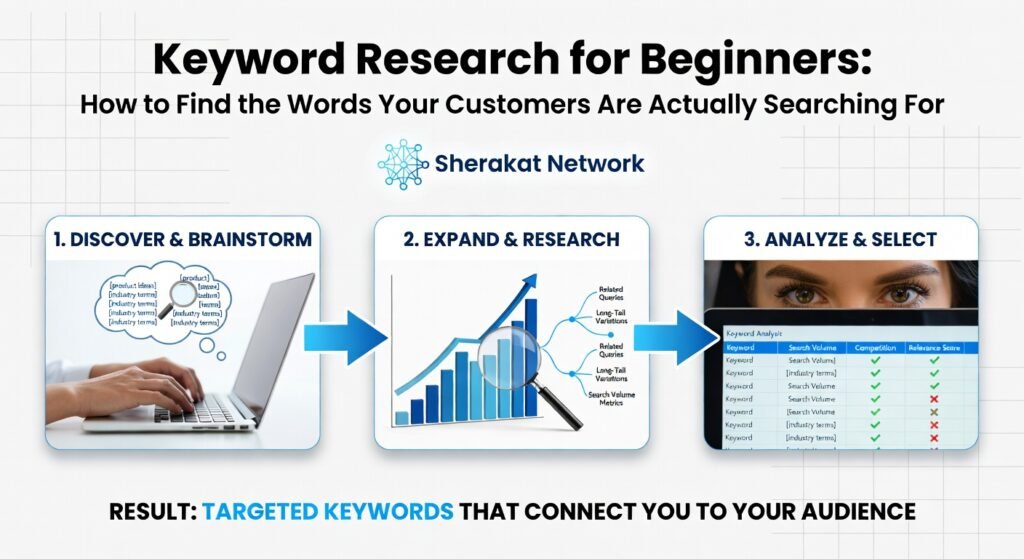
Keyword research is the foundation of effective SEO. Without it, you’re creating content in the dark, hoping to stumble upon what your audience actually wants. With it, you’re responding to real demand with precision and purpose.
Key Takeaways:
- Start with seed keywords: Brainstorm the fundamental terms that describe your business and audience needs.
- Expand using tools: Use free and paid tools to discover what people are actually searching for—you’ll be surprised by what you find.
- Analyze search intent: Before targeting any keyword, understand why people search for it. Match your content to intent.
- Evaluate metrics wisely: Consider search volume, difficulty, and business value. Balance these factors based on your site’s authority.
- Think long-tail: Specific, longer phrases have lower competition and higher conversion potential. They’re your path to early wins.
- Map keywords to content: Each page should have one primary keyword and naturally cover related terms. Group content into topic clusters.
- Track and refine: Keyword research is ongoing. Monitor performance, adapt to changes, and continuously discover new opportunities.
Remember the lesson from my early career: I ranked a page for “leather notebook” and got traffic that didn’t convert because I hadn’t understood intent. Don’t make that mistake. Let keyword research be your guide to not just traffic, but the right traffic.
If you haven’t yet mastered the fundamentals of SEO and on-page optimization, revisit our SEO Fundamentals for Beginners and On-Page SEO Checklist. They pair perfectly with the keyword research skills you’ve just learned.
FAQs (Frequently Asked Questions)
1. What is keyword research in SEO?
Keyword research is the process of discovering, analyzing, and selecting search terms that people enter into search engines. The goal is to understand what your target audience is searching for so you can create content that matches their needs and attracts relevant traffic to your website.
2. Why is keyword research important for beginners?
For beginners, keyword research prevents wasted effort. Instead of guessing what topics to write about, you base your content strategy on actual search demand. This increases your chances of ranking and attracting traffic, which is especially important when you’re building authority from scratch.
3. What’s the difference between short-tail and long-tail keywords?
Short-tail keywords are broad, general terms (1-2 words) like “yoga” or “shoes.” They have high search volume but also high competition and vague intent. Long-tail keywords are longer, specific phrases (3-5+ words) like “best yoga for beginners with back pain.” They have lower volume but higher conversion rates and lower competition.
4. How do I find keywords for free?
Free methods include Google Autocomplete (start typing and note suggestions), “People also ask” boxes, related searches at the bottom of Google results, Google Keyword Planner (free with Google Ads account), AnswerThePublic, and Ubersuggest (limited free version) .
5. What is search intent, and how do I determine it?
Search intent is the goal behind a search query. To determine it, search for your keyword and analyze the top-ranking pages. Are they blog posts, product pages, or videos? What questions do they answer? Match your content to the dominant intent pattern.
6. How many keywords should I target per page?
Focus on one primary keyword per page. This gives your page a clear focus and prevents keyword cannibalization (multiple pages competing for the same term). Naturally include secondary keywords and related terms throughout your content.
7. What is keyword difficulty, and how do I use it?
Keyword difficulty (KD) is a metric (usually 0-100) that estimates how hard it is to rank for a keyword based on the authority of current ranking pages. For beginners, target keywords with low difficulty (under 30-40) until your site builds authority.
8. Should I target keywords with no search volume?
Sometimes yes. Zero-volume keywords often represent very specific queries that tools don’t track. If you answer these questions thoroughly, you may attract highly engaged visitors and rank for terms competitors overlook.
9. What is a seed keyword?
A seed keyword is a broad starting term related to your business or topic. You use seed keywords as inputs for keyword research tools to generate expanded lists of related terms.
10. How often should I do keyword research?
Keyword research should be ongoing. Review your keyword strategy quarterly, and always research keywords before creating new content. Additionally, monitor performance monthly to identify new opportunities.
11. What is keyword cannibalization?
Keyword cannibalization happens when multiple pages on your site target the same keyword, causing them to compete against each other. This dilutes your ranking potential. Consolidate content or ensure each page targets distinct keywords.
12. How do I know if a keyword is too competitive?
Check the domain authority of the current top-ranking pages. If they’re all major brands or highly authoritative sites, and you have a new site, it’s likely too competitive for now. Also, check if they have extensive backlink profiles and high-quality content.
13. What are LSI keywords?
LSI (Latent Semantic Indexing) keywords are terms semantically related to your primary keyword. While Google has moved beyond simple LSI, the concept remains valid: include related terms and synonyms to help search engines understand your content’s context.
14. How do I find question-based keywords?
Use AnswerThePublic, check “People also ask” boxes on Google, search forums like Quora and Reddit in your niche, and use tools like AlsoAsked.com. These reveal the specific questions your audience is asking.
15. What is a topic cluster?
A topic cluster is a group of interlinked content pieces centered around a “pillar” page that covers a broad topic comprehensively. This structure signals topical authority to search engines and helps with rankings for both broad and specific terms.
16. Should I use keyword research tools for YouTube and other platforms?
Yes. YouTube has its own search algorithm. Use YouTube’s autocomplete and tools like TubeBuddy or vidIQ for video keyword research. Similarly, consider platform-specific search behavior for Pinterest, Amazon, and TikTok, depending on your niche.
17. How do I balance search volume and keyword difficulty?
For new sites, prioritize low-difficulty keywords even if volume is modest. As your site builds authority, gradually target higher-volume, more competitive terms. A mix of both creates a sustainable traffic growth strategy.
18. What’s the role of seasonality in keyword research?
Some keywords spike at certain times (e.g., “Christmas gift ideas” in November-December). Seasonality affects search volume and competition. Plan content to capitalize on seasonal peaks, and balance with evergreen keywords that provide consistent traffic.
19. How do I find keywords my competitors rank for?
Use tools like Ahrefs or SEMrush for competitor gap analysis. If you don’t have paid tools, manually review competitor content, note their topics and headings, and use free tools to estimate which keywords they might target.
20. What is the difference between informational and transactional keywords?
Informational keywords indicate a desire to learn (e.g., “how to meditate”). Transactional keywords indicate readiness to buy (e.g., “buy meditation cushion”). Your content strategy needs both, but they serve different purposes in your marketing funnel.
21. How do I optimize for featured snippets?
Target question-based keywords and provide clear, concise answers immediately after the question heading. Use lists, tables, and definitions where appropriate. Structure your content so Google can easily extract the answer.
22. Should I include location in my keywords?
If you serve a local audience, absolutely. “Dentist” becomes “dentist [city name]” or “emergency dentist near me.” Local keywords often have lower competition and higher conversion rates for local businesses.
23. What is the difference between keywords and search queries?
Keywords are the terms you target in your content. Search queries are the actual words users type into search engines. They’re related but not identical. Keyword research bridges this gap by identifying the queries your audience uses.
24. How do I know if I’m using too many keywords?
If your content feels unnatural or forced, you’re over-optimizing. Read your content aloud. Does it sound like natural human communication? If not, dial back. Focus on comprehensive topic coverage rather than keyword counting.
25. Can I rank for keywords without linking to my site?
On-page optimization (including keywords) is necessary but not sufficient for ranking competitive terms. You also need technical SEO, backlinks (off-page SEO), and user engagement signals. All work together.
About Author
Sana Ullah Kakar is a seasoned digital marketing strategist and SEO consultant with over a decade of experience helping businesses establish and scale their online presence. As the lead content contributor for the Sherakat Network, Sana specializes in translating complex digital marketing concepts into actionable strategies for entrepreneurs and professionals across the Middle East and beyond. His approach is rooted in data-driven decision-making and a deep understanding of how evolving search technologies impact real-world business growth. When he’s not analyzing search trends or mentoring the next generation of marketers, Sana is exploring the intersection of technology and human behavior to build more authentic and effective online experiences.
Free Resources
To help you implement everything we’ve covered, here are valuable free resources:
Google Keyword Planner: Find keyword ideas and search volume data (requires a free Google Ads account).
AnswerThePublic: Discover questions people are asking about your topics.
Ubersuggest: Free keyword ideas with limited volume data.
Google Search Console: See which keywords already bring traffic to your site.
AlsoAsked.com: Visualize “People also ask” data for any keyword.
Google Trends: Understand keyword seasonality and interest over time.
Keywords Everywhere: Browser extension showing volume and CPC data.
QuestionDB: Find questions people ask on Reddit about any topic.
For more in-depth resources, explore the Sherakat Network:
- Browse our Resources page for tools and templates
- Read the latest insights on our Blog
- Learn how to Start an Online Business in 2026
- Explore more SEO articles
- Understand Business Partnership Models
Expand your knowledge with these external resources:
- Mental Health: The Complete Guide to Psychological Wellbeing
- Global Supply Chain Management: The Complete Guide
- Artificial Intelligence & Machine Learning
- Remote Work Productivity
- Climate Policy & Agreements
- Culture & Society
Discussion
Now I’d love to hear from you. What’s the most surprising thing you’ve discovered about your audience’s search behavior? Have you ever targeted a keyword that seemed perfect, only to find it attracted the wrong visitors?
Share your experiences and questions in the comments below. Have you tried the keyword research process outlined here? What worked? What challenges did you face?
If you need personalized help with your keyword strategy, don’t hesitate to contact us. We’re here to help you succeed.
I all the time used to read paragraph in news papers but now
as I am a user of internet so from now I am using net for content, thanks to web.
you have a great blog here! would you like to make some invite posts on my blog?
There are some interesting time limits on this article however I don’t know if I see all of them middle to heart. There is some validity however I’ll take maintain opinion till I look into it further. Good article , thanks and we wish more! Added to FeedBurner as nicely
Your place is valueble for me. Thanks!…
I genuinely enjoy examining on this internet site, it contains wonderful articles. “Wealth and children are the adornment of life.” by Koran.