

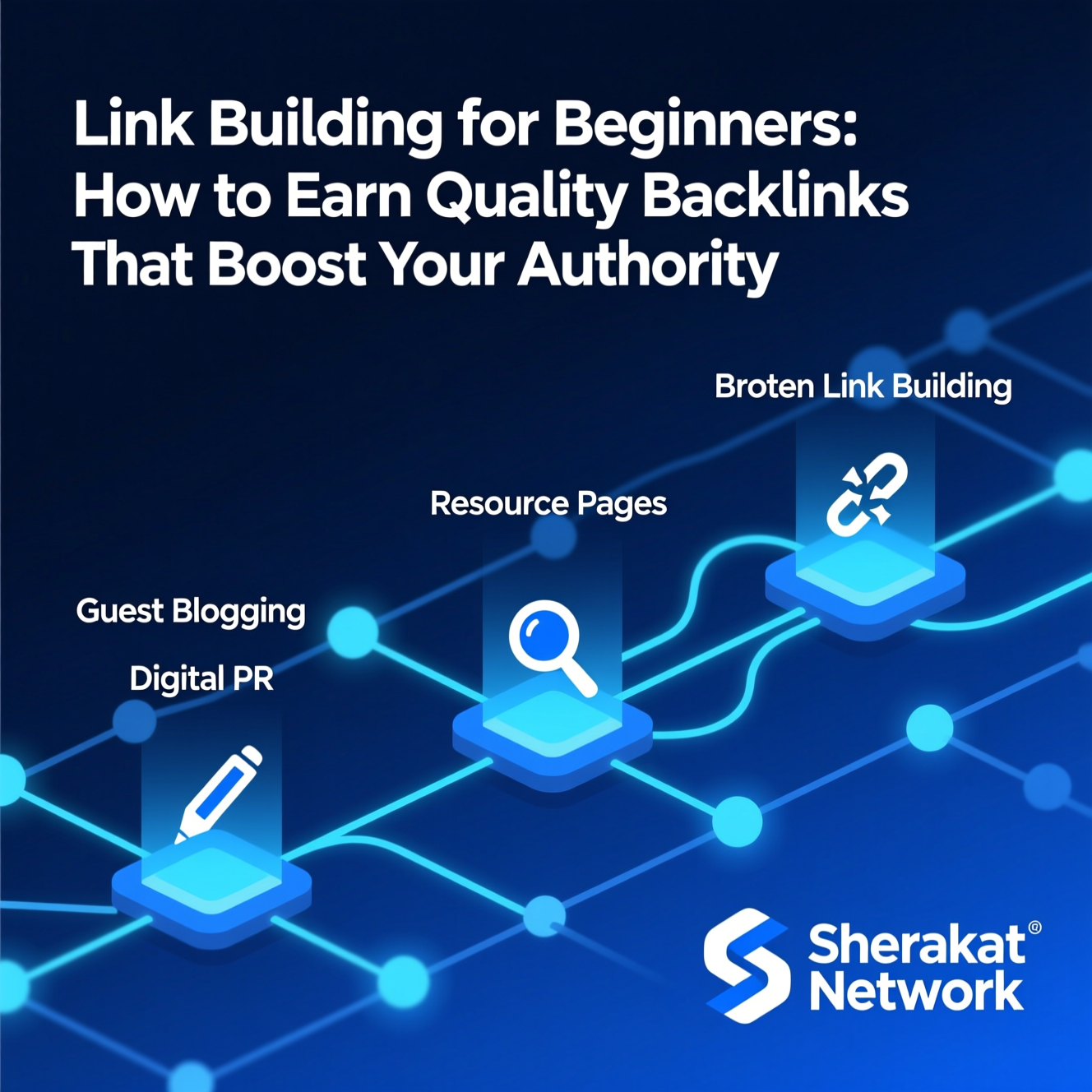

Introduction – Why This Matters
In my experience, link building is the SEO skill that beginners fear the most. They’ve mastered the art of keyword research, perfected their on-page optimization, and even tackled the intimidating world of technical SEO. Their websites are fast, their content is excellent, and their keywords are perfectly targeted. Yet, they’re still not ranking. What I’ve found is that the missing piece is almost always authority—and authority, in Google’s eyes, is largely built on backlinks.
Think of the internet as a vast academic library. Your website is a research paper you’ve written. On-page and technical SEO are about making sure your paper is well-written, properly formatted, and easy to find in the card catalog. But backlinks? Backlinks are citations from other respected papers. When a leading professor in your field cites your work, it signals to everyone—including the librarians (search engines)—that your paper is important, credible, and worth reading.
Here’s the reality: Google’s algorithm, even in 2026, still relies heavily on links as a primary signal of authority. A 2025 study by Backlinko analyzed over 11 million search results and found a clear correlation: pages with more backlinks from unique websites tend to rank higher. But—and this is crucial—it’s not just about quantity. It’s about quality. A single link from a highly trusted, relevant website (like a .edu domain or a leading industry publication) can be more powerful than hundreds of links from low-quality, spammy directories.
In this guide, we’re going to demystify link building. We’ll walk through what backlinks are, why they matter, and most importantly, how you, as a beginner, can start earning them safely, ethically, and effectively. We’ll focus on strategies that build real authority and avoid the pitfalls that can get your site penalized.
Background / Context
To understand link building, we need to look at the history of how Google came to rely on links. The original Google algorithm, called PageRank, was revolutionary because it treated links as votes. When one website linked to another, it was seen as a vote of confidence. The more votes you had, and the more authoritative the sites casting those votes, the higher you’d rank.
This system worked brilliantly for a while. But, as with any system, people figured out how to game it. The early 2000s saw the rise of “black hat” SEO tactics like link farms (networks of websites created solely to link out to paying customers), paid links, and automated comment spam. The web was flooded with low-quality, manipulative links.
Google fought back. Major algorithm updates like Penguin (first launched in 2012) were designed specifically to penalize sites that engaged in manipulative link building. Suddenly, having thousands of spammy links could destroy your rankings overnight. The focus shifted from quantity to quality.
Today, in 2026, link building is more sophisticated. Google’s algorithms are incredibly good at distinguishing between natural, editorially given links and manipulative ones. They look at the context of the link, the relevance of the linking site, the authority of the linking domain, and even the anchor text (the clickable words of the link). The goal is no longer to “get links.” The goal is to “earn citations” by creating something so valuable that people naturally want to reference it. This aligns perfectly with Google’s broader focus on E-E-A-T (Experience, Expertise, Authoritativeness, Trustworthiness) . Backlinks are a primary way Google assesses your site’s Authority and Trustworthiness.
Link building, therefore, is the process of proactively earning these citations. It’s a blend of marketing, relationship-building, and content creation.
Key Concepts Defined
Before we dive into the strategies, let’s establish the key vocabulary of link building.
- Backlink (or Inbound Link): A link from one website to another. This is the “vote” we’ve been discussing. For example, if
wikipedia.orglinks to your site, you have a backlink from Wikipedia. - Outbound Link (or External Link): A link from your website to another website. When you cite a source, you’re creating an outbound link.
- Internal Link: A link from one page on your website to another page on the same website. This helps with site navigation and distributing link equity.
- Link Equity (or “Link Juice”): The value or authority passed from one site to another through a hyperlink. High-authority sites pass more equity. A “nofollow” link does not pass equity.
- Nofollow Link: A link with a
rel="nofollow"attribute. It tells search engines, “I am not vouching for this linked site; please do not pass any authority through this link.” These are often used for paid links, user-generated content (like blog comments), or untrusted sources. They don’t directly help with rankings but can still drive traffic. - Dofollow Link: The default type of link. It passes link equity and is the kind you want to earn for SEO purposes.
- Anchor Text: The visible, clickable text of a hyperlink. Optimizing anchor text (making it relevant to the linked page) was heavily abused in the past. Modern best practices favor natural, varied anchor text (e.g., “click here,” “this great guide,” or the brand name).
- Domain Authority (DA) / Domain Rating (DR): A metric developed by SEO tools (like Moz’s DA or Ahrefs’ DR) to predict how well a website will rank on search engines. It’s not a Google metric, but it’s a useful way to estimate the authority of a site you might want a link from. A link from a site with high DA/DR is generally more valuable.
- Referring Domains: The number of unique websites linking to you. This is a more important metric than total backlinks. One hundred links from one domain is less valuable than one link each from one hundred different domains.
- Link Reclamation: The process of finding mentions of your brand, website, or content that are not linked, and asking the site owner to turn them into a clickable link.
- Broken Link Building: A strategy where you find broken links on other websites, create relevant content, and suggest they replace the broken link with a link to your useful resource.
- Guest Posting / Guest Blogging: Writing an article for another website in your niche in exchange for a byline and a link back to your site. This is one of the most common and effective link-building strategies when done right.
- Skyscraper Technique: A method popularized by Brian Dean of Backlinko. It involves finding popular content in your niche, creating something even better (more comprehensive, more up-to-date, better designed), and then reaching out to people who linked to the original content, asking them to link to your superior version instead.
How It Works (Step-by-Step Breakdown)
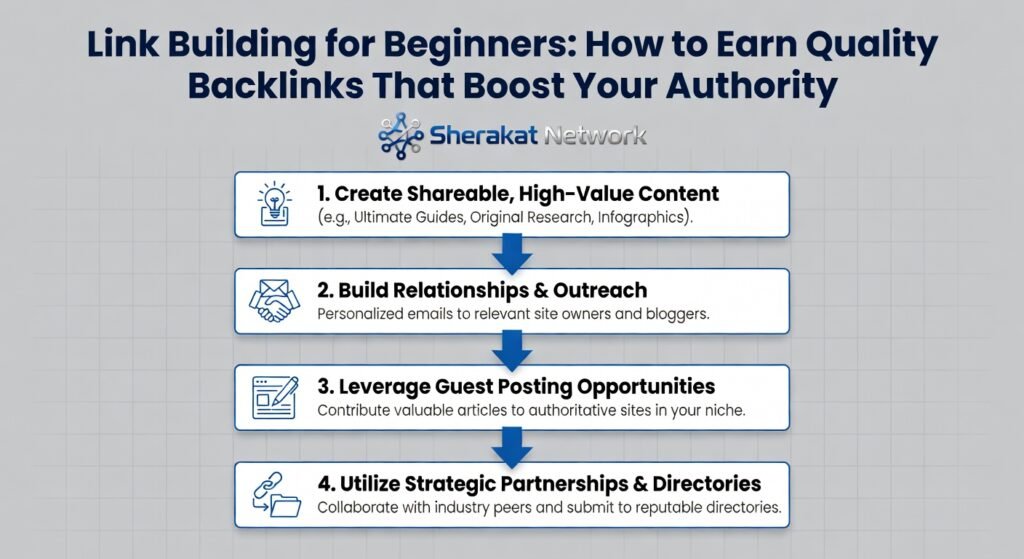
Link building is not about quick tricks; it’s about a strategic, value-driven process. Here’s a step-by-step breakdown of how to build a sustainable link-building campaign.
Step 1: Create a Link-Worthy Asset (The Foundation)
Before you can earn links, you need something worth linking to. This is the most important step and the one beginners often skip. You can’t just ask people to link to your homepage or your “About Us” page and expect results. You need a linkable asset.
What makes a good linkable asset?
- Comprehensive Guides: The “ultimate guide” to a topic. Think of our series on SEO fundamentals, keyword research, on-page SEO, and technical SEO—these are perfect examples. They are deep, authoritative resources that others will want to cite.
- Original Research and Data: Conduct a survey, analyze a dataset, or compile industry statistics. Original data is incredibly link-worthy because journalists, bloggers, and researchers love to cite unique findings.
- Infographics and Visual Assets: A well-designed infographic that distills complex information is highly shareable and linkable.
- Free Tools: If you can create a simple, useful online tool (like a calculator, a checklist generator, or a keyword density analyzer), people will link to it.
- Expert Roundups: Compile insights from multiple industry experts on a specific topic. Each expert is likely to share the post, and their followers may link to it.
Pro Tip from experience: Before you create anything, look at what’s already out there. Use tools to find the most linked-to content on your topic. Can you create something more comprehensive, more current, or more visually appealing? This is the essence of the Skyscraper Technique.
Step 2: Find Link Prospects
Once you have your amazing asset, you need to find websites that might be interested in linking to it. This is where research comes in.
Strategies for finding prospects:
- Analyze Competitor Backlinks: Use tools like Ahrefs, SEMrush, or Moz to see who is linking to your competitors’ best content. If they linked to a similar piece from a competitor, they might be open to linking to your (hopefully better) resource.
- Search for “Best of” or Resource Lists: Use Google search operators to find pages that curate resources. Search for things like:
"keyword" + "useful resources""keyword" + "helpful links""keyword" + "recommended tools"best "keyword" resources
- Look for Broken Links on Relevant Sites: Find high-quality websites in your niche, check them for broken links (using a tool like Check My Links Chrome extension), and note which broken pages are relevant to your content. You now have a perfect outreach opportunity.
- Find Unlinked Brand Mentions: Use tools like Google Alerts or Mention to track when your brand or content is mentioned online. If someone mentions you but doesn’t link, that’s a low-hanging fruit for link reclamation.
- Identify Journalists and Bloggers: Find reporters and bloggers who cover your niche. Tools like Help a Reporter Out (HARO) can connect you with journalists seeking sources for their articles.
Step 3: Categorize and Prioritize Your Prospects
Not all prospects are created equal. You need to prioritize your outreach efforts. Create a spreadsheet with your prospects and rank them based on:
- Domain Authority: Higher authority sites are more valuable, but also harder to get links from.
- Relevance: A link from a site in your exact niche is much more powerful than a link from a general, unrelated site.
- Link Type: Is it a blogroll link, a resource page link, or a link within a well-written article? Links within content are generally the most valuable.
- Outreach Difficulty: Is there a clear contact person? Is the site actively maintained? Personal blogs might be easier to reach than big media outlets.
Start with the “low-hanging fruit”—relevant, moderately authoritative sites with a clear path to contact. Build momentum, and then tackle the more difficult, high-authority targets.
Step 4: Craft Personalized Outreach Emails
This is the art of link building. Your email needs to be polite, personalized, and value-driven. It’s not about what you can get; it’s about what you can offer.
The structure of a good outreach email:
- Personalized Greeting: Use their name, not “Dear Webmaster.”
- The Compliment/Connection: Show you’ve actually engaged with their site. Mention a specific article you liked or how their resource has been helpful. This proves you’re not sending a mass email. (“I really enjoyed your recent post on [Topic], especially the section on [Specific Point].”)
- The Value Proposition: Introduce your resource, but frame it in terms of how it benefits them and their audience. Don’t just say “I want a link.” Say, “I thought your readers might find this [comprehensive guide/original data] helpful as a supplementary resource. I’ve linked to your excellent article on [Related Topic] within my guide because it provided great context.” (This also shows you’re willing to give first.)
- The Specific Ask: Make it easy for them. Don’t say “link to me somewhere.” Suggest where the link might fit naturally. “If you ever update your [Specific Page/Resource List], this guide might be a valuable addition to the [Specific Section].”
- Polite Sign-off: Thank them for their time and consideration, regardless of their decision.
Crucial Tip: Do not use templates. Personalized emails have a much higher success rate. Track your outreach in a spreadsheet and follow up politely once if you don’t hear back after a week or two.
Step 5: Build Relationships, Not Just Links
The most sustainable link-building strategy is relationship-building. Instead of cold emailing strangers, become a part of your community.
- Engage on Social Media: Share and comment on the work of influencers and bloggers in your niche. Build a genuine connection.
- Attend Industry Events (Virtual or In-Person): Networking can lead to natural collaborations and links.
- Collaborate on Content: Offer to co-author a piece, provide a quote for an article, or be a source for a journalist. HARO is great for this.
- Guest Post on Reputable Sites: Once you’ve built a relationship, offering a high-quality guest post is a natural next step. It provides value to their audience and earns you a link.
Step 6: Monitor Your Results and Maintain Links
Link building is an ongoing process. You need to track your progress.
- Use Backlink Monitoring Tools: Tools like Ahrefs, SEMrush, and Moz can alert you when you gain (or lose) new backlinks.
- Monitor Your Rankings: Are your link-building efforts translating into higher rankings for your target keywords?
- Check for Lost Links: If a link disappears, see if you can reach out to the site owner to get it reinstated. The page may have been moved or deleted.
- Keep Your Content Updated: A link-worthy asset needs to stay current. Update your “ultimate guides” and original research regularly to maintain their value and encourage people to keep linking to them.
Why It’s Important
Link building is often the most challenging part of SEO, but it’s also one of the most rewarding. Here’s why it’s non-negotiable for long-term success.
- It’s a Top Ranking Factor: Google’s algorithm, despite all its advancements, still treats backlinks as one of its top three ranking signals. You can have the best content and a perfectly optimized site, but without authority signals from other sites, you’ll struggle to outrank established competitors.
- It Builds Your Site’s Authority and Trust: Backlinks from reputable sites act as endorsements. They signal to Google (and to users) that your site is a trusted source in your niche. This is a core component of Google’s E-E-A-T framework, especially the “A” for Authoritativeness.
- It Drives Referral Traffic: A link on a popular, relevant website can send a steady stream of highly targeted visitors directly to your site. This traffic is often more engaged and more likely to convert than traffic from other sources, because it comes with an implicit endorsement from the linking site.
- It Accelerates Discovery and Indexing: When a high-authority site links to your new page, Googlebot finds that page faster. It’s like a fast-pass for crawling and indexing your content.
- It Creates Long-Term, Passive Value: Unlike paid advertising, which stops working when you stop paying, a good backlink can send traffic and authority your way for years. It’s an asset that continues to appreciate over time.
Sustainability in the Future
Is link building still relevant in the age of AI and entity-based search? Absolutely. But the type of links that matter is evolving.
- Quality Over Quantity, Forever: The trend away from mass, low-quality links is permanent. Google’s algorithms are too sophisticated to be fooled by link schemes. Sustainable link building is about earning fewer, but much higher-quality, contextual links.
- Links as Entity Associations: In an entity-based search world, a link is not just a “vote.” It’s a way for Google to understand the relationships between entities. A link from a site about
healthto a site aboutyogahelps Google understand that the yoga site is relevant to the broader topic of health. Relevance is becoming as important as authority. - The Rise of “Brand Mentions” as Implied Links: Google is getting better at recognizing unlinked brand mentions. If you have a strong brand that is frequently talked about online (even without links), Google may treat those mentions as a signal of authority. This makes brand building a critical part of a sustainable “off-page” strategy.
- Links from Authoritative, Human-Created Content Will Win: As AI-generated content floods the web, links from sites that are clearly run by humans, with real expertise and editorial standards, will become even more valuable. These are the citations that AI models and search engines will trust most.
Common Misconceptions
Let’s clear up some myths that can lead beginners astray—and potentially get their sites penalized.
- Myth: “The more links, the better.”
- Reality: This is the oldest and most dangerous myth. A sudden influx of hundreds of low-quality, spammy links (from link farms or paid directories) will trigger Google’s spam algorithms and can lead to a manual penalty. Focus on earning a few high-quality, relevant links.
- Myth: “I can just buy links to rank faster.”
- Reality: Buying links violates Google’s Webmaster Guidelines. Google is very good at detecting paid links (unnatural patterns, irrelevant sites, optimized anchor text). If caught, your site can be de-ranked or removed from the index entirely. It’s simply not worth the risk.
- Myth: “All links should have exact-match anchor text.”
- Reality: In the past, people tried to game the system by making all anchor text “best running shoes.” This looks highly unnatural to Google. A healthy, natural backlink profile has varied anchor text: brand names (“Nike”), generic phrases (“click here,” “this article”), partial matches (“great guide to shoes”), and the occasional exact match.
- Myth: “Nofollow links are useless.”
- Reality: While nofollow links don’t pass link equity for ranking purposes, they are still valuable. They can drive significant referral traffic, increase brand visibility, and make your backlink profile look more natural. A mix of dofollow and nofollow links is a sign of a healthy site.
- Myth: “Link building is just about getting links.”
- Reality: At its core, effective link building is about building relationships and creating value. The links are a byproduct of doing good work and connecting with your community. If you focus solely on the link, your outreach will feel transactional and will likely fail.
Recent Developments
Link building in 2026 is shaped by a few key trends.
- The Continued Relevance of “Skyscraper” Content: As competition increases, the bar for “link-worthy” content is higher than ever. Basic listicles no longer cut it. The most successful link-building campaigns are built around truly comprehensive, data-driven, or visually unique assets.
- Digital PR as a Link-Building Strategy: This is a major trend. Instead of traditional blogger outreach, businesses are using public relations tactics to get featured in major news outlets and online publications. This involves creating newsworthy stories, conducting original research that journalists would want to cite, or commenting on industry trends. The links from high-authority news sites are incredibly powerful.
- The Power of HARO and Source Requests: Platforms like Help a Reporter Out (HARO) and similar services have become a staple for link builders. By responding to journalist queries and providing valuable expert insights, you can earn high-quality backlinks from reputable .edu, .gov, and major media sites.
- E-E-A-T and Link Relevance: Google’s emphasis on E-E-A-T means that relevance is now arguably as important as authority. A link from a moderately authoritative site that is highly relevant to your niche can be more valuable than a link from a high-authority site that is completely unrelated (e.g., a link from a news site about sports to a page about plumbing).
Success Stories
The Startup That Got on Page One with Digital PR
A few years ago, I worked with a small SaaS startup that had created a free, simple tool for analyzing website speed. The tool was genuinely useful, but no one knew about it. Instead of traditional outreach, we took a digital PR angle. We analyzed a public dataset of the top 1,000 websites and published a report titled “The State of Website Speed in 2025,” highlighting which industries were the fastest and slowest.
This was new, original data. We sent a press release and pitched the story to tech journalists. Within a week, we were featured in articles on Forbes, TechCrunch, and several industry blogs. Each of those articles linked back to our report (and our free tool). The startup gained dozens of high-authority backlinks and thousands of visitors in a matter of days. The key wasn’t asking for links; it was creating something newsworthy.
The Blogger Who Built Links Through Relationships
A food blogger I know wanted to build links to her site, but she had no budget and a small audience. Instead of cold outreach, she focused on engagement. She consistently left thoughtful comments on the blogs of more established food writers. She shared their content on social media with genuine praise. She became a known and liked member of the community.
After a few months, she reached out to one of the bloggers she had built a rapport with, not asking for a link, but offering to write a guest post. The blogger happily agreed. Her high-quality guest post earned her a link, and the relationship led to more opportunities. Over time, her genuine engagement and excellent content led to natural links from other bloggers who admired her work. This is sustainable, ethical link building at its best.
Real-Life Examples
Example 1: The Power of a .edu Link
Scenario: A company selling online courses for students wants to build authority.
The Strategy: They create a comprehensive, free guide on “How to Survive Freshman Year,” with practical tips on studying, time management, and mental health. It’s genuinely helpful and well-designed.
The Outreach: They reach out to university websites, specifically targeting the student resources section or the advising office. Their email is personalized: “I saw your university’s excellent resource page for new students. I thought your students might also find our free guide, ‘How to Survive Freshman Year,’ helpful. It covers topics like study skills and managing stress, which complement the resources you already have. I’ve linked to your page from our guide as a great example of university support services.”
The Result: A few universities link to the guide from their official .edu websites. These are incredibly powerful backlinks, signaling to Google that the company is a trusted, authoritative resource in the education space. The company also gets targeted referral traffic from students.
Example 2: The Broken Link Building Win
Scenario: A website selling hiking gear has a fantastic, in-depth guide on “Choosing the Right Hiking Boots.”
The Strategy: They find a popular outdoor blogger’s resource page titled “Essential Hiking Gear for Beginners.” They use a tool to check the page for broken links and discover that a link to a “Boot Buying Guide” is broken (404 error).
The Outreach: They email the blogger: “Hi [Name], I’m a big fan of your site, especially your ‘Essential Hiking Gear’ page—it’s a fantastic resource. I was browsing it today and noticed that the link to the ‘Boot Buying Guide’ seems to be broken. I wanted to let you know, in case you weren’t aware. By the way, we have a very detailed, up-to-date guide on ‘Choosing the Right Hiking Boots’ that your readers might find useful. If you’re looking to replace that broken link, we’d be honored to be considered. Keep up the great work!”
The Result: The blogger appreciates the heads-up about the broken link and, after reviewing their guide, replaces it with a link to the hiking gear company’s page. The company earns a high-quality, relevant backlink and builds a positive relationship with a key influencer.
Example 3: The Guest Post That Opened Doors
Scenario: A digital marketing agency wants to build authority in the B2B space.
The Strategy: They identify a well-respected B2B marketing blog that accepts guest posts. They pitch an idea for a data-driven article: “5 B2B Marketing Trends for 2026 (Backed by Data).” They put significant effort into the post, including original survey data from their clients.
The Outreach: Their pitch is clear and professional: “I’ve been a long-time reader of your blog and particularly enjoyed your recent series on account-based marketing. I have an idea for a guest post that I think your audience would love: ‘5 B2B Marketing Trends for 2026 (Backed by Data).’ I have access to some unique survey data that would make this post highly actionable and link-worthy. I’m confident I can deliver a piece that meets your high editorial standards.”
The Result: The blog accepts the post. It gets published with a byline and a link back to the agency’s website. The post is shared on social media, bringing in new traffic and establishing the agency’s team as thought leaders. This one link opens doors for future guest posting opportunities and builds their overall authority.
Conclusion and Key Takeaways
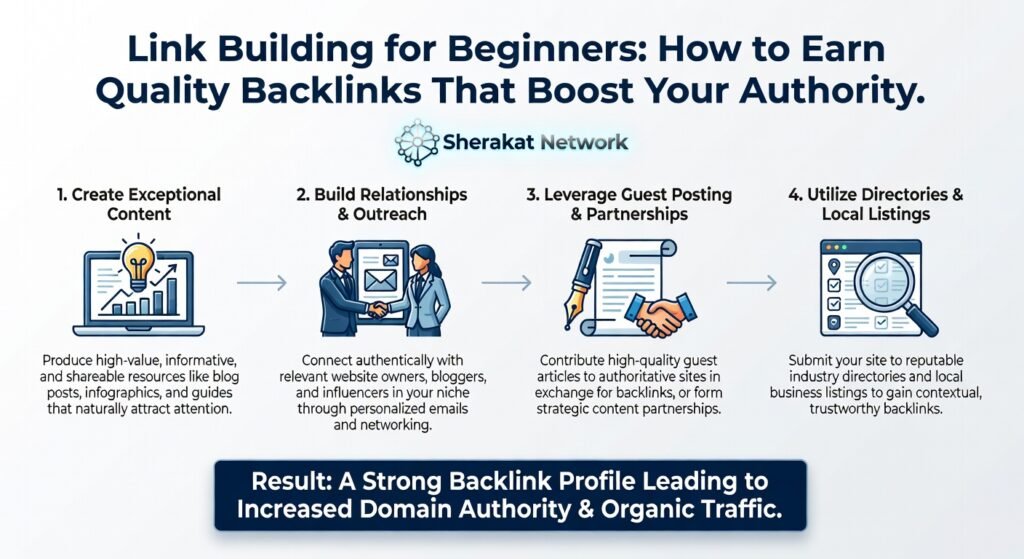
Link building is often the most challenging, but also the most rewarding, part of SEO. It’s the bridge between having a great website and being recognized as an authority in your space. It’s not about quick tricks or gaming the system; it’s about earning the respect and recognition of your peers and your community.
Key Takeaways:
- Build Something Link-Worthy First: Before you ever send an outreach email, ensure you have a valuable asset—a comprehensive guide, original research, a useful tool—that people will genuinely want to link to.
- Quality Trumps Quantity: A handful of links from highly relevant, authoritative websites is infinitely more valuable than hundreds of links from low-quality, spammy sources. Focus on earning fewer, better links.
- Relevance is Key: A link from a site in your niche is worth far more than a link from a general, unrelated site. Google uses links to understand the relationships between topics.
- Outreach is About Value, Not Requests: Your emails should focus on how your resource can benefit the other site’s audience. Be personal, be polite, and make it easy for them to say yes.
- Build Relationships, Not Just Links: Engage with your community, be helpful, and become a known entity. Links will often follow naturally from genuine connections.
- Avoid Shortcuts: Buying links or participating in link schemes might seem tempting, but the risk of a Google penalty is too high. Play the long game.
- Diversify Your Anchor Text: Ensure your backlink profile looks natural with a mix of branded, generic, and keyword-rich anchor text.
- Monitor and Maintain: Use tools to track your backlinks, celebrate your wins, and quickly address any lost links.
Remember the foundation you’ve built. Your site is now technically sound thanks to our technical SEO guide. You’re targeting the right terms based on your keyword research. Your pages are perfectly optimized following the on-page SEO checklist. And you have a solid understanding of the SEO fundamentals. Link building is the final, crucial layer that builds the authority your great content deserves. It takes time, effort, and patience, but the rewards—sustainable rankings, targeted traffic, and true industry authority—are well worth it.
FAQs (Frequently Asked Questions)
1. What is a backlink in simple terms?
A backlink is a link from one website to another. Think of it as a vote or a recommendation. When another site links to yours, they’re telling their audience (and search engines) that your content is valuable or worth checking out.
2. Why are backlinks important for SEO?
Backlinks are one of Google’s top ranking factors. They signal to search engines that your website is a trusted and authoritative source. More high-quality backlinks usually lead to higher rankings and more organic traffic.
3. What’s the difference between dofollow and nofollow links?
A dofollow link passes “link equity” (ranking power) from the linking site to yours. A nofollow link (with a rel="nofollow" attribute) tells search engines not to pass that equity. No-follow links don’t directly help with rankings, but they can still drive traffic and make your link profile look natural.
4. How do I check how many backlinks my website has?
You can use free tools like Google Search Console (under the “Links” report) or more detailed (and often paid) tools like Ahrefs, SEMrush, or Moz Link Explorer.
5. What is a good number of backlinks?
There’s no magic number. It’s about quality, not quantity. A site with 10 high-quality backlinks from authoritative, relevant sites can outrank a site with 1,000 low-quality, spammy links. Focus on earning links from reputable sources in your niche.
6. Can I buy backlinks?
You can, but you shouldn’t. Buying links violates Google’s guidelines and can result in a severe penalty, including your site being completely de-indexed. It’s a high-risk strategy that’s not worth it.
7. What is anchor text, and why does it matter?
Anchor text is the clickable text of a hyperlink. It matters because it gives search engines context about the linked page. A natural backlink profile has varied anchor text, including your brand name, generic phrases like “click here,” and some relevant keywords.
8. What is a 301 redirect, and how does it affect link equity?
A 301 redirect is a permanent redirect from one URL to another. It passes most (around 90-99%) of the link equity from the old URL to the new one. This is crucial when you move or delete a page, so you don’t lose the value of your backlinks.
9. What is the Skyscraper Technique?
It’s a link-building method where you find popular, highly linked-to content in your niche, create something even better (more comprehensive, more up-to-date), and then reach out to the people who linked to the original content, suggesting they check out your superior version.
10. What is guest posting, and is it still effective?
Guest posting is writing an article for another website in your niche in exchange for a byline and a link back to your site. Yes, it’s still very effective when done on high-quality, relevant sites. Avoid low-quality guest post farms, as they can do more harm than good.
11. What is HARO, and how do I use it for link building?
HARO (Help a Reporter Out) is a free service that connects journalists with sources. You can sign up to receive daily queries from reporters looking for expert quotes. By providing a helpful, insightful response, you can get quoted in their article and earn a high-quality backlink from a major news site.
12. What is broken link building?
It’s a strategy where you find broken links on other websites, create relevant content that would be a good replacement, and then contact the site owner to let them know about the broken link and suggest your resource as a fix.
13. How do I find broken links on other sites?
You can use browser extensions like Check My Links for Chrome, or more advanced tools like Ahrefs or Screaming Frog (which can crawl other sites to find broken outbound links).
14. What is link reclamation?
It’s the process of finding mentions of your brand, website, or content that are not linked, and asking the site owner to turn that mention into a clickable link. Tools like Google Alerts can help you find these unlinked mentions.
15. What kind of content earns the most backlinks?
Generally, comprehensive “ultimate guides,” original research and data, infographics, useful free tools, and expert roundups tend to earn the most backlinks because they provide unique, valuable, and referenceable information.
16. How long does it take to see results from link building?
Link building is a long-term strategy. It can take several months of consistent effort to start seeing significant improvements in rankings. Building a few high-quality links each month is more sustainable than trying to get hundreds quickly.
17. Should I link to other websites from my content?
Yes, absolutely. Linking to authoritative, relevant sources is good for users and shows that you’ve done your research. It can also help you build relationships—the sites you link to may notice and reciprocate in the future.
18. What is a link scheme?
A link scheme is any practice intended to manipulate PageRank or a site’s ranking in Google search results. Examples include buying links, excessive link exchanges, using automated tools to create links, or participating in link farms. Engaging in link schemes can lead to a penalty.
19. What is the difference between a backlink and an internal link?
A backlink (or inbound link) comes from another website to yours. An internal link connects one page on your website to another page on the same website. Both are important for SEO, but they serve different purposes.
20. How do I ask for a backlink without sounding spammy?
Be personal, offer value, and be polite. Compliment their work, explain why your resource would be genuinely useful to their audience, and make a specific, easy-to-follow suggestion on where it could fit. Don’t just send a generic template.
21. What is Domain Authority (DA), and should I use it?
DA is a metric created by Moz to predict a website’s ranking potential. It’s not used by Google, but it can be a useful benchmark for comparing the relative authority of different sites when doing link prospecting. Other tools have similar metrics (e.g., Ahrefs’ DR).
22. Are links from social media websites valuable for SEO?
Links from most social media platforms (like Facebook, Twitter, LinkedIn) are typically “nofollow,” meaning they don’t pass direct link equity. However, they are still valuable for driving traffic, increasing brand visibility, and getting your content in front of people who might link to it with a “dofollow” link from their own websites.
23. What should I do if I have bad or spammy backlinks?
You can use Google’s Disavow Tool to tell Google that you don’t want certain links to be considered when assessing your site. This is an advanced step and should only be used if you have a manual penalty or a large number of clearly spammy links that you can’t get removed manually.
24. How do I find link-building opportunities in my niche?
Start by analyzing your competitors’ backlinks. Then use Google search operators to find resource pages or “best of” lists in your niche. Engage in your community on social media and forums. Sign up for HARO and look for journalist queries in your industry.
25. What is the most important rule of link building for beginners?
Create something link-worthy first. Before you spend hours on outreach, make sure you have a piece of content that people will genuinely want to link to. A fantastic resource is your strongest asset in any link-building campaign.
About Author
Sana Ullah Kakar is a seasoned digital marketing strategist and SEO consultant with over a decade of experience helping businesses establish and scale their online presence. As the lead content contributor for the Sherakat Network, Sana specializes in translating complex digital marketing concepts into actionable strategies for entrepreneurs and professionals across the Middle East and beyond. His approach is rooted in data-driven decision-making and a deep understanding of how evolving search technologies impact real-world business growth. When he’s not analyzing search trends or mentoring the next generation of marketers, Sana is exploring the intersection of technology and human behavior to build more authentic and effective online experiences.
Free Resources
To help you implement everything we’ve covered, here are valuable free resources:
- Google Search Console: Monitor your backlink profile (see who links to you) under the “Links” report. (https://search.google.com/search-console/)
- Google Alerts: Set up alerts for your brand name or key topics to find unlinked mentions and link-building opportunities. (https://www.google.com/alerts)
- HARO (Help a Reporter Out): Sign up as a source to connect with journalists and earn high-authority backlinks. (https://www.helpareporter.com/)
- Ahrefs Backlink Checker: A free tool to check the backlink profile of any website (limited results). (https://ahrefs.com/backlink-checker)
- Moz Link Explorer: Free link analysis tool with limited daily queries. (https://moz.com/link-explorer)
- Check My Links: A free Chrome extension to find broken links on any webpage. (Chrome Web Store)
- AnswerThePublic: Discover questions people are asking, which can inspire link-worthy content ideas. (https://answerthepublic.com/)
- Screaming Frog SEO Spider: A powerful desktop tool that can crawl websites to find broken links and analyze on-page elements. (Free for up to 500 URLs.)
For more in-depth resources, explore the Sherakat Network:
- Browse our Resources page for tools and templates
- Read the latest insights on our Blog
- Learn how to Start an Online Business in 2026
- Explore more SEO articles
- Understand Business Partnership Models
Expand your knowledge with these external resources:
- Mental Health: The Complete Guide to Psychological Wellbeing
- Global Supply Chain Management: The Complete Guide
- Artificial Intelligence & Machine Learning
- Remote Work Productivity
- Climate Policy & Agreements
- Culture & Society
Discussion
Now I’d love to hear from you. What’s been your biggest challenge or fear when it comes to link building? Have you tried any of the strategies mentioned, like guest posting or broken link building? What were your results?
Share your experiences, questions, and successes in the comments below. Have you ever had a link-building win? What made it work? Let’s learn from each other’s journeys.
If you need personalized help with your link-building strategy or have a specific project in mind, don’t hesitate to contact us. We’re here to help you succeed.
As someone who’s been diving into SEO lately, I appreciate how this post breaks down link building without the overwhelm. It’s easy to get caught up in the ‘quantity over quality’ trap, but your emphasis on earning backlinks through valuable content really resonates. I’m excited to try out some of the strategies, especially the outreach tips you mentioned.
Great post. Really enjoyed reading this. The section covering online video
was really interesting. Will come back to this later.
I have been reading about video hosting lately and this write up
breaks it down nicely. Nice one.
Found this while searching for CDN info.
Saved me time. What you mentioned about load times rings true.
Actually useful article about the tech behind streaming.
Not many people take for granted the infrastructure. Forwarded to a friend who works
in hosting.
Quality post. Not the usual recycled posts you get
on this subject. The writer clearly knows this space. Bookmarked.
I am in web development and this lines up with my experience.
Particularly the section on bandwidth pricing. Refreshing that someone explain this accurately.
Just went through this and had to say something.
Really well done. The analysis between video formats was really interesting.
This is one of the better articles I have come across on this subject.
No fluff, just real knowledge. Good job on this.
I love it when individuals come together and share ideas.
Great blog, continue the good work!
My developer is trying to persuade me to move to .net from PHP.
I have always disliked the idea because of the costs. But he’s tryiong none the less.
I’ve been using Movable-type on a number of websites for about a year and am nervous about
switching to another platform. I have heard good things about blogengine.net.
Is there a way I can transfer all my wordpress content
into it? Any kind of help would be greatly
appreciated!
Thank you for the auspicious writeup. It in truth was once
a enjoyment account it. Glance advanced to more delivered agreeable
from you! However, how could we keep in touch?
Howdy would you mind stating which blog platform you’re
using? I’m going to start my own blog in the near
future but I’m having a difficult time selecting between BlogEngine/Wordpress/B2evolution and Drupal.
The reason I ask is because your design and style seems different
then most blogs and I’m looking for something unique.
P.S Apologies for being off-topic but I had to ask!
Pretty nice post. I simply stumbled upon your weblog and wanted to say that
I’ve truly loved browsing your blog posts.
In any case I’ll be subscribing in your feed and I am hoping you write once
more very soon!
Awesome! Its genuinely remarkable article, I have got much clear idea on the topic of from this paragraph.
excellent put up, very informative. I’m wondering why the other
specialists of this sector don’t notice this. You must
proceed your writing. I’m sure, you’ve a huge readers’ base already!
This post is priceless. How can I find out more?
Hi to every one, it’s genuinely a nice for me to visit this web page, it contains important Information.
First off I would like to say superb blog! I had a
quick question in which I’d like to ask if you do not mind.
I was curious to know how you center yourself and clear
your thoughts before writing. I’ve had trouble clearing my mind in getting
my thoughts out. I do enjoy writing however it just seems like the first 10 to 15 minutes tend to be lost just
trying to figure out how to begin. Any ideas or tips? Appreciate it!
Valuable info. Lucky me I discovered your web site accidentally,
and I’m stunned why this twist of fate didn’t came about
earlier! I bookmarked it.
Hey! Do you know if they make any plugins to safeguard
against hackers? I’m kinda paranoid about losing everything I’ve worked
hard on. Any tips?
I’m extremely pleased to find this web site. I need to to thank you for ones time
due to this wonderful read!! I definitely really liked every
little bit of it and i also have you saved
as a favorite to check out new stuff on your site.
Howdy, i read your blog occasionally and i own a similar one
and i was just curious if you get a lot of spam feedback?
If so how do you stop it, any plugin or anything you
can recommend? I get so much lately it’s driving me crazy so any help
is very much appreciated.
A person necessarily help to make significantly posts I’d state.
That is the very first time I frequented your web page and so far?
I surprised with the analysis you made to make this
actual put up extraordinary. Wonderful activity!
Heya! I just wanted to ask if you ever have any issues with hackers?
My last blog (wordpress) was hacked and I ended up
losing many months of hard work due to no backup.
Do you have any solutions to prevent hackers?
Quality articles or reviews is the main to invite the viewers to visit the site, that’s what this web site is providing.
Very nice post. I just stumbled upon your weblog and wanted to say
that I’ve truly enjoyed browsing your blog posts.
In any case I’ll be subscribing to your feed and I hope you write again very soon!
Great goods from you, man. I’ve understand your
stuff previous to and you’re just extremely fantastic.
I actually like what you have acquired here, certainly like
what you are stating and the way in which
you say it. You make it enjoyable and you still take care of to keep it smart.
I cant wait to read much more from you. This is really a wonderful site.
I have not checked in here for a while because I thought it was getting boring, but the last several posts are great quality so I guess I’ll add you back to my daily bloglist. You deserve it my friend 🙂