

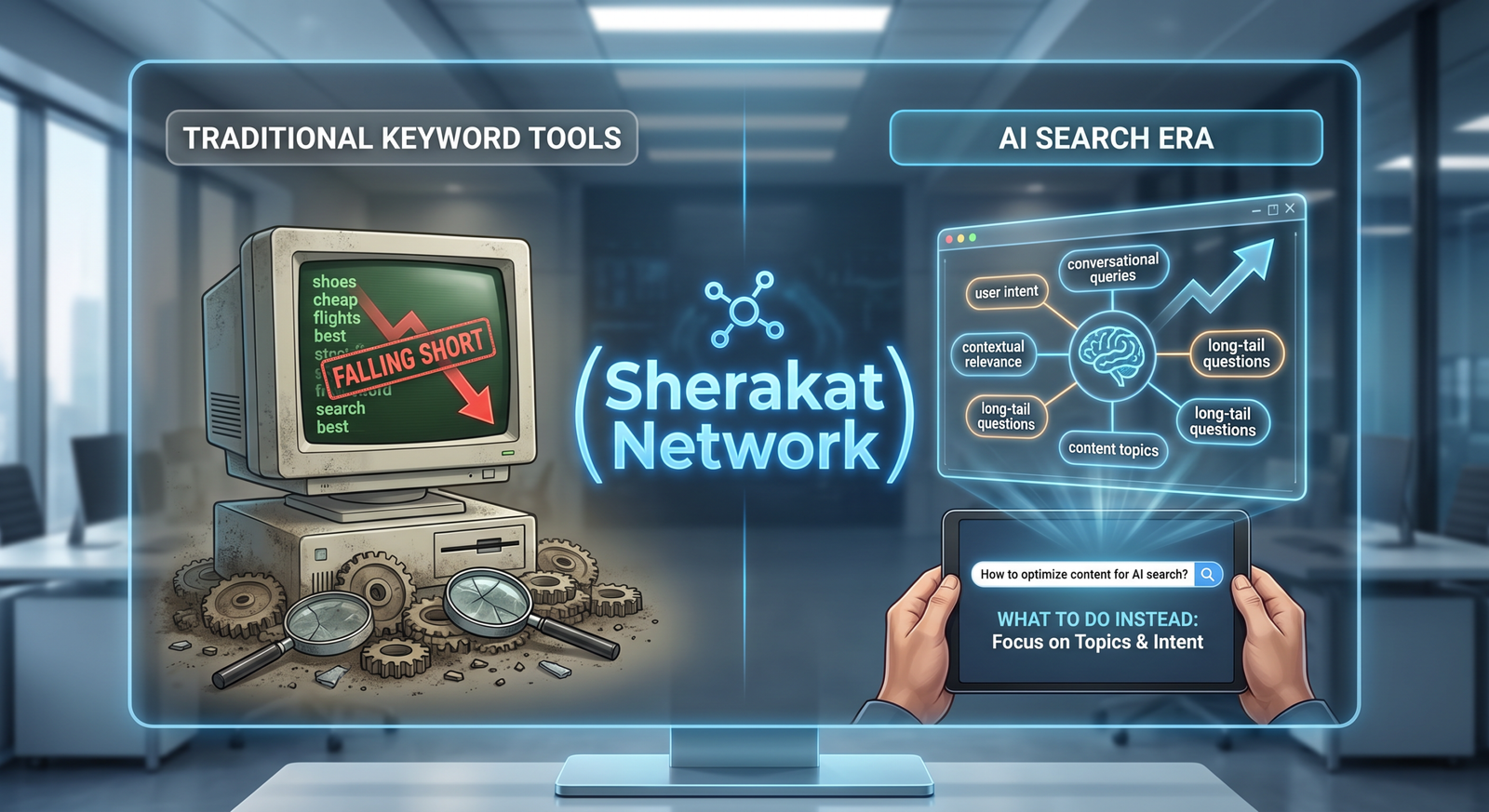

Introduction: Why This Matters
In my experience, the most dangerous moment in any SEO professional’s career is when their tools stop telling the truth.
I’ve watched brilliant content strategists confidently present keyword spreadsheets to clients—beautifully formatted, color-coded, filled with volume estimates and difficulty scores—only to see those carefully selected keywords produce nothing. The pages ranked. The positions improved. The traffic never came. And nobody could explain why.
What I’ve found is that the keyword research tools most of us rely on were built for a search engine that no longer exists. They were designed for a world where users typed short queries into a box, Google returned ten blue links, and rankings translated directly into clicks. That world is gone.
This guide exists because the gap between what keyword tools measure and what actually drives visibility in 2026 has become enormous—and the consequences of ignoring that gap are severe. Sites are publishing content optimized for keywords that trigger AI Overviews, only to watch clicks evaporate. Teams are chasing volume metrics that no longer predict traffic. Marketers are building strategies on data that Google itself acknowledges is fundamentally unreliable.
By the end of this guide, you’ll understand exactly why traditional keyword research is failing, what’s replaced it, and how to build a keyword strategy that works in the AI search era—whether you’re a beginner trying to understand the new landscape or a professional who needs to pivot fast.
Background / Context: The Three Assumptions That Broke
Traditional keyword research rests on three foundational assumptions. In 2026, all three have collapsed.
Assumption 1: Queries are stable. The old model assumed that if a keyword had 1,000 monthly searches last year, it would have roughly 1,000 this year. You could build a content strategy around volume estimates and expect predictable traffic. This assumption is now false. Google’s own product lead confirmed that AI Mode queries are three times longer than traditional searches, with follow-up queries growing 40% month-over-month. The same underlying information need now generates dozens of different query variations—and most of those variations appear only once.
Assumption 2: Search intent is static. Keyword tools classify intent as informational, commercial, or transactional—and assume that classification holds. But AI-powered search dynamically refines intent within a single conversation. A user might start with “best running shoes,” get a follow-up asking about trail running specifically, then pivot to questions about arch support. Each turn in the conversation generates new queries that tools never see.
Assumption 3: Rankings drive traffic. This was always somewhat true but never absolute. In 2026, it’s dangerously wrong. Ahrefs’ analysis of 300,000 informational keywords found that the top-ranking page had a 58% lower average CTR when an AI Overview appeared. Pew Research found users clicked a regular search result on just 8% of visits with an AI summary, versus 15% without. You can rank position one and still get almost no clicks.
What replaced the old model: AI engines now decompose every user prompt into 2 to 10 synthetic sub-queries before retrieving content. Citations go to pages that match these sub-queries, not the original query. The retrieval unit is no longer the page—it’s the passage. And the entity—not the keyword string—is what gets matched.
The implication is stark: keyword research as a discipline hasn’t died, but it has moved. The professionals who thrive in 2026 and beyond are those who understand where it moved to and how to follow it.
Key Concepts Defined
Before we build the replacement framework, let’s establish the language of AI-era keyword research.
Query Fan-Out: The process by which AI engines decompose a single user prompt into multiple synthetic sub-queries before retrieving content. When you ask ChatGPT or Google AI Mode a question, the system generates 2-10 related searches behind the scenes, retrieves content matching those sub-queries, and synthesizes an answer. The sub-queries are invisible to users and often to traditional tools.
Prompt Research: The practice of analyzing the actual prompts users submit to AI engines, clustering similar prompts by topic, and understanding the intent clusters that emerge. Unlike keyword research, which analyzes search volume for fixed phrases, prompt research analyzes conversational patterns across millions of unique queries.
Entity: A distinct concept, person, place, or thing that AI systems recognize and can reason about. Entities are the unit of retrieval in AI search—not keywords. When AI engines fan out a query, they retrieve based on entity relationships, not string matches.
Intent Cluster: A group of queries that share the same underlying goal, even if the phrasing varies dramatically. “How to fix a leaky faucet,” “faucet dripping repair,” and “why won’t my faucet stop dripping” might all belong to the same intent cluster.
Citation: A link to a source included in an AI-generated answer. Citations are chosen separately from traditional rankings—a page ranking tenth can be cited while the page ranking first is not.
Citation Drift: The rapid turnover of sources cited in AI answers. SISTRIX’s 17-week analysis found that neighboring citations rotate at approximately 70% per week, and only 1.4% of news articles cited in AI responses remain in the citation set permanently.
Answer Engine Optimization (AEO): The practice of optimizing content to be cited in AI-generated answers, as distinct from traditional SEO which focuses on ranking in search results.
Generative Engine Optimization (GEO): A broader term encompassing AEO, focusing on visibility across all generative AI platforms including ChatGPT, Perplexity, Google AI Mode, and Copilot.
Atomic Answer: A self-contained response block (typically 40-60 words) placed at the beginning of a section that directly answers the heading’s question. Designed for AI extraction and citation.
How It Works: The Step-by-Step Breakdown
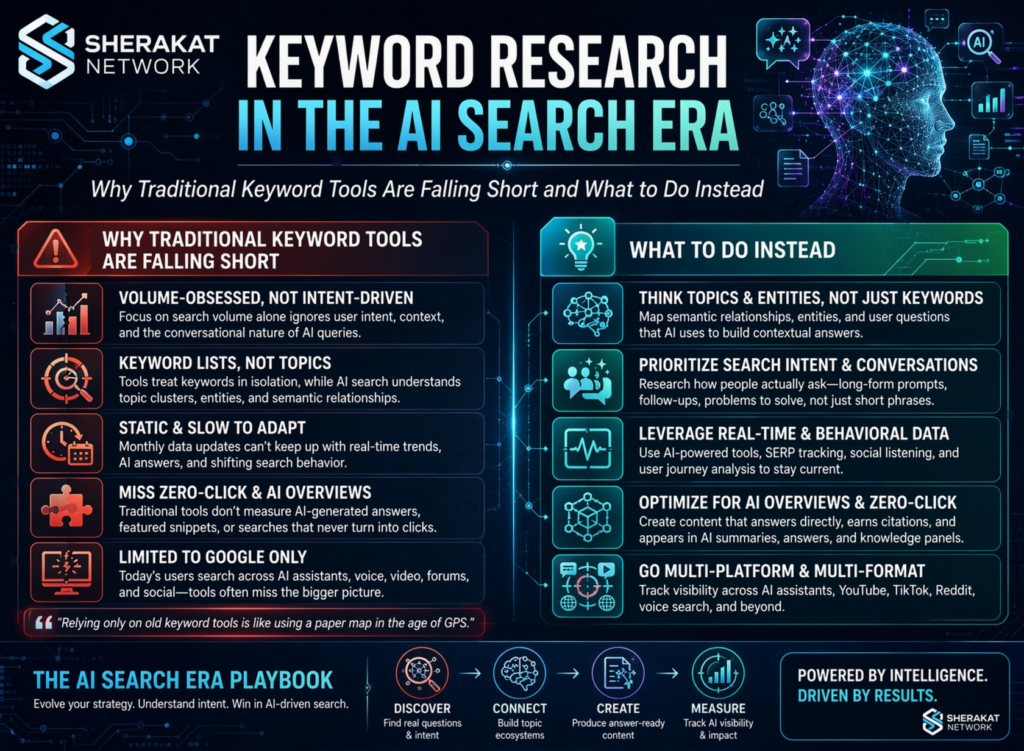
This is the core of the guide. Follow these steps in order, adapting them to your available tools and technical capacity.
Step 1: Stop Using Search Volume as Your Primary Prioritization Signal
This is the hardest step for most professionals. Volume data is comforting. It gives you a number to sort by. It feels objective.
But search volume in 2026 is functionally dead as a prioritization signal for mid-funnel informational content. Here’s why:
Google Keyword Planner groups keywords with similar meanings, rounds volumes into buckets, and was found to drastically overestimate search volumes 54% of the time. Ahrefs’ own data shows their volume estimates are “roughly accurate” for only 60% of keywords, compared to Google Search Console impressions. And for low-volume, niche, or conversational queries, Google often groups them into broad ranges like 0-10 even when the term actively ranks and brings traffic.
What to do instead:
Use volume data only for:
- Branded queries: Still predictive of direct traffic
- Transactional queries: Still predictive of revenue potential
- Long-tail commercial queries: Still predictive of intent
- Local queries: Still predictive of geographic demand
For everything else—especially mid-funnel informational content that AI engines now summarize—prioritize by intent cluster coverage rather than volume.
Step 2: Map the Query Fan-Out Space
Since AI engines decompose prompts into sub-queries, your content must match the sub-queries, not just the original query. This means you need to understand what fan-out looks like for your target topics.
Manual method (free but time-intensive):
Use inverse-prompting. Ask the AI engine what it would search for. For example, prompt ChatGPT: “What sub-queries would you generate for the prompt ‘best protein powders for runners?'” The engine will return approximate fan-outs.
Tool-assisted methods:
- queryfanout.ai: Extracts real fan-out queries directly from Google’s API, showing exact search strings Google generated
- Otterly Query Fan-Out Simulator: Modeled expansion based on Google AI Mode behavior
- SISTRIX Prompt Research: Clusters over 62 million real user prompts into over 1.4 million topics, providing estimated AI search volume, intent classification, and customer journey stage
The eight angles of fan-out mapping:
For any target topic, map sub-queries across these dimensions:
- Definition — “what is [topic]”
- Comparison — “[topic] vs [alternative]”
- How-to — “how to [do topic]”
- Pros/cons — “[topic] benefits and drawbacks”
- Examples — “[topic] case studies”
- Tools — “best tools for [topic]”
- Trends — “[topic] 2026 trends”
- Beginner — “[topic] for beginners”
What you’re building: A map of the intent clusters your content needs to cover. Not a keyword list—a coverage diagram.
Step 3: Build Topic Clusters Mapped to Intent Clusters
Topic clusters become more important in the AI era, not less—because they map cleanly to intent clusters, which is what AI engines retrieve against during fan-out.
The structure:
- Pillar page: Comprehensive coverage of the main topic
- Cluster pages: Individual articles addressing each sub-intent
- Internal links: Bidirectional connections between pillar and cluster pages
What changes from traditional clustering:
The unit of work shifts from “keyword × difficulty × volume” to “intent cluster × entity coverage × answer format × retrieval probability”. You’re not targeting a head term with supporting long-tails. You’re targeting an intent-and-entity pair, with content chunks covering the sub-queries AI generates.
Practical example: For a project management SaaS, the intent cluster might be “managing remote teams.” Sub-intents include “time zone coordination,” “async communication,” “remote meeting fatigue,” “tracking productivity without surveillance.” Each sub-intent gets a cluster page. The pillar page covers the overarching theme.
Step 4: Optimize for Chunk-Level Retrievability
AI engines don’t retrieve pages. They retrieve passages. A 3,000-word article is not the unit of retrieval—individual paragraphs and sections are.
Three formatting changes make content citation-ready:
Use Q&A-style headings. Instead of “Overview of Query Fan-Out,” write “What Is Query Fan-Out?” AI matches sub-queries to question headings more easily.
Place Atomic Answers at the start of each section. Write a self-contained 40-60 word answer immediately after the heading. This gives AI a ready-to-cite block.
Keep paragraphs short (2-4 sentences). Long paragraphs burn the AI’s “prefill” budget—the compute phase where it reads input context. Structured, well-typed content is cheap to parse; unstructured prose gets dropped before the model even starts reasoning.
What doesn’t work (despite what you may have heard):
FAQ schema was long believed to boost AI citations. But Google discontinued FAQPage rich results in May 2026, and controlled experiments found that schema additions produced changes indistinguishable from noise for AI Mode (+2.4%) and ChatGPT (+2.2%). Schema makes you legible; it doesn’t guarantee citation.
Step 5: Deploy Entity-First Structured Data
The unit of retrieval in AI search is the entity, not the keyword. Entities are what AI systems resolve, disambiguate, and cite.
Three entity types decide whether you get cited:
- Author (Person schema): Who wrote it, resolved via structured affiliations, prior works, and sameAs links
- Brand (Organization schema): Who’s publishing, with logo, founder, and organizational data
- Product/Service (Product schema): What’s being discussed, with distinguishing attributes
Priority order for deployment:
- P0 (non-negotiable): Organization schema, Person schema for verifiable authors, Product/Service schema
- P1 (high leverage): Article schema with author and topic linkage
- P2 (hygiene): BreadcrumbList for site hierarchy
The connected graph principle: A pile of well-marked-up pages that don’t reference each other is a stack of business cards. A connected graph—where author links to article, article links to topic, brand links to product—is queryable infrastructure. Schema is necessary. It pays off when there’s a connected graph for agents to follow.
Step 6: Research Prompts, Not Just Keywords
Traditional keyword tools show you what people type into search boxes. Prompt research shows you what people ask AI engines—which is increasingly different.
How prompts differ from keywords:
- A keyword user types: “balkonkraftwerk”
- A ChatGPT user asks: “Create a checklist for buying a balcony solar system”
- An AI Mode user asks: “Which inverter is most efficient for a balcony solar system?”
Same information need. Completely different formulations. And most prompts appear only once.
The solution: prompt clustering. SISTRIX’s Prompt Research approach clusters similar prompts into topics—abstracting one level above individual queries to reveal the underlying intent space. For “balcony solar,” this reveals 117 topics spanning solar modules, installation, inverters, storage, economics, and registration.
What prompt research provides that keyword tools don’t:
- Estimated AI search volume: Based on real AI platform usage data
- Intent classification: Whether the topic is informational, commercial, or transactional
- Customer journey stage: Where the user is in their decision process
- Platform-specific prompts: How users phrase the same need on ChatGPT vs. AI Mode vs. Perplexity
- Unasked questions: Questions users should ask but don’t—content that demonstrates expertise
Step 7: Create Content for Sub-Queries, Not Head Terms
Pages now rank for hundreds or thousands of queries they don’t explicitly target. This happens because AI engines understand semantic relationships and match content to intent, not just keyword strings.
What this means for content creation:
Cover the sub-query, not just the main topic. If your target query is “how to reduce WordPress image file size,” your content should cover: “WordPress image compression without quality loss,” “best WordPress image optimization plugins,” “how to resize images in WordPress,” “bulk image optimization WordPress.”
Each sub-query can become a section. A question-phrased heading, followed by an Atomic Answer, followed by supporting detail. This structure lets AI extract the specific chunk that matches the sub-query.
Don’t optimize for the primary keyword density. Keyword density is irrelevant. Entity coverage and semantic completeness matter.
Step 8: Monitor AI Citation, Not Just Rankings
Rankings alone no longer predict traffic. You need to track whether your content is being cited in AI answers—and where.
Three ways to check AI citation:
Option 1: Manual spot-checking. Search your target queries in Google and look for your domain among AI Overview citations. Free, instant, but doesn’t scale.
Option 2: Google Search Console’s generative AI report. Google began rolling this out in June 2026 and made it available worldwide by August 31, 2026. It shows how often links to your site appeared in AI Overviews and AI Mode, broken down by page, country, device, and date. Limitation: No query dimension, no click data, no citation position.
Option 3: Keyword visibility tools. Tools like LinkSurge’s AIO keyword analysis take a domain and return every keyword where you’re cited, your position among citations, and search volume. Other tools: Profound, Otterly, Peec, SE Ranking AI Search.
What to track:
- Which pages are cited, and for which topics
- Your position among citations (first source vs. last)
- Citation drift—how long your citations persist
- Competitor citation share
Step 9: Prioritize for AI Citation Probability, Not Volume
Not all keywords have equal AI citation potential. Long-tail queries (8+ words) are 7 times more likely to trigger an AI Overview. Queries requiring personalization, recent data, or action are less likely to be fully satisfied by AI summaries.
Prioritization framework for AI-era keyword research:
| Signal | High Priority | Low Priority |
|---|---|---|
| Query length | 8+ words (long-tail) | 1-3 words (head terms) |
| Intent | Commercial, transactional | Broad informational |
| AI Overview presence | Absent or weak | Strong, comprehensive |
| Competition | Forum posts, thin content | Major brands, definitive guides |
| Entity clarity | Clear entity relationships | Ambiguous topics |
The single biggest mistake teams make: Adding AI-search work on top of existing keyword work instead of consolidating. Most content backlogs are 60-80% keyword-aligned but entity-thin. A consolidation pass—updating existing content to cover sub-queries and strengthen entity signals—beats new production.
Why It’s Important
Understanding the shift from keyword research to AI-era research isn’t academic. It’s the difference between a strategy that produces results and one that produces spreadsheets.
The traffic reality. Globally, 35% of consumers now use AI tools at the discovery stage of the purchase journey, versus just 13.6% using traditional search at that same stage. AI Overviews reduce website clicks by 34.5%. If your keyword research doesn’t account for this, you’re optimizing for a shrinking portion of the market.
The measurement problem. GA4 continues to misreport AI search traffic because referrer information is stripped by many AI engines. You can’t optimize what you can’t measure—which means you need different signals.
The strategic shift. Search is shifting from search to conversation. Visibility depends on authority within context, not just keywords. When your content reflects how people actually speak, think, and build on ideas, AI systems recognize your brand as a trusted contributor.
What happens if you ignore this: You publish content optimized for keywords that trigger AI summaries. You rank position one and watch clicks flatline. You present traffic projections to stakeholders that never materialize. The tools said the keywords were good. The keywords weren’t good. The tools were measuring the wrong thing.
Sustainability in the Future
The AI search landscape is evolving fast. Here’s what to watch and how to stay adaptable.
Citation volatility is structural, not transitional. SISTRIX’s 17-week analysis found that citation drift rates across six countries run consistently between 54% and 59%, with no sign of declining. This is not an introductory effect that stabilizes—it’s a characteristic of the platforms themselves.
News content doesn’t sustain citations. Only 1.4% of news articles cited in AI responses remain in the citation set permanently. Evergreen content survives better. If you’re planning citation strategy around timely content, you’re planning wrong.
Platform-specific optimization matters. ChatGPT favors comparison and how-to content. Google AIO prefers structured lists and definitions. Perplexity rewards data-rich tables and explicit citation density. A page that excels on one platform is not guaranteed to excel on another.
The sustainable approach: Build intent clusters, not keyword lists. Optimize for chunk-level retrievability, not page-level rankings. Track citation frequency, not just position. And accept that AI search visibility is inherently volatile—your strategy should assume drift, not permanence.
Common Misconceptions
Misconception 1: “Keyword research is dead.” No. Volume-based keyword research as the primary strategic anchor is functionally dead for mid-funnel informational content. It remains directly useful for branded, transactional, long-tail commercial, and local queries. The discipline has moved up the stack, not disappeared.
Misconception 2: “If I rank position one, I’ll get the traffic.” Ahrefs found the top-ranking page had a 58% lower CTR when an AI Overview appeared. Rankings and traffic have decoupled for a meaningful share of keywords.
Misconception 3: “Schema markup guarantees AI citations.” Controlled experiments found schema additions produced changes indistinguishable from noise for AI Mode (+2.4%) and ChatGPT (+2.2%). Schema makes you legible. Entity coverage determines whether you get cited.
Misconception 4: “I can use the same keyword research workflow, just add AI tools.” Adding without consolidating creates double the spreadsheet and the same citation rate. The workflow has fundamentally changed—not expanded.
Misconception 5: “Long-tail keywords are always the answer.” Long-tail queries are more likely to trigger AI Overviews (8+ words are 7x more likely). They’re also more specific and easier to satisfy. The right long-tail keywords—commercial, transactional, or requiring expertise—still work. Broad informational long-tails get summarized away.
Misconception 6: “Search volume data is accurate enough.” Google Keyword Planner overestimated search volumes 54% of the time. Ahrefs’ estimates are “roughly accurate” for only 60% of keywords. The data is directional, not precise—and for low-volume queries, it’s often invisible.
Recent Developments
Three developments in 2025-2026 have reshaped keyword research for AI search.
1. Google’s generative AI performance report launched. Google began offering it to some sites in June 2026 and completed worldwide rollout on August 31, 2026. It shows AI Overview and AI Mode impressions by page, country, device, and date. What it doesn’t show: queries, clicks, or citation position.
2. SISTRIX published 17-week citation drift data. Across six countries, citation drift rates run 54-59% with no sign of stabilizing. Only 1.4% of news articles cited in AI responses remain permanently. The message: AI visibility is structurally volatile, not a transitional phase.
3. Prompt Research emerged as a keyword research alternative. SISTRIX’s Prompt Research clusters over 62 million real user prompts into 1.4 million topics, providing estimated AI search volume, intent classification, and content briefings per topic. This represents a new abstraction level—topics instead of keywords—built for how AI search actually works.
Success Stories
Case Study: The B2B SaaS Blog’s Query Fan-Out Audit
A project management SaaS analyzed its content against query fan-out patterns for its target topics. Using Similarweb’s Citation Analysis, they found competitors like Asana and Monday.com appeared in AI answers for dozens of sub-queries their content didn’t cover—”managing remote team time zones,” “async standup alternatives,” “tracking productivity without surveillance.”
They audited existing content against the fan-out map and found 60% coverage gaps. Instead of publishing new articles, they consolidated and expanded existing pages to cover the missing sub-queries. Within three months, AI citation frequency for their domain increased 40% across tracked topics.
The key insight: Consolidation beat new production. The gaps were in existing content, not missing pages.
Case Study: The Recipe Blog’s Entity-First Pivot
A recipe blog was struggling with declining traffic despite stable rankings. They deployed Organization schema, Person schema for their author, and connected their content graph—linking recipes to ingredients, techniques, and equipment as entities.
They also restructured content for chunk-level retrievability: question-phrased headings, Atomic Answers at the start of sections, short paragraphs. Six months later, their recipes were being cited in Google AI Overviews for troubleshooting queries like “why is my bread dense” and “how to fix runny frosting.”
The key insight: Entity clarity and chunk structure made them legible to AI systems in a way keyword optimization never could.
Case Study: The Local Service Business’s Prompt Research
A plumbing company used Google Search Console’s regex filter to find conversational queries generating impressions: “how to turn off water to toilet,” “why is my sink gurgling,” “water heater pilot light won’t stay lit.” These were real prompts people were asking—and the company’s pages were appearing.
They optimized existing pages to answer these questions directly, using Q&A headings and Atomic Answers. Within eight weeks, they were cited in AI Overviews for 12 problem-specific queries—driving calls from people who found them while researching their issue.
The key insight: The best prompt research data was already in their Search Console. They just needed to look for conversational patterns, not keywords.
Real-Life Examples
Example 1: The “Best [Product]” Trap
Search “best CRM software” and examine the results. AI Overviews now appear on 71% more commercial-intent searches than six months prior. The top-ranking page gets 58% lower CTR. A comprehensive buying guide that once drove affiliate revenue now drives almost nothing.
What works instead: Specific comparison queries—”CRM for small law firms,” “CRM with built-in VoIP,” “CRM that integrates with QuickBooks”—where AI Overviews are less likely to fully satisfy intent.
Example 2: The “How to [Task]” Opportunity
Search “how to fix a leaky faucet.” AI Overviews summarize the basic steps. But the user who needs to know which washer to buy for their specific faucet model—that’s a query AI can’t fully answer without specific product data. Content targeting the specific, the contextual, and the personalizable survives the AI Overview shift.
Example 3: The Entity Gap
A B2B company had excellent content and strong rankings. But when AI engines fanned out queries about their topic, they cited competitors instead. The problem: their Organization schema was incomplete. AI couldn’t resolve their brand as a known entity. After deploying complete Organization and Person schema, their citation frequency increased within weeks—without any content changes.
Conclusion and Key Takeaways
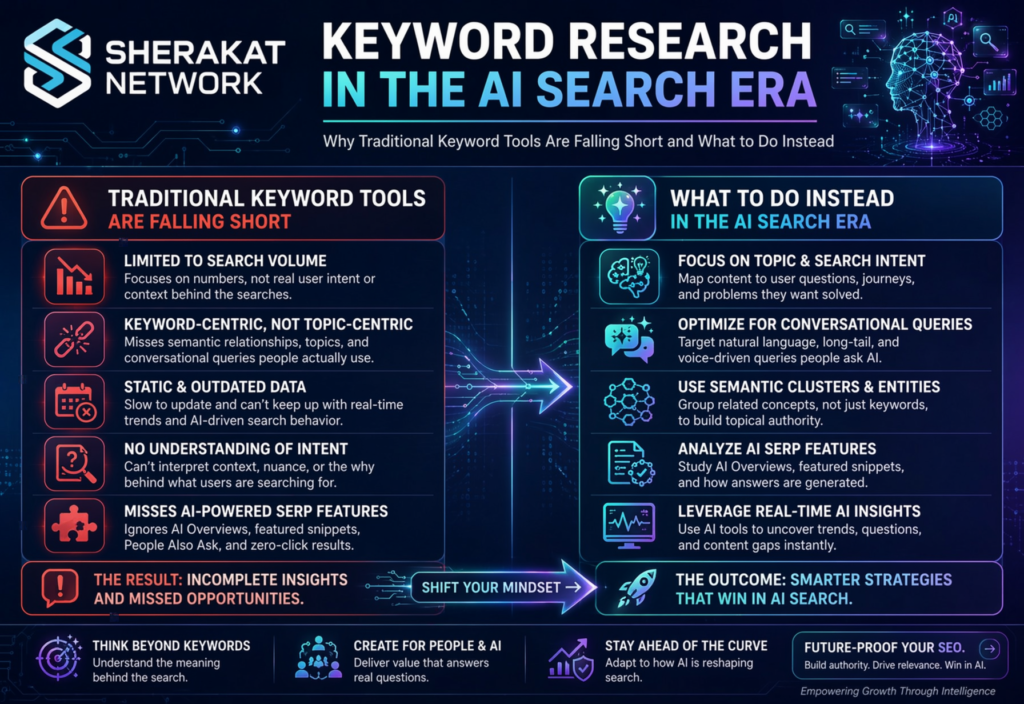
Traditional keyword research tools aren’t broken. They’re measuring the wrong things for a search landscape that has fundamentally changed.
Key Takeaways:
- Volume-based keyword research is functionally dead for mid-funnel informational content
- AI engines decompose prompts into 2-10 sub-queries; citations go to pages matching sub-queries
- The unit of retrieval is the passage, not the page
- Entities, not keywords, are what AI systems match and cite
- Query fan-out is invisible—you need tools or inverse-prompting to map it
- Prompt research reveals intent clusters that keyword tools miss
- Schema makes you legible; entity coverage determines citation
- AI citation is structurally volatile—drift rates of 54-59% with no stabilization
- Rankings and traffic have decoupled where AI Overviews appear
- The single biggest mistake is adding AI work without consolidating existing content
Your next step: Pick one target topic. Map its query fan-out manually using inverse-prompting. Audit your existing content for sub-query coverage. Find the gaps. Fill them. Then track whether your content appears in AI answers—not just whether it ranks.
Frequently Asked Questions (FAQs)
Q1: Is keyword research actually dead?
A: No. Volume-based keyword research as the primary strategic anchor is functionally dead for mid-funnel informational content. It remains directly useful for branded, transactional, long-tail commercial, and local queries.
Q2: What is query fan-out?
A: The process by which AI engines decompose a single prompt into 2-10 synthetic sub-queries before retrieving content. Citations go to pages matching the sub-queries, not the original prompt.
Q3: How do I see what sub-queries AI generates?
A: Use inverse-prompting (ask the AI what it would search for), tools like queryfanout.ai, or SISTRIX Prompt Research.
Q4: Should I still use Ahrefs and Semrush?
A: Yes, with narrower scope: branded, transactional, long-tail commercial, and local research where volume still predicts traffic. Plus backlink and authority analysis, which matters more than before.
Q5: What is prompt research?
A: Analyzing the actual prompts users submit to AI engines, clustering similar prompts by topic, and understanding intent clusters. Unlike keyword research, which analyzes fixed phrases, prompt research analyzes conversational patterns.
Q6: How do I track AI citations?
A: Manual spot-checking, Google Search Console’s generative AI report (page-level impressions), or keyword visibility tools that show citation position and volume.
Q7: What is the generative AI performance report in GSC?
A: A report showing how often links to your site appeared in AI Overviews and AI Mode, broken down by page, country, device, and date. It has no query dimension and no click data.
Q8: Does schema markup help with AI citations?
A: Schema makes you legible. Entity coverage determines whether you get cited. Controlled experiments found schema additions alone produced changes indistinguishable from noise.
Q9: Why are AI citations so volatile?
A: SISTRIX’s 17-week study found citation drift rates of 54-59% with no sign of stabilizing. Only 1.4% of news articles remain cited permanently. This is structural, not transitional.
Q10: What’s an Atomic Answer?
A: A self-contained 40-60 word response block placed immediately after a question-phrased heading. Designed for AI extraction and citation.
Q11: How do I write content for AI citation?
A: Use Q&A-style headings, place Atomic Answers at the start of sections, keep paragraphs short, and build topic clusters mapped to intent clusters.
Q12: What entity types matter most for AI citation?
A: Author (Person schema), Brand (Organization schema), and Product/Service. Author and Brand carry the most citation weight.
Q13: Why did my traffic drop despite stable rankings?
A: AI Overviews are reducing click-through rates. The top-ranking page had 58% lower CTR when an AI Overview appeared.
Q14: Should I stop creating new content and optimize existing pages?
A: Likely yes. Most backlogs are 60-80% keyword-aligned but entity-thin. A consolidation pass beats new production.
Q15: What’s the Query Rewrite Gap?
A: The difference between what users want (intent layer), what AI retrieves (rewrite layer), and what gets cited (synthesis layer). Research must address all three.
Q16: How often should I monitor AI citations?
A: Weekly for priority prompts, monthly for full cluster coverage. Citation patterns drift faster than classic SERP positions.
Q17: What tools track AI citations?
A: Profound, Otterly, Peec, SE Ranking AI Search, LinkSurge AIO analysis, Similarweb Citation Analysis.
Q18: Can I do AI-era keyword research for free?
A: Yes. Google Search Console regex filters, manual inverse-prompting, and free AI engine testing can reveal substantial insight.
Q19: What’s the difference between AEO and GEO?
A: AEO (Answer Engine Optimization) focuses on being cited in AI-generated answers. GEO (Generative Engine Optimization) is broader, covering visibility across all generative AI platforms.
Q20: Why don’t my old keyword rankings produce traffic anymore?
A: AI Overviews summarize answers directly, reducing clicks. Users clicked a regular result on 8% of visits with an AI summary, versus 15% without.
Q21: What’s the biggest mistake in AI-era keyword research?
A: Adding AI-search work on top of existing keyword work without consolidating. This creates double the spreadsheet and the same citation rate.
Q22: How do I find conversational queries in Search Console?
A: Use regex filters. Apply ^(cómo|qué|cuál|por qué) or similar patterns to find question-based queries already generating impressions.
Q23: What is feature stacking?
A: The implicit attributes AI engines add to product queries beyond what users explicitly ask for—shade of red, wireless charging compatibility, local retailer availability.
Q24: Do FAQ sections still help with AI visibility?
A: Google discontinued FAQPage rich results in May 2026. But Q&A-structured content still helps AI extract information. The benefit is structural, not schema-dependent.
Q25: How do I research prompts for my niche?
A: SISTRIX Prompt Research clusters 62 million prompts into topics. For free alternatives, use Search Console regex filters and manual AI engine testing.
Q26: What’s citation drift?
A: The rapid turnover of sources cited in AI answers. Neighboring citations rotate at ~70% per week.
Q27: Should I optimize for ChatGPT, Google AIO, and Perplexity differently?
A: Yes. ChatGPT favors comparison and how-to content. Google AIO prefers structured lists and definitions. Perplexity rewards data-rich tables and citation density.
Q28: What’s the prefill budget and why does it matter?
A: The compute phase where AI reads input context. Structured, well-typed content is cheap to parse; unstructured prose burns budget and gets dropped before reasoning begins.
Q29: How long does it take to see AI citation results?
A: Citation patterns drift quickly—some shifts appear within weeks. But sustained visibility requires consistent entity signals and content freshness.
Q30: What’s the one thing I should do differently after reading this guide?
A: Map the query fan-out for one target topic. Audit existing content for sub-query coverage. Fill the gaps. Then check whether your content appears in AI answers—not just search results.
About Author
[Sana Ullah Khan Kakar, Content and Article Writer Specialist]
This guide was written based on hands-on experience adapting keyword research strategies for AI search across multiple industries since 2024, including B2B SaaS, local services, and content publishing. The frameworks outlined here have been tested against Google AI Overviews, ChatGPT, and Perplexity citation data.
Free Resources

AI-Era Keyword Research Tools:
- queryfanout.ai — real fan-out queries from Google API
- Otterly Query Fan-Out Simulator — modeled expansion
- SISTRIX Prompt Research — prompt clustering and AI search volume
- Google Search Console — generative AI report (page-level impressions)
- LinkSurge AIO Keyword Analysis — citation visibility by keyword
Recommended Reading on Sherakat Network:
External Resources:
- World Class Blogs: AI & Machine Learning
- World Class Blogs: Climate Policy
- The Daily Explainer: Mental Health Guide
Discussion
What’s your experience with keyword research in the AI search era? Have you seen traffic decline despite stable rankings? Found tools or strategies that work? Share your insights in the comments below.
If you found this guide helpful, consider sharing it with someone who’s struggling to adapt their keyword strategy. The shift is real—but the professionals who adapt will thrive.
Have questions? Reach out via our contact page.