



Introduction: Why This Matters
In my experience, the fastest shortcut in keyword research is looking at what your competitors are already doing—and doing it better.
I’ve watched beginners spend weeks brainstorming keywords from scratch, staring at blank spreadsheets, wondering what their audience might search for. Meanwhile, their competitors have already done the hard work: they’ve published content, tracked rankings, and revealed exactly which keywords drive traffic in their niche. That data is sitting there, publicly available, waiting to be analyzed.
What I’ve found is that competitor keyword research isn’t about copying. It’s about understanding. When you see that a competitor ranks for a specific query, you learn something concrete: there’s search demand for this topic, someone is already satisfying that demand, and a spot exists on the first page that you could potentially occupy. That’s not theft—that’s market intelligence.
This guide exists because competitor keyword research has become simultaneously easier and more nuanced. Tools have made it simple to pull competitor keyword data. But the ethics, the analysis, and the strategic application require judgment. You can’t just export a competitor’s keyword list and start writing. You need to understand why they rank, what the search intent is, and whether you can realistically compete.
By the end of this guide, you’ll have a complete framework for finding, analyzing, and ethically using competitor keyword data—whether you’re a beginner with zero budget or a professional looking for a systematic refresher.
Background / Context: The Transparency of Search
Here’s a fundamental truth about SEO that surprises many beginners: your competitors’ keyword rankings are not secret.
Every time a competitor ranks on page one of Google, they’re revealing valuable information. They’re telling you which queries they consider worth targeting, which topics their audience cares about, and where Google has decided their content is relevant. All of this is publicly visible to anyone who searches.
Why this matters for keyword research:
Traditional keyword research starts with a seed term and expands outward using tools. Competitor keyword research starts with a domain and works inward—analyzing what’s already working for others and finding the gaps you can fill.
The rise of accessible SEO tools has democratized this process. What once required expensive enterprise software (or manual SERP scraping) is now available through freemium tools, browser extensions, and even open-source utilities . You can analyze a competitor’s organic keywords with a free Chrome extension . You can run gap analyses with Python scripts if you’re technically inclined .
But accessibility has a downside: more people doing competitor research means more competition for the same opportunities. The edge comes not from having the data, but from interpreting it well. Understanding search intent, evaluating content quality, and identifying genuine gaps—these are skills that separate effective competitor research from lazy copying.
The ethical dimension: This guide focuses on legal and ethical competitor research. You’re analyzing publicly available ranking data, not hacking into anyone’s analytics. You’re studying what Google displays publicly, not accessing private keyword data. The line between “inspired by” and “copied from” matters—but analyzing competitor keywords is firmly on the right side of that line.
Key Concepts Defined
Before diving into the process, let’s establish the terminology that matters for competitor keyword research.
Competitor Keyword: Any search query for which a competing website ranks in Google’s search results. These are visible through SEO tools, browser extensions, or manual searching .
Keyword Gap: Keywords where competitors rank but you don’t. Gap analysis identifies these opportunities by comparing your site’s rankings against competitors’ rankings .
Content Gap: Similar to keyword gap, but broader. Content gaps exist when competitors cover topics you haven’t addressed, even if you rank for some related queries .
Digital Competitor vs. Business Competitor: Your business competitors are companies selling similar products. Your digital competitors are websites ranking for the same keywords—they might be blogs, review sites, or publishers you’d never consider business rivals . For keyword research, digital competitors matter more.
Keyword Overlap: The percentage of keywords shared between your site and a competitor. High overlap indicates you’re competing for the same audience; low overlap suggests different niches or strategies .
Traffic Lift: A metric estimating how much additional traffic you could gain by outranking a competitor for a specific keyword. This prioritizes opportunities by potential impact .
Search Intent: The underlying goal behind a query. Four types exist: informational, navigational, commercial, and transactional. Matching your content to intent is non-negotiable for ranking .
Keyword Difficulty (KD): A metric estimating how hard it would be to rank for a keyword. Different tools calculate it differently, but low KD scores indicate easier opportunities.
Long-Tail Keywords: Specific, often longer queries with lower volume but higher intent and easier competition. Competitor research often reveals long-tail opportunities that tools miss .
How It Works: Step-by-Step Breakdown
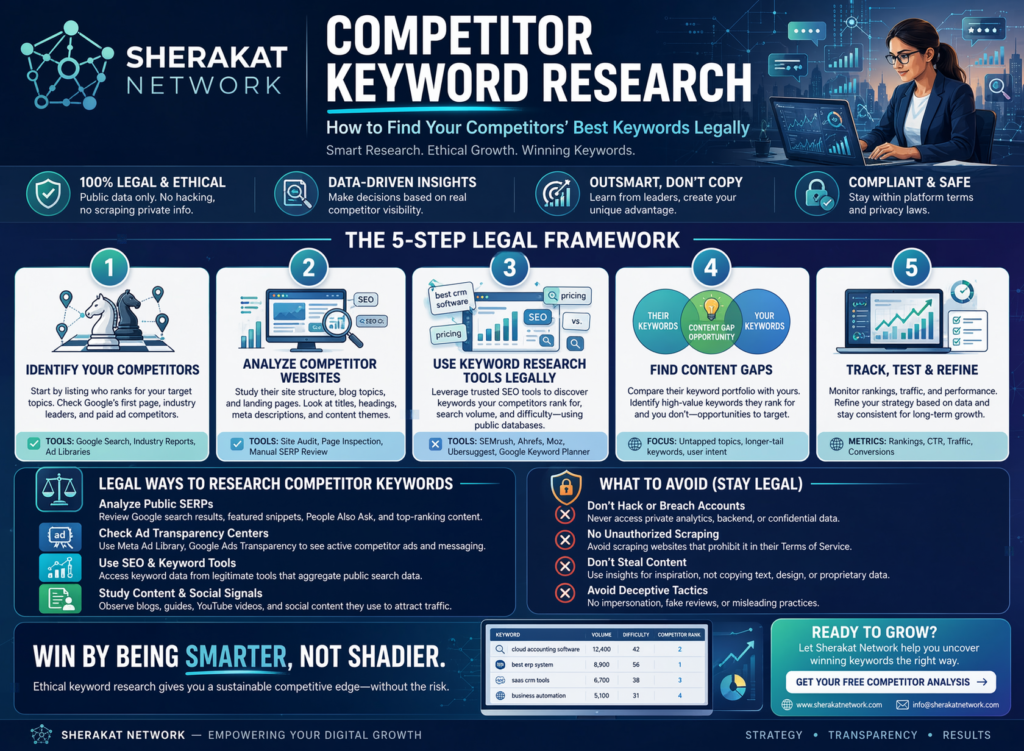
This is the core of the guide. Follow these steps in order, adapting the depth to your available tools and budget.
Step 1: Identify Your True Digital Competitors
Your business competitors aren’t always your SEO competitors. A local bakery might compete with other bakeries for customers, but for keyword rankings, it might compete with recipe blogs, food publications, and cooking sites .
How to find digital competitors:
Manual method: Search your primary keywords. Who appears on page one? Those are your digital competitors, regardless of whether they sell what you sell.
Tool method: Moz’s True Competitor tool analyzes your top-ranking keywords and identifies sites competing for the same SERPs . Semrush’s Competitor Research module does similar work .
What to look for:
- Domain Authority (DA): Choose competitors with similar DA to yours. Competing with a DA 80 site when you’re at DA 20 is unrealistic .
- Keyword Overlap: Higher overlap means you’re competing for the same audience .
- Rivalry Score: Moz’s metric combining DA, overlap, volume, and rankings to identify your biggest threats .
Real example: A personal finance blog might identify NerdWallet and The Balance as digital competitors. But if those sites have DA 85+ and the blog has DA 25, a better strategy is finding mid-tier competitors with DA 30-45—sites ranking for similar topics but at a more achievable level.
Step 2: Pull Competitor Organic Keywords
Once you’ve identified competitors, it’s time to see what keywords they rank for.
Method A: Free Browser Extensions
Tools like AutoTDK and Keyword Surfer let you see competitor keywords directly in your browser . Visit a competitor’s site, activate the extension, and view estimated keywords, traffic, and difficulty data.
Method B: Freemium SEO Tools
- Ahrefs Site Explorer: Enter a competitor domain, navigate to “Organic Keywords,” and see their ranking queries sorted by traffic .
- Semrush: Similar functionality through their Organic Research tool.
- Moz Keyword Gap: Enter your domain and up to three competitors to see keyword overlap and gaps .
- Ubersuggest: Free tier shows limited competitor keyword data.
Method C: Google Search Operators
Use site: searches to find competitor content on specific topics. For example: site:competitor.com "keyword topic" reveals pages targeting that topic .
Method D: Open-Source Tools
For technically inclined users, tools like SerpX SEO Tools allow offline keyword gap analysis from CSV exports . No subscription required.
What you’re looking for: Keywords where the competitor ranks positions 1-20, especially those with:
- Decent search volume
- Low to moderate keyword difficulty
- Clear search intent
- Relevance to your business
Step 3: Filter for Low-Competition Opportunities
A competitor’s keyword list will include many queries you can’t realistically target. Filter aggressively.
Filter criteria:
Keyword Difficulty (KD): Set a maximum threshold. For new sites, KD under 30. For established sites, KD under 50 .
Volume: Set a minimum threshold. For niche B2B, 100/month might be sufficient. For broad consumer topics, 500+ is better .
Position: Focus on keywords where competitors rank positions 5-20. If they’re position 1-3, the SERP is likely locked down. If they’re position 15-20, there’s room to improve .
Intent: Match keywords to your business goals. Informational queries build authority; commercial and transactional queries drive revenue .
The striking distance advantage: Moz’s Keyword Gap tool highlights “Keywords to Improve”—queries where competitors outrank you but you’re already in the top 20 . These are your fastest wins because you have existing content that Google considers relevant.
Step 4: Run a Keyword Gap Analysis
This is where competitor research becomes actionable. Instead of just seeing what competitors rank for, you identify what you don’t rank for—your gaps.
How to run a gap analysis:
Ahrefs Content Gap: Enter your domain and up to 10 competitors. The tool shows keywords competitors rank for that you don’t .
Moz Keyword Gap 2.0: Enter your domain and up to three competitors. View the Venn diagram showing keyword overlap, then dive into “Keywords to Improve” and “New Keyword Opportunities” .
Semrush Keyword Gap: Available in the Compare Domains report, showing top opportunities and keyword overlap .
What to look for in gap results:
- Missing keywords: Competitors rank, you have no content. These are new content opportunities.
- Weak keywords: You rank, but below competitors. These are optimization opportunities.
- Shared keywords: Both rank, roughly equal. These are competitive battlegrounds.
Prioritization framework:
| Gap Type | Action | Priority |
|---|---|---|
| Missing + Low KD + Clear Intent | Create new content | High |
| Weak + Position 11-20 | Optimize existing content | High |
| Missing + High KD | Deprioritize or long-term | Low |
| Shared + Competitor Rank 1-3 | Evaluate ROI before competing | Medium |
Step 5: Analyze Why Competitors Rank
Finding keywords is step one. Understanding why competitors rank for them is step two—and most beginners skip this entirely .
For each high-priority keyword, examine:
The ranking page type: Is it a blog post, product page, comparison, tutorial, or landing page? Match the format .
Content depth: How comprehensively does the page cover the topic? Count words, sections, images, and tables.
Content freshness: When was it published? Updated? Outdated content is a vulnerability you can exploit .
Unique elements: Does the page include original research, tools, calculators, videos, or expert quotes? These are harder to replicate but signal quality.
User experience: Is the page mobile-friendly? Fast-loading? Easy to navigate?
Gaps in their content: Read the page critically. What questions does it fail to answer? What examples are missing? What’s confusing or poorly explained?
The insight: You’re not looking for reasons to copy. You’re looking for reasons to create something better. If the competitor’s page is comprehensive and excellent, move on. If it’s thin, outdated, or missing key information, you’ve found your angle.
Step 6: Analyze Competitor Paid Keywords (Bonus Intelligence)
Competitors bidding on Google Ads reveal commercial intent keywords they consider profitable .
Why paid data matters: If a competitor is spending money on a keyword, they’ve likely tested it and found it converts. Those keywords are valuable for organic targeting too.
How to find paid keywords:
- Ahrefs Site Explorer > Paid Keywords: Shows keywords competitors bid on .
- Semrush Advertising Research: Shows paid positions, CPC estimates, and ad copy .
- Manual observation: Search your target keywords and note which competitors have ads.
What to do with this data: Prioritize organic content targeting keywords competitors pay for. If they’re spending money, the intent is commercially valuable .
Step 7: Map Opportunities to Your Content Plan
Raw keyword lists are useless without action. Map each opportunity to a specific content action.
Three actions for competitor keyword opportunities:
1. Create new content: For missing keywords with clear intent and achievable difficulty. Write a dedicated article targeting the query .
2. Optimize existing content: For weak keywords where you rank position 11-20. Update the page to better match intent, improve the title, and expand coverage .
3. Add to existing pages: For related keywords that fit naturally within existing content. Add sections, FAQ entries, or supporting details .
Create a content map:
| Keyword | Intent | Action | Target Page | Priority |
|---|---|---|---|---|
| [query] | Informational | Create | New post | High |
| [query] | Commercial | Optimize | Existing page | High |
| [query] | Navigational | Skip | N/A | Low |
Group related keywords: Don’t create one page per keyword. Cluster related queries by intent and target them with comprehensive content .
Step 8: Monitor and Iterate
Competitor keyword research isn’t a one-time project. Competitors publish new content, rankings shift, and new opportunities emerge.
Monthly monitoring:
- Re-run gap analysis to catch new competitor keywords
- Check rankings for targeted keywords
- Note competitors’ new content and topics
- Adjust your content plan based on results
Tools for monitoring: Rank tracking tools (Moz, Semrush, SEO PowerSuite) let you track your rankings against competitors for specific keywords . Set up alerts for competitor content changes if possible.
Why It’s Important
Competitor keyword research isn’t just “a smart shortcut”—it’s foundational to any serious SEO strategy.
Proven demand. When a competitor ranks for a keyword, you have evidence that search demand exists. You’re not guessing whether people search for something; you’re seeing proof that they do .
Reduced research time. Instead of brainstorming hundreds of potential keywords, you start with a curated list of queries already proven relevant to your niche .
Competitive intelligence. You learn what topics competitors prioritize, which content formats work, and where their weaknesses lie. This informs strategy beyond just keyword selection .
Realistic targeting. By analyzing competitor strength, you avoid targeting keywords you can’t win. A DA 25 site shouldn’t compete with Forbes—but it can compete with other DA 25 sites .
Faster results. Targeting keywords where competitors rank but you can improve (position 11-20) produces faster results than starting from scratch. You’re building on existing relevance signals .
What happens if you ignore this: You write content based on assumptions about what your audience searches for. You miss keywords competitors have already validated. You compete blindly against sites you don’t understand. Your SEO becomes guesswork instead of strategy.
Sustainability in the Future
Competitor keyword research is evolving. Here’s what to watch.
AI-powered competitive intelligence. Tools like Semrush MCP now connect AI assistants directly to live competitor data . Instead of manually building reports, you can ask natural language questions and get data-driven answers. This will make competitive analysis faster and more accessible.
AI Overviews changing the competitive landscape. When Google answers queries directly, the click-through value of ranking position 1 declines. Competitor research must now include checking whether competitors are cited in AI Overviews—and whether you can earn those citations .
Paid and organic convergence. Tools increasingly show paid and organic competitor data together, revealing which keywords are commercially valuable enough that competitors pay for them .
The sustainable approach: Use competitor research as one input, not the only input. Combine it with Search Console data (your actual performance), audience research (what your readers ask), and your own expertise (what you uniquely know). Competitor analysis tells you what’s working for others; it doesn’t tell you what’s right for your business.
Common Misconceptions
Misconception 1: “Competitor keyword research is stealing.” Analyzing publicly visible ranking data is legal and ethical. You’re not accessing private analytics or copying content. You’re understanding market dynamics .
Misconception 2: “I should target every keyword my competitors rank for.” No. Prioritize by relevance, difficulty, and business value. A competitor’s keyword list includes many queries irrelevant to your goals .
Misconception 3: “If a competitor ranks, I can just write a longer article.” Length isn’t the differentiator. Quality, intent match, and unique value are. If the competitor’s content is excellent, a longer version won’t outrank it .
Misconception 4: “Competitor research requires expensive tools.” Free tools exist. Browser extensions show competitor keywords . Google Search operators reveal competitor content . Open-source tools enable gap analysis .
Misconception 5: “I should only analyze direct business competitors.” Digital competitors—blogs, review sites, publishers—often matter more for keyword research than business rivals .
Misconception 6: “Once I find keywords, I’m done.” Finding keywords is step one. Analyzing why competitors rank, evaluating their content, and creating something better is where the work happens .
Recent Developments
Three developments in 2025-2026 have reshaped competitor keyword research.
1. Keyword Gap 2.0 and Traffic Lift metrics. Moz’s redesigned Keyword Gap tool introduces Traffic Lift—estimating the actual traffic gain from outranking a competitor . This moves beyond abstract difficulty scores to concrete opportunity sizing.
2. AI-powered competitive intelligence. Semrush MCP connects AI assistants to live competitor data, enabling natural language queries about competitor keywords, traffic, and content strategy . What once required dashboard navigation now works through conversation.
3. Open-source and affordable alternatives. Tools like SerpX SEO Tools provide offline keyword gap analysis without subscriptions . Apify’s Ranked Keywords Checker offers pay-per-keyword pricing instead of monthly fees . The barrier to entry has never been lower.
Success Stories
Case Study: The Local Service Business
A plumbing company in a competitive metro area was struggling to rank for obvious keywords like “plumber near me” and “emergency plumbing.” They analyzed three local competitors and found something unexpected: those competitors ranked for dozens of specific problem queries—”how to turn off water to toilet,” “why is my sink gurgling,” “water heater pilot light won’t stay lit” .
The plumbing company created comprehensive how-to content targeting these queries. Each article ranked quickly because the competition was weak—mostly old forum posts and thin content. Within six months, they ranked page one for 14 problem-specific queries, driving consistent calls from people who found them while researching their issue.
The key insight: Competitors were targeting head terms and ignoring the long-tail problem queries that actually drive service calls.
Case Study: The B2B SaaS Blog
A project management software company analyzed competitors and found they all ranked for “best project management software” and “project management tools”—impossible keywords for a smaller player.
The gap analysis revealed opportunity in adjacent topics: “how to manage remote team time zones,” “meeting notes template for client projects,” “how to track billable hours without software.” These keywords had lower volume but clear intent and weak competition .
Content targeting these gaps ranked within weeks and converted at higher rates than broad software keywords—because searchers were looking for solutions to specific problems the software solved.
The key insight: Competitor gaps often lie in problem-solving content, not product comparison pages.
Real-Life Examples
Example 1: The Recipe Blog Gap
A food blog analyzed competitors and found that major recipe sites dominated “chocolate cake recipe” but ignored troubleshooting queries like “cake sunk in middle” and “how to fix dry cake.” These queries had lower volume but weak competition—mostly old forum posts. The blog created troubleshooting content and ranked page one within weeks.
Example 2: The Freelance Writer Niche
A freelance writing blog found competitors ranking for “how to become a freelance writer” (high competition) but ignoring “how to write a cold email to a potential client” and “freelance writing contract template.” These specific, action-oriented queries attracted readers with immediate needs—and converted to newsletter subscribers at 3x the rate of broad traffic.
Example 3: The E-commerce Store
An online store selling ergonomic chairs analyzed competitors and found they all ranked for “best office chair” but neglected specific use cases: “office chair for tall person,” “chair for small home office,” “ergonomic chair under $200” . Product pages optimized for these specific queries ranked faster and converted better than generic category pages.
Conclusion and Key Takeaways
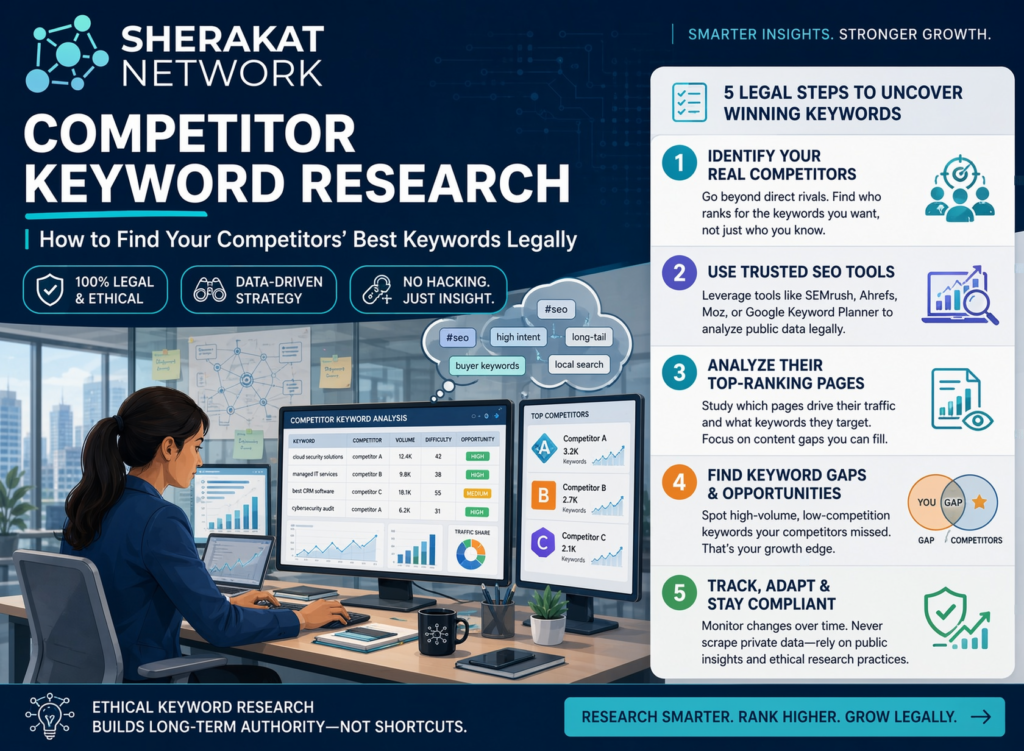
Competitor keyword research is the fastest path to understanding what works in your niche—and where the opportunities lie. The process is systematic, the data is public, and the tools are accessible.
Key Takeaways:
- Identify digital competitors (not just business competitors) by searching your target keywords
- Use free tools and extensions to pull competitor organic keyword data
- Filter aggressively for low-competition, relevant opportunities
- Run keyword gap analysis to find queries competitors rank for that you don’t
- Analyze why competitors rank—content quality, format, freshness, unique elements
- Prioritize striking distance keywords (position 11-20) for fastest wins
- Create something better, not just longer—quality and intent match matter
- Monitor monthly and iterate based on results
Your next step: Pick three digital competitors. Run a gap analysis. Find one keyword where they rank position 5-15 and you don’t rank at all. That’s your next content project.
Frequently Asked Questions (FAQs)
Q1: Is competitor keyword research legal?
A: Yes. You’re analyzing publicly visible ranking data, not accessing private analytics. SEO tools and browser extensions display this information legally .
Q2: What’s the difference between a business competitor and a digital competitor?
A: Business competitors sell similar products. Digital competitors rank for the same keywords in search results—they might be blogs, review sites, or publishers, not direct business rivals .
Q3: How do I find my digital competitors?
A: Search your primary keywords. Sites appearing on page one are your digital competitors. Tools like Moz True Competitor and Semrush can also identify them automatically .
Q4: What’s a keyword gap?
A: Keywords where competitors rank but you don’t. Gap analysis identifies these opportunities by comparing ranking data .
Q5: Can I do competitor keyword research for free?
A: Yes. Browser extensions like AutoTDK show competitor keywords . Google Search operators (site:) reveal competitor content . Open-source tools enable gap analysis .
Q6: What’s the best tool for competitor keyword research?
A: It depends on your budget. Ahrefs and Semrush are industry standards. Moz Keyword Gap 2.0 is excellent for gap analysis . Free options include Ubersuggest, browser extensions, and Search Console (for your own data).
Q7: Should I target every keyword my competitors rank for?
A: No. Prioritize by relevance to your business, keyword difficulty, search intent, and potential traffic. A competitor’s full keyword list includes many irrelevant queries .
Q8: How do I analyze why a competitor ranks?
A: Examine the ranking page: format, depth, freshness, unique elements, and gaps. Read critically and identify weaknesses you can improve on .
Q9: What’s the difference between keyword gap and content gap?
A: Keyword gap is specific queries competitors rank for that you don’t. Content gap is broader—topics competitors cover that you haven’t addressed .
Q10: How do I prioritize competitor keyword opportunities?
A: Focus on: low difficulty, clear intent, relevance to your business, and striking distance positions (11-20). Use Traffic Lift metrics if available .
Q11: What are paid competitor keywords?
A: Keywords competitors bid on in Google Ads. These reveal commercially valuable queries worth targeting organically .
Q12: How often should I do competitor keyword research?
A: Monthly for monitoring, quarterly for comprehensive analysis. Competitors publish new content and rankings shift .
Q13: Can I rank for keywords where competitors have position 1?
A: Possible but difficult. Focus on striking distance opportunities first (positions 5-20). If competitors are position 1-3 with comprehensive content, consider whether the ROI justifies the effort .
Q14: What’s Traffic Lift?
A: A metric estimating additional traffic from outranking a competitor for a specific keyword. Higher Traffic Lift = bigger opportunity .
Q15: How do I find competitor keywords with Google Search operators?
A: Use site:competitor.com "keyword topic" to find pages targeting specific topics. This reveals content gaps manually .
Q16: What if my competitors have much higher Domain Authority?
A: Target lower-difficulty keywords where DA matters less. Long-tail, specific queries often have weak competition regardless of competitor DA .
Q17: Should I copy competitor content structure?
A: No. Analyze structure to understand what searchers expect, but create original content. Copying headings, examples, or wording creates weak content .
Q18: How do I find low-competition competitor keywords?
A: Filter keyword lists by KD scores (under 30 for new sites). Prioritize long-tail queries with clear intent .
Q19: What’s keyword overlap?
A: The percentage of keywords shared between your site and a competitor. High overlap indicates competing for the same audience .
Q20: Can I do competitor research for local SEO?
A: Yes. Analyze local competitors’ rankings for location-specific queries. Focus on “[service] in [city]” and “[service] near me” keywords .
Q21: What’s the best free competitor keyword tool?
A: AutoTDK (Chrome extension) for quick analysis . Ubersuggest for limited free data. Google Search operators for manual research.
Q22: How do I turn competitor keywords into content?
A: Group by intent, assign to pages (new or existing), and create content that’s better than what currently ranks—more comprehensive, updated, or uniquely valuable .
Q23: Should I analyze competitor backlinks too?
A: Yes, for competitive intelligence. Backlinks reveal what content attracts links and which sites are authoritative in your niche.
Q24: What’s the difference between organic and paid competitor keywords?
A: Organic keywords are queries competitors rank for naturally. Paid keywords are queries they bid on in ads. Both reveal valuable opportunities .
Q25: How do I track my rankings against competitors?
A: Use rank tracking tools (Moz, Semrush, SEO PowerSuite) to monitor keyword positions for your site and competitors .
Q26: What if competitors don’t exist in my niche?
A: Analyze aspirational competitors—sites where you’d like to be in two years. Or analyze adjacent niches for keyword inspiration .
Q27: Can AI tools help with competitor keyword research?
A: Yes. Semrush MCP connects AI assistants to live competitor data . ChatGPT can help analyze competitor content and identify gaps.
Q28: How do I avoid keyword cannibalization when targeting competitor keywords?
A: Check your existing content first. If you have a page targeting similar intent, optimize it instead of creating a new page .
Q29: What’s a content map?
A: A spreadsheet mapping keywords to specific pages and actions (create, optimize, skip). Prevents opportunities from being lost in exports .
Q30: What’s the one thing I should do differently after reading this guide?
A: Run a gap analysis with three digital competitors. Find one keyword where they rank position 5-15 and you have no content. Write that article this month.
About Author
Sanaullah khan Kakar, Content and Article Writer Specialist
This guide was written based on hands-on experience conducting competitor keyword research for sites across multiple niches since 2015, including local businesses, B2B SaaS companies, and content publishers. The strategies outlined here have been tested across hundreds of competitive analyses.
Free Resources

Competitor Keyword Research Tools:
- AutoTDK (Chrome extension) — free competitor analysis
- Ubersuggest — limited free competitor data
- Google Search operators — manual competitor research
- SerpX SEO Tools — open-source gap analysis
- Apify Ranked Keywords Checker — pay-per-keyword pricing
Recommended Reading on Sherakat Network:
External Resources:
Discussion
What’s your experience with competitor keyword research? Have you found valuable opportunities by analyzing what competitors rank for? Share your insights in the comments below.
If you found this guide helpful, consider sharing it with someone who’s struggling to find keywords worth targeting. The strategies here work—but only if you actually run the analysis.
Have questions? Reach out via our contact page.