

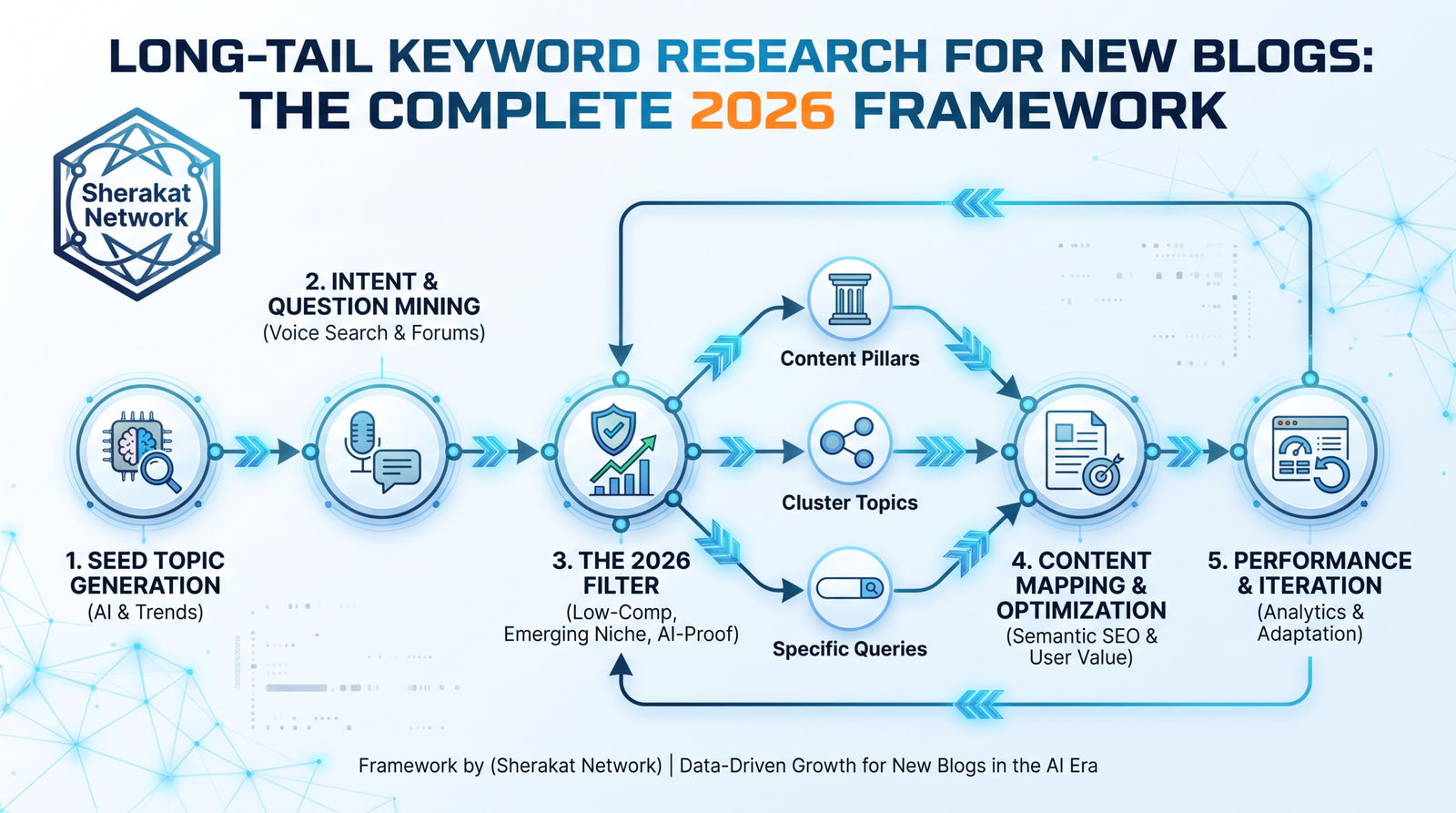

Introduction: Why This Matters
In my experience, the fastest way to kill a new blog is to compete for keywords you cannot possibly win.
I’ve watched aspiring bloggers spend weeks crafting a 3,000-word “ultimate guide” targeting something like “how to start a blog” or “best coffee makers”—keywords dominated by sites with millions of backlinks and decade-old domain authority. They publish. They wait. Nothing happens. Two months later, they’ve written four more articles targeting equally impossible terms, and they’re ready to quit.
What I’ve found is that blogging works beautifully—but only when you understand the physics of search rankings. New sites don’t have authority. They don’t have backlinks. They don’t have brand recognition. What they do have is the ability to be specific.
Long-tail keywords are the great equalizer in SEO. They’re the specific, conversational, problem-focused queries that big sites often overlook because the volume looks unimpressive on a spreadsheet. But here’s what most beginners miss: a keyword with 300 monthly searches that you rank number one for beats a keyword with 30,000 searches where you languish on page seven. Every single time.
This guide exists because long-tail keyword research has become simultaneously more important and more misunderstood in 2026. The search landscape has shifted dramatically. Head terms are declining. Long-tail queries are growing. AI Overviews are eating clicks. But for new bloggers who understand the framework, there has never been a better opportunity to build an audience from scratch.
By the end of this guide, you will have a repeatable system for finding long-tail keywords that new blogs can actually rank for—and you will understand why the system works, not just how to execute it. If you are building a business around your content, the strategic context in our complete online business guide will help you see how SEO fits into the bigger picture.
Background / Context: The Structural Shift Toward Specificity
To understand why long-tail keywords matter more than ever, you need to understand what has happened to search over the past two years.
In 2024, if you asked most SEO professionals about keyword strategy, they would tell you to find a balance: target some high-volume head terms for authority, some long-tail for quick wins. That advice made sense in a world where Google returned ten blue links and users refined their queries through trial and error.
In 2026, that advice is obsolete.
The data tells a striking story. Analysis of 1.35 million keywords across nine categories found that head terms (one to three words) are declining at rates of -5% to -16% year-over-year, while long-tail terms (four or more words) are growing at rates up to +62% in some categories. Entertainment is the most dramatic example: head terms fell 16% while long-tail grew 62.1%. Home improvement and pet care showed similar patterns at smaller scales.
Why is this happening? Google’s own product lead explained the shift on a podcast interview. Users have always wanted to express longer, more natural queries—but they were forced to translate their needs into keyword-speak because that’s what search engines understood. Someone wanting a restaurant for a party of five with vegan options and kids in tow would type “restaurants New York” and hope for the best.
AI Mode and AI Overviews changed that. Users now tell the search engine their actual problem—”I need a restaurant in Manhattan for 5 people, my sister is vegan, and I have two kids under 10″—and expect Google to do the translation. The result is keyword fragmentation: one complex need becomes many specific sub-queries that Google fans out and searches individually.
What this means for new blogs: The queries that matter most are increasingly the ones that were previously invisible. Google’s Keyword Planner rounds small volumes to zero. Search Console strips queries used by small numbers of people for privacy reasons. The granular, specific, conversational queries that represent real user needs are exactly the ones that are hardest to see in traditional tools—and exactly the ones new blogs can win.
One SEO practitioner analyzed 25 UK e-commerce stores and found something counterintuitive: measurable search volume fell across all query lengths, but the decline was steepest for broad terms (two-word queries down 9.6%) and gentlest for specific terms (five-plus word queries down only 3.0%). His conclusion: “The long tail is growing and we simply can’t see it.”
The implication for new bloggers is clear. Stop looking for keywords a tool tells you to target. Start looking for the questions real people are asking—the ones that don’t show up in volume metrics because they’re too specific, too new, or too conversational for the tools to measure properly.
This mirrors broader shifts in how information systems adapt. The global supply chain evolved from broad logistics to granular, real-time optimization. AI and machine learning systems moved from general models to specialized applications. Search is following the same pattern: from broad to specific, from generic to personalized.
Key Concepts Defined
Before we get into the framework, let’s establish shared language. These definitions matter because misunderstanding them is the most common reason new bloggers waste months on the wrong keywords.
Long-Tail Keyword: A search phrase containing four or more words that targets a specific, often conversational query. Examples: “how to clean a coffee maker without vinegar,” “best budget laptop for nursing students,” “why is my sourdough bread dense and heavy.” Long-tail keywords are defined by their specificity, not just their length—though length is usually a reliable indicator.
Head Term (Short-Tail Keyword): The opposite of long-tail. Short, broad, high-volume keywords like “coffee maker,” “SEO,” or “running shoes.” These are typically dominated by major brands, established publications, and sites with significant authority. New blogs should avoid these until they have built substantial authority.
Search Intent: The underlying goal behind a search query. There are four types:
- Informational: The user wants to learn something (“how to fix a leaky faucet”)
- Commercial: The user is comparing options (“best dishwasher under $500”)
- Transactional: The user is ready to act (“buy dishwasher filters online”)
- Navigational: The user wants to find a specific site (“Home Depot dishwasher section”)
Matching your content format to search intent is non-negotiable. A tutorial won’t rank for a “best products” query, no matter how well-written it is.
Keyword Difficulty (KD): A metric (usually 0-100) estimating how hard it would be to rank for a keyword. Tools calculate this differently, so treat it as directional. For new blogs, target keywords with KD scores under 30—ideally under 20.
KGR (Keyword Golden Ratio): A metric developed by SEO Doug Cunnington that divides the number of search results containing the exact keyword (in quotes) by the monthly search volume. KGR scores under 0.25 indicate excellent opportunities for new sites—keywords with enough volume to matter but few enough exact-match results that a new site can rank.
People Also Ask (PAA): The expandable question boxes Google displays in search results. These represent real user queries Google associates with your topic—often low competition, high intent, and perfectly suited for FAQ sections or dedicated content.
Keyword Cluster: A group of related keywords that share search intent and can be targeted by a single piece of content. Instead of writing one article per keyword, you create comprehensive content that ranks for the entire cluster.
Topic Authority: Google’s assessment of whether your site is a legitimate resource on a given subject. Built through publishing comprehensive, interconnected content on related topics. Topic authority is more important than ever because it influences both traditional rankings and AI Overview citations.
Atomic Answer: A self-contained 40-60 word response block placed immediately after a question-phrased heading. Designed for AI extraction and citation—an increasingly important format for long-tail content.
How It Works: The Step-by-Step Framework
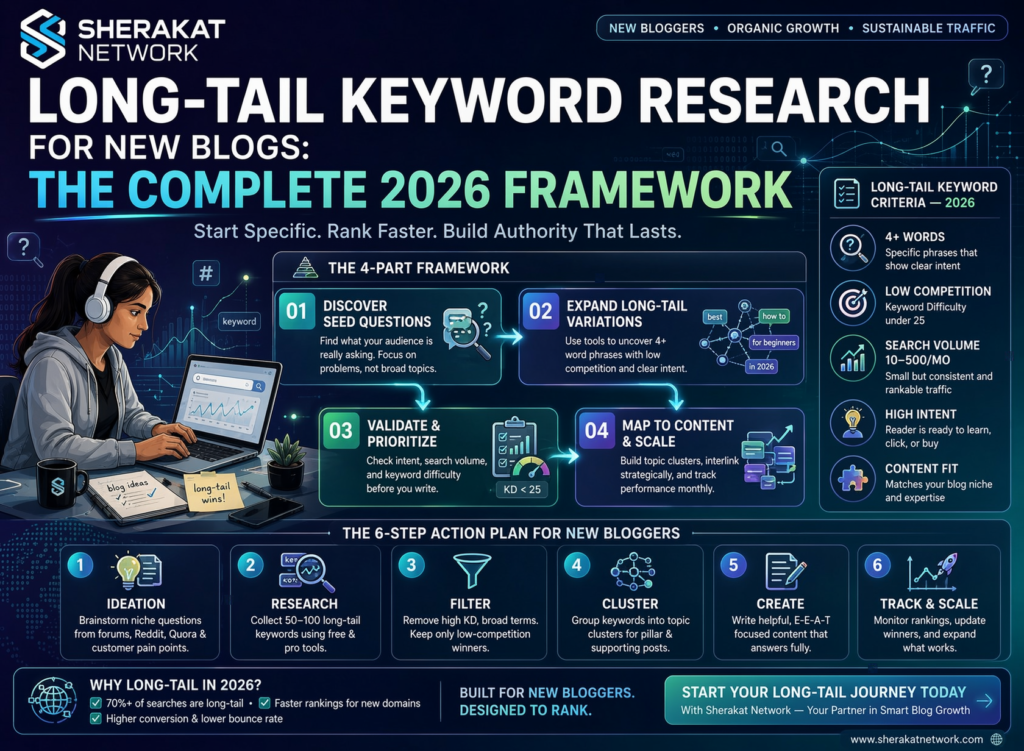
This is the core of the guide. Follow these steps in order. Each builds on the previous one.
Step 1: Start with Search Console (Even If You Have Almost No Traffic)
If you have been blogging for even a few weeks, Google Search Console is the single most valuable keyword research tool you have access to—and most new bloggers ignore it.
Here’s why: Search Console shows you the actual queries people used to find your site, including the specific, long-tail phrases you would never think to target. It also shows you queries where you are ranking position 8-20—the “striking distance” keywords where a content optimization push could get you to page one.
How to use it:
- Log into Google Search Console
- Navigate to Performance > Search Results
- Enable the “Average Position” metric
- Filter for queries with:
- High impressions (meaning people are seeing your site)
- Average position between 8 and 20
- Intent that matches your content
These are your quick wins. You are already visible. You just need to push a little harder.
The regex trick: Use regular expressions to find question-based queries. Filter for “what,” “how,” “why,” “when,” “which,” and “can” to surface the informational long-tail queries that are perfect for FAQ sections or dedicated articles.
What I’ve found: For new blogs, Search Console often reveals that you are ranking for queries you did not even target—because Google understood the semantic meaning of your content and matched it to user needs. These “accidental rankings” are clues about what your site can realistically own. For a complete guide to GSC keyword research, see our dedicated Search Console guide.
Step 2: Mine Google Autocomplete (The Free Goldmine)
Google’s autocomplete feature is the most underrated keyword research tool in existence. It is free, it is real-time, and it reflects what actual humans are typing into the search bar.
The manual method (most revealing):
- Type your seed keyword into Google
- Watch the suggestions appear
- Add each letter of the alphabet after your seed (seed + “a”, seed + “b”, etc.)
- Record every suggestion
This is tedious. It is also the most reliable way to find queries that tools miss—because the suggestions come directly from Google’s understanding of what users search.
The tool-assisted method:
Several free tools automate autocomplete mining:
- AnswerThePublic: Visualizes questions, prepositions, and comparisons around your seed term
- Answer Socrates: Provides question clusters organized by intent
- Keyword Tool.io: Scrapes Google Autocomplete for long-tail variations, with dedicated tabs for YouTube, Amazon, and Instagram
- Apify’s Long Tail Keyword Generator: Fans out across Google, YouTube, and Bing autocomplete, with options for question expansion, intent suffixes, and People Also Ask integration
Why this works for new blogs: Autocomplete reveals queries that are specific enough to be winnable. “Coffee maker” is impossible. “Coffee maker that doesn’t wake up my roommate” is a query where the competition is likely thin, the intent is clear, and the content virtually writes itself.
Step 3: Harvest People Also Ask (PAA) Questions
The PAA box is Google’s way of saying, “Here are related questions people ask about this topic.” It is a keyword research gift.
How to harvest PAA:
- Search your seed keyword
- Find the “People also ask” section
- Click each question to expand it—Google generates two to three more related questions each time
- Record every question
Why PAA matters: These are real queries Google has identified as related to your topic. They are often long-tail, informational, and low-competition. They are also perfect for FAQ sections, which can help your content get cited in AI Overviews.
The workflow: Each PAA question can become:
- A dedicated article (if the question has enough depth)
- A section within a comprehensive article
- An FAQ entry at the bottom of your post
- A schema markup element to help Google understand your content
Pro tip: Apify’s Long Tail Keyword Generator can automatically pull PAA questions along with autocomplete data, cluster duplicates, and even export paste-ready FAQ schema. This saves hours of manual work.
Step 4: Validate with the Keyword Golden Ratio (KGR)
The KGR is the best free metric for identifying keywords new blogs can actually rank for.
The formula:
KGR = (Number of exact-match search results) ÷ (Monthly search volume)
How to calculate:
- Search your keyword in quotes: “your target keyword”
- Note the number of results Google returns
- Find the monthly search volume (from Keyword Planner, Keyword Surfer, or another tool)
- Divide results by volume
Interpreting KGR scores:
- Under 0.25: Excellent. Very few exact-match results relative to search volume. High probability of ranking.
- 0.25 to 1.0: Good. Reasonable competition relative to volume.
- Over 1.0: Difficult. Too many exact-match results for a new site to compete.
Why exact-match matters: When you search a phrase in quotes, Google returns only pages containing that exact phrase. This is a rough proxy for how many sites have specifically targeted that keyword. If few have, and volume is decent, you have found an opportunity.
Example calculation: A keyword returns 50 exact-match results with 400 monthly searches. KGR = 50 ÷ 400 = 0.125. That is an excellent opportunity. You need few exact-match results and decent volume.
The insight: KGR is not perfect, but it is free, fast, and specifically designed for new sites. It is a screening tool, not a final verdict—always verify by examining the actual search results.
Step 5: Analyze the SERP for Weakness
Before committing to any keyword, Google it and analyze the first page. This is where most beginners skip a critical step.
Questions to answer:
Who is ranking?
- If positions 1-10 are Reddit threads, Quora answers, forum posts, or small blogs: green light.
- If they are Forbes, Wikipedia, Amazon, and major publications: walk away.
What format dominates?
- Are results listicles? Tutorials? Comparisons? Product pages?
- Match the format. If Google shows listicles, write a listicle.
What is missing?
- Read the top three results. Do they skip subtopics? Use outdated data? Have poor formatting?
- That is your angle.
Does an AI Overview appear?
- Over half of Google searches now end without a click, and AI Overviews appear on a significant share of searches.
- Long-tail queries (eight or more words) are seven times more likely to trigger an AI Overview.
- If an AIO appears, your goal shifts: get cited as a source, not just ranked. For a complete strategy on AI search visibility, see our AI keyword research guide.
The weakness test: If you look at the first page and think, “I could write something meaningfully better than this,” you have found a keyword worth targeting. If you think, “These results are excellent and comprehensive,” move on.
Step 6: Cluster Keywords by Intent
Do not write one article per keyword. Group related keywords into clusters that share intent.
Example cluster:
- Primary keyword: how to make cold brew coffee at home
- Supporting keywords:
- cold brew coffee ratio
- how long to steep cold brew
- cold brew vs iced coffee
- best coffee beans for cold brew
- cold brew coffee without a filter
One comprehensive article can rank for all of these. You create topic authority rather than thin content competing with itself.
Clustering rule: If a reader searching Keyword A would be satisfied by the same content that satisfies Keyword B, they belong in the same cluster.
Mapping to content:
- Primary keyword → H1 and main content
- Supporting keywords → H2s, H3s, and FAQ sections
- Question keywords → FAQ entries with schema markup
Step 7: Structure Content for Both Traditional and AI Search
Long-tail content now needs to serve two masters: traditional search rankings and AI citation. The good news is that the same structure works for both.
Question-phrased headings. Instead of “Overview of Cold Brew Ratios,” write “What Is the Best Cold Brew Coffee Ratio?” This matches how people search and how AI generates sub-queries.
Atomic Answers at the start of sections. Write a self-contained 40-60 word answer immediately after each heading. This gives AI a ready-to-cite block and gives human readers a quick answer before diving deeper.
Short paragraphs. Keep paragraphs to two to four sentences. Long blocks of text burn the AI’s context budget and get dropped before reasoning even begins.
Data-rich tables and comparisons. AI engines and human readers both love structured data. Include comparison tables, pros and cons lists, and specification breakdowns.
Real examples and case studies. Specificity signals expertise. “A client increased traffic 40% in three months” is more citable than “businesses can benefit from SEO.”
Step 8: Prioritize by Opportunity Score
You will likely end up with dozens of potential keywords. Here is how to prioritize:
High priority:
- KGR under 0.25
- Clear search intent
- Weak SERP competition (forums, outdated content, thin pages)
- Relevance to your site’s topic
- You can create genuinely better content
Medium priority:
- KGR 0.25-1.0
- Decent intent match
- Moderate competition
- Good volume potential
Low priority:
- KGR over 1.0
- Unclear intent
- Strong competition
- Tangential to your topic
The compounding effect: Every low-competition keyword you rank for strengthens your site’s topical authority. Start with the easiest wins. Build momentum. Then gradually pursue more competitive terms as your authority grows.
Step 9: Track, Iterate, and Update
Long-tail keyword research is not a one-time project. It is an ongoing process.
Weekly tracking:
- Check Search Console for new queries generating impressions
- Monitor striking distance keywords for position improvements
- Track CTR changes after title and description optimizations
Monthly review:
- Run a fresh gap analysis to catch new opportunities
- Update content that has declined in rankings
- Add new sections to existing articles as new PAA questions emerge
Quarterly strategy:
- Reassess your keyword clusters
- Identify topics you have built authority on and expand into adjacent areas
- Evaluate AI citation frequency for your top pages
The iteration mindset: Google rewards iteration, not volume. Updating what already works often outperforms publishing new content blindly. When you see a query start to climb, lean into it. Add more content around that topic. Build internal links to the page. Give Google more reasons to trust your relevance. For more resources on building sustainable SEO practices, explore our resources section.
Why It’s Important
Long-tail keyword research is not just “a good strategy”—it is the only strategy that works reliably for new blogs.
The math is brutal. A study of 1,000 long-tail queries found that only 0.49% of page-one display titles contained the full query as an exact match. But the semantic similarity was much higher—average cosine similarity of 0.76. Google understands meaning, not just keywords. This means you do not need to stuff exact phrases; you need to comprehensively answer the underlying question.
The competition reality. For a broad term like “running shoes,” Google returns 808 million results. For “soft running shoes for concrete roads Australia,” that drops to 1.16 million. And 96.55% of content on Google gets no traffic at all. The odds of making an impact are dramatically better when you are specific.
The conversion advantage. Users searching long-tail queries often know exactly what they want. They are further down the buying journey. They are comparing options, troubleshooting problems, or seeking specific solutions. This means:
- Higher conversion rates
- Lower customer acquisition costs
- More qualified traffic
- Better engagement metrics
The authority effect. Ranking for long-tail keywords builds topical authority. Google sees your site as a legitimate resource on the subject. This makes ranking for the next keyword easier—and the next one after that. Over 12-18 months, this accumulation of small wins creates a site that can eventually compete for moderate-difficulty terms.
What happens if you ignore this: You write ten articles targeting competitive keywords. None rank. Six months pass. You have no traffic, no conversions, no momentum. The psychological impact is brutal—most new bloggers quit at this stage, convinced SEO is rigged against them. It is not. They just targeted the wrong keywords. For more on building a sustainable business around content, see our guide to business partnerships.
Sustainability in the Future
Long-tail keyword research is not a static skill. What works in 2026 will need adaptation by 2028. Here is what to watch:
AI Overviews will continue expanding. Over half of searches now end without a click. Research suggests organic traffic could drop 18-64% for content-heavy sites. But there is a silver lining: getting cited in an AI Overview might be the new first-page ranking. By the time someone clicks through to your site, they have already evaluated the competition and chosen you.
Long-tail queries will keep growing. Entertainment search data shows head terms declining 16% while long-tail grows 62% year-over-year. As users become comfortable with conversational AI search, this trend accelerates. The queries that matter will be increasingly specific, conversational, and problem-focused.
Zero-volume keyword tracking will become standard. If you are only targeting keywords a tool assigns volume to, you are competing with everyone else using the same tools. The best opportunities hide in queries too new, too niche, or too conversational for traditional volume estimates.
Brand and entity signals will matter more. Google’s systems understand topics, not just phrases. Building topical authority around entities—your brand, key concepts, related people and places—will outperform keyword-focused optimization.
The sustainable approach: Build content around solving real problems, not chasing keyword data. Use keywords as validation that a problem exists, not as the sole driver of your content calendar. The bloggers who thrive in 2027 and beyond will be those who listen to their audience’s actual questions and answer them comprehensively. This principle applies across disciplines—from mental health to climate policy to culture and society—specific, human-centered approaches consistently outperform generic ones.
Common Misconceptions
Misconception 1: “Long-tail keywords have low volume, so they are not worth targeting.” A keyword with 300 monthly searches that converts at 10% is worth more than a keyword with 30,000 searches that converts at 0.1%. Volume matters, but intent and conversion potential matter more.
Misconception 2: “I need to use the exact keyword phrase throughout my content.” Analysis of 1,000 long-tail queries found that only 0.49% of ranking titles contained the exact query. Google understands semantic meaning. Write naturally. Cover the topic comprehensively. The exact-match days are over.
Misconception 3: “Long-tail keywords are always low competition.” Not true. Some long-tail terms are targeted by everyone because they are obviously valuable. Competition depends on who is actually ranking, not keyword length.
Misconception 4: “I should target zero-volume keywords because they are easy.” Zero-volume keywords can convert well because they are highly specific. But the time investment is the same as targeting a keyword with volume. Prioritize zero-volume terms when they have strategic value—brand building, internal linking, covering a topic gap.
Misconception 5: “Once I rank, I am done.” Rankings decay. Competitors improve. Search intent shifts. Content requires updates. The sites that sustain rankings treat content as a living asset, not a one-time project.
Misconception 6: “I need expensive tools to find good long-tail keywords.” Google Search Console, Autocomplete, People Also Ask, and the KGR method are all free. They require more manual effort but reveal opportunities paid tools often miss.
Misconception 7: “Long-tail SEO is separate from AI search optimization.” The same content structure—question headings, Atomic Answers, short paragraphs, structured data—serves both traditional rankings and AI citation. Long-tail keywords are actually better suited for AI search because they are more specific and easier to satisfy comprehensively.
Recent Developments
Three developments in 2025-2026 have reshaped how long-tail keyword research works:
1. Google confirmed keyword fragmentation as a structural shift. Google’s product lead explained that AI Mode and AI Overviews enable users to express their actual needs rather than translating them into keyword-speak. One complex question becomes many specific sub-queries that Google fans out and searches individually. This means the old head-term strategies are losing effectiveness while specific, problem-focused queries grow.
2. Long-tail queries are now the highest-exposure zone for AI Overviews. Across nine categories, volume-weighted long-tail AIO rates range from 23.4% to 58.5%. Being ranked position one for a long-tail query no longer guarantees meaningful traffic if an AIO sits above you. Optimizing for AIO citation—through specificity, demonstrable expertise, and factual precision—is now a parallel objective to ranking.
3. The long tail is growing even when we cannot see it. One analysis of 25 UK stores found that measurable search volume fell across all query lengths, but specific queries declined much less than broad ones. The analyst concluded that the long tail is likely growing but is invisible to traditional measurement tools because Google rounds small volumes to zero and strips query data for privacy. This means the best opportunities are often hidden in plain sight—in real conversations with customers, in forum questions, in the exact language your audience uses.
4. Prompt research emerged as a complement to keyword research. Tools like SISTRIX Prompt Research cluster millions of real user prompts into topics, revealing intent clusters that keyword tools miss. For long-tail research, this provides a new layer: not just what people search, but how they phrase their needs conversationally.
Success Stories
Case Study: The Sourdough Troubleshooting Blog
A client came to me with a sourdough baking blog that was six months old and getting zero organic traffic. They had published 40 recipes targeting keywords like “sourdough bread recipe” and “how to make sourdough starter.” Every post was buried on page 5-10.
What we changed: We stopped targeting recipe keywords and started targeting problem keywords.
- “Why is my sourdough bread dense and gummy”
- “Sourdough not rising in cold kitchen”
- “Sourdough starter smells like acetone”
- “How to fix overproofed sourdough”
- “Sourdough bread too sour how to fix”
These keywords had volumes ranging from 150-2,400 monthly searches. Competition was weak—mostly old forum posts and thin content. We wrote comprehensive troubleshooting guides with photos and videos.
Results after six months:
- 14 of 16 articles ranked page one
- Organic traffic grew from approximately 30 per month to 8,400 per month
- Email signups increased from 12 to 1,200
- A digital sourdough troubleshooting ebook sold 340 copies
The key insight: Nobody searches “sourdough bread recipe” looking for troubleshooting help. But someone whose bread just came out dense and gummy searches exactly that—and they are highly motivated to find an answer.
Case Study: The Freelance Writing Niche Blog
A freelance writer started a blog about freelance writing. She was targeting “how to become a freelance writer” and “freelance writing tips”—keywords dominated by major career sites and established writing blogs.
We shifted focus to ultra-specific problem keywords:
- “How to write a cold email to a potential freelance client”
- “Freelance writing contract template for beginners”
- “What to do when a freelance client doesn’t pay”
- “How to set freelance writing rates for beginners”
- “Freelance writing portfolio examples that got clients”
Results after eight months:
- 11 articles ranked position 1-3
- Organic traffic: 220 per month to 6,800 per month
- Newsletter grew from 45 to 2,100 subscribers
- Two retainer clients found her through the blog
The key insight: Specificity wins. “How to become a freelance writer” is too broad and competitive. “How to write a cold email to a potential freelance client” is a query with clear intent, weak competition, and a reader who needs exactly what you are offering.
Case Study: The Recipe Blog’s Troubleshooting Queries
A recipe blog with almost no traffic checked Google Search Console impressions and found queries like “why is my cake dry,” “cake sunk in middle,” and “how to fix runny frosting.” They had written recipe posts, not troubleshooting guides. But Google was showing their content for these problem queries anyway. They wrote dedicated troubleshooting articles targeting these exact queries. Within six weeks, three of those articles ranked page one—not because the blog had authority, but because the queries matched content Google already associated with the site. For more on using GSC for this kind of research, see our Search Console guide.
Case Study: The B2B SaaS Blog’s Query Fan-Out Audit
A project management SaaS analyzed its content against query fan-out patterns for its target topics. They found competitors appeared in AI answers for dozens of sub-queries their content did not cover—”managing remote team time zones,” “async standup alternatives,” “tracking productivity without surveillance.”
They audited existing content against the fan-out map and found 60% coverage gaps. Instead of publishing new articles, they consolidated and expanded existing pages to cover the missing sub-queries. Within three months, AI citation frequency for their domain increased 40%.
The key insight: Consolidation beat new production. The gaps were in existing content, not missing pages. This approach connects to broader patterns in how businesses optimize operations—principles you can explore in our online business guide.
Real-Life Examples
Example 1: The “Why Is My [Thing] Broken” Pattern
Search “why is my dishwasher not draining” and examine the results. In many niches, the first page contains outdated forum posts, thin YouTube video descriptions, and generic appliance repair sites. A comprehensive troubleshooting guide with real photos, diagnostic steps, and video demonstrations can rank within weeks.
Example 2: The “Best [Product] for [Specific Use Case]” Opportunity
Search “best laptop for nursing students” or “best coffee maker for small office.” These queries have lower volume than “best laptop” or “best coffee maker,” but the intent is crystal clear and the competition is often weak. A well-researched buying guide targeting the specific use case can rank faster and convert better than a broad review.
Example 3: The Local Plus Specific Query
“Dentist for nervous patients in [city]” or “tax preparer for freelancers in [city]”—these queries have low competition in most markets, high commercial value, and clear conversion paths. A single well-optimized page can drive consistent leads for years.
Example 4: The Entity-Based Gap
A B2B company analyzed their content against query fan-out patterns for their target topics. Using citation analysis tools, they found competitors appeared in AI answers for dozens of sub-queries their content did not cover—”managing remote team time zones,” “async standup alternatives,” “tracking productivity without surveillance.” They consolidated and expanded existing pages to cover the missing sub-queries. Within three months, AI citation frequency for their domain increased 40%.
Example 5: The Prompt Cluster Discovery
A solar installation company used prompt research to discover 117 distinct topics within their niche—far more than their keyword tools had revealed. Topics included “solar panel efficiency in cloudy climates,” “battery storage for winter,” and “permit requirements for historic homes.” Each topic represented a content opportunity their competitors had not addressed. They built content around the top 20 topics and saw citation frequency increase threefold within six months.
These examples connect to broader patterns in how information systems evolve. The global supply chain provides a useful parallel: just as supply chains evolved to handle complexity through modularization and real-time data, content strategy is evolving to handle AI retrieval through chunk-level optimization and entity clarity. Even the mental health field has seen how frameworks must adapt to changing conditions—a lesson that applies directly to SEO.
Conclusion and Key Takeaways
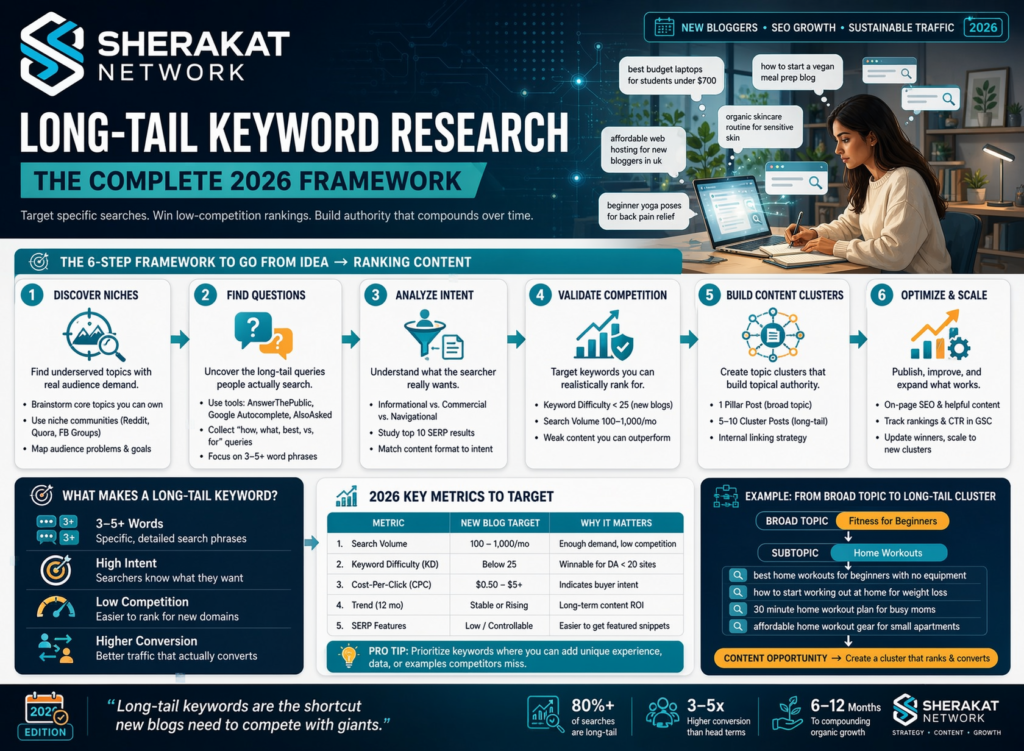
Long-tail keyword research is not about finding secret keywords or gaming the system. It is about understanding a fundamental truth about search: specificity wins.
Key Takeaways:
- Head terms are declining while long-tail queries grow—this is a structural shift, not a temporary trend
- Google Search Console reveals queries you already rank for, including “striking distance” keywords at positions 8-20
- Autocomplete and People Also Ask are free goldmines for long-tail discovery
- The Keyword Golden Ratio (KGR) identifies keywords new sites can actually rank for
- Only 0.49% of ranking titles contain the exact query—Google understands semantics, so write naturally
- Match content format to search intent—a tutorial will not rank for “best products” queries
- Cluster related keywords into comprehensive content rather than thin single-keyword pages
- Structure content for both traditional and AI search: question headings, Atomic Answers, short paragraphs
- AI Overviews change which keywords drive clicks—target queries requiring personalization, recent data, or action
- The compounding effect of small wins beats swinging for home runs
Your next step: Open Google Search Console. Look for queries where you rank position 8-20. Find one with clear intent and weak competition. Optimize that content. Then do it again.
That is how this works—one specific, winnable keyword at a time. For more strategic guidance, explore our complete online business guide and our full SEO resource library.
Frequently Asked Questions (FAQs)
Q1: What exactly counts as a “long-tail” keyword?
A: Long-tail keywords typically contain four or more words and target specific, often conversational queries. But the definition is about specificity, not just length. “How to fix a leaky faucet” (five words) is long-tail. “Faucet repair” (two words) is not.
Q2: How many monthly searches should a long-tail keyword have to be worth targeting?
A: For new blogs, 100-500 monthly searches is often sufficient—especially if the keyword has clear commercial intent or solves a specific problem. A keyword with 200 searches that you rank number one for beats a keyword with 20,000 searches where you rank 47th.
Q3: Can I find good long-tail keywords without paying for Ahrefs or Semrush?
A: Absolutely. Google Search Console, Autocomplete, People Also Ask, and the KGR method are all free. They require more manual effort but reveal opportunities paid tools often miss.
Q4: What is the Keyword Golden Ratio (KGR), and how do I use it?
A: KGR = (exact-match search results) ÷ (monthly search volume). Search your keyword in quotes, note the result count, divide by volume. KGR under 0.25 indicates excellent opportunities for new sites.
Q5: How do I know if a keyword triggers an AI Overview?
A: Just search it. If a generated summary appears above traditional results, that keyword triggers an AI Overview. Long-tail queries (eight or more words) are seven times more likely to trigger an AIO. You can still target these keywords, but set realistic click-through expectations and focus on getting cited as a source.
Q6: What is search intent, and why does it matter?
A: Search intent is the underlying goal behind a query. Informational intent seeks knowledge; commercial intent compares options; transactional intent wants to buy. Matching your content format to intent is essential—a tutorial will not rank for a “best products” query.
Q7: How many keywords should I target per article?
A: One primary keyword and three to ten supporting keywords. This is keyword clustering—it builds topical authority rather than creating competing pages.
Q8: Should I target zero-volume keywords?
A: Sometimes. Zero-volume keywords can convert well because they are highly specific. But the time investment is the same as targeting a keyword with volume. Prioritize zero-volume terms when they have strategic value.
Q9: How often should I update my long-tail keyword research?
A: Review your keyword strategy quarterly. Search behavior shifts, competitors emerge, and AI Overviews expand to new query types. What worked six months ago may need adjustment.
Q10: What is the biggest mistake new bloggers make in keyword research?
A: Targeting keywords based on what they personally find interesting, without validating that others search for those terms or that the competition is manageable. Passion matters, but demand matters more.
Q11: How do I find keywords my competitors are ranking for?
A: Use tools like AutoTDK, Ubersuggest (free tier), SEO PowerSuite’s Rank Tracker, or paid alternatives like Ahrefs and Semrush. You can also manually examine competitor sitemaps and blog archives. For a complete guide, see our competitor keyword research article.
Q12: Can I rank for competitive keywords with a new site?
A: Realistically, no—not quickly. New sites lack domain authority, backlinks, and brand signals. Target long-tail keywords first to build authority, then gradually pursue more competitive terms as your site strengthens.
Q13: How long does it take to rank for long-tail keywords?
A: Often 4-12 weeks for new content on a site with some existing authority. Brand-new sites may take 3-6 months. Low competition reduces the time required, but indexing and evaluation still take time.
Q14: What are seed keywords, and how do I find them?
A: Seed keywords are broad topics that define your niche—not search phrases yet, but themes. Identify them by asking: “What does my audience care about?” Then expand each seed into actual keywords using tools.
Q15: Is keyword density still a ranking factor?
A: No. Keyword stuffing performs below unoptimized content. Modern SEO rewards semantic coverage, natural language, and answering user questions completely—not repeating a phrase a certain number of times.
Q16: How do I research keywords for a local business blog?
A: Include location modifiers (“[service] in [city]”), target “near me” queries, and focus on specific pain points that local customers have.
Q17: What is a keyword gap analysis?
A: Comparing your site’s rankings against competitors to find keywords they rank for that you do not. These gaps reveal content opportunities you might have missed.
Q18: Should I use ChatGPT for long-tail keyword research?
A: ChatGPT is useful for brainstorming seed topics and content angles, but it lacks real-time search volume and competition data. Use it for ideation, then validate with actual keyword tools.
Q19: How do I know when to give up on a keyword?
A: If you have published strong content, waited 3-6 months, built some backlinks, and you are still not ranking page 1-2, the keyword may be more competitive than initial analysis suggested. Move on.
Q20: What is the relationship between backlinks and long-tail keyword targeting?
A: Long-tail keywords often require few or no backlinks to rank—content quality and intent match can be enough. Competitive keywords require backlinks as a prerequisite. This is another reason to start with long-tail terms.
Q21: Can one article rank for multiple long-tail keywords?
A: Yes, and it should. A comprehensive article naturally covers related queries. Google understands semantic relationships and will rank one page for multiple phrases if it satisfies the intent behind them.
Q22: How do I find “question” keywords?
A: Use People Also Ask, AnswerThePublic, Answer Socrates, and search your seed plus “how,” “what,” “why,” “when,” “which,” and “can.” Question queries are often informational, low competition, and highly targetable.
Q23: What is the difference between Google Keyword Planner and a dedicated SEO tool?
A: Keyword Planner is built for ads—it shows volume ranges and CPC data useful for PPC. Dedicated SEO tools show difficulty scores, related keywords, and competitor data more suited to organic strategy.
Q24: How do I prioritize which long-tail keywords to target first?
A: Rank by: (1) KGR under 0.25, (2) Clear search intent, (3) Weak SERP competition, (4) Relevance to your site, (5) Your ability to create genuinely better content. Start with the easiest wins.
Q25: What role does content length play in ranking for long-tail keywords?
A: Length matters less than completeness. A 1,200-word article that fully answers a question beats a 3,000-word article that rambles. Match depth to the query—do not pad for the sake of word count.
Q26: How do I handle seasonal long-tail keywords?
A: Plan ahead. Publish and optimize seasonal content 2-3 months before peak season so Google has time to index and evaluate it. Update annually to maintain freshness.
Q27: What are “People Also Ask” keywords, and why are they valuable?
A: PAA questions are queries Google associates with your topic. They represent real user questions, often low competition, and provide clear content structure guidance. Answer them within your article or in dedicated sections.
Q28: Can I do long-tail keyword research for YouTube or social media?
A: Yes. YouTube has its own search behavior—target video-specific queries. TikTok’s Creator Search Insights tool shows trending searches. Each platform has unique keyword patterns worth researching separately.
Q29: How has AI Overviews changed long-tail keyword strategy?
A: Long-tail queries now trigger AI Overviews at rates of 23-58% depending on category. This means ranking position one no longer guarantees clicks. You need to optimize for AIO citation—through specificity, demonstrable expertise, and factual precision.
Q30: What is the one thing I should do differently after reading this guide?
A: Before writing your next article, spend 30 minutes examining the search results for your target keyword. Look for weakness. If you see Reddit, forums, or outdated content, you have found an opportunity. If you see major brands and perfect content, move on.
About Author
[Sana Ullah Khan Kakar, Content and Article Writing Specialist]
This guide was written based on hands-on experience building and ranking niche blogs across multiple industries since 2015, including work with food blogs, personal finance sites, and B2B content publishers. The long-tail keyword strategies outlined here have been tested and refined across hundreds of keyword research campaigns for new and emerging websites.
Free Resources
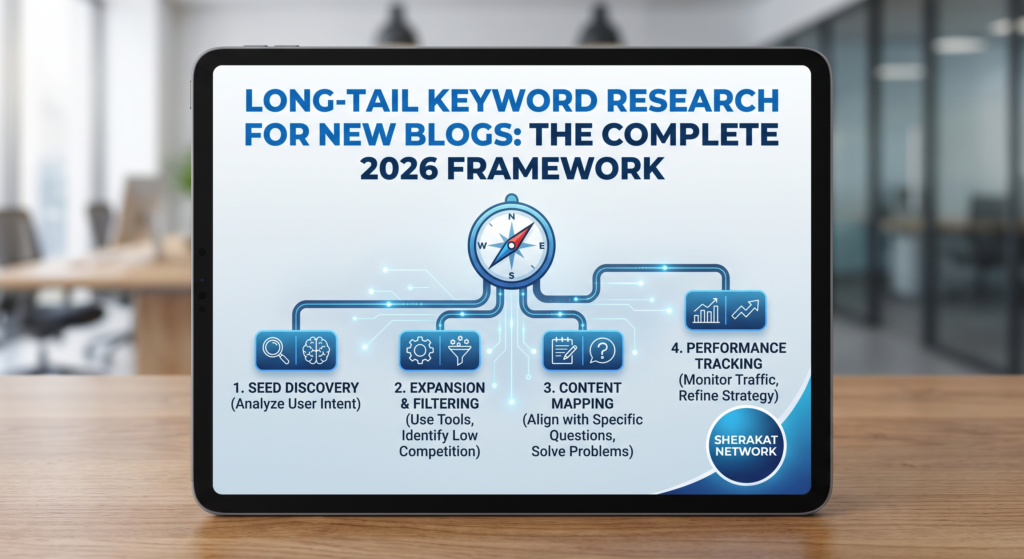
Long-Tail Keyword Research Tools (Free Tiers Available):
- Google Search Console
- Google Autocomplete (manual method)
- AnswerThePublic
- Answer Socrates
- Keyword Surfer (Chrome extension)
- Google Trends
- Apify’s Long Tail Keyword Generator
- SEO Research and Keyword Explorer (with KGR scores)
- Keyword Tool.io
- SerpX SEO Tools (open-source gap analysis)
Recommended Reading on Sherakat Network:
- Start Online Business 2026 Complete Guide
- The Alchemy of Alliance: A Comprehensive Guide to Building a Successful Business Partnership
- SEO Category
- Resources Category
- Blog Category
External Resources:
- The Daily Explainer: Mental Health Complete Guide
- The Daily Explainer: Global Supply Chain Management Guide
- World Class Blogs: AI and Machine Learning
- World Class Blogs: Remote Work and Productivity
- World Class Blogs: Climate Policy Agreements
- World Class Blogs: Culture and Society
Discussion
What is your biggest challenge with long-tail keyword research for a new blog? Have you discovered any techniques that work particularly well in your niche? Share your experiences in the comments below.
If you found this guide helpful, consider sharing it with someone who is struggling to get their new blog ranked. The strategies here work—but only if you actually apply them.
Have questions? Reach out via our contact page.