
Introduction: The Digital Imperative
Why This Matters Now More Than Ever
I remember sitting with a client in 2024—a brilliant artisan furniture maker whose craftsmanship was breathtaking. He had a beautiful showroom but was barely surviving. “My customers just don’t appreciate quality anymore,” he lamented. What I discovered was heartbreaking: his ideal customers—young professionals furnishing their first homes—were searching for “custom walnut desk” and “modern handmade furniture” daily on Instagram and Google, but they never found him. They were buying inferior products from competitors who understood the digital landscape. This isn’t an isolated story. In 2025, 83% of consumers discover products through digital channels first (Gartner, 2025), yet countless businesses operate as if we’re still in 2005.
Digital marketing is no longer a “nice-to-have” or something you delegate to “the young person who’s good with computers.” It is the central nervous system of modern commerce. Whether you’re a seasoned professional needing a refresh or a curious beginner taking your first steps, understanding digital marketing is no longer optional—it’s survival. The gap between businesses that master these fundamentals and those that don’t widens daily, creating a chasm in revenue, relevance, and resilience.
This guide is designed to be your comprehensive map across that chasm. We’ll move beyond buzzwords to practical mechanics, beyond theory to actionable strategy, grounded in the reality of 2025’s algorithms, consumer behaviors, and economic pressures.
Background & Context: From Banner Ads to Behavioral Ecosystems
The Evolution of a Revolution
To appreciate where digital marketing is going, we must understand its remarkable journey. The first recognized digital advertisement, a clickable banner for AT&T, appeared on HotWired.com in 1994 with the humble, prophetic text: “Have you ever clicked your mouse right HERE? You will.” The click-through rate? An astronomical 44%. This was the broadcast era of digital—a one-way message in a new medium.
The 2000s introduced search engines, transforming marketing from interruption to intention. Google AdWords (now Google Ads), launched in 2000, allowed businesses to bid on user queries. Suddenly, you could reach someone actively typing “best running shoes for flat feet.” This was paradigm-shifting. The 2010s brought the social and mobile explosion. Facebook opened to the public in 2006, Instagram launched in 2010, and with the smartphone’s ubiquity, marketing became personal, visual, and omnipresent.
Today, we’re in the “Relationship and Ecosystem” era. It’s not about single channels or one-off campaigns. As I’ve advised businesses through the Sherakat Network, success now depends on creating a cohesive, value-driven ecosystem where content, community, and conversation intertwine across platforms. Consumers don’t see “your email campaign” or “your Instagram post”—they see your brand, and they expect a unified, helpful, and seamless experience at every digital touchpoint. This holistic view is similar to the integrated approach needed in modern partnerships, detailed in our guide to business partnership models.
The catalyst for this latest shift? Data privacy concerns, AI democratization, and a consumer who is simultaneously more connected and more skeptical than ever before.
Key Concepts Defined: Building Your Digital Vocabulary
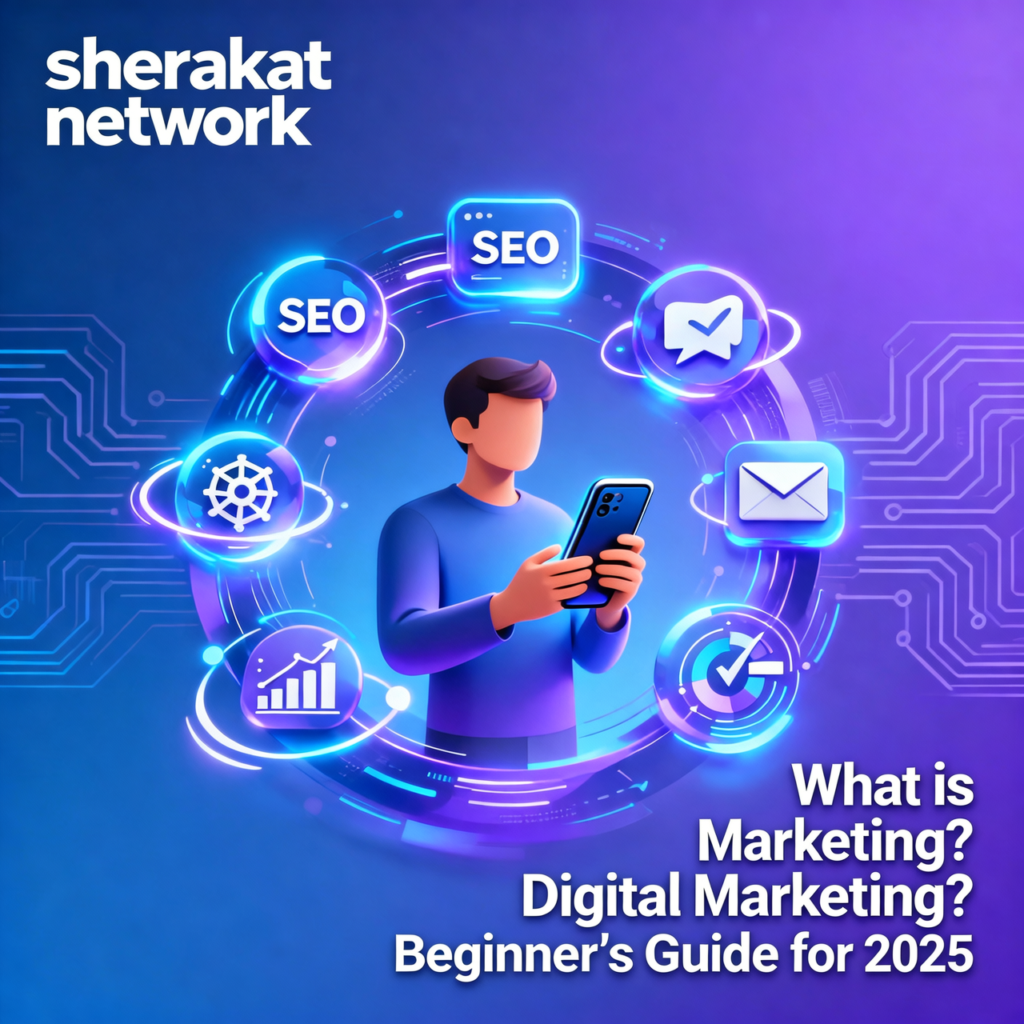
Let’s build a foundational lexicon. These aren’t just jargon; they are the building blocks of your strategy.
1. Digital Marketing (The Umbrella): The strategic use of digital channels, platforms, and technologies to promote a product, service, or brand and connect with current and prospective customers. It encompasses everything from your website text to your TikTok videos to the automated email thanking someone for a purchase.
2. Inbound vs. Outbound Marketing (The Philosophy):
- Inbound Marketing: The methodology of attracting customers by creating valuable content and experiences tailored to them. It’s “pull” marketing. Think: a helpful blog post that ranks on Google, an engaging educational YouTube video, or a free tool that solves a problem. It builds trust and authority.
- Outbound Marketing: The traditional method of pushing a message out to a broad audience, hoping it resonates with a subset. It’s “push” marketing. Think: TV commercials, display banner ads, cold calling, or mass email blasts to purchased lists.
*What I’ve found is that the most successful 2025 strategies use a hybrid “Inbound-First” approach. You build a foundation of valuable, SEO-optimized content (inbound) to attract an audience, then use sophisticated, targeted outbound methods (like retargeting ads or sponsored content) to accelerate growth within that warmed-up audience.*
3. Omnichannel vs. Multichannel (The Experience):
- Multichannel: Being present on multiple channels (website, Instagram, email, store).
- Omnichannel: Integrating those channels so the customer experience is seamless. A customer can add a product to a cart on Instagram, save it on your website, and complete the purchase via a link in a follow-up email—all with their preferences and data synced. The channel is irrelevant; the consistent experience is paramount.
4. The Customer Journey (The Pathway): This maps the process a potential buyer goes through. The classic model has three core stages:
* Awareness Stage: The buyer realizes they have a problem or need. (e.g., “My back hurts when I sit at my desk all day.”)
* Consideration Stage: The buyer defines their problem and researches solutions. (e.g., “What are the best ergonomic office chairs?”)
* Decision Stage: The buyer chooses a solution, service, or brand. (e.g., “Should I buy the Herman Miller Aeron or the Steelcase Gesture?”)
In 2025, we add a critical fourth stage: Loyalty/Advocacy, where marketing turns customers into repeat buyers and vocal promoters.
5. Return on Investment (ROI) & Key Performance Indicators (KPIs) (The Measurement):
- ROI: The ultimate financial metric: (Revenue from Campaign – Cost of Campaign) / Cost of Campaign. It tells you profitability.
- KPI: The signposts that indicate you’re moving toward your goal. These are specific and measurable. Examples: Website Traffic, Click-Through Rate (CTR), Conversion Rate, Cost Per Lead (CPL), Customer Lifetime Value (CLV).
How Digital Marketing Works: The 8-Step Strategic Framework
This is where theory meets practice. Let’s break down the process into a repeatable, scalable framework. In my experience, businesses that formalize this process see 70% greater efficiency in their marketing operations within six months.
Step 1: Deep-Dive Goal Setting & Business Alignment
Before any tactic, ask: What does business success look like? Goals must be SMART: Specific, Measurable, Achievable, Relevant, and Time-bound.
- Bad Goal: “Get more website traffic.”
- 2025 SMART Goal: “Increase qualified lead generation from the website by 30% within Q3 2025 by optimizing service page content and CTAs, moving from 100 to 130 leads per month.”
This step forces alignment between marketing activity and business outcomes. Your goal dictates everything that follows.
Step 2: Comprehensive Audience Research & Persona Development
This is the most skipped and most critical step. You must move beyond “women 25-40” to a psychographic profile.
- Build a Buyer Persona: Give them a name, a job, frustrations, aspirations. What keeps “Marketing Manager Maya” up at night? What blogs does she read? What does she value in a vendor?
- Leverage 2025 Tools: Use tools like SparkToro to analyze audience interests, review Reddit communities and LinkedIn groups where they gather, and employ social listening via Brandwatch or Mention. A 2025 Stat: High-performing marketing teams are 2.3x more likely to report conducting weekly audience research (CMI, 2025).
Step 3: Channel & Platform Selection
Don’t be everywhere. Be strategically everywhere your persona is. Here’s a 2025 snapshot:
- B2B Professional Services: LinkedIn (especially organic thought leadership + ABM ads), SEO/Content Marketing, Podcast Sponsorships, Email Newsletters.
- D2C E-commerce: Instagram & TikTok (Shop features, UGC, Influencers), Pinterest, Google Shopping Ads, SMS Marketing.
- Local Service Business: Google Business Profile (dominant), Local SEO, Facebook Community Groups, Nextdoor, Targeted YouTube demos.
For more on choosing the right model for growth, explore our resources on strategic alliances.
Step 4: Content Strategy & Asset Creation (The “Fuel”)
Content is the substance of all digital marketing. Your strategy should map content types to journey stages.
- Awareness Stage Content: Blog posts, infographics, educational videos, social media posts (non-promotional), podcasts. Goal: Educate and attract.
- Consideration Stage Content: Case studies, webinars, comparison guides, product demo videos. Goal: Build trust and differentiate.
- Decision Stage Content: Free trials, consultations, coupons, and detailed testimonials. Goal: Convert.
- Loyalty Stage Content: Exclusive user communities, advanced tutorials, referral programs, “behind-the-scenes” content. Goal: Retain and energize.
In my work with a SaaS startup, we created a single, definitive “Ultimate Guide” eBook for the Awareness stage. That one asset, gated behind an email form, generated over 5,000 leads in 12 months and became the cornerstone of their lead nurturing program.
Step 5: Execution, Publication & Campaign Launch
This is the “doing” phase. It requires a content calendar (I recommend using Notion or Asana for dynamic planning) and adherence to platform-specific best practices.
- SEO Execution: Publishing optimized website content, building technical site health, and earning quality backlinks.
- Social Media Execution: Consistent posting, community engagement, and running ad campaigns.
- Email Execution: Segmenting lists, designing automated workflows (welcome series, abandoned cart), sending newsletters.
Step 6: Paid Amplification & Budget Allocation
Organic reach is limited. In 2025, a smart paid strategy is essential to cut through the noise.
- Start with Retargeting: The highest ROI ad spend is often on people who already know you (website visitors, email subscribers).
- Test and Learn: Allocate 10-20% of your ad budget to testing new audiences, creatives, and platforms. Use A/B testing rigorously.
- Embrace Native Advertising: Sponsored articles in reputable industry publications (like those found on WorldClassBlogs) often outperform traditional display ads.
Step 7: Data Collection, Monitoring & Attribution
You can’t manage what you don’t measure. Implement tracking from day one.
- Essential Tools: Google Analytics 4 (GA4) for website behavior, platform-native insights (Meta Business Suite, LinkedIn Analytics), and a CRM like HubSpot or Salesforce to track leads.
- The Attribution Challenge: A customer might see a LinkedIn post, read a blog from Google a week later, and finally convert from a retargeting ad. Multi-touch attribution models (in GA4) help assign credit across touchpoints, giving you a true picture of what drives sales.
Step 8: Analysis, Reporting & Continuous Optimization
This is the feedback loop that creates growth. Schedule a weekly 30-minute and a monthly deep-dive review.
- Ask: What KPI moved the most? Why? Which piece of content had the highest engagement? Which ad had the lowest cost per result?
- Pivot Quickly: Kill underperforming campaigns. Double down on what works. Update your personas with new insights. This agile approach is what separates stagnant from scaling businesses.
Why It’s Important: The Tangible Business Impact
The importance of digital marketing is crystallized in its direct impact on a company’s bottom line and strategic positioning.
1. Unmatched Precision and Efficiency
Traditional marketing is a shotgun; digital marketing is a scoped rifle. You can target:
- Demographics: Age, gender, income, job title.
- Geographics: Down to a 1-mile radius around your store.
- Psychographics/Interests: “People interested in keto diet, yoga, and entrepreneurship podcasts.”
- Behavioral/Intent: “People who visited your pricing page but didn’t buy in the last 7 days.”
This precision reduces waste and increases conversion rates dramatically.
2. Complete Measurability and Accountability
Every dollar can be traced. This transforms marketing from a cost center to a profit-driving engine. You can calculate the exact Customer Acquisition Cost (CAC) and Lifetime Value (LTV) for each channel, allowing for intelligent budget reallocation in real-time.
3. Scalability and Global Reach
A small Shopify store in Lisbon can sell to a customer in Tokyo. A consultant in Toronto can build a global audience through a niche YouTube channel. Digital platforms remove traditional geographic and scale barriers, enabling micro-businesses to access macro markets.
4. Leveled Competitive Playing Field
A clever social media campaign or a brilliantly executed SEO strategy can allow a small, agile company to outmaneuver a larger, slower competitor with a much bigger traditional ad budget. Creativity and strategy often trump sheer spend.
5. Direct Customer Relationships and Loyalty Building
Digital channels enable two-way communication. You can respond to comments, address concerns publicly, run polls to involve customers in decisions, and create communities. This builds emotional equity and loyalty far beyond what a TV ad can achieve, fostering a sense of alliance similar to that described in our article on The Alchemy of Alliance.
6. Speed and Agility
You can launch, test, tweak, and pivot a campaign in hours or days, not the months required for TV production or print runs. This allows businesses to respond to market trends, news, or competitor moves with incredible speed.
Sustainability in the Future: Building for 2030 and Beyond
The future of sustainable digital marketing is built on three pillars: Privacy, Personalization, and Purpose.
1. The Privacy-First Imperative
The era of unchecked third-party data tracking is over. With Apple’s ATT framework, the demise of third-party cookies (now delayed to 2025 but inevitable), and regulations like GDPR and CCPA, the future is first-party data.
- Actionable Strategy: Build direct relationships. Encourage email sign-ups with valuable lead magnets. Create member-only content areas. Be transparent about data use and offer clear value in exchange for information. This shift mirrors a broader societal focus on wellbeing and ethical practice, a topic deeply explored in resources like The Daily Explainer’s guide to mental health.
2. AI-Enhanced, Not AI-Replaced, Personalization
AI (like ChatGPT, Claude, and Midjourney) is a powerful co-pilot for efficiency—generating content ideas, writing ad copy variations, and analyzing data sets. However, the sustainable edge will come from human creativity + AI efficiency. Use AI to handle scale and data, but humans must provide strategic direction, brand voice, empathy, and creative spark.
3. Purpose and Value Alignment
2025 consumers, especially Gen Z and Millennials, choose brands based on values. Sustainability, ethical sourcing, DEI commitments, and community impact are purchase drivers. Your digital marketing must authentically communicate your purpose. It’s not a sidebar; it’s central to your messaging. For insights into how global values are shaping business, consider perspectives from global affairs and policy.
4. The Rise of “Closed-Loop” Ecosystems
The most sustainable models will create self-reinforcing digital ecosystems. For example: A blog (SEO) attracts visitors > A lead magnet (content upgrade) captures emails > An email sequence nurtures with valuable content > A community platform (like Circle) fosters peer connections > User-generated content from the community fuels social media and the blog. This creates a virtuous cycle that reduces dependence on volatile ad platforms.
Common Misconceptions Debunked
Let’s dismantle the myths that hold businesses back.
Misconception 1: “Set it and forget it.”
Reality: Digital marketing is a dynamic garden, not a static billboard. Algorithms change, competitors adapt, audience tastes shift. It requires constant attention, testing, and optimization. A campaign that worked perfectly in January may need a complete overhaul by June.
Misconception 2: “More content = better results.”
Reality: Quality and strategic alignment trump quantity every time. One comprehensive, authoritative “pillar page” that thoroughly answers a core customer question will outperform 50 thin, generic blog posts. Google’s 2024 “Helpful Content Update” punishes content created for search engines first instead of people.
Misconception 3: “Viral fame is the ultimate goal.”
Reality: Virality is unpredictable and often fleeting. Sustainable growth is built on consistent, reliable lead generation and customer retention. I’d rather have a predictable system that generates 10 qualified leads a week than a one-off viral video that brings 10,000 uninterested visitors.
Misconception 4: “Digital marketing kills traditional/offline marketing.”
Reality: The most powerful strategies are integrated. A QR code on a physical product package (offline) that leads to a tutorial video (digital). A podcast ad (audio) mentioning a unique URL to track listeners. The line is blurred; the winners are channel-agnostic.
Misconception 5: “You need a huge budget to start.”
Reality: You need a huge budget to compete in broad, winner-take-all categories. But for most small businesses, you can start with a lean, focused budget. A few hundred dollars a month on highly targeted social ads, coupled with a dedicated 5 hours a week to create genuine content and engage in online communities, can yield significant results. Our guide to starting an online business is built on this principle.
Recent Developments (2024-2025): What’s Changing Right Now
1. Search Generative Experience (SGE) & The “Answer Engine” Shift
Google is no longer just a list of blue links. With AI Overviews (formerly SGE), Google aims to answer queries directly on the search results page. For marketers, this means:
- “Position Zero” (Featured Snippets) is more critical than ever. You must structure content to directly answer questions concisely.
- E-E-A-T (Experience, Expertise, Authoritativeness, Trustworthiness) is the ranking holy grail. Google prioritizes content demonstrating first-hand experience and deep expertise.
- Long-tail, conversational keyword targeting (“how do I…”, “what’s the best way to…”) is essential.
2. AI-Generated Content: The New Normal (With a Caveat)
Tools like Gemini and Claude can draft articles, social posts, and emails in seconds. The 2025 best practice is AI-Assisted, Human-Edited.
- Use AI for: Brainstorming outlines, overcoming writer’s block, creating multiple copy variations for A/B testing, summarizing complex reports.
- Human Required for: Injecting unique anecdotes, applying brand voice and strategic nuance, adding proprietary data or opinions, ensuring factual and ethical accuracy.
3. The “De-influencing” & Authenticity Backlash
Consumers are growing weary of overly polished, salesy influencer content. There’s a surge towards raw, authentic, and “de-influencing” content—where creators honestly critique trends or showcase “normal” life. Brands that partner with micro-influencers who have highly engaged, niche communities or that showcase real employee/customer stories are winning trust.
4. Audio and Conversational Marketing
With the growth of podcasts, Clubhouse-style rooms, and AI voice assistants, optimizing for audio is rising. This includes creating podcast content, using SEO strategies for podcast platforms, and ensuring your business information is accurate on voice search platforms.
5. Interactive & Shoppable Content
Static images are losing ground to interactive experiences: 360° product views, “try-on” AR filters (especially in beauty/fashion), interactive quizzes that recommend products, and shoppable video pins on Pinterest. These formats dramatically reduce the steps between discovery and purchase.
Success Story: “Urban Oasis Plants” – From Local Shop to National Brand
The Challenge: A beloved local plant shop with incredible expertise but zero online presence beyond a basic Facebook page. Foot traffic was seasonal and limited to a 3-mile radius.
The 18-Month Digital Transformation Strategy:
Phase 1: Foundation (Months 1-3)
- Built a simple Shopify website with a blog (“The Plant Parent Journal”).
- Claimed and optimized their Google Business Profile with high-quality photos, regular posts, and a Q&A section.
- Created three “Hero” blog posts targeting high-intent local searches: “Best Low-Light Plants for Apartments in [City],” “How to Save an Overwatered Fiddle Leaf Fig,” “Where to Buy Rare Houseplants Near Me.”
Phase 2: Community & Content (Months 4-9)
- Launched an Instagram account focused not on sales, but on education and community. Daily “Plant Care Tip” Reels, weekly “Plant Diagnosis” live streams.
- Started a weekly email newsletter with exclusive care tips and early access to new plant arrivals.
- Created a simple lead magnet: a printable “Watering Schedule Cheat Sheet” PDF in exchange for an email address.
Phase 3: Scale & Monetize (Months 10-18)
- Used the growing email list (5,000+ subscribers) to soft-launch an e-commerce store for hardy, shippable plants and unique pots.
- Implemented a modest Google Ads campaign targeting “buy rare houseplants online” and retargeting website visitors.
- Partnered with 5 micro-influencers in the #houseplant community for unboxing and review videos.
The Results (18 Months Later):
- Revenue: 300% increase. E-commerce now accounts for 45% of total revenue.
- Audience: Email list: 22,000. Instagram followers: 65,000 (highly engaged).
- Authority: Recognized as a top 10 result for dozens of plant-care keywords nationally.
- Sustainability: Built a digital asset (audience, content library) that provides predictable, weather-proof revenue.
What I’ve found is that their success wasn’t about a single viral moment. It was the relentless, consistent execution of a simple, integrated plan: provide immense value (education), build a community around a shared passion, and then make it easy for that community to support the business.
Real-Life Examples Across Industries
B2B Example: “CloudSecure” (SaaS Cybersecurity)
- Awareness: Publishes white papers and research reports on LinkedIn about emerging cyber threats (leveraging their CEO’s authority).
- Consideration: Hosts bi-monthly, no-pitch technical webinars featuring their head engineer solving real-world scenarios. Gated behind a registration form.
- Decision: Offers a personalized, live “Security Gap Analysis” demo for webinar attendees who book a meeting.
- Loyalty: Creates a private customer-only Slack community for peer support and early beta access.
Local Service Example: “Premier Plumbing Co.”
- Awareness: Dominates Google Maps with 150+ 5-star reviews and posts “before/after” project photos on their GBP weekly.
- Consideration: Runs a YouTube channel with 2-minute “Quick Fix” videos (e.g., “How to unclog a kitchen sink with baking soda”).
- Decision: Uses a clear “Book Online Now” button on every page of their mobile-optimized website and sends automated SMS confirmations.
- Loyalty: Implements a post-service email sequence with maintenance tips and a “Refer a Friend, Get $50 Off” offer.
Non-Profit Example: “City Arts Youth Foundation”
- Awareness: Shares powerful student success story videos on Instagram and TikTok, using relevant hashtags like #ArtsEducation.
- Consideration: Publishes blog interviews with teaching artists and impact reports on their website.
- Decision: Makes the online donation process seamless with multiple payment options and recurring gift setups.
- Loyalty: Sends monthly “Impact Update” emails to donors, showing exactly how their gift was used (e.g., “Your $50 funded 5 art kits”).
Conclusion and Key Takeaways: Your Action Plan
Digital marketing in 2025 is a sophisticated discipline, but its core is timeless: connect the right person with the right solution through the right message at the right time.
The complexity lies in the execution across an ever-evolving digital landscape. You now have the map—the definitions, the framework, the warnings against myths, and the inspiration from real success.
Your Action Plan for Next Week:
- Define One SMART Goal. Be specific. (e.g., “Get 30 email subscribers from the blog this month”).
- Sketch One Buyer Persona. Give them a name, a core problem, and where they spend time online.
- Audit Your Digital Presence. Google your business. Is your Google Business Profile complete? Is your website’s “About Us” page clear?
- Create One Piece of “Awareness Stage” Content. Write a 500-word blog post answering a common question your persona has. Or film a 60-second “Tip” video.
- Set Up One Measurement Tool. Install Google Analytics 4 on your website if it’s not there already.
The journey of a thousand clicks begins with a single step. Start small, be consistent, measure everything, and never stop learning. The digital world rewards curiosity and strategic action.
Final Key Takeaways:
- Strategy Before Tactics: Goals and audience define everything.
- Quality Over Quantity: One magnificent piece of content is worth 100 mediocre ones.
- Data is Your Superpower: Make no decision without it.
- Integration is Non-Negotiable: Your channels must tell one cohesive story.
- Agility is Survival: Be prepared to pivot based on performance and platform changes.
- Human Connection is the Ultimate Algorithm: Technology changes, but the need for trust, empathy, and value is constant.
FAQs: 30 Detailed Questions Answered
- Q: I’m completely new. What’s the very first thing I should do?
A: Secure your digital real estate. Buy your domain name (yourbusiness.com), set up professional email addresses, and claim your business name on key social platforms (even if you don’t plan to use them all immediately). Then, build a simple, clear website with an obvious value proposition and a way for people to contact you. - Q: What’s the difference between SEO and SEM?
A: SEO (Search Engine Optimization) is the practice of optimizing your website and content to rank organically (for free) in search results. SEM (Search Engine Marketing) is the broader term that includes both SEO and paid search advertising (like Google Ads). SEM is often used synonymously with “paid search.” - Q: How do I choose between Facebook, Instagram, TikTok, LinkedIn, etc.?
A: Go where your audience is, not where you are comfortable. Research your customer persona. B2B? LinkedIn is essential. Selling visually appealing products to under-35s? Instagram and TikTok. Building a local service reputation? Facebook Community Groups and Nextdoor. Don’t spread yourself thin; master 1-2 primary platforms. - Q: What is a “funnel” and do I really need one?
A: A funnel is a visualized model of the customer journey from awareness to purchase. Yes, you need one, even if it’s simple. It forces you to think about what content or interaction a person needs at each stage to move them closer to becoming a customer. A basic funnel is: Visitor > Lead (via email sign-up) > Customer. - Q: What is content marketing, and is it just blogging?
A: Content marketing is the strategic creation and distribution of valuable, relevant content to attract and retain a defined audience. It’s not just blogging. It includes videos, podcasts, infographics, newsletters, social media posts, webinars, and ebooks. The goal is to drive profitable customer action by building trust. - Q: How much does digital marketing cost?
A: It ranges from $0 (sweat equity) to millions. A solo entrepreneur can start with free tools and their own time. A typical small business might spend $1,000 – $5,000 per month on a mix of tools, ad spend, and possibly a freelancer. The cost is less important than the ROI. A $5,000/month spend that generates $20,000 in sales is a fantastic investment. - Q: What is Google Analytics 4 (GA4) and why is it confusing?
A: GA4 is Google’s new analytics platform, replacing Universal Analytics. It’s confusing because it’s a fundamental shift from session-based to event-based tracking and focuses more on user journey and privacy. It’s essential to learn because it’s the future. Use Google’s free GA4 courses to get up to speed. - Q: What are “backlinks” and why are they important for SEO?
A: Backlinks are links from other websites to your website. They are like votes of confidence. Google views them as a key signal of your site’s authority and trustworthiness. Earning high-quality backlinks from reputable sites in your industry is a core SEO task. - Q: Can I run digital marketing in-house, or should I hire an agency?
A: This depends on resources and expertise. If you have the time and aptitude to learn, starting in-house gives you deep control and understanding. As you scale, an agency or freelancer can provide specialized skills and save you time. Many businesses use a hybrid: in-house for strategy and core content, agency for specialized tasks like PPC or technical SEO. - Q: What is “conversion rate optimization” (CRO)?
A: CRO is the systematic process of increasing the percentage of website visitors who take a desired action (a “conversion”), such as making a purchase or filling out a form. It involves testing different elements (headlines, button colors, page layouts) to see what performs best. - Q: How important is mobile-friendliness?
A: It’s critical. Over 60% of web traffic is mobile. Google uses mobile-first indexing, meaning it primarily uses the mobile version of your site for ranking and indexing. If your site is difficult to use on a phone, you will lose rankings and customers. - Q: What is an “email marketing automation workflow”?
A: It’s a pre-set series of emails triggered by a user’s action or attribute. Example: A Welcome Series is automated when someone subscribes. Day 1: Thank you email + lead magnet. Day 3: Introductory story about your brand. Day 7: First gentle offer or invitation to follow on social media. This nurtures leads without daily manual effort. - Q: What does “UGC” stand for?
A: User-Generated Content. This is any content (photos, videos, reviews, testimonials) created by your customers or fans, not your brand. It’s incredibly powerful for social proof and authenticity. Reposting UGC (with permission) is a top social media strategy. - Q: How do I deal with negative comments or reviews online?
A: Respond promptly, professionally, and publicly. Acknowledge the concern, apologize for the poor experience, and offer to take the conversation offline to resolve it (e.g., “We’re so sorry to hear this, Jane. We’ve sent you a private message to get details and make this right.”). This shows you care about customer satisfaction. - Q: What is “programmatic advertising”?
A: It’s the automated buying and selling of online ad space using AI. Instead of negotiating directly with a website, you tell a platform (like Google Display Network) your target audience and budget, and its algorithms place your ads on relevant sites across the internet in real-time. - Q: What’s the difference between CPC, CPM, and CPA?
A: These are key ad pricing models.- CPC (Cost-Per-Click): You pay each time someone clicks your ad.
- CPM (Cost-Per-Mille/Thousand Impressions): You pay for every 1,000 times your ad is shown.
- CPA (Cost-Per-Acquisition/Action): You pay only when a specific action is completed (like a sale or lead form submission). This is often the goal for performance marketing.
- Q: What is “voice search optimization”?
A: Optimizing your content for queries spoken to devices like Siri, Alexa, or Google Assistant. These are often longer, more conversational, and phrased as questions. FAQ pages structured with clear Q&A are great for voice search. - Q: How often should I post on social media?
A: Consistency is more important than frequency. It’s better to post 3 high-quality, engaging times a week reliably than to post 3 times daily for a week and then disappear for a month. Use your analytics to see when your audience is most active. - Q: What is a “CRM” and do I need one?
A: A Customer Relationship Management system (like HubSpot, Salesforce) is software that helps you track all interactions with leads and customers. If you have more than 20 leads/customers, yes, you need one. It organizes email, notes, deals, and automates follow-ups. - Q: What are “dark social” and “dark traffic”?
A: Dark social refers to social sharing that occurs through private channels (DM, WhatsApp, email) which analytics tools can’t track. Dark traffic in analytics is website traffic where the source is unknown. It highlights the limits of tracking and the importance of building a recognizable brand. - Q: How do I measure social media ROI?
A: Tie social efforts to business goals. If the goal is sales, use tracking pixels and UTM parameters to track conversions from social ads and posts. If the goal is brand awareness, track metrics like Reach, Impressions, and Engagement Rate. The key is to move beyond “likes” to metrics that matter. - Q: What is “landing page” and why is it different from my homepage?
A: A landing page is a standalone web page created for a specific marketing campaign. It has one focused goal (e.g., get an ebook download) and removes navigation distractions. Your homepage serves multiple audiences and goals. Use landing pages for paid ads and specific offers. - Q: What are “cookies” and should I have a cookie consent banner?
A: Cookies are small data files stored on a user’s browser. Yes, you likely need a consent banner to comply with privacy laws like GDPR (EU) and CCPA (California). It informs users about tracking and gives them a choice. Use a plugin like CookieYes or ConsentManager. - Q: What is “influencer marketing” and is it worth it?
A: Partnering with individuals who have a dedicated social following to promote your product. It can be worth it, but micro-influencers (10k-100k followers) in a specific niche often have higher engagement and more affordable rates than celebrities. Always vet for authentic audience alignment. - Q: How do I come up with content ideas?
A: Use: AnswerThePublic.com, Google’s “People also ask” section, comments on your own blog/social posts, questions your sales team gets, competitor content gaps, industry forums (Reddit, Quora), and keyword research tools (Google Keyword Planner, SEMrush). - Q: What is “meta description” and “title tag”?
A: These are HTML elements crucial for SEO. The title tag is the clickable blue headline in search results. The meta description is the short text snippet below it. They don’t directly affect rankings but greatly influence click-through rate. Write compelling, keyword-inclusive titles and descriptions for every page. - Q: Can digital marketing work for a very traditional, offline business (e.g., a law firm, a dentist)?
A: Absolutely. For these businesses, digital marketing is often about local SEO (showing up in “lawyer near me” searches), reputation management (getting positive reviews), and building authority (publishing informative articles on your website). It’s less about e-commerce and more about lead generation and trust signaling. - Q: What is “chatGPT” and how can I use it ethically in marketing?
A: ChatGPT is an AI language model. Use it ethically as a brainstorming partner, first-draft writer, or editor. Never publish AI-generated content without significant human editing, fact-checking, and adding your unique perspective and data. Transparency is key if you use AI heavily. - Q: How do I stay updated without getting overwhelmed?
A: Curate your sources. Follow 2-3 authoritative marketing blogs/newsletters (e.g., MarketingProfs, HubSpot Blog, Search Engine Journal). Join 1-2 professional communities (like LinkedIn groups). Listen to 1 marketing podcast during your commute. Ignore the rest. Depth over breadth. - Q: When will I see results?
A: It depends on the tactic. Paid ads can drive traffic in minutes. SEO can take 4-12 months to gain traction. Email list building is steady growth. Social media community building takes months of consistent engagement. Have patience and judge success against your weekly/monthly KPIs, not an arbitrary “overnight success” timeline.
About the Author
Sana Ullah Kakar is a collective of seasoned digital strategists, former entrepreneurs, and data-driven marketers. With a combined experience of over 50 years across B2B, B2C, and non-profit sectors, we’ve lived through the evolution from dial-up banners to AI-generated content. Our mission at Sherakat Network is to demystify the complex world of business growth, providing not just theory, but battle-tested, actionable frameworks. We believe that sustainable success is built on knowledge, ethical practice, and strategic partnerships. Have a specific challenge or want to connect? Reach out to our team via our Contact Us page—we read every message.
Free Resources to Accelerate Your Journey
- Sherakat Network Library: Dive deeper into related topics in our Blog and Resources sections, including detailed partnership frameworks and startup guides.
- Google Skillshop: Free, official certifications in Google Ads, Analytics, and YouTube.
- HubSpot Academy: Arguably the best free resource for inbound marketing, sales, and CRM certifications.
- Canva for Education: If you’re a non-profit or student, apply for free Canva Pro to design all your graphics.
- BuzzSumo Free Trial: Great for content research and finding top-performing topics in your niche.
- SEO Starter Guide by Google: The official, plain-English guide to SEO fundamentals from the source.
Discussion & Community Engagement
We want to hear from you! The digital landscape is built on shared knowledge.
- What’s the #1 question about digital marketing that this guide didn’t answer for you?
- Have you tried implementing any of these strategies? What was your biggest win or lesson learned?
- For the pros: What’s one “basic” fundamental you see beginners overlook most often?
Share your thoughts and questions. Let’s build a community of continuous learners here at Sherakat Network. For broader discussions on technology’s impact on society, you might also find valuable conversations at WorldClassBlogs’ Culture & Society section.
Thanks for sharing your info. I really appreciate your efforts and
I will be waiting for your further write ups thanks
once again.