

Introduction – Why This Matters
The era of the solo affiliate blogger operating in isolation is giving way to the age of the affiliate ecosystem. By 2026, the most successful digital publishers will not be individual creators, but architects and managers of sophisticated, multi-tiered partnership networks. These networks amplify reach, diversify traffic sources, and create formidable competitive moats that are nearly impossible to replicate. Relying solely on your own content output is a ceiling; building an ecosystem is a launchpad.
In my experience, the transition from solo operator to network manager is the single most impactful leverage point for scaling an affiliate business. What I’ve found is that a well-managed network of just 50 micro-influencers and niche content creators can generate more consistent, high-quality traffic and conversions than a single macro-influencer partnership costing ten times as much. The diversity mitigates risk—no single algorithm change or platform policy can collapse your entire business. A 2025 report by Partnership Leaders indicated that companies with mature partnership ecosystems grew revenue 28% faster than those relying on traditional marketing alone.
This guide is your blueprint for designing, building, and scaling a profitable affiliate ecosystem from 2026 to 2030. We will move beyond the basics of affiliate programs into the strategic realm of network effects, relationship architecture, and scalable management systems. This is about transforming from a participant in the affiliate game to a creator of the playing field itself.
Background / Context: The Network Effects Imperative
Several converging forces are making ecosystem building not just advantageous, but essential for sustainable growth:
- The Fragmentation of Attention: Audience attention is no longer concentrated on a few mega-platforms or mega-influencers. It is distributed across countless niches, sub-communities, and emerging platforms (think micro-communities on Discord, curated newsletters on Beehiiv, video essays on niche YouTube channels). To capture attention, you must have a presence in many places, which requires many partners.
- The Rising Cost & Risk of Solo Creation: Creating enough high-quality, multi-format content (written, video, audio, interactive) to compete in 2026 is prohibitively expensive and time-consuming for a single entity. An ecosystem allows you to leverage the unique talents and audiences of many creators.
- The Power of Distributed Trust: As discussed in our Trust Economy guide, trust is hyper-localized. An audience trusts their specific niche creator far more than a generic brand. By partnering with these trusted voices, you borrow and scale that trust, embedding your recommendations within authentic communities.
- Technology Enables Management at Scale: The rise of Partner Relationship Management (PRM) and Alliance Management platforms (like Impact, PartnerStack, Affise) has democratized the tools once reserved for enterprise affiliate networks. You can now track, pay, and communicate with hundreds of partners efficiently.
- The Strategic Shift from “Influencer” to “Partner”: The transactional “sponsorship” model is dying. The future is strategic co-creation. Partners are not billboards; they are R&D extensions, content co-producers, and community gatekeepers. Your ecosystem is your innovation lab.
The paradigm has shifted from competition to coopetition and collaboration. Your growth is now a function of your network’s health and activity.
Key Concepts Defined
- Affiliate Ecosystem: A interconnected network of publishers, content creators, influencers, and community leaders who promote a brand or central hub’s products/services under a structured partnership model, creating multiplicative growth through shared incentives.
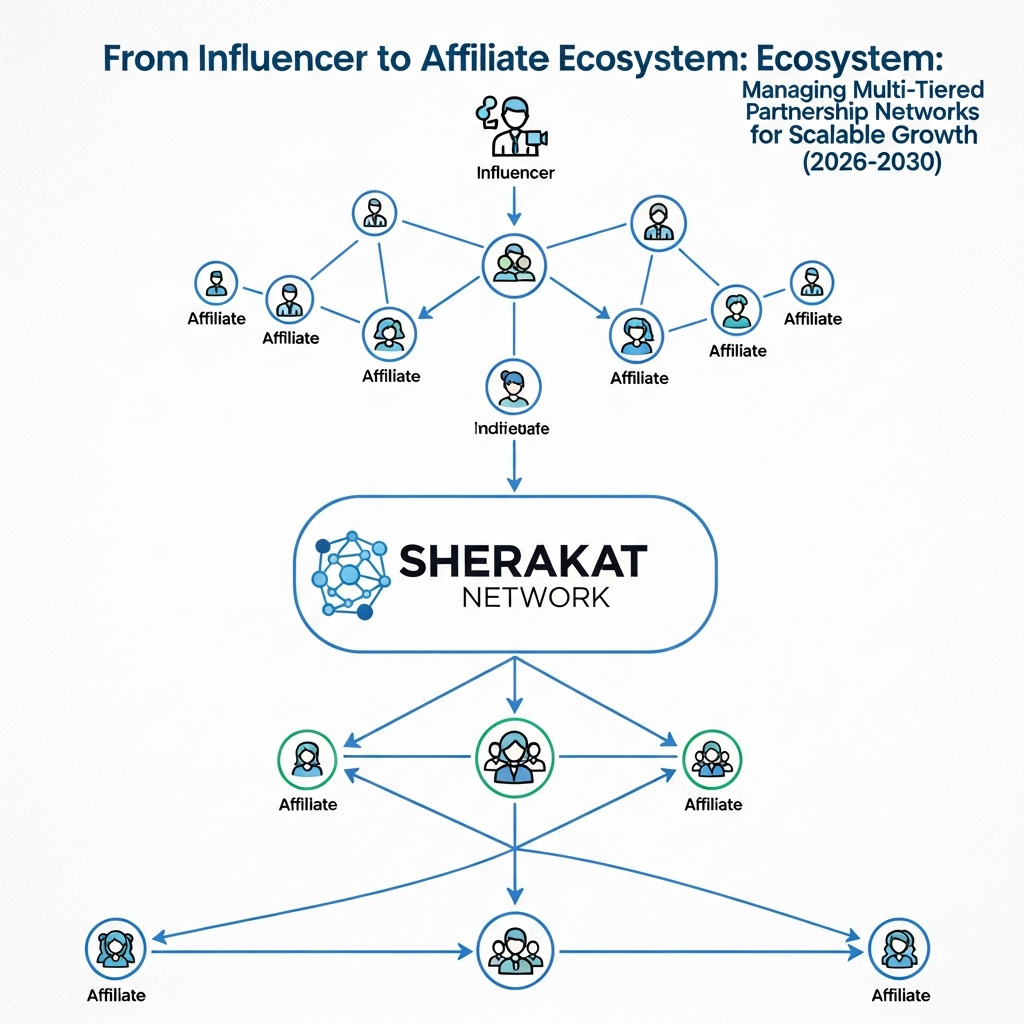
- Multi-Tiered Partnership Model: A structure with different levels or types of partners, each with distinct roles, requirements, and commission structures. Common tiers: Tier 1: Strategic Content Partners (deep integration), Tier 2: Active Affiliates/Publishers, Tier 3: Referral Partners/Micro-Influencers.
- Partner Relationship Management (PRM) Software: A platform designed to automate and streamline the recruitment, onboarding, tracking, payment, and communication processes with a large network of partners. It’s the operational engine of an ecosystem.
- User-Generated Content (UGC) Strategy: A systematic approach to encouraging and leveraging content created by your partners and community (reviews, unboxings, tutorials) for use in your own marketing, social proof, and SEO.
- Co-Creation & Revenue Sharing: Moving beyond simple affiliate commissions to collaborative projects where partners help create products (e.g., an ebook, a course, a physical product) and share in the revenue or profits generated, aligning long-term incentives.
- Affiliate Recruitment Funnel: The process of proactively attracting, vetting, and onboarding high-quality partners, modeled similarly to a customer acquisition funnel (Awareness → Consideration → Onboarding → Activation).
- Network Effects: The phenomenon whereby a network’s value increases for all participants as more participants join and engage. A vibrant ecosystem attracts better partners, which attracts more merchants/brands, creating a virtuous cycle.
- Strategic Alliance: A formalized, long-term collaborative agreement with a key partner (often another business or large publisher) that goes beyond affiliate links to include joint ventures, content swaps, product bundling, or shared technology.
How It Works (Step-by-Step Breakdown): Building Your Ecosystem

Phase 1: Strategy & Architecture Design (Weeks 1-4)
- Define Your Ecosystem’s Core Purpose & Value Proposition: Why should a creator join your network vs. a generic affiliate program? Your USP could be: higher commissions, exclusive products, co-creation opportunities, advanced data sharing, or a supportive community.
- Design Your Tiered Partnership Model:
- Tier 1 (Elite/Strategic): 5-10 hand-picked partners. Offer: Custom commission deals, early product access, co-branded content, invite-only masterminds. Requirement: Proven audience, high engagement, brand alignment.
- Tier 2 (Core/Active): 50-200 vetted affiliates. Offer: Competitive standard commissions, dedicated affiliate manager, promotional kit. Requirement: Active site/social channel, basic content standards.
- Tier 3 (Community/Referral): Open to many. Offer: Lower flat-rate or percentage commissions, self-service portal. Requirement: Simple sign-up. This tier acts as a feeder for Tiers 1 and 2.
- Craft Your Legal & Compensation Foundation:
- Develop a clear, fair Partner Agreement that covers payment terms, disclosure requirements, content guidelines, and brand safety rules.
- Design a compensation structure that incentivizes the right behavior. Beyond straight sales commissions, consider bonuses for: content quality, new customer acquisition (vs. existing), recurring revenue, or social shares.
- Select Your Technology Stack:
- PRM/Network Platform: Impact.com, PartnerStack, or Tapfiliate for robust management.
- Communication Hub: A dedicated partner Discord server or Circle.so community.
- Shared Resource Library: A Notion or Google Drive portal for assets, guidelines, and data.
Phase 2: Recruitment & Onboarding (Weeks 5-12)
5. Proactive Recruitment:
* Identify Ideal Partners: Use tools like SparkToro or Modash to find creators whose audience overlaps with your niche but who aren’t direct competitors.
* The Personalized Outreach: Never send a generic “join our program” email. Reference their specific content, explain why they’re a fit, and articulate the unique value you offer them.
6. Streamline the Onboarding Funnel:
* Application Process: A simple form that assesses their channels, audience size, and content style.
* Welcome Sequence: Automated but warm emails that deliver: 1) Welcome & Agreement, 2) Access to PRM portal, 3) Link to resource library & training, 4) Schedule a 1:1 intro call (for Tiers 1 & 2).
* Activation Goal: Define a clear “first success” (e.g., publish first review, generate first sale). Track this relentlessly.
7. Provide Exceptional Onboarding Resources:
* Brand Guidelines: Clear dos and don’ts.
* Product/Service Training: Deep-dive materials, maybe even a live webinar.
* Creative Assets: Not just logos, but swipe files for email copy, social posts, and video scripts.
* “Quick Win” Promo: Offer a limited-time elevated commission for their first promotion to get momentum.
Phase 3: Management, Growth & Optimization (Ongoing)
8. Foster Community & Communication:
* Host monthly partner-only AMAs (Ask Me Anything) or webinars with industry experts.
* Create a “Top Performers” spotlight in your newsletter.
* Encourage peer-to-peer help in your Discord/Circle community.
9. Implement a UGC Engine:
* Create a system for partners to submit their best content (reviews, videos).
* With permission, repurpose this UGC on your own social channels, website, and ads (always tagging and compensating the creator, sometimes with a bonus).
* This provides you with authentic social proof and rewards partners with exposure.
10. Analyze & Optimize with Data:
* In your PRM, track key metrics per partner: Earnings Per Click (EPC), conversion rate, new vs. returning customer rate, content quality score.
* Identify your “power partners” (the 20% driving 80% of results) and invest more in them.
* Diagnose churn: Why do partners go inactive? Survey them and iterate.
11. Scale through Co-Creation & Advanced Models:
* Develop Co-Created Products: Work with top Tier 1 partners to develop digital products (courses, templates) or physical products. Use a revenue-sharing model (e.g., 50/50 profit split) instead of a one-time commission.
* Launch a “Find an Expert” Directory: If you’re in a service-oriented niche (e.g., business software), feature your top partners as certified experts or consultants, taking a smaller fee for qualified referrals.
* Explore Sub-Affiliation/Two-Tier: Allow your partners to recruit their own sub-affiliates, earning a small percentage of their sub-affiliates’ sales. This incentivizes them to grow your network for you.
Why It’s Important: The Unassailable Advantage
Building an ecosystem is the ultimate business leverage.
- Exponential, Non-Linear Growth: Your marketing reach becomes the sum of your partners’ reach. As your network grows, your potential audience grows combinatorially, not linearly.
- Risk Diversification: You are no longer dependent on Google’s algorithm, a single social platform, or your own content calendar. If one partner’s traffic dips, dozens of others can compensate.
- Enhanced Credibility & Market Saturation: When multiple trusted voices in a niche independently recommend your core brand or products, it creates a powerful “echo chamber” of social proof that establishes market dominance and drowns out competitors.
- Sustainable Competitive Moat: A well-run ecosystem with high partner satisfaction is incredibly difficult to copy. Competitors can steal your product, but they cannot instantly replicate the trust, relationships, and community you’ve built with dozens or hundreds of creators.
- Access to Innovation & Trends: Your partners are on the front lines with audiences. They provide invaluable, real-time feedback on products, content ideas, and emerging trends, making your entire operation more agile and market-informed.
For a deep dive into structuring the formal agreements that underpin these relationships, explore our guide on Business Partnership Models.
Sustainability in the Future (2026-2030): The Autonomous, Value-Driven Network
Ecosystems will evolve from managed hierarchies to fluid, value-driven networks.
- DAO-Styled Governance: Advanced ecosystems may adopt Decentralized Autonomous Organization (DAO) principles, where top partners hold governance tokens to vote on key decisions: which new products to promote, commission rule changes, or community fund allocations. This deepens ownership and loyalty.
- AI-Powered Partner Matching & Optimization: AI will analyze potential partner audiences, content styles, and performance data to automatically suggest ideal partnership pairings, predict lifetime value, and recommend personalized incentive structures.
- The Rise of Niche Ecosystem Platforms: Vertical-specific PRM platforms will emerge (e.g., for SaaS, for sustainable products), offering built-in compliance tools, niche-specific reporting, and integrated community features tailored to that industry’s needs.
- Value-Exchange Beyond Money: Compensation will include access to exclusive data, software licenses, equity-like profit shares, and prestigious “ambassador” status that carries weight within a community. The ecosystem becomes a career-advancing platform for partners.
To understand the complex operational backbone required for scaling such networks, consider the principles in Global Supply Chain Management.
Common Misconceptions
- Misconception 1: “More partners always equals more revenue.”
- Reality: A small, highly-engaged, and well-managed network of 50 partners will outperform a bloated, neglected network of 5,000 inactive sign-ups. Focus on partner quality and activation rate, not raw sign-up numbers.
- Misconception 2: “Setting up an affiliate program is enough; partners will find me.”
- Pitfall: In 2026, this is passive and ineffective. The best partners are recruited, not acquired. You must proactively build relationships. An affiliate program is the infrastructure; recruitment and management are the active work.
- Misconception 3: “Partners are a cost center to be minimized.”
- Reality: High-performing partners are a profit center and strategic asset. Investing in their success—through better commissions, training, and support—yields a massive ROI. Scrimping on partner rewards is the fastest way to kill your ecosystem.
- Misconception 4: “I need to control everything my partners say and do.”
- Pitfall: Overly restrictive control stifles authenticity, which is the partners’ primary value. Provide clear brand and legal guidelines, but trust their voice and audience judgment. Autonomy within a framework breeds the best content.
Recent Developments (2024-2025)
- The “Creator Economy Stack” Maturation: Tools like ConvertKit’s Commerce and Kajabi’s Affiliate Program have made it easy for individual creators to launch their own affiliate programs, raising the bar. To attract top creators, your ecosystem must offer more value than they can get by going solo.
- Increased Scrutiny on Partner Compliance: Platforms and regulators are cracking down on improper disclosures and misleading claims within affiliate networks. Ecosystem managers now have a legal and fiduciary responsibility to educate and monitor their partners for compliance.
- The Micro-Community Affiliate: The most effective new partners are not broad influencers, but admins and respected members of tight-knit Discord servers, Slack groups, or newsletter communities. Their influence is hyper-concentrated and powerful.
- Performance-Based Tier Advancement: Automated systems that use performance data (conversion rate, EPC, content quality) to automatically promote partners to higher commission tiers are becoming standard, creating a meritocratic and motivating environment.
For insights into the AI tools that can power partner matching and analytics, visit World Class Blogs’ AI & Machine Learning section.
Success Stories
Case Study: “The Niche Software Company’s Expert Ecosystem”
A B2B SaaS company selling project management software struggled with cold outreach.
- Ecosystem Strategy: They stopped seeking generic influencers and instead built the “Certified Productivity Partner (CPP)” network.
- Recruitment: They targeted: 1) Productivity-focused YouTubers, 2) Project management consultants, 3) Top reviewers on software comparison sites like G2.
- Value Proposition: Partners received: 30% recurring commissions (high for SaaS), a “Certified Partner” badge, listing in a public directory on their site, leads from their “Find a Consultant” page, and access to a private Slack community.
- Co-Creation: Top CPPs were invited to co-write advanced e-books and teach paid webinars, sharing 50% of the revenue.
- Result: Within 18 months, the CPP network drove 40% of all new sales. The public directory became a lead-gen tool for clients seeking implementation help, which they sold as a qualified lead to partners. The ecosystem became a primary differentiator, as competitors could not match the depth of expert support available.
Real-Life Examples
- Example 1: The “Style Collective” for a Fashion Affiliate Site:
- Central Hub: A sustainable fashion review site.
- Ecosystem: A network of 200+ micro-influencers (5k-50k followers) who genuinely care about sustainable fashion.
- Management: A private Instagram Group Chat for daily communication. A monthly “Style Challenge” where partners create content around a theme (e.g., “Monochromatic Green Look”) using specific affiliate-linked items.
- UGC & Reward: The best entries each month are featured on the central hub’s Instagram and website, with a bonus $100 commission. This provides constant, authentic content for the hub and motivates partners.
- Result: The hub appears to have an omnipresent, grassroots brand, and sales are driven by authentic styling ideas, not just product links.
- Example 2: The “Local Guide Ambassador” Program for a Travel Affiliate:
- Central Hub: A site for budget travel in Southeast Asia.
- Ecosystem: Recruits travelers who are currently long-term staying in cities like Bangkok, Chiang Mai, Ho Chi Minh City.
- Role: Ambassadors create hyper-local content: “Best $2 Meals in Chiang Mai,” “Hidden Cafe with Fast WiFi in Da Nang.” They use unique affiliate links for hostels, tours, and sim cards.
- Compensation: Base commission plus a “local expert” fee for answering community forum questions about their city.
- Result: The site gains impossibly fresh, trustworthy local content. Travelers planning trips trust these “on-the-ground” reports more than generic guidebooks, leading to high conversion rates.
- Example 3: The “Tool Integrator” Network for a Tech Affiliate:
- Central Hub: A site reviewing marketing software.
- Ecosystem: Partners are not reviewers, but creators who make tutorial content about how to use specific software (e.g., “How to build a Zapier automation between Tool A and Tool B”).
- Partnership: The hub provides partners with free software licenses and a custom affiliate link. In their tutorial, they mention “I use [Tool A] for this, which you can check out via my link.”
- Synergy: The hub gets detailed, use-case content that ranks for long-tail “how to” keywords. The partner gets free tools and commissions. The software company gets qualified, educated users.
- Result: The hub becomes a repository of practical implementation advice, not just surface-level reviews, dominating a more valuable segment of the search funnel.
Conclusion and Key Takeaways
Building an affiliate ecosystem is the definitive strategy for transcending the limitations of individual effort and achieving scale in the attention-rich, trust-scarce landscape of 2026-2030. It transforms your business from a content publisher into a community-powered platform.
Key Takeaways:
- Architect, Don’t Just Recruit. Design your ecosystem with intent—clear tiers, compelling value propositions, and fair compensation. It is a system you build, not a list you accumulate.
- Technology is Your Force Multiplier. Invest in a PRM/management platform from the start. It pays for itself in saved time, improved partner experience, and actionable data.
- Community is the Glue. Beyond transactions, foster genuine connection among your partners. A shared community increases retention, sparks collaboration, and builds loyalty that pure money cannot buy.
- Move Up the Value Chain. Evolve from simple affiliate commissions to co-creation and revenue sharing. The deepest partnerships are built on shared ownership of outcomes, not one-off sales.
- Your Partners are Your Most Important Audience. Nurture them, listen to them, and invest in their success. Their growth is directly correlated with your growth.
Begin not by looking for a hundred partners, but by identifying five perfect ones. Onboard them flawlessly, over-deliver on value, and build your system around their success. Let that core group become the proof point and template for scaling your ecosystem to the next tier, and the next.
For perspectives on how such collaborative models fit into broader societal shifts, explore content on Culture & Society.
FAQs (Frequently Asked Questions)
1. How many partners do I need to start an ecosystem?
Start with a pilot group of 5-10 highly aligned partners. This allows you to refine your onboarding, communication, and support processes before scaling. Quality over quantity at the start.
2. What’s the difference between an affiliate program and an affiliate ecosystem?
An affiliate program is a transactional system for tracking and paying commissions. An affiliate ecosystem is a strategic community built around that program, featuring tiered relationships, shared resources, co-creation, and communication designed to foster mutual growth.
3. How much should I pay in commissions?
It depends on your niche and margins. SaaS often offers 20-40% recurring. Digital products: 30-50%. Physical products: 5-15%. Competitive research is key. Consider offering a tiered commission structure (e.g., 15% for first $1k in sales, 20% thereafter) to reward top performers.
4. What are the legal requirements for running an affiliate network?
You need a robust Partner/Affiliate Agreement that covers: payment terms, disclosure requirements (FTC compliance), intellectual property rights, data privacy (GDPR/CCPA if handling EU/CA data), termination clauses, and tax forms (W-9/W-8BEN in the US). Consult a lawyer.
5. How do I prevent affiliate fraud?
Use a PRM with fraud detection tools. Monitor for suspicious patterns: sudden spikes from new partners, low-quality traffic, and cookie stuffing. Implement a probation period for new partners. Have clear terms in your agreement prohibiting fraudulent activity.
6. What’s the best PRM platform for a growing ecosystem?
- For robust, enterprise features: Impact.com or Partnerize.
- For SMBs and scalability: PartnerStack or Tapfiliate.
- For simplicity and low cost: Refersion or FirstPromoter.
Choose based on your budget, number of partners, and required features (like sub-affiliation, custom tiers).
7. How do I communicate effectively with hundreds of partners?
Use a layered communication strategy:
- Broadcasts: Monthly newsletter via PRM or email.
- Community: A dedicated Discord/Slack for real-time chat.
- Segmented Updates: Use PRM tags to message specific partner tiers.
- 1:1 Communication: Reserved for top-tier strategic partners.
8. Should I accept every applicant to my affiliate program?
No. Have an application process and vet for: audience relevance, content quality, and brand alignment. Letting in low-quality or spammy sites can damage your brand and drain support resources.
9. How can I encourage partners to create better quality content?
- Provide swipe files and examples.
- Offer a “Quality Content Bonus” (e.g., an extra $100 for a well-produced video review).
- Feature the best content prominently in your own marketing.
- Give direct, constructive feedback.
10. What is a “sub-affiliation” or “two-tier” program and should I use it?
It allows your affiliates to recruit their own sub-affiliates, earning a small commission on the sub-affiliate’s sales (e.g., you pay Partner A 20%, and if Partner A recruits Partner B, you pay Partner B 15% and Partner A 5% of B’s sales). It’s powerful for viral growth but adds complexity. Implement it once your core program is stable.
11. How do I track the ROI of my ecosystem management efforts?
Track metrics beyond total sales:
- Partner Acquisition Cost (recruitment spend / new active partners).
- Partner Lifetime Value (total commissions paid to a partner over time).
- Activation Rate (% of approved partners who make a first sale).
- Churn Rate (% of partners who go inactive).
Aim for LTV > 3x Acquisition Cost.
12. How do I handle partners who promote competitors?
Address this in your agreement. Most programs allow it, but you can set rules (e.g., “cannot promote direct competitors on the same page/post as our link”). For top-tier strategic partners, you may negotiate exclusivity with a higher commission.
13. What should I include in a partner welcome kit?
- Your brand story and values.
- Links to all key products/services with benefits.
- Affiliate links and tracking instructions.
- Creative assets (logos, banners, product photos).
- Content ideas and swipe copy.
- Disclosure guideline examples.
- Support contact information.
14. How do I deal with an underperforming partner?
- Analyze: Is it a traffic issue or a conversion issue? Check their EPC.
- Reach Out: Send a helpful, non-accusatory email. “Noticed you haven’t had much luck yet. Can I help? Would better assets or a different product focus help?”
- Provide Support: Offer a 1:1 consult.
- Sunset if Necessary: If they remain unresponsive and inactive, your PRM platform can automatically sunset them after a period (e.g., 6 months of no sales).
15. Can I build an ecosystem as a small affiliate, not a brand?
Yes, absolutely. This is a powerful strategy. As an affiliate with deep expertise, you can become a “master affiliate” or affiliate agency. Recruit a network of smaller affiliates or content creators, provide them with your tested links, copy, and strategies, and take a small override on their sales. You become an intermediary value-add.
16. What are the tax implications for paying international partners?
This is complex. You may need to collect tax forms (like W-8BEN for non-US partners). International partners are often responsible for their own taxes. Your PRM may handle some compliance. Consult a tax professional. Consider using a global payment processor like Payoneer or Wise that handles currency conversion.
17. How do I create a partner community that’s actually engaging?
- Assign community managers to seed conversations.
- Start weekly threads: “Win of the Week,” “Question Wednesday.”
- Host regular live events: AMAs, training, networking.
- Gamify it: Award points or badges for helpfulness, content submission, etc.
- Make it valuable: Share exclusive data or early news there first.
18. Should I offer upfront payments or bonuses?
For top-tier strategic partners, performance bonuses (e.g., “$500 bonus for first $5k in sales”) are effective. Upfront flat fees are risky and can attract mercenaries, not partners. Reserve upfront payments for true co-creation projects with a defined deliverable.
19. How do I scale my management as the network grows?
- Automate: Use your PRM’s automation for onboarding, payments, and reporting.
- Delegate: Hire a part-time “Partner Success Manager” once you have 50+ active partners.
- Empower: Create a “Partner Advisory Council” of top performers to give feedback and help guide strategy.
- Segment: Focus your 1:1 time on top performers; use scalable channels for the long tail.
20. What’s the role of content in an ecosystem strategy?
Your central hub must produce “partner-facing” content (training, strategy updates) and “ecosystem-amplifying” content (showcasing partner successes, aggregating UGC). Your content strategy now serves two audiences: end consumers and your partners.
21. How do I find potential partners in niche communities?
- Lurk authentically in relevant Discords, Reddits, and Facebook Groups.
- Use social listening tools (Brand24, Mention) to see who’s talking about your niche.
- Search for “best [niche] creators” on YouTube and newsletters.
- Ask your audience: “Who are your favorite creators in this space?”
22. What metrics should each partner see in their dashboard?
At a minimum: Clicks, Conversions, Conversion Rate, Earnings, EPC. Advanced: Customer lifetime value, new vs. returning customer breakdown, top-performing links/content.
23. How do I handle a partner who violates my terms (e.g., spamming, fake claims)?
Have a clear escalation process in your agreement. 1) Issue a warning. 2) Suspend their account if not corrected. 3) Terminate and withhold earnings for severe violations. Be firm and consistent to protect the ecosystem’s integrity.
24. Can I integrate my ecosystem with my CRM and email marketing?
Yes, via API. This is powerful. When a partner makes a sale, you can automatically: 1) Tag that customer in your CRM as coming from “Partner X,” 2) Add the partner to a “High Performer” segment in your email tool for special communications, 3) Trigger a thank-you email to the partner.
25. What is “attribution” and why does it matter in an ecosystem?
Attribution is the set of rules determining which partner gets credit for a sale (e.g., first-click, last-click, linear). Last-click attribution is standard but can undervalue influencers who create awareness. Consider a multi-touch model for your top-tier partners or a longer cookie window (e.g., 90 days).
26. How do I promote my affiliate program to attract partners?
- Have a beautiful “Become a Partner” page on your site.
- List your program on affiliate directories (ShareASale, Impact Radius).
- Leverage your own content: Mention it in relevant blog posts/podcasts.
- Use LinkedIn: Post about looking for expert partners.
- Ask for referrals from existing happy partners.
27. Should I create physical swag or gifts for partners?
For your top-tier strategic partners, yes. A thoughtful, high-quality gift (not just a cheap t-shirt) can significantly boost loyalty and emotional connection. It signals they are valued beyond a transaction.
28. How does an affiliate ecosystem interact with other marketing channels?
It should be integrated. UGC from partners fuels social media and ads. Partner reviews improve SEO. Partner-driven sales data informs product development. Your ecosystem is not a silo; it’s a content, traffic, and innovation engine for your entire business.
29. What are the biggest challenges in year 1 of building an ecosystem?
- Finding the first 10 great partners.
- Creating efficient processes (onboarding, communication).
- Managing time between creating your own content and managing partners.
- Setting the right compensation to attract quality without losing money.
- Measuring the right KPIs to prove value to yourself/stakeholders.
30. When is the right time to start building an ecosystem?
Now. Even if you’re a solo operator, start thinking like an ecosystem architect. Identify 2-3 potential collaborators. The process of building relationships is slow; starting early gives you a foundational network you can scale as your business grows.
31. How can I use my ecosystem for product launches?
An ecosystem is a launch rocket. For a new product:
- Give top-tier partners early access.
- Provide exclusive launch commission bumps.
- Co-create launch content with them (live unboxings, joint webinars).
- Create a shared hashtag and track all partner launch content.
- The coordinated burst of authentic promotion from many sources can make a launch.
32. What’s the difference between an affiliate and an ambassador?
Semantics often, but generally: Affiliates are paid per performance (sale/lead). Ambassadors may have a longer-term, retainer-like relationship that includes performance pay but also involves deeper brand representation, content creation quotas, and exclusivity. Ambassadors are usually a subset of your top-tier affiliates.
33. How do I ensure brand consistency across dozens of partners?
Provide clear, inspiring guidelines, not restrictive rules. Show examples of “on-brand” and “off-brand” content. Trust that partners who align with your values will naturally create consistent content. Monitor and provide gentle guidance when needed.
34. Can I build an ecosystem in a B2B niche?
Absolutely, and it’s often more effective. B2B buyers rely heavily on peer recommendations and expert opinions. Your ecosystem could include: industry consultants, podcast hosts, LinkedIn influencers, and other software companies with complementary products (integration partners).
35. How do I sunset the ecosystem if it doesn’t work out?
Have a termination clause in your agreement. If you need to wind down, provide partners with ample notice (e.g., 90 days), pay all owed commissions, and communicate transparently about the reasons. Handle it professionally to protect your reputation.
About Author
Sana Ullah Kakar is a partnership strategist and ecosystem architect. With a background in scaling affiliate networks for both tech startups and established digital publishers, they specialize in designing collaborative systems that turn partner relationships into a company’s most valuable asset. They believe the future of marketing is decentralized and community-powered. Through the Sherakat Network, they provide actionable frameworks for entrepreneurs to build leverage through partnership. For more on strategic growth, visit our Blog.
Free Resources

To help you launch your ecosystem, download these tools:
- Affiliate Ecosystem Blueprint Worksheet: A fillable PDF to design your tiered model, value proposition, and recruitment plan.
- Partner Agreement Template (Simple): A foundational legal template to adapt with your lawyer.
- Partner Recruitment Email Swipe File: 5 proven email templates for reaching out to potential partners.
- Partner Onboarding Checklist & Trello Board Template: A step-by-step checklist to ensure no new partner falls through the cracks.
- Access all these and more in our comprehensive Resources library.
Discussion
Ecosystem building is as much about psychology and community as it is about systems and spreadsheets. What’s your biggest fear about managing other people? Have you been part of a great (or terrible) affiliate network as a partner? What unique value could you offer to attract top-tier collaborators?
Join the conversation below. Your insights help us all build better, more human-centric partnerships. For deeper collaboration, connect with us via Contact Us.
Ready to lay the groundwork for your own business? Start with the fundamentals in our Complete Guide to Starting an Online Business in 2026.
For the reason that the admin of this site is working, no uncertainty very quickly it will be renowned, due to its quality contents.
I’ve read similar posts, but yours stood out for its clarity.
Choose a trusted platform for your gaming sessions by heading to mosbeth, offering strong reliability and excellent playing conditions.
Those involved confront both conspiracies and otherworldly powers.
Мне кажется важным, что в тестах выплат Анна Дорошина фиксирует не только результат, но и процесс. На gir-casi.fun описывается, сколько времени занимает вывод в рублях, какие этапы проверки проходят средства и где чаще всего возникают задержки. Это делает картину более прозрачной.
New Member Introduction – Happy to Join the Community
Thi is a great article no doubt about it, i just started following you and i enjoy reading this piece. Do you post often ? we have similar post on the german best freelancer platform you can check it out if you want. Trusted source by Google.Thank you
Мне оказалось полезно, что в обзорах Генриха Лидова делается упор не на бонусы, а на логику работы казино. Он как главный редактор отвечает за методологию рейтингов и объясняет, какие параметры реально влияют на итоговую оценку — RTP, выплаты, условия верификации.
Greetings! Hope you’re having a good one.
Let’s work together on your project or personal challenge. I provide financial support through grants, not loans. Message me on WhatsApp +380938820856
Hi! Hope your day is going smoothly.
I’m here to help bridge the financial gap for your project or personal need. I provide grants, not loans. Reach out on WhatsApp +31687318106
Health topics are now discussed across many platforms.Visibility alone does not create comprehension.Nuance is commonly lost in popular explanations.Context is often minimized or excluded.As a result, individuals may struggle to interpret bodily signals.The problem stems from oversimplified framing.Responses are inherently individualized.Patterns offer context to symptoms.Listening to the body takes time.Medical conversation allows nuance to remain intact.Depth requires room to develop.Podcast discussions offer a structured yet open environment.Questions are explored, not rushed.Balance is emphasized.For individuals interested in thoughtful health discussion.To learn more through thoughtful analysis of suhagra online.
Great blog
nakliye
Greetings! Hope you’re having a good one.
I believe in empowering people to reach their goals. That’s why I provide financial grants for various projects and life situations. Let’s connect on WhatsApp +79819166495
Greetings! Hope you’re having a good one.
I’m in a unique position to offer financial help for projects and personal situations. If you need support, let’s connect on WhatsApp +380668962476
Awesome, thanks!
Many thanks!
Awesome, thanks!
Thank you!
Many thanks!
Thank you!