



The Executive Summary: How to Craft the Most Important Page of Your Business Plan
You have 60 seconds. A potential investor, a busy bank loan officer, or a strategic partner has just opened your business plan. They will not read the 30 pages that follow—at least, not yet. Their first and often only stop is the executive summary. In my experience, this single page determines whether the rest of your meticulously crafted document gets a thorough read or finds its way to the recycling bin. For curious beginners, it’s a daunting piece of writing. For professionals, it’s a critical exercise in distillation and persuasion. In 2025, with attention spans shorter than ever, the executive summary isn’t just an introduction; it’s your one-shot audition on the global stage.
This guide deconstructs the art and science of the executive summary. We’ll move beyond the generic advice to provide a proven, section-by-section template, the psychology of what hooks a reader, and the common pitfalls that instantly undermine credibility. You will learn how to make this page not just a summary, but a compelling narrative that demands the reader turn to page two.
Introduction: The 60-Second Test
Think of your executive summary as a “business plan in miniature” or the ultimate elevator pitch in written form. Its purpose is singular: to persuade a time-constrained, skeptical reader that your venture is worth their further investigation. What I’ve found, after reviewing thousands of plans, is that a weak summary often reveals a weak underlying strategy. Conversely, a sharp, confident summary signals a founder who has clarity of thought. A 2024 survey by the Angel Capital Association revealed that 74% of angel investors make a preliminary “yes/no/maybe” decision based solely on the executive summary. This page is your first and most important impression. It must stand alone, tell a complete and captivating story, and ignite immediate interest.
Background: From Formality to Persuasion
Historically, the executive summary was a dry, formal précis—a sterile overview for corporate managers. In the modern entrepreneurial context, it has evolved into a dynamic marketing and sales document. It blends hard data with persuasive storytelling, designed to achieve a specific action: scheduling a meeting, moving to due diligence, or approving a loan. It synthesizes the entire business plan’s essence, answering the reader’s subconscious questions: “What is this? Why should I care? Why now? Why this team? And what do you want from me?” It is the gateway between your vision and the resources needed to achieve it.
Key Concepts Defined
- Executive Summary: A concise, compelling overview of a business plan, typically one to two pages, designed to provide a busy reader with a complete understanding of the venture’s core elements and to motivate them to read the full plan.
- Hook: The opening sentence or paragraph that grabs the reader’s attention by stating a compelling problem, a surprising statistic, or a bold vision.
- Value Proposition: A clear, concise statement that explains how your product or service solves a customer’s problem, the specific benefits it delivers, and what makes it uniquely different from alternatives.
- Traction: Evidence of market validation and progress. This can be early sales, pilot customers, letters of intent, user growth metrics, or key partnerships secured.
- The Ask: The specific request you are making of the reader, usually the amount of funding sought and its intended use, or the specific partnership or action desired.
- Call to Action (CTA): The explicit next step you want the reader to take after finishing the summary (e.g., “We welcome the opportunity to discuss this plan in detail at your convenience.”).
How It Works: The Seven-Paragraph Blueprint
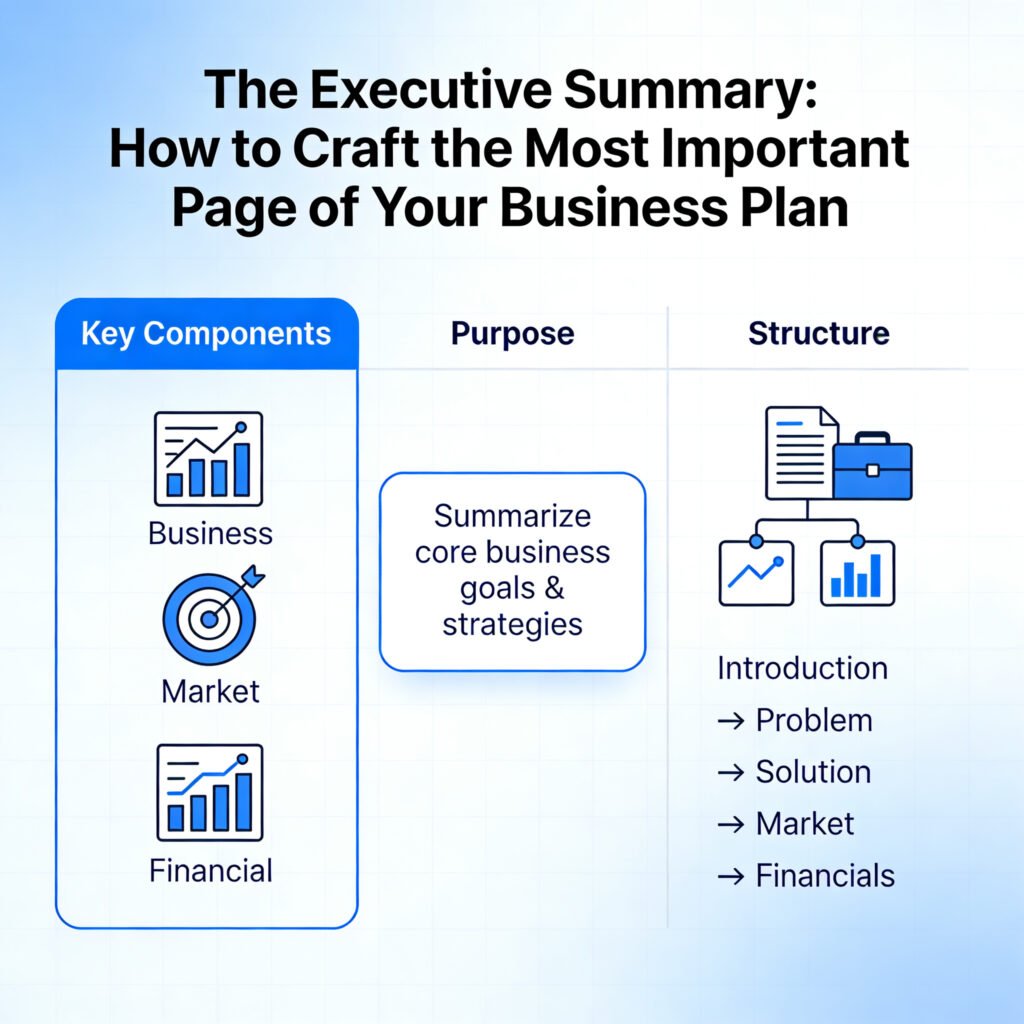
While formats can vary, this seven-paragraph structure is a proven winner. Each paragraph serves a distinct purpose in building a logical and persuasive argument.
Paragraph 1: The Hook & The Problem
Start with a punch. Describe the significant, urgent problem or opportunity you are addressing. Use data if possible.
- Formula: “Every year, [Target Market] wastes/loses/suffers from [Problem] costing [Quantifiable Impact]. The current solutions, like [Current Alternatives], are inadequate because [Key Shortcomings].”
- *Example from a recent successful client summary: “Small e-commerce brands in the MENA region lose an estimated $200M annually to cart abandonment driven by distrust in cross-border payment systems.”*
Paragraph 2: The Solution & Value Proposition
Introduce your company as the answer. Clearly state what you offer and why it’s superior.
- Formula: “[Your Company Name] has developed [Your Product/Service] to solve this. Our solution [Key Thing It Does] unlike anything else because of our [Key Differentiator: technology, process, model].”
- Crucially, connect it directly to the problem stated above. Make the “problem-solution” link obvious.
Paragraph 3: The Market Validation & Traction
Prove you’re not just theorizing. This is where you build credibility.
- Formula: “The market opportunity is substantial, with a [Your Region] SAM of [$$]. We have validated our approach through [Evidence: pilot sales, MVP testing, LOIs]. To date, we have achieved [Key Metrics: e.g., $50K in pre-sales, 1,500 beta users, a partnership with X].”
- In my experience, this is the paragraph where investor eyes light up or glaze over. Concrete traction beats grandiose market size claims every time.
Paragraph 4: The Business Model & Marketing Strategy
Explain how you will make money and acquire customers succinctly.
- Formula: “We will generate revenue through [Primary Revenue Stream: e.g., SaaS subscriptions, transaction fees]. Our primary customer acquisition strategy leverages [Key Channel: e.g., content marketing, partner integrations, outbound sales] targeting [Specific Customer Segment].”
Paragraph 5: The Competitive Landscape & Sustainable Advantage
Acknowledge competition confidently and state why you will win.
- Formula: “While alternatives exist, such as [Competitor A] and [Competitor B], our sustainable advantage lies in our [1-2 key strengths: proprietary technology, exclusive partnerships, first-mover advantage in a niche]. The following comparison table illustrates our key differentiators…” (A simple, embedded mini-table can be powerful here).
Paragraph 6: The Team
Briefly introduce the founders and key team members. Focus on relevant expertise and past successes, not just job titles.
- Formula: “The venture is led by [Founder A], who brings [X years of experience in relevant industry] and a previous exit in [related field], and [Founder B], an expert in [key functional area like engineering or sales]. Our advisory board includes [Name], former [Impressive Title] at [Known Company].”
Paragraph 7: The Ask, Financial Projections & Call to Action
State clearly what you need and what you will achieve with it.
- Formula: “We are seeking an investment of [Amount] in exchange for [Equity %] / a loan of [Amount]. These funds will be allocated to [Top 3 uses: e.g., product development, marketing, key hires]. Based on our projections, we anticipate reaching [Key Milestone, e.g., profitability, $1M in revenue] within [Timeframe]. We invite you to review the detailed financials and discuss how we can partner for mutual success.”
- Always end with a professional call to action.
Why It’s Important: Your Strategic Linchpin
The executive summary is important because it performs multiple critical functions simultaneously:
- Saves the Reader Time: It respects their most valuable asset.
- Demonstrates Clarity and Focus: A well-structured summary shows you can synthesize complex information—a key leadership skill.
- Creates a First Impression of Professionalism: Typos, vagueness, or hype here will color the perception of your entire venture.
- Serves as a Standalone Document: It can be emailed separately, used in pitch deck appendixes, or shared with contacts who don’t need the full plan.
- Aligns Your Team: The process of writing it forces absolute consensus on the most critical elements of your strategy. It is the foundational document for all other messaging, as explored in our resources on strategic alignment and partnerships.
Sustainability in the Future: The Dynamic, Living Summary
The future of the executive summary is dynamic and data-linked. We are moving towards interactive summaries where key metrics (like current MRR, user growth) are pulled from live dashboards, ensuring the summary is never outdated. For internal use, the summary evolves into a “North Star” document that is reviewed quarterly, aligning the team on current priorities, traction metrics, and immediate goals, much like a living lean business plan. The static PDF will be supplemented by a secure, updatable digital version that provides a real-time snapshot of the business.
Common Misconceptions

- Misconception: “It’s just a summary, so I’ll write it last.” Reality: While you finalize it last, you should draft it first. Writing a one-page summary at the outset forces you to clarify your core message before you get lost in 40 pages of details. Use it as an outline for the full plan.
- Misconception: “It needs to include every detail from the plan.” Reality: Its power is in omission. You must kill your darlings. Include only the most compelling, highest-level points. Think highlights, not transcripts.
- Misconception: “Using hype words and exaggerated projections will make it more exciting.” Reality: Experienced readers have hype detectors. Words like “revolutionary,” “guaranteed,” and “no competition” trigger skepticism. Use confident, factual language.
- Misconception: “It should be written for everyone.” Reality: Know your audience. An executive summary for a bank loan officer will emphasize assets, collateral, and cash flow. One for a tech VC will emphasize growth rate, market size, and defensibility. Tailor the emphasis accordingly.
Recent Developments: The “Teaser Deck” Integration
A significant trend in 2024-2025 is the blending of the executive summary and the pitch deck. Many investors now request a “teaser deck”—a 5-7 slide PowerPoint that follows almost the exact structure of a powerful executive summary. This visual format is often more digestible. Therefore, your written summary and your teaser deck should be siblings, conveying the same core narrative in slightly different mediums. This integrated approach ensures consistency across all your fundraising touchpoints.
Success Story: From Summary to Series A
A clean-tech startup, “AquaNex,” had a complex technology for water purification. Their initial executive summary was a dense, three-page technical document filled with jargon. It failed to generate meetings. We reframed it using the seven-paragraph blueprint.
- Hook: Led with the problem: “2.2 billion people lack access to safe drinking water, and current purification systems are too costly and energy-intensive for off-grid communities.”
- Solution: Simplified: “AquaNex’s solar-powered unit provides clean water for 500 people per day at 1/10th the operational cost of existing systems.”
- Traction: Highlighted: “Awarded a $250k UN grant, with units deployed in 10 pilot villages reducing waterborne illness by 90%.”
- The Ask: “Seeking $2M to scale manufacturing and deploy 500 units across Sub-Saharan Africa.”
This revised summary, focusing on the massive problem and proven impact rather than the technical nuances, secured 12 investor meetings in a month and was instrumental in closing their Series A round. The summary didn’t change their business; it changed how the world understood it.
Real-Life Examples
- SaaS Company Summary: Would emphasize the pain point for businesses (e.g., low team productivity), the subscription solution, monthly recurring revenue (MRR) growth, low churn rate, and the scalable customer acquisition cost (CAC).
- Local Restaurant Seeking a Loan: Would emphasize the proven concept (if a franchise), the specific location’s demographics and traffic, the experienced restaurateur leading it, detailed financial projections showing debt service coverage, and the personal investment of the owner.
- Social Enterprise Seeking a Grant: Would lead with the social or environmental problem, the innovative model for addressing it, key impact metrics from pilots, the sustainability plan (how it will eventually cover costs), and the specific grant amount needed to achieve the next milestone.
Conclusion and Key Takeaways
The executive summary is the most concentrated piece of strategic writing you will ever do for your business. It is a test of your understanding, your communication skills, and your venture’s fundamental strength. A powerful summary opens doors; a weak one slams them shut. Invest the time to make it exceptional. Write it, rewrite it, test it on trusted advisors, and polish it until every word carries weight.
Key Takeaways:
- Draft First, Finalize Last: Use the summary to outline your plan’s core argument.
- Follow a Proven Structure: The seven-paragraph blueprint provides a failsafe framework for completeness and flow.
- Lead with the Problem: You must establish a compelling “why” before explaining your “what.”
- Quantify Everything Possible: Use numbers for the problem, the market, traction, and projections. Numbers create credibility.
- Know Your Audience & Tailor the Tone: A bank, an angel investor, and a corporate partner have different primary concerns.
For more on crafting compelling narratives and strategic documents, explore our full library of guides in the Sherakat Network blog.
Frequently Asked Questions (FAQs)
1. How long should an executive summary be?
The absolute ideal is one page. Never exceed two pages. A single page demonstrates discipline and respect for the reader’s time. If you can’t captivate them in one page, 30 won’t help.
2. Should I include financial tables in the summary?
Include only the key headline numbers: Amount of funding sought, key uses of funds, and perhaps one top-line projection (e.g., “Projecting $2M in revenue in Year 3”). Save the full financials for the plan appendix.
3. Can I use bullet points?
Yes, sparingly. They are excellent for listing key achievements, team expertise, or uses of funds. But the core narrative should be in clear, compelling paragraphs. Avoid turning the entire summary into a bulleted list.
4. Where does the executive summary go in the business plan?
It is always the first section, after the title page and before the table of contents.
5. How is this different from an elevator pitch?
An elevator pitch is a 30-60 second verbal overview. The executive summary is its more detailed, written counterpart (1-2 minutes of reading). They should convey the same core story.
6. What tone should I use?
Confident, professional, and enthusiastic, but grounded in facts. Avoid slang, jokes, and overly casual language. Write in the active voice (“We will capture market share,” not “Market share will be captured.”).
7. How specific should I be about competitors?
Name 1-3 key competitors to show you understand the landscape. Briefly state your differentiator. Do not disparage them. A simple comparison table can be very effective here.
8. What if I’m pre-revenue and have no traction?
Focus on other forms of validation: positive feedback from potential customer interviews, letters of intent, successful prototype tests, relevant industry awards, or the compelling prior experience of your team. “Traction” can be evidence of problem validation, not just sales.
9. Should I hire a professional writer to do this?
You can hire an editor to polish it, but you must write the first draft. The process of distilling your own vision is irreplaceable. An outside writer won’t have your passion or deep knowledge.
10. How many times should I revise it?
Expect to write 5-10 drafts. Read it aloud. Have people who know nothing about your business read it and tell you what they understood. Their confusion is your editing guide.
11. What’s the biggest mistake you see in executive summaries?
Starting with “My company is…” or “We are seeking…” You must earn the reader’s interest by first describing a problem they care about. Starting with yourself is boring and self-centered.
12. How do I handle confidential information?
The summary should be compelling without revealing your “secret sauce.” Describe the benefit of your technology or process, not the precise technical details. You can mark the document “Confidential.”
13. Is it okay to use industry jargon?
Minimize it. If you must use a technical term, explain it in plain language immediately. Your goal is clarity, not to prove how smart you are. Assume an intelligent reader who is not an expert in your niche.
14. How do I write a summary for a internal business plan (not for funding)?
The structure is similar, but the “Ask” becomes your “Request for Approval” or “Key Recommendation.” Focus on the business case: the opportunity cost, the expected ROI, the resources required, and the strategic alignment with company goals.
15. Can I use the same summary for different types of investors?
Create a master version, then tailor the emphasis for each audience. For a venture capitalist, highlight growth potential and market size. For an impact investor, highlight social/environmental metrics. For a bank, highlight assets, cash flow, and collateral.
16. What font and formatting should I use?
Use a standard, professional font (e.g., Times New Roman, Arial, Calibri), 11 or 12-point size, with 1.5 line spacing. Use bold for section headings if you use them. Ensure ample white space—a dense wall of text is off-putting.
17. How do I write about the team if I’m a solo founder?
Highlight your direct, relevant experience and achievements. Then, discuss your plan to build the team with the funding, and mention any key advisors or mentors you have already enlisted. Show self-awareness about the gaps you will fill.
18. Should I include graphics or logos?
A simple, clean logo at the top is acceptable. One small, simple chart or graph (e.g., a market growth curve or a traction timeline) can be powerful if it communicates a key point instantly. Do not clutter the page.
19. How does this relate to the Business Model Canvas?
The executive summary is the narrative story; the Canvas is the visual framework. The summary paragraphs on Solution, Business Model, and Competition directly reflect the Value Proposition, Revenue Streams, and Customer Segments blocks of the Canvas.
20. What if my business is very complex?
The more complex the business, the more vital it is to have a simple, clear summary. This is where you shine. If you can explain a complex idea simply, you demonstrate mastery. Use analogies if helpful.
21. How do I project confidence without arrogance?
Use data and evidence as the source of your confidence. Instead of “We are the best,” say “Our pilot achieved a 40% higher retention rate than the industry average.” Let the facts speak.
22. What should the call to action (CTA) be?
Make it easy and clear. “We are available to present our detailed plan next week at your convenience.” or “Please contact us to review the full financial model and discuss partnership.” Provide clear contact information.
23. How important are spelling and grammar?
Critically important. A single typo suggests sloppiness and can cause a reader to doubt your operational rigor. Use spellcheck, then have at least two other people proofread it meticulously.
24. Can I include customer testimonials?
A short, powerful one-sentence quote from a pilot customer or respected advisor can be incredibly effective, placed strategically (e.g., after the solution paragraph). It serves as social proof.
25. How do I write a summary for a non-profit or social enterprise?
The structure is identical, but replace “Business Model” with “Sustainable Funding Model.” The “Ask” becomes a grant or donation request. “Traction” becomes “Impact Metrics” (lives changed, trees planted, etc.). Emphasize the theory of change.
26. What’s the role of storytelling in an executive summary?
A subtle narrative arc is essential: Problem (Conflict) -> Solution (Resolution) -> Team (Heroes) -> Vision (New World) -> Ask (Call to Adventure). This structure is psychologically engaging.
27. How do I balance brevity with providing enough information?
After each draft, ask for every sentence: “Is this absolutely essential for the reader to understand the core opportunity and take the next step?” If not, cut it. Be ruthless.
28. Should I include an exit strategy for investors?
In a summary for equity investors, it can be appropriate to hint at the long-term potential. A sentence like “The company is positioned for acquisition by major players in the adjacent [X] market” can be effective. Do not over-promise.
29. Where can I see good examples?
Harvard Business School’s publishing arm and many university entrepreneurship centers publish sample plans. Our Sherakat Network Resource Library provides annotated templates.
30. What is the final, non-negotiable test for a great executive summary?
Give it to a busy, intelligent friend in a different industry. If they can read it in 90 seconds and then accurately explain to you: 1) What your business does, 2) Why it’s needed, and 3) What you want—it’s a success. If they can’t, revise.
About the Author
Sana Ullah Kakar is a strategic communications specialist who has spent over a decade translating complex business concepts into compelling narratives. As a former venture capital analyst, they have read thousands of executive summaries, witnessing firsthand the direct correlation between a well-crafted page and a founder’s ability to secure meetings and funding. At Sherakat Network, they coach founders on the art of persuasive writing, believing that the ability to articulate a vision clearly is as important as the vision itself. Their philosophy is that an executive summary is not an extract, but the essence—and capturing that essence is the founder’s ultimate test of clarity. They are passionate about empowering entrepreneurs with the tools to make their ideas understood and irresistible. For direct guidance, reach out via our contact page.
Free Resources
From Sherakat Network:
- Annotated Template: Download our seven-paragraph executive summary template with line-by-line instructions from our Resource Library.
- From Summary to Launch: After your summary is set, build the rest of your plan with our guide on One-Page Lean Business Planning.
- Partnership Narratives: Learn how to frame partnership opportunities compellingly in our guide to business partnership models.
External Insights:
- Mental Clarity: The focus needed for this work ties to overall wellbeing; explore insights in The Complete Guide to Psychological Wellbeing.
- Global Narratives: Understand how to position your business in a global context, similar to topics covered in Global Supply Chain Management.
- Innovation Context: See how cutting-edge fields like AI and Machine Learning are framed in investment summaries.
Discussion
What is the hardest part of writing your executive summary: boiling down the problem, describing the solution simply, or presenting the financial ask with confidence? Share your specific challenges or “aha!” moments about crafting your one-page story in the comments below.
Great article! I’ll definitely come back for more posts like this.
You’ve clearly done your research, and it shows.
This site offers a curated approach to film discovery.Each selection features curated posters, official trailers, and accessible streaming options,and the collections are categorized for straightforward navigation.The platform is actively maintained with new releases.This approach streamlines your search by bringing together all necessary elements.You can find recommendations suited to your mood.
Step into the London Hatchery and Conditioning Centre and witness a future devoid of pain but lacking soul. Finding a high-quality Brave New World PDF allows you to read this prophetic novel on any device. Understand why this book remains one of the most important critiques of modern society.
There is a unique joy in following the lives of the March sisters as they navigate the challenges of poverty and the pressure to conform. Their story is a testament to the power of individuality and the strength of sisterhood. If you are looking to read this book for the first time or the fiftieth, a digital copy is incredibly practical. Searching for a Little Women PDF enables you to have the book on your smartphone or tablet. This means you can steal a few pages of this heartwarming classic during your lunch break or while traveling, keeping the spirit of the March family with you.
For a reading experience that fits your lifestyle, choose the digital version of Shield of Sparrows by Devney Perry. The epub file is easy to download and works on almost all devices. This novel is a stunning addition to the romance genre, offering depth and excitement. Perry has a unique voice that resonates with readers, and this book is a prime example. The portability of the ebook means you can take the story with you on all your adventures. Don’t miss out on this incredible read; add it to your digital collection.
This novel is a dark adventure. Shay is the hero we need. The The Last Housewife epub is the perfect format. The story is gripping. It is a book about hope. Winstead is amazing.
Understanding German grammar is hard, but seeing it in action makes it easier. You might be looking for a short stories in German PDF to see examples of cases and conjugations. In “Short Stories in German for Beginners,” grammar is woven naturally into the text. You see how the dative and accusative cases work in real sentences, not just in tables. This implicit learning helps you develop a “feel” for what sounds right. Over time, you will stop translating in your head and start just understanding. It is the natural evolution of language learning.
Better Than the Prom is the perfect book to discuss with friends. It has so many memorable moments. If you are looking for the PDF, you might be preparing for a book club. The story sparks conversation and debate. It is a thought-provoking read that offers more than just fluff.
Better Than the Prom proves that YA romance can be smart and sophisticated. It treats its audience with respect. If you are searching for the PDF, you are a discerning reader. The book doesn’t talk down to its readers. It engages them on an intellectual and emotional level.
If you want to understand German culture, you need to read. While these stories are written for learners, they reflect the cultural nuances of the language. A simple short stories in German PDF might miss these subtleties. The way characters interact, the idioms they use, and the settings all provide cultural context. Language and culture are inseparable. Learn both at the same time by diving into stories that are rich in linguistic and cultural detail.
Celeste Ng weaves a masterful tale of a mixed-race family living in a small Ohio town during the 1970s. The disappearance of the teenage daughter, Lydia, acts as a catalyst that destroys the delicate balance of the Lee household. Readers often look for a digital version or a Everything I Never Told You PDF to dive into this emotional thriller immediately. The book explores the crushing weight of dreams that parents place upon their children and the silence that can grow between people who love each other. It is a story of missed understandings and the ultimate cost of keeping secrets.
Zade Meadows is the monster under the bed that you actually want to find. His character is a bundle of contradictions that makes him endlessly fascinating. Readers searching for the Haunting Adeline PDF are often looking to understand the hype behind this enigmatic figure. The book does not disappoint, providing a deep dive into his twisted motivations. Adeline is a worthy match for him, fighting back with a fire that matches his darkness. Together, they create a combustion that burns through the pages of the book.
The Lee family’s story is a reminder that we never truly know anyone, not completely. But we can try. We must try. That is the heart of this book. If you are searching for the Everything I Never Told You PDF, you are taking a step toward understanding. It is a book about the effort of love. It is a story that will change you.
Are you prepared to face the man who calls himself a shadow? The narrative of this book is designed to make your heart race and your palms sweat. With so many readers looking for the Haunting Adeline PDF, it is clear that the appetite for dark, twisted love stories is at an all-time high. The plot twists will keep you guessing, and the spice level is off the charts. It is a perfect blend of adrenaline and endorphins, providing an escape from reality that is both terrifying and exhilarating. Join the thousands of readers who have already succumbed to the madness of the Cat and Mouse duet.
Healing is a major theme as Yrene Towers continues to play a pivotal role. Her power is the antithesis of the Valg, representing life and health. The connection between healers and warriors is explored deeply. Access the kingdom of ash pdf to read about Yrene’s crucial contribution to the war. She proves that you don’t need a sword to be a hero. Her confrontation with Erawan is one of the most unique battles in the book.
This is the crescendo of a symphony that started in a salt mine. The music of the story reaches its loudest point. Listen to the story in the kingdom of ash pdf. It is a masterpiece of composition.
Sarah J. Maas has created a masterpiece of the genre. The intricate plotting, the deep character work, and the expansive world-building come together perfectly. A Queen of Shadows pdf is the evidence of her skill. It is a book that stands the test of time. Years from now, readers will still be discovering and falling in love with this story. It is a classic in the making.
Steinbeck’s use of the biblical narrative is not a direct copy, but a reinterpretation that empowers the individual. The shift from “thou shalt” to “thou mayest” is the crux of the novel. Theology students often use the book to discuss secular interpretations of scripture. An East of Eden PDF is a useful resource for comparing the novel side-by-side with the Book of Genesis. Our platform facilitates this comparative study, offering insights into how Steinbeck adapted the ancient text for a modern audience. We provide the theological context to deepen your appreciation of the novel.
The intricate legal maneuverings regarding the property in the novel are often overlooked. A Wuthering Heights PDF helps you understand how Heathcliff legally steals the estate. It is a plot point that turns on the laws of the time. The digital text allows you to slow down and parse the details of the inheritance. It adds a layer of realism to the gothic drama. The ebook format is perfect for this kind of close reading, where every detail matters to the overall understanding of the villain’s master plan.
This book is a love letter to teenage girls who feel too much and dream too big. Liz Buxbaum is a protagonist who deserves her happy ending, and watching her get it is a joy. A Better Than the Movies PDF is perfect for late-night reading under the covers. It is a story that proves that the best romantic moments are the ones that aren’t rehearsed.
The ending of the novel is one of the most debated in literature. Does it offer hope or just a continuation of the cycle? You can decide for yourself by reading the final chapters in a Wuthering Heights PDF. The image of the three headstones on the edge of the moor is iconic. A digital copy allows you to reread the conclusion as many times as needed to grasp the subtle nuances. It is a hauntingly beautiful finish to a turbulent story, leaving the reader with a sense of peace that contrasts sharply with the rest of the book.
Classics are often best enjoyed when they are easily accessible on modern devices. A search for a Wuthering Heights PDF reveals the enduring popularity of this stormy tale. The relationship between Catherine and Heathcliff is not just a romance; it is a force of nature that destroys everything in its path. By reading the electronic version, you can pause to reflect on the intense dialogues and the intricate genealogy of the characters without carrying a heavy hardback. It is the perfect solution for commuters and travelers who want to get lost in a great book.
If you are a fan of “To All the Boys I’ve Loved Before,” this book will be your next obsession. The fake dating setup is executed flawlessly, leading to real and intense feelings. A PDF format is ideal for binge-reading this addictive storyline in one sitting. It is a book that celebrates the genre while elevating it, showing that real love is often better than the movies we watch on repeat.
If you are a student struggling with the symbolism of the box of money or the auto mechanic shop, you are not alone. These symbols are layered. A close reading is required. An East of Eden PDF allows you to mark up the text and make connections. Our site offers a symbolism tracker, explaining the recurring objects and what they represent. We provide the keys to unlocking the deeper meaning of the narrative objects.
Austen’s heroines are always intelligent, but Elizabeth is the sharpest. Her mind is her greatest asset. To watch her think, read the novel. A Pride and Prejudice PDF allows you to follow her thought process. Our site champions intelligence in literature. We provide access to the story of a woman who uses her brain to get what she wants. Be inspired by her wit and wisdom.
Why do readers continue to be obsessed with a novel published in 1847? The answer lies in the raw human emotion found on every page. Finding a Wuthering Heights PDF allows you to join the millions who have been moved by this story. It is not just a love story; it is a tragedy about the loss of the self. The famous quote, “I am Heathcliff,” resonates because it speaks to a connection deeper than romance. Reading this digitally brings these powerful words to life on your screen, offering a convenient entry point into a world of intense feeling.
The enduring popularity of the novel has led to countless adaptations, but the original text remains superior. The internal monologues of Elizabeth Bennet provide insight that no movie can fully capture. If you want the full experience, reading the book is non-negotiable. Many readers find that a Pride and Prejudice PDF offers the best balance of accessibility and readability. Our website is committed to this literary gem, helping you connect with the source material. Explore the depth of emotion and the sparkle of wit that characterizes Austen’s best work.
Friendship is tested in the fires of romance. Jenny Han explores this conflict. The PDF of the book reveals the strain on the group dynamic. The Summer I Turned Pretty is about how love changes friendships. Belly, Conrad, and Jeremiah have to figure out a new way to be together. The story is about the evolution of relationships.