


Profit with Purpose: The Rise of Hybrid Social Enterprises in Pakistan:
Introduction – Why This Matters
In a country where pressing social challenges—from education gaps and healthcare access to gender inequality and rural poverty—intersect with a vibrant entrepreneurial spirit, a powerful new model of business is taking center stage: the social enterprise. This is not charity; it’s not traditional corporate social responsibility (CSR). It is a fundamentally different beast: a business built from the ground up to generate both sustainable financial profit and measurable, scalable social impact. For the curious beginner, this shatters the false dichotomy of “do good” versus “make money.” For the professional, it offers a sophisticated framework for systems change, stakeholder capitalism, and building ventures that are resilient because they are deeply embedded in solving real human needs.
In my experience working with over fifty social entrepreneurs across Pakistan, I’ve observed a crucial evolution. A decade ago, founders often asked, “How much impact can I create with the grants I raise?” Today, the defining question is, “What sustainable business model can I build to solve this problem for a billion people?” This shift from donor-dependence to market-based sustainability marks the maturation of Pakistan’s social impact sector into a formidable economic force. This matters because philanthropy, while vital, is finite and often cyclical. Business models, when designed correctly, are engines of infinite, self-sustaining change.
Background / Context: Bridging the Gulf Between Need and Market
Pakistan faces a significant “social sector gap.” Government services often struggle to reach the most vulnerable, especially in remote areas. Traditional non-profits, reliant on unpredictable donor funding, face constant scalability constraints. The private sector, meanwhile, has historically focused on serving the middle and upper classes, leaving Base of the Pyramid (BoP) populations—comprising hundreds of millions—underserved as consumers and producers.
This gap represents not just a moral failure, but a monumental market failure. It’s an economy operating at half-capacity. Enter the social entrepreneur. They see the BoP not as passive beneficiaries, but as dynamic customers, suppliers, and partners. They recognize that a low-income mother will pay for high-quality, affordable neonatal healthcare because the value is clear. They understand that a smallholder farmer will adopt a new technology if it demonstrably increases her income.
The context is ripe for this model. A young, digitally-connected population is demanding more from businesses. Global impact investing capital has grown to over $1.16 trillion in assets under management (GIIN, 2024), with increasing interest in South Asia. Within Pakistan, pioneers have spent the last 15 years proving the concept—often through immense struggle—creating a blueprint for a new generation. They’ve navigated the complexities of hybrid legal structures, balanced the expectations of impact-first and financial-first investors, and developed metrics that satisfy both boardrooms and communities. For a foundational understanding of structuring complex ventures, see our guide on Business Partnership Models.
Key Concepts Defined
- Social Enterprise: An organization that applies commercial strategies to maximize improvements in human and environmental well-being—this includes both social and financial goals.
- Impact Investing: Investments made with the intention to generate positive, measurable social and environmental impact alongside a financial return. It spans from below-market “concessionary” capital to market-rate returns.
- Theory of Change: A comprehensive description of how and why a desired change is expected to happen in a particular context. It maps out the causal pathway from activities to impact.
- Blended Finance: The strategic use of development finance (philanthropic or public funds) to mobilize private capital for social impact. For example, a grant covers the high-risk R&D phase, attracting venture capital for scaling.
- Base of the Pyramid (BoP): The largest but poorest socio-economic group, comprising roughly 4-5 billion people globally living on less than $8 per day. In Pakistan, this represents the majority of the population.
- Impact Measurement & Management (IMM): The process of defining, tracking, and optimizing the social and environmental effects of an enterprise. Key frameworks include IRIS+ and the UN Sustainable Development Goals (SDGs).
- Hybrid Legal Structure: A corporate form designed for mission-driven businesses. While Pakistan doesn’t yet have a dedicated “Benefit Corporation” law, social enterprises often use a Private Limited Company structure with their social mission embedded in the Articles of Association.
- Double/ Triple Bottom Line: Accounting frameworks that go beyond profit to include People (social equity) and Planet (environmental health) alongside Profit.
How It Works: Architecting a Hybrid Enterprise (Step-by-Step)
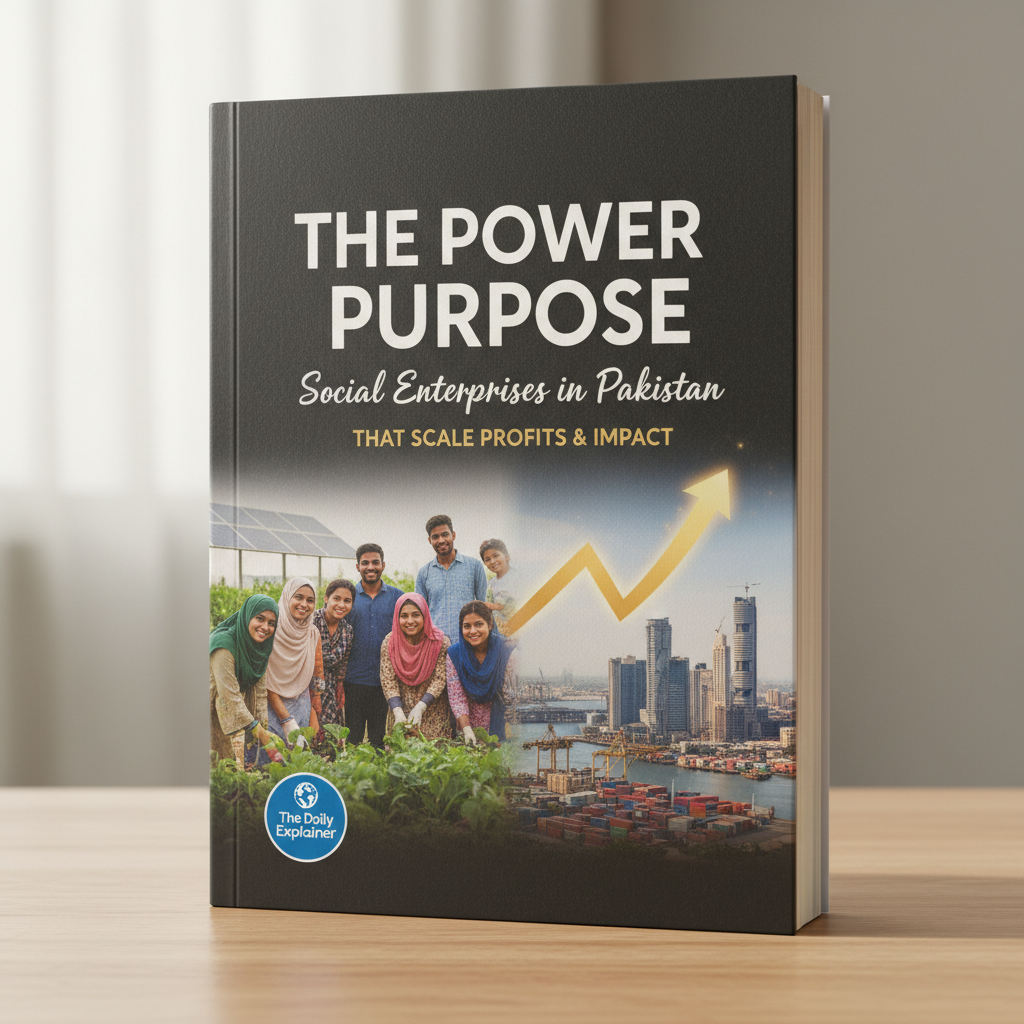
Phase 1: Problem-Centric, Not Product-Centric, Ideation
The process begins with deep immersion in the community facing the challenge. Founders live the problem. They identify not just the surface need (“access to loans”) but the root systemic failures (“lack of collateral due to unregistered land, leading to no credit history”). The solution is designed backward from this deep understanding.
Phase 2: Designing the “Magic” Revenue Model
This is the core innovation. The enterprise must generate enough revenue from its operations to cover costs and grow, while ensuring the price point is accessible to the target population. Common models include:
- Cross-Subsidy: Charging wealthier customers more (or selling them premium products) to subsidize services for the poor. (e.g., a clinic with a full-price ward funding a community outreach program).
- Franchising/ Licensing: Creating a standardized, low-cost operating model and training local entrepreneurs (often women) to run units, sharing revenue.
- Fee-for-Service with Tiered Pricing: A clear, affordable fee for a essential service, with a sliding scale based on ability to pay, verified through simple means-testing.
- By-Product or Ancillary Revenue: Selling data (anonymized), training, or certification based on the core operational expertise.
Phase 3: Building a Mission-Locked Governance Structure
To prevent “mission drift”—where financial pressures eclipse social goals—the enterprise’s DNA must be legally and culturally encoded. This involves:
- Mission in MoA/AoA: Enshrining the social objective in the company’s constitutional documents.
- Impact-Voting Shares: Creating different share classes where impact-focused investors or an advisory board have veto rights on decisions that could harm the core mission.
- Impact-Linked Executive Compensation: Tying a portion of leadership bonuses to hitting social, not just financial, KPIs.
Phase 4: Capital Stack Architecture: Blending the Right Funds
Social enterprises rarely thrive on a single funding type. They build a layered “capital stack”:
- Grant/Philanthropic Capital (0% return expected): For high-risk R&D, proof-of-concept, and serving the hardest-to-reach populations initially.
- Concessionary Debt/Quasi-Equity (below-market return): From impact investors or development finance institutions (DFIs) like the Karandaaz Pakistan.
- Commercial Investment (market-rate return): For scaling proven, profitable models. This attracts traditional VCs and private equity.
Phase 5: Rigorous Impact Measurement Integration
Impact is not an afterthought; it’s a core operational metric, tracked with the same rigor as revenue. They use tools like Social Return on Investment (SROI), calculating that for every 1 rupee invested, 5 rupees of social value is created (e.g., through increased income, saved medical costs, educational attainment).
Phase 6: Scaling: The Replication vs. Ecosystem Approach
Scaling impact doesn’t always mean growing the single organization. It can mean:
- Open-Sourcing the Model: Making the playbook available for others to replicate.
- Government Adoption: Proving a model’s efficacy so the state adopts and funds it at scale.
- Creating a Marketplace: The enterprise itself becomes a platform that enables thousands of other small businesses to thrive.
Why It’s Important: The Systemic Ripple Effect
The importance transcends individual success stories. Pakistani social enterprises are:
- Market Creators: They formalize informal economies, bringing marginalized populations into the financial system as consumers and entrepreneurs.
- Innovation Labs: They develop frugal, context-appropriate innovations under extreme constraints, which often have global applications.
- Trust Bridges: They build credibility and networks in communities where governments and large corporations have failed, creating pathways for broader development.
- Talent Magnets: They attract a new generation of talent—both local and diasporic—who seek meaningful work.
- Policy Proof Points: They provide evidence-based models for how public-private partnerships can effectively deliver essential services.
What I’ve found is that the discipline required to run a successful social enterprise—extreme capital efficiency, deep customer empathy, and systems thinking—creates some of the most resilient and adaptable leaders in the Pakistani business landscape.
Sustainability in the Future: The Next Frontier
The future of social enterprise in Pakistan is moving towards systems change entrepreneurship. The next wave isn’t just about building a better school or clinic; it’s about rewiring the entire education or healthcare system. Key trends include:
- Tech-Enabled Hyper-Localization: Using AI and mobile platforms to tailor solutions (education content, agricultural advice, healthcare diagnostics) to the specific needs of a village or even a household.
- Focus on “Just Transition”: Enterprises that help communities and workers transition from carbon-intensive or precarious livelihoods to green, dignified jobs—a topic aligning with global Climate Policy discussions.
- Mainstreaming of Impact Accounting: Expect impact metrics to become as standardized as financial accounting, audited by third parties, and integrated into stock exchange listings.
- The Rise of the “Social IPO”: As these enterprises mature, we will see exits and public listings where impact performance is a core part of the investor prospectus.
- Corporate Spin-Outs: Large Pakistani corporations will spin out or partner deeply with social enterprises to manage their ESG portfolios and reach new markets authentically.
The enterprises that will define the next decade are those that can move from delivering a service to transforming a market structure.
Common Misconceptions
- Misconception 1: Social enterprises are just nice-sounding NGOs.
- Reality: They are legally for-profit entities with shareholders. Their innovation lies in aligning profit motives with impact outcomes. An NGO gives away mosquito nets; a social enterprise sells them at a tiny margin, creating a self-sustaining distribution channel.
- Misconception 2: They can’t achieve venture-scale returns.
- Reality: Many do. A market-rate impact investor expects the same financial return as a traditional VC. The difference is the additional due diligence on impact. Companies like d.light (solar lighting, global) proved you can achieve unicorn status while serving the BoP.
- Misconception 3: Impact measurement is soft and unquantifiable.
- Reality: Modern IMM is highly quantitative. It tracks metrics like “incremental income increase per beneficiary household,” “tonnes of CO2 avoided,” or “learning-adjusted years of schooling gained.” These are hard numbers.
- Misconception 4: You have to sacrifice salary and talent quality.
- Reality: While early-stage founders may take lower pay, successful social enterprises compete for top talent by offering mission-alignment, equity, and competitive packages. The “purpose premium” is real.
- Misconception 5: It’s only for “soft” sectors like education and health.
- Reality: Some of the most impactful enterprises are in financial technology, supply chain logistics, and clean energy—hardcore, tech-intensive industries.
Recent Developments (2024-2025): The Ecosystem Matures
- SEF (Social Enterprise Foundation) Pakistan’s Legal Advocacy: Intensive lobbying is underway for a new Social Enterprise Act that would provide tax incentives, easier incorporation, and clarity for investors—a potential game-changer.
- Blended Finance Facilities Launch: DFIs like the British International Investment (BII) and local banks have launched dedicated blended finance vehicles to de-risk private investment in Pakistani social enterprises, particularly in climate adaptation.
- Corporate Venture Arms for Impact: Major Pakistani conglomerates are setting up corporate venture capital (CVC) arms specifically targeting social enterprises that can enhance their value chain resilience or CSR goals.
- University-Led Incubators: Institutions like LUMS, IBA, and NUST now have dedicated social innovation incubators, producing a pipeline of ventures grounded in academic research.
- Diaspora-Led Syndicates: Pakistani expatriates in tech and finance hubs are forming impact investing angel syndicates, bringing both capital and global operational expertise to local founders.
Success Stories & Real-Life Examples
1. Maqsad – EdTech with a Social Mission at Scale:
Founded by Taha Ahmed and Rooshan Aziz, Maqsad started as a classic venture-backed EdTech, providing after-school academic content for Pakistani students. However, their social mission is hardwired into their model. They maintain a freemium core—a vast library of free, high-quality video lessons in Urdu for matric and intermediate students, directly serving the BoP. Their revenue comes from premium features (test prep, doubt-solving) and a small subscription for advanced content. This cross-subsidy model ensures accessibility. By 2025, they had reached over 4 million monthly active users, with a significant majority on the free tier. Their impact metric is learning outcomes improvement, which they track rigorously. They prove that a venture-scale company can prioritize reach and impact without sacrificing growth.
2. Taraqee Foundation – The Rural Distribution Pioneer (A For-Profit Non-Profit Hybrid):
Taraqee operates a unique, legally hybrid model. The Taraqee Foundation (a non-profit) builds the “last-mile” infrastructure: it identifies, trains, and supports female micro-entrepreneurs (“Community Business Partners”) in remote villages. The Taraqee Impact Enterprises (a for-profit) then sources essential goods (sanitary pads, fortified food, solar lights) and uses this pre-built distribution network to sell them. The Foundation ensures social integrity and training; the Enterprise ensures supply chain efficiency and scale. This elegant separation allows them to attract both grants (to the Foundation) and investment (to the Enterprise). They’ve built a network of over 5,000 women entrepreneurs serving millions of rural customers.
3. Sehat Kahani – Democratizing Healthcare through a Platform Model:
Founded by doctors Dr. Sara Saeed Khurram and Dr. Iffat Zafar Aga, Sehat Kahani tackled the dual problem of unemployed female doctors (due to societal restrictions) and communities with no healthcare access. They created a telemedicine platform where female doctors, often working from home, consult with patients at digital clinics in low-income communities, staffed by nurse assistants. The revenue comes from a B2B model: subscriptions from corporations for employee healthcare, and from NGOs/government for serving specific populations. They also have a direct B2C fee-for-service. Their impact is measured in patients served, jobs created for female doctors, and reduced patient travel time/cost. They’ve conducted over 3 million consultations, showcasing a platform model that scales both impact and revenue.
4. Cykle – Circular Economy as Social Justice:
Cykle addresses plastic waste and informal waste-picker livelihoods. They partner with informal waste pickers (the kabariwalas), providing them with digital tools, fair-price contracts, and safety gear. They then collect, sort, and process plastic into high-quality recycled raw material sold to manufacturers. Their revenue comes from the sale of recycled plastic. Their impact is threefold: environmental (waste diverted), economic (stable, increased income for waste pickers), and social (dignity and formalization for a marginalized workforce). They measure tonnes of plastic recycled and percentage income increase per waste-picker household.
Key Takeaway Box:
The Hybrid Engine: The most resilient Pakistani social enterprises don’t just balance profit and purpose; they engineer a virtuous cycle where each drives the other. A deeper social reach (purpose) builds trust and market penetration, which lowers customer acquisition costs and drives revenue (profit). Higher profits allow for greater R&D and scaling, which deepens impact (purpose). Breaking this false dichotomy is their superpower.
Conclusion and Key Takeaways
The journey of the Pakistani social entrepreneur is perhaps the most complex entrepreneurial path—navigating the expectations of beneficiaries and bankers, measuring smiles and shareholder value. Yet, it is also the most necessary. In a world of polycrisis, business models that externalize their social and environmental costs are becoming obsolete. The future belongs to hybrids.
Final Takeaways:
- Start with Systems, Not Symptoms: Design for root-cause change, not just service delivery.
- Engineer Your Revenue Model First: The business model is your theory of change in economic form. If it doesn’t work financially, your impact won’t scale.
- Legally Lock Your Mission: Protect your social purpose from future dilution with smart governance.
- Build a Blended Capital Stack: Match the right type of capital (grant, debt, equity) to each stage of your risk and impact journey.
- Measure with Ruthless Rigor: Your impact data is your credibility currency with investors, partners, and the community.
The power of purpose in Pakistani business is no longer a fringe concept. It is becoming the benchmark for what a successful, future-proof company looks like. For those drawn to this path, begin by studying the landscape in our Resources section and connecting with the community.
FAQs (25 Detailed Q&A)
1. What’s the legal structure for a social enterprise in Pakistan?
Most register as a Private Limited Company (Pvt. Ltd.) under the Companies Act, 2017. The social mission is embedded in the Memorandum and Articles of Association (MoA/AoA). Some use a dual structure: a non-profit trust/foundation for community work and a for-profit company for commercial operations, linked by a formal agreement.
2. How do I find impact investors in Pakistan?
Network through platforms like Pakistan Impact Investing Network (PIIN), Karandaaz Pakistan, Acumen Pakistan, and attend events like the Pakistan Social Enterprise Conference. Also, research DFIs active in Pakistan (e.g., CDC Group, FMO, PROPARCO).
3. Can a social enterprise pay dividends to shareholders?
Yes, if structured as a for-profit. However, many have a dividend cap or profit reinvestment policy in their charter, limiting payouts to ensure the majority of profits are reinvested for growth and impact.
4. What are the biggest challenges in measuring social impact?
Attribution (proving your intervention caused the change, not other factors), cost of data collection, and selecting the right metrics that are both meaningful and feasible to track longitudinally.
5. How do I price my product/service for the BoP?
Use “reverse innovation”: Start with the price the BoP can afford (often determined through willingness-to-pay surveys), then work backwards to design a product/service that can be delivered sustainably at that price point. This forces extreme innovation.
6. Is there a conflict between serving shareholders and beneficiaries?
It can be managed through clear governance. The board should include representatives who are guardians of the mission (e.g., impact advisory board). Key decisions are evaluated through a dual lens: financial viability and impact integrity.
7. What sectors are most attractive to impact investors in Pakistan?
Financial Inclusion (FinTech), Climate-Smart Agri-Tech, Affordable Healthcare, EdTech, and Sustainable Energy Access. These have clear revenue models and scalable impact potential.
8. How do I write an impact-focused investment pitch deck?
Follow a structure: 1. The Problem (with data), 2. Your Solution, 3. Theory of Change (how your activities lead to impact), 4. Business & Revenue Model, 5. Traction (Financial & Impact Metrics), 6. The Team, 7. The Ask & Use of Funds (split between financial and impact milestones).
9. Can social enterprises get government contracts?
Yes, and this is a growing opportunity, especially in health, education, and vocational training. The Public Procurement Regulatory Authority (PPRA) rules have provisions for engaging with social enterprises, though the process can be complex.
10. How do I build a team that is both business-savvy and impact-driven?
Look for talent with a hybrid background—e.g., someone who worked in corporate strategy but also volunteered extensively. Assess for empathy and systems thinking during interviews. Offer equity to align long-term interests.
11. What is “impact washing” and how do I avoid it?
It’s exaggerating or fabricating social impact for marketing or fundraising. Avoid it by: setting modest, credible impact goals; using standardized metrics (IRIS+); conducting third-party evaluations; and being transparent about failures.
12. How does remote work culture affect social enterprises?
It allows access to diaspora talent and experts globally, but can create a disconnect from the communities served. Mandate regular “immersion” trips for all team members and hire locally for community-facing roles. Insights on managing remote teams can be found on World Class Blogs.
13. What are the tax implications for social enterprises?
Currently, taxed as a normal company. However, if part of the work is charitable (e.g., free clinics for the destitute), that portion may be eligible for tax exemption under Section 61 of the Income Tax Ordinance, but requires approval from the Commissioner. Advocacy is ongoing for better tax treatment.
14. How do I scale impact without scaling the organization massively?
Use the “franchise,” “open-source,” or “ecosystem catalyst” models. Train and empower others (local NGOs, entrepreneurs) to replicate your model. Your enterprise becomes a wholesaler of knowledge, technology, and products.
15. What role does technology play in social enterprise?
It’s a massive force multiplier: for last-mile delivery (mobile money), monitoring impact (data collection apps), lowering costs (AI-driven diagnostics), and scaling communication (edtech platforms).
16. How do I handle the emotional burnout of working on tough social problems?
It’s a real risk. Build a strong co-founding team for mutual support, set clear work-life boundaries, celebrate small wins, and connect with a peer community of social entrepreneurs. Prioritizing founder mental health is critical.
17. Can a traditional small business transform into a social enterprise?
Absolutely. It starts by formally defining a social mission, changing governance documents, and integrating impact measurement into operations. This can open new markets, attract loyal customers, and access impact capital.
18. What are “Development Impact Bonds (DIBs)” and are they used in Pakistan?
DIBs are outcomes-based contracts where private investors front the capital for a social program, and donors/governments repay them only if independently verified outcomes are achieved. Pakistan has piloted DIBs in education (e.g., Sindh Education DIB), and they represent a future tool for social enterprise financing.
19. How important is gender lens investing in this space?
Extremely. Most social challenges disproportionately affect women. Enterprises designed by and for women (like Taraqee’s network) often have deeper impact and are a major focus for impact investors. Applying a gender lens means analyzing how your venture affects women’s economic participation, health, and decision-making.
20. Where can I find mentors for this specific journey?
Organizations like The NEST I/O’s Social Innovation Program, Invest2Innovate (i2i), and global networks like Miller Center for Social Entrepreneurship (GSBI) offer structured mentorship programs connecting Pakistani founders with international experts.
21. How do I balance rapid growth with deep community impact?
Don’t sacrifice depth for breadth. Choose your growth geographies strategically, ensuring you have the operational capacity to maintain impact quality. Sometimes, growing slower but stronger in a region creates a more replicable model.
22. What is the exit strategy for a social enterprise?
Exits can be: acquisition by a larger corporation seeking impact (e.g., a pharma company buying a healthcare social enterprise), a management buyout, a “social IPO,” or a transition to a cooperative or employee-owned trust to preserve the mission.
23. How do I communicate my impact to different audiences?
- Investors: Hard metrics, ROI, SROI.
- Beneficiaries/Community: Simple language, stories, visual demonstrations.
- General Public/Media: Compelling narratives that connect individual stories to the systemic model.
- Partners/Government: Evidence-based reports, cost-benefit analyses.
24. Are there specific challenges for youth-led social enterprises?
Yes, including lack of collateral for debt, perceived lack of experience, and difficulty being taken seriously by conservative communities or institutions. Mitigate by building an advisory board with respected figures, seeking grant funding for proof-of-concept, and focusing on digital-native models.
25. What’s the first step if I have a social enterprise idea?
Conduct a “Lean Impact” experiment. Before building anything, go into the field and test your core assumptions about the beneficiary’s need, willingness to pay, and your proposed solution. Use simple prototypes and conversations. Document everything. This will save you years of wasted effort.
About the Author
Sana Ullah Kakar is a specialist in impact finance and hybrid organisational design. With a decade of experience advising social enterprises from Karachi to Khyber, they have helped structure over $50 million in blended finance deals. They serve as an impact advisor to several fund boards and is a passionate advocate for creating a more supportive legal and financial architecture for mission-driven businesses in Pakistan. They believe that the most elegant solutions are those that align profit and purpose irreversibly.
Free Resources
- Social Enterprise Business Model Canvas (Custom Template): Includes blocks for Theory of Change, Impact Metrics, and Capital Stack.
- Glossary of Impact Investing Terms & Key Pakistani DFI/Investor Profiles.
- Template for Embedding Social Mission into Company MoA/AoA.
- Impact Measurement Starter Kit: Simple survey tools and dashboard templates for early-stage ventures.
(These resources are curated by Sherakat Network. Express your interest via our Contact Us page to receive them.)
Discussion
We want to hear from you!
- Are you running or planning a social enterprise? What unique challenge are you facing in balancing profit and impact?
- Which Pakistani social enterprise inspires you the most, and what can we learn from their model?
- How can consumers and corporations better support social enterprises in Pakistan?
- Is the current legal and financial system adequate, or what changes are urgently needed?
Share your thoughts, questions, and experiences in the comments. Let’s build a community dedicated to meaningful business.