

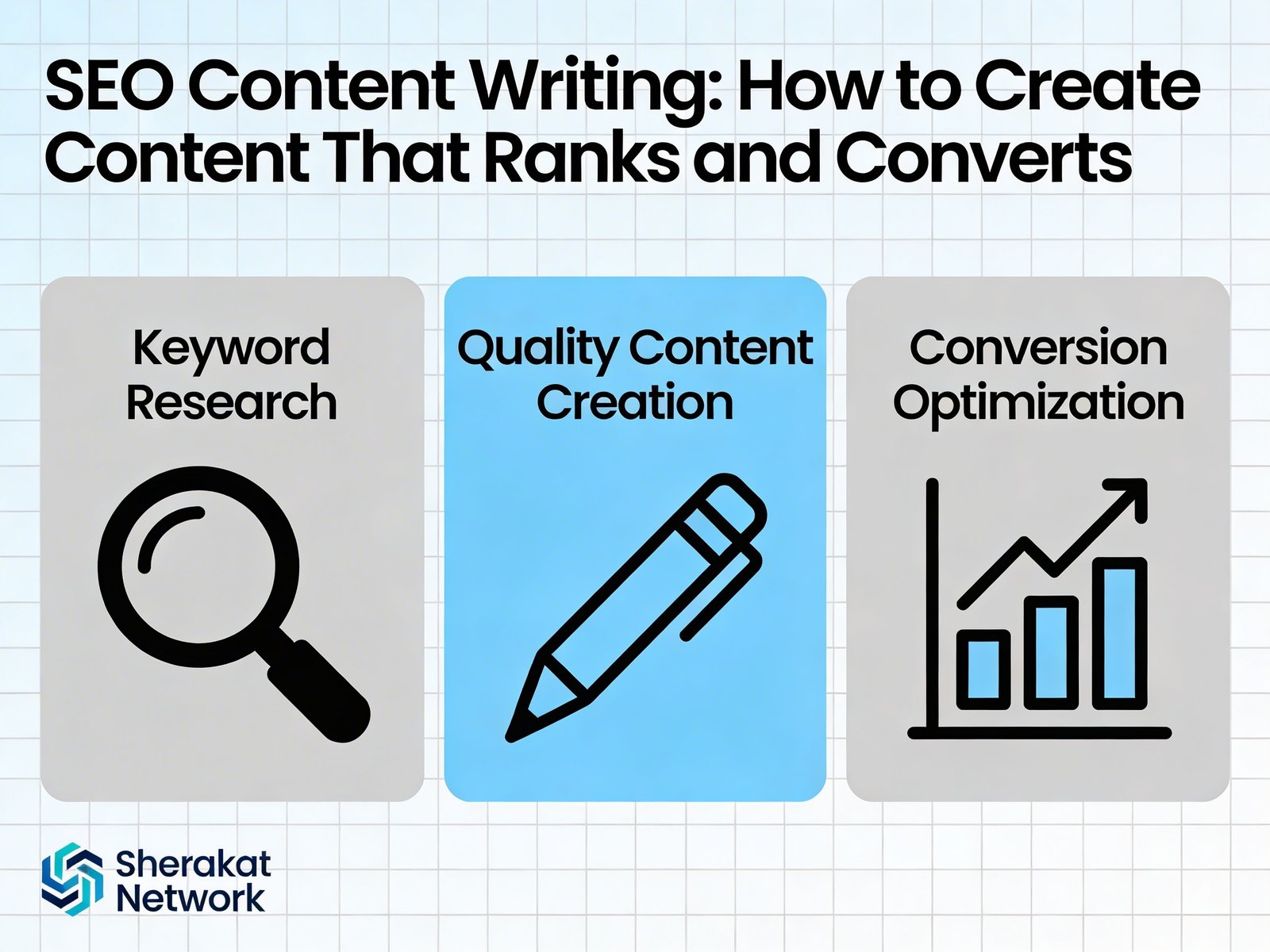

Introduction – Why This Matters
In my experience, there’s a common misconception among beginners that SEO content writing is about stuffing keywords into paragraphs and hoping for the best. They’ve learned the importance of keyword research and on-page optimization, but when they sit down to write, the result is often robotic, awkward, and ultimately unhelpful to readers.
What I’ve found is that the best SEO content doesn’t read like it was written for search engines at all. It reads like it was written for humans—because it was. It just happens to be structured in a way that search engines can understand and reward. This is the art and science of SEO content writing.
Here’s the reality: Google’s algorithms are more sophisticated than ever. They can detect when content is genuinely helpful and when it’s just keyword-stuffed fluff. They reward content that demonstrates E-E-A-T: Experience, Expertise, Authoritativeness, and Trustworthiness. And perhaps most importantly, they pay attention to how users interact with your content. If people land on your page and quickly bounce back to search results, that’s a signal that your content isn’t meeting their needs.
But writing for SEO isn’t just about ranking—it’s about converting. What good is traffic if it doesn’t lead to action? Whether you want readers to buy a product, sign up for a newsletter, or simply trust your expertise, your content needs to persuade, engage, and guide.
In this guide, we’re going to cover everything you need to know about SEO content writing in 2026. We’ll start with the fundamentals of writing for both humans and search engines, then dive into structure, readability, engagement, and conversion optimization. By the end, you’ll have a complete framework for creating content that not only ranks but truly serves your audience.
Background / Context
To understand SEO content writing, we need to look at how content has evolved. In the early days of SEO, content was often thin and keyword-focused. Writers would create pages with exactly the right keyword density, stuff keywords into headings, and call it a day. The result was content that ranked but was virtually unreadable.
Then Google introduced algorithms like Panda (2011), which targeted low-quality content, and later RankBrain (2015) and BERT (2019), which improved Google’s understanding of natural language. Suddenly, writing for humans became as important as writing for search engines. Google could now understand context, synonyms, and the overall meaning of content.
The introduction of E-E-A-T as a framework further emphasized the importance of quality. Content needed to demonstrate expertise and trustworthiness, not just keyword optimization. Author bios, citations, and accurate information became essential.
Today, in 2026, we’re in the era of helpful content. Google’s helpful content system, fully integrated into its core algorithm, prioritizes content created for people, not for search engines. It penalizes content that seems designed primarily to manipulate rankings.
At the same time, the rise of AI-generated content has created new challenges and opportunities. Anyone can now generate thousands of words in seconds. But AI-generated content often lacks the depth, originality, and human insight that makes content truly valuable. This has made human-written, experience-driven content more valuable than ever.
SEO content writing now sits at the intersection of several disciplines:
- Traditional writing skills: Clarity, grammar, storytelling.
- SEO knowledge: Keyword research, structure, optimization.
- User experience: Readability, scannability, engagement.
- Conversion optimization: Calls-to-action, persuasion, trust-building.
- E-E-A-T: Demonstrating expertise and trustworthiness.
Key Concepts Defined
Before we dive into the how-to, let’s establish the key vocabulary of SEO content writing.
- SEO Content: Content created with the goal of attracting search engine traffic. This includes blog posts, articles, product descriptions, landing pages, and more.
- Search Intent: The reason behind a user’s search query. Are they looking to learn (informational), find a specific site (navigational), research before buying (commercial), or make a purchase (transactional)? Your content must match intent.
- Readability: How easy your content is to read and understand. Factors include sentence length, paragraph structure, word choice, and formatting. In 2025, research showed that 54% of Americans read below a sixth-grade level, making readability crucial.
- Scannability: How easy it is for users to quickly scan your content and find what they need. Achieved through headings, bullet points, bold text, and short paragraphs.
- Featured Snippet (Position Zero) : The highlighted box at the top of some search results that directly answers a query. Structuring content to win featured snippets can dramatically increase visibility.
- E-E-A-T: Experience, Expertise, Authoritativeness, Trustworthiness. Google’s framework for evaluating content quality. Your content must demonstrate these qualities.
- Topic Cluster: A group of interlinked content pieces centered around a “pillar” page on a broad topic. This structure signals topical authority to search engines.
- Internal Linking: Links from one page on your site to another. Internal links help distribute authority and guide users to related content.
- External Linking (Outbound Links) : Links from your content to other websites. Linking to authoritative sources builds trust and shows you’ve done your research.
- Call-to-Action (CTA) : A prompt that encourages users to take a specific action, such as “Buy Now,” “Subscribe,” or “Learn More.”
- Dwell Time: The amount of time a user spends on your page before returning to search results. Longer dwell time suggests your content is valuable.
- Bounce Rate: The percentage of visitors who leave your site after viewing only one page. A high bounce rate may indicate that your content isn’t meeting user expectations.
- Content Gap: A topic or question that your competitors cover but you don’t. Identifying content gaps helps you create content that fills unmet needs.
- Evergreen Content: Content that remains relevant and useful for a long time, with minimal updates needed. “How to tie a tie” is evergreen; “2026 fashion trends” is not.
- Content Refresh: The process of updating old content to keep it current and maintain its rankings.
How It Works (Step-by-Step Breakdown)
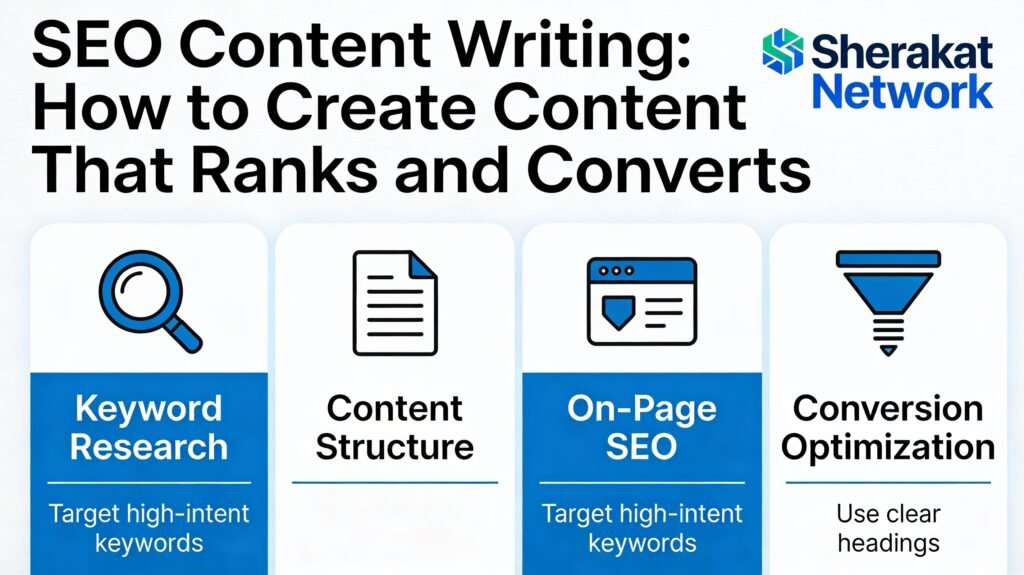
SEO content writing is a process that starts long before you write a single word. Here’s a step-by-step breakdown.
Step 1: Understand Search Intent
Before you write anything, you must understand why someone would search for your target keyword. This is the foundation of all good content.
How to analyze intent:
- Search for your keyword: Look at the current top-ranking pages. What type of content are they? Blog posts, product pages, videos, listicles?
- Identify the dominant format: If the top results are all “best of” lists, creating a single product review won’t satisfy intent.
- Look at the questions answered: What subtopics do the top pages cover? What questions do they answer?
- Consider the funnel stage: Is this an informational query (top of funnel) or a commercial/transactional query (bottom of funnel)?
The four types of search intent:
| Intent Type | Goal | Example | Content Approach |
|---|---|---|---|
| Informational | Learn something | “how to tie a tie” | Tutorial, guide, how-to |
| Navigational | Find a specific site | “Facebook login” | Not usually content-focused |
| Commercial | Research before buying | “best running shoes” | Comparisons, reviews, best-of lists |
| Transactional | Make a purchase | “buy Nike Air Zoom” | Product page, sales copy |
Step 2: Conduct Thorough Keyword Research
Building on your keyword research skills, identify not just your primary keyword but also secondary and related keywords.
What to look for:
- Primary keyword: The main focus of your content.
- Secondary keywords: Related terms that support your primary topic.
- Question-based keywords: What questions are people asking? Use “People also ask” boxes and tools like AnswerThePublic.
- Long-tail variations: More specific phrases with lower competition.
- Semantic keywords: Related terms and synonyms that help search engines understand your topic’s depth.
Example: For a guide on “how to start a blog,” secondary keywords might include “choose a blogging platform,” “blogging tips for beginners,” “how to make money blogging,” etc.
Step 3: Create a Content Outline
A detailed outline keeps your writing focused and ensures you cover all relevant subtopics. This is where you apply the on-page SEO checklist principles.
Your outline should include:
- Working title (H1): Include your primary keyword.
- Introduction: What problem does this content solve? Why should the reader care?
- Main sections (H2s): The key subtopics you’ll cover.
- Subsections (H3s): Deeper dives within each main section.
- Key points: Bullet points of what you’ll cover in each section.
- Questions to answer: List the questions your content will address.
- Internal linking opportunities: Where can you link to other relevant content on your site?
- External sources: What authoritative sources will you cite?
- Call-to-action: What do you want readers to do after reading?
Pro tip: Look at the top-ranking pages for your keyword and note their structure. What headings do they use? What questions do they answer? Use this as inspiration, but create something better.
Step 4: Write a Compelling Headline
Your headline is the first thing people see in search results. It determines whether they click. It also helps search engines understand your content.
Headline best practices:
- Include your primary keyword: Ideally near the beginning.
- Make it compelling: Use power words, numbers, or emotional triggers.
- Keep it under 60 characters: Longer headlines may get cut off in search results.
- Be accurate: Don’t promise what you don’t deliver.
- Consider formats: Lists (“10 Ways to…”), questions (“How to…”), guides (“The Ultimate Guide to…”).
Examples:
- Good: “How to Start a Blog in 2026: A Step-by-Step Guide for Beginners”
- Good: “10 Proven Ways to Increase Website Traffic (Backed by Data)”
- Poor: “Blog Post”
- Poor: “Amazing Tips You Won’t Believe!!!”
Step 5: Write an Engaging Introduction
Your introduction needs to hook the reader and convince them to keep reading. It should also clearly communicate what the content will cover.
Introduction structure:
- Hook: Start with a problem, a question, a surprising fact, or a relatable scenario.
- Context: Briefly explain why this topic matters.
- Preview: Tell readers what they’ll learn and how it will help them.
- Credibility (optional) : Briefly establish your expertise or experience with the topic.
Example introduction:
“Starting a blog can feel overwhelming. You’ve probably heard that blogging can help you build an audience, make money, or establish yourself as an expert. But when you sit down to start, you’re faced with dozens of questions: Which platform should you use? What should you write about? How do people actually find your blog? In this comprehensive guide, I’ll walk you through every step of starting a successful blog in 2026—from choosing your niche to publishing your first post and beyond.”
Step 6: Write for Scannability
Most online readers don’t read every word—they scan. Structure your content to make scanning easy.
Scannability techniques:
- Use short paragraphs: 2-4 sentences maximum. Walls of text scare readers away.
- Use descriptive subheadings: H2s and H3s that clearly indicate what each section covers.
- Use bullet points and numbered lists: These are easier to scan than dense paragraphs.
- Bold key phrases: Emphasize important points, but don’t overdo it.
- Use images and visuals: Break up text with relevant images, charts, or screenshots.
- Include pull quotes or call-out boxes: Highlight key takeaways.
Step 7: Write with Readability in Mind
Your content should be easy to read and understand. This is especially important given that many readers have limited time and attention.
Readability tips:
- Use simple language: Avoid jargon unless your audience expects it. If you must use technical terms, explain them.
- Keep sentences short: Aim for an average of 15-20 words per sentence.
- Use transition words: “However,” “in addition,” “for example” help guide readers through your content.
- Read your content aloud: If it sounds awkward when spoken, rewrite it.
- Check readability scores: Tools like Hemingway Editor can help identify complex sentences.
Step 8: Demonstrate E-E-A-T
Your content needs to demonstrate Experience, Expertise, Authoritativeness, and Trustworthiness. This is especially important for YMYL (Your Money or Your Life) topics.
How to demonstrate E-E-A-T in content:
- Experience: Share personal stories, anecdotes, and firsthand insights. “When I first started blogging, I made the mistake of…” This shows you’ve been there.
- Expertise: Include accurate, well-researched information. Cite authoritative sources. If relevant, mention your credentials or experience.
- Authoritativeness: Link to reputable sources. Include quotes from industry experts. Show that others recognize your expertise (e.g., through backlinks, but that’s not directly in content).
- Trustworthiness: Be transparent about who you are and your intentions. Disclose affiliate relationships. Link to your sources. Correct errors promptly.
Step 9: Optimize for Featured Snippets
Featured snippets (position zero) appear at the top of many search results and can drive significant traffic. Structuring your content to win them is a valuable skill.
How to optimize for featured snippets:
- Answer questions directly: If you’re targeting a question, provide a clear, concise answer in a paragraph, often right after the heading.
- Use lists for “best of” or “ways to” queries: Numbered lists (for steps) or bulleted lists (for items) are often featured.
- Use tables for comparisons: If comparing products or features, a table can be featured.
- Define terms clearly: For “what is” queries, provide a clear definition early in your content.
- Structure with headings: Use H2s for questions and answer directly below.
Example:
If targeting “how to tie a tie,” include a clear, step-by-step list with each step as a numbered item.
Step 10: Incorporate Visuals
Images, videos, charts, and infographics make your content more engaging and can also rank in search.
Visuals best practices:
- Use original images when possible: Original photos and screenshots add authenticity and demonstrate experience.
- Optimize images: Use descriptive file names, alt text, and compress for speed (see technical SEO).
- Include videos: If you have relevant video content (see video SEO), embed it.
- Use charts and graphs: For data-driven content, visual representations help readers understand.
- Add captions: Captions are often read more than body text.
Step 11: Link Strategically
Internal and external links are essential parts of SEO content.
Internal linking:
- Link to other relevant content on your site using descriptive anchor text.
- This helps distribute authority and keeps users on your site longer.
- Create topic clusters by linking related posts to pillar pages.
External linking:
- Link to authoritative, reputable sources to support your claims.
- This builds trust and shows you’ve done your research.
- It can also build relationships with other site owners.
Step 12: Include a Clear Call-to-Action
What do you want readers to do after consuming your content? Every piece of content should have a purpose.
Types of calls-to-action:
- Subscribe: “Sign up for our newsletter to get more tips like this.”
- Buy: “Shop our collection of running shoes.”
- Download: “Download our free SEO checklist.”
- Contact: “Contact us for a free consultation.”
- Comment: “Share your experience in the comments below.”
- Share: “Share this post with someone who needs it.”
CTA best practices:
- Make it clear and specific.
- Use action-oriented language.
- Place it strategically (often at the end, but sometimes mid-content).
- Consider using buttons for important CTAs.
Step 13: Review and Edit
Never publish without editing. Even the best writers need to review their work.
Editing checklist:
- Check for spelling and grammar errors.
- Ensure the content flows logically.
- Verify all facts and links.
- Confirm that you’ve included your target keywords naturally.
- Check readability—is it easy to scan?
- Is the content comprehensive? Does it fully answer the query?
- Have you demonstrated E-E-A-T?
Step 14: Add Metadata
Before publishing, optimize your metadata. This is covered in detail in the on-page SEO checklist.
- Title tag: Include primary keyword, compelling, under 60 characters.
- Meta description: Include primary keyword, compelling, under 160 characters, includes call-to-action.
- URL slug: Short, descriptive, includes keyword.
- Alt text for images: Descriptive, includes keywords where natural.
Step 15: Publish and Promote
Once published, your content needs promotion to gain initial traction.
Promotion strategies:
- Share on social media.
- Include in email newsletters.
- Reach out to people you mentioned or linked to.
- Share in relevant online communities (where appropriate).
- Consider paid promotion for important content.
Step 16: Monitor and Update
Content is never truly finished. Monitor performance and update as needed.
What to monitor:
- Rankings for target keywords.
- Organic traffic to the page.
- Engagement metrics (time on page, bounce rate).
- Conversions (if applicable).
When to update:
- When rankings drop.
- When information becomes outdated.
- When new developments occur in your industry.
- Periodically (e.g., annually) for evergreen content.
Why It’s Important
SEO content writing isn’t just about getting traffic—it’s about creating value that serves both users and search engines.
- It Drives Organic Traffic: Well-optimized content is how people find you. Without it, you’re invisible in search.
- It Builds Authority and Trust: High-quality content demonstrates your expertise and builds trust with your audience. This supports the E-E-A-T framework.
- It Supports Conversions: Content that engages and persuades leads to actions—whether that’s a purchase, a sign-up, or a share.
- It’s a Long-Term Asset: Unlike paid ads, which stop working when you stop paying, great content can drive traffic for years.
- It Fuels Your Entire Marketing: Content feeds social media, email marketing, and link building. It’s the foundation of your digital presence.
- It Answers Your Audience’s Questions: At its heart, good content serves your audience by providing the information they’re seeking.
Sustainability in the Future
SEO content writing will continue to evolve. Here’s what the future looks like.
- AI as a Tool, Not a Replacement: AI writing tools will become more sophisticated, but they won’t replace human writers. The most successful content will combine AI’s efficiency with human creativity, experience, and insight.
- Experience Will Be the Differentiator: As AI generates more generic content, content that demonstrates genuine human experience will stand out. Personal stories, case studies, and original research will become even more valuable.
- E-E-A-T Will Matter More: Google’s emphasis on expertise and trustworthiness will only grow. Demonstrating credentials, citing sources, and being transparent will be essential.
- Voice and Visual Search: Content will need to adapt to new search modalities—optimizing for voice queries and visual discovery.
- Topic Authority Over Individual Keywords: Rather than optimizing for single keywords, successful sites will build authority on broad topics through comprehensive content clusters.
- User Engagement Signals: How users interact with your content (dwell time, scrolling, sharing) will become increasingly important ranking signals.
Common Misconceptions
Let’s clear up some myths that can derail your content writing efforts.
- Myth: “Longer content always ranks better.”
- Reality: While comprehensive content often outperforms thin content, length alone isn’t a ranking factor. What matters is that you cover your topic thoroughly. A 500-word post that perfectly answers a question can outrank a 2,000-word post that rambles.
- Myth: “I need to include my keyword exactly X times.”
- Reality: Keyword density is obsolete. Use your keyword naturally. Include variations and synonyms. Focus on covering the topic, not hitting a keyword count.
- Myth: “Writing for SEO means writing for robots.”
- Reality: Modern SEO is about writing for humans in a way that robots can understand. If your content doesn’t serve human readers, it won’t rank well.
- Myth: “I can just use AI to write all my content.”
- Reality: AI can be a helpful tool for research, outlines, and drafts, but publishing unedited AI content is risky. It often lacks the depth, accuracy, and human insight that makes content valuable. Always review and enhance AI-generated content.
- Myth: “Once I publish, my work is done.”
- Reality: Content needs ongoing attention—updating, promoting, and monitoring. The best content is regularly refreshed to stay current.
- Myth: “I don’t need to worry about readability if my content is expert-level.”
- Reality: Even expert audiences appreciate clear, scannable content. Don’t confuse complexity with expertise. The best experts can explain complex ideas simply.
Recent Developments
SEO content writing in 2026 is shaped by several key developments.
- Google’s Helpful Content System: Now fully integrated into the core algorithm, this system rewards content created for people, not search engines. Content that seems designed primarily to rank is devalued.
- AI Content Detection: Google has become increasingly sophisticated at detecting AI-generated content, especially low-quality, unedited AI content. While AI-generated content isn’t penalized automatically, content that lacks value is.
- E-E-A-T Emphasis: Google continues to refine how it evaluates expertise and trustworthiness. Author bios, citations, and transparent information are more important than ever.
- People-First Content Updates: Google’s guidance now explicitly emphasizes creating content that demonstrates first-hand experience and addresses user needs directly.
- Search Generative Experience (SGE) : Google’s AI-powered search experience synthesizes information from multiple sources. Content that is clear, well-structured, and authoritative is more likely to be cited.
Success Stories
The Blogger Who Turned a Hobby Into a Business
A few years ago, I worked with a passionate home baker who started a blog sharing her recipes. She followed her passion, but initially, her content was unstructured—random recipes with minimal optimization. Traffic was minimal.
We applied the principles in this guide. We researched what people were searching for (“sourdough for beginners,” “easy chocolate chip cookies”). We created comprehensive guides with detailed instructions, personal tips, and high-quality photos. We structured content for scannability with clear headings and bullet points. We added personal stories about her baking failures and successes, demonstrating experience.
Within 18 months, her traffic grew from 1,000 to over 100,000 monthly visitors. She published a cookbook, launched an online baking course, and turned her passion into a full-time business. The key wasn’t just writing—it was writing content that people actually wanted and structuring it so they could find it.
The B2B Company That Dominated Through Content
A B2B software company struggled to compete with larger competitors on paid ads. They couldn’t outspend them, but they could out-content them.
They created a comprehensive content hub around their industry, answering every question their customers might have. They wrote detailed guides, case studies, and comparison articles. They demonstrated expertise by citing research and including quotes from industry experts. They structured content for easy scanning, knowing their busy audience wanted quick answers.
Within two years, they were ranking #1 for dozens of high-value keywords. Their organic traffic grew 400%, and they reduced their paid ad spend by 60%. Their content became their primary customer acquisition channel.
Real-Life Examples
Example 1: The Informational Blog Post
Scenario: A fitness website wants to rank for “how to do a push-up.”
Poor Content Writing:
- Thin content: “Push-ups are good for you. They work your chest and arms. Do them regularly.”
- No structure, just paragraphs.
- No personal experience or expertise demonstrated.
- No images or videos.
Good SEO Content Writing:
They create a comprehensive guide:
- Title: “How to Do a Push-Up: Proper Form, Variations, and Common Mistakes”
- Introduction hooks the reader: “Push-ups seem simple, but most people get them wrong. Here’s how to do them correctly.”
- Clear H2 sections: “Proper Push-Up Form,” “Common Mistakes to Avoid,” “Beginner Variations,” “Advanced Variations,” “How Many Push-Ups Should You Do?”
- Step-by-step instructions with bullet points.
- High-quality images or embedded video demonstrating each step.
- Personal tip: “When I first started, I couldn’t do a single push-up. Here’s how I progressed.”
- Internal links to related content: “Best Chest Exercises,” “Beginner Workout Plan.”
- Call-to-action: “Download our free beginner workout plan.”
Result: The post ranks #1 for “how to do a push-up,” earns featured snippets for related questions, and drives newsletter sign-ups.
Example 2: The Commercial Comparison Post
Scenario: A tech site wants to rank for “iPhone vs Samsung.”
Poor Content Writing:
- Generic: “Both phones are good. It depends on what you like.”
- No data, no specifics.
Good SEO Content Writing:
They create a detailed comparison:
- Title: “iPhone vs Samsung: Which Phone Is Right for You? (2026 Comparison)”
- Introduction sets up the comparison: “Choosing between iPhone and Samsung can be overwhelming. Both offer excellent phones, but they excel in different areas.”
- Clear H2 sections: “Camera Comparison,” “Battery Life,” “Operating System,” “Price,” “Ecosystem.”
- Comparison table summarizing key differences.
- Detailed analysis with specific examples and data.
- Personal experience: “I’ve used both phones extensively. Here’s my take.”
- Pros and cons lists for each.
- Clear conclusion with recommendations for different user types.
- Affiliate links to purchase (with clear disclosure).
Result: The post ranks for multiple comparison keywords, earns affiliate income, and establishes the site as a trusted source for phone buying advice.
Example 3: The Evergreen Pillar Page
Scenario: A marketing site creates a pillar page on “SEO for Beginners.”
Content Approach:
- Comprehensive guide covering all aspects of SEO for beginners.
- Structured with clear H2 sections: “What is SEO,” “Keyword Research,” “On-Page SEO,” “Technical SEO,” “Link Building,” “Measuring Success.”
- Each section links to more detailed cluster content (like the Sherakat Network series).
- Includes original research, expert quotes, and case studies.
- Regularly updated with new information.
- Clear calls-to-action: “Download our SEO checklist,” “Subscribe for updates.”
Result: The pillar page becomes a go-to resource, earns backlinks from other sites, and ranks for dozens of SEO-related keywords.
Conclusion and Key Takeaways
SEO content writing is the practice of creating content that serves both users and search engines. It’s about understanding what your audience needs, providing it in a clear and engaging way, and structuring it so search engines can understand and reward it.
You’ve now built an enormous SEO foundation across twelve comprehensive guides. You understand the fundamentals. You can research keywords. You know how to optimize pages. You can fix technical issues. You understand link building and E-E-A-T. You can measure success. You know how to dominate local search. You can optimize e-commerce sites. You understand mobile SEO. You know how to optimize video content. And now, you know how to write content that ranks and converts.
Key Takeaways:
- Start with intent: Understand why people search for your topic and what they want to find. Match your content to that intent.
- Research thoroughly: Use keyword research to identify primary and secondary keywords, questions, and related topics.
- Outline before writing: A clear structure keeps you focused and ensures comprehensive coverage.
- Write for humans first: Clear, engaging, helpful content will always outperform keyword-stuffed fluff.
- Make it scannable: Use headings, short paragraphs, bullet points, and visuals to help readers find what they need.
- Demonstrate E-E-A-T: Show your experience and expertise. Be trustworthy. Cite sources. Share personal insights.
- Optimize for featured snippets: Structure content to answer questions directly, use lists, and provide clear definitions.
- Link strategically: Use internal links to guide users and distribute authority. Link to external sources to build trust.
- Include clear CTAs: Tell readers what to do next.
- Promote and update: Great content needs promotion and regular updates to maintain its value.
Remember, at its heart, SEO content writing is about serving your audience. When you genuinely help people, search engines will notice. Focus on creating the best possible answer to your audience’s questions, and the rankings will follow.
FAQs (Frequently Asked Questions)
1. What is SEO content writing?
SEO content writing is the practice of creating content that is optimized to rank in search engines while also being valuable and engaging for human readers. It involves keyword research, strategic structuring, and a focus on quality and relevance.
2. How is SEO content writing different from regular writing?
SEO content writing considers both human readers and search engines. It involves keyword research, strategic use of headings, optimization of metadata, and attention to factors like readability and scannability—all while maintaining a natural, engaging voice.
3. How do I choose a topic for SEO content?
Start with keyword research. Identify what your target audience is searching for. Look for topics with decent search volume and manageable competition. Consider search intent—what do users want when they search this term?
4. What is search intent, and why does it matter?
Search intent is the reason behind a user’s search query. It matters because your content must match what the user is looking for. If someone searches “buy running shoes” (transactional), a general article about running (informational) won’t satisfy their intent.
5. How long should my content be?
There’s no magic length. Cover your topic comprehensively. Some topics can be covered in 500 words; others need 2,500+. Focus on providing value, not hitting a word count. If you’ve answered the query thoroughly, you’re done.
6. How often should I include my keyword?
Use your keyword naturally throughout your content. Include it in your title, H1, and naturally in the body. Use variations and synonyms. Don’t force it—if you’re repeating unnaturally, you’re overdoing it.
7. What is readability, and why does it matter?
Readability measures how easy your content is to read and understand. Factors include sentence length, paragraph structure, and word choice. Good readability keeps users engaged and signals quality to search engines.
8. How do I make my content more scannable?
Use short paragraphs, descriptive subheadings, bullet points, numbered lists, bold text for key phrases, and visuals. Most online readers scan before they read—make it easy for them.
9. What is a featured snippet, and how do I optimize for it?
A featured snippet is a highlighted box at the top of some search results that directly answers a query. To optimize, answer questions directly, use lists for step-by-step or itemized content, use tables for comparisons, and structure with clear headings.
10. What is E-E-A-T, and how do I demonstrate it in content?
E-E-A-T stands for Experience, Expertise, Authoritativeness, and Trustworthiness. Demonstrate it by sharing personal experiences, providing accurate information, citing authoritative sources, being transparent, and showcasing credentials.
11. Should I use AI to write my content?
AI can be a helpful tool for research, outlines, and drafting, but published content should be reviewed and enhanced by a human. AI-generated content often lacks depth, accuracy, and the personal insight that makes content valuable.
12. How important are headings (H1, H2, H3)?
Very important. Headings structure your content for both readers and search engines. They help readers scan and find what they need. They help search engines understand your content’s hierarchy and main topics.
13. What is internal linking and why does it matter?
Internal linking means linking to other pages on your own website. It helps distribute authority, guides users to related content, and helps search engines discover and understand your site structure.
14. Should I link to other websites?
Yes, linking to authoritative, relevant sources builds trust and shows you’ve done your research. It can also build relationships with other site owners. Just ensure you’re linking to reputable sites.
15. What is a call-to-action (CTA) and why do I need one?
A CTA tells readers what you want them to do next—subscribe, buy, comment, share. Every piece of content should have a purpose, and a clear CTA helps achieve that purpose.
16. How do I optimize content for voice search?
Target question-based keywords, use natural conversational language, create FAQ pages, aim for featured snippets, and optimize for local intent.
17. What is evergreen content?
Evergreen content remains relevant and useful for a long time with minimal updates. Examples include “how to” guides, definitions, and fundamental tutorials. It’s valuable because it can drive traffic for years.
18. How often should I update old content?
Review your top-performing content at least annually. Update statistics, add new information, refresh examples, and ensure all links still work. This signals freshness to search engines.
19. What is a content gap?
A content gap is a topic or question that your competitors cover but you don’t. Identifying content gaps helps you create content that fills unmet needs and attracts new traffic.
20. How do I measure if my content is successful?
Track rankings for target keywords, organic traffic to the page, engagement metrics (time on page, bounce rate), and conversions (if applicable). Use tools like Google Analytics and Google Search Console.
21. What’s the biggest mistake in SEO content writing?
The biggest mistake is writing for search engines instead of humans. Keyword-stuffed, low-value content may have worked in the past, but modern algorithms are sophisticated enough to detect and devalue it.
22. How do I balance SEO and creativity?
Think of SEO as the framework and creativity as the filling. SEO tells you what topics to cover and how to structure them. Creativity makes that content engaging, unique, and memorable. Both are essential.
23. What is a topic cluster?
A topic cluster is a group of interlinked content pieces centered around a “pillar” page on a broad topic. This structure signals topical authority to search engines and helps with rankings.
24. How do I write for both beginners and experts?
Structure your content to serve both. Start with fundamentals for beginners, then dive deeper for experts. Use clear headings so readers can jump to the level they need. Include both basic explanations and advanced insights.
25. What’s the future of SEO content writing?
The future will emphasize genuine human experience, expertise, and trustworthiness. AI will be a tool, not a replacement. Content that demonstrates real insight and helps users will continue to win.
About Author
Sana Ullah Kakar is a seasoned digital marketing strategist and SEO consultant with over a decade of experience helping businesses establish and scale their online presence. As the lead content contributor for the Sherakat Network, Sana specializes in translating complex digital marketing concepts into actionable strategies for entrepreneurs and professionals across the Middle East and beyond. His approach is rooted in data-driven decision-making and a deep understanding of how evolving search technologies impact real-world business growth. When he’s not analyzing search trends or mentoring the next generation of marketers, Sana is exploring the intersection of technology and human behavior to build more authentic and effective online experiences.
Free Resources
To help you implement everything we’ve covered, here are valuable free resources:
- Google’s Search Quality Rater Guidelines: Understand how Google evaluates content quality. (Search for “Google Search Quality Rater Guidelines PDF”)
- Hemingway Editor: Check and improve your content’s readability. (https://hemingwayapp.com/)
- Grammarly: Free grammar and spelling checker. (https://www.grammarly.com/)
- AnswerThePublic: Find questions people are asking for content ideas. (https://answerthepublic.com/)
- Google Trends: See what topics are trending. (https://trends.google.com/)
- AlsoAsked.com: Visualize “People also ask” data. (https://alsoasked.com/)
- Google’s Rich Results Test: Check if your content is eligible for featured snippets. (https://search.google.com/test/rich-results)
- Yoast SEO / Rank Math: WordPress plugins that guide on-page optimization.
- Google Analytics: Track content performance. (https://analytics.google.com/)
- Google Search Console: Monitor search performance. (https://search.google.com/search-console/)
For more in-depth resources, explore the complete Sherakat Network SEO for Beginners series:
- Start with the SEO Fundamentals in 2026
- Master Keyword Research for Beginners
- Follow the Complete On-Page SEO Checklist
- Get your site healthy with Technical SEO for Beginners
- Build authority with Link Building for Beginners
- Understand quality with E-E-A-T Explained
- Track progress with Measuring SEO Success
- Dominate locally with Local SEO for Beginners
- Optimize your store with SEO for E-commerce
- Master mobile with Mobile SEO for Beginners
- Grow with Video SEO for Beginners
Then, continue your journey:
- Browse our Resources page for tools and templates
- Read the latest insights on our Blog
- Learn how to Start an Online Business in 2026
- Explore more SEO articles
- Understand Business Partnership Models
Expand your knowledge with these external resources:
- Mental Health: The Complete Guide to Psychological Wellbeing
- Global Supply Chain Management: The Complete Guide
- Artificial Intelligence & Machine Learning
- Remote Work Productivity
- Climate Policy & Agreements
- Culture & Society
Discussion
Now I’d love to hear from you. What’s your biggest challenge with writing content? Is it coming up with ideas, structuring your posts, or making them engaging? What strategies have you found that work?
Share your experiences, questions, and insights in the comments below. Let’s learn from each other’s journeys in creating content that truly serves our audiences.
If you need personalized help with your content strategy or have a specific project in mind, don’t hesitate to contact us. We’re here to help you succeed.
Hello.This post was extremely fascinating, particularly because I was looking for thoughts on this matter last week.