
Introduction – Why This Matters
In my experience working with ecommerce brands across every stage of growth, I have seen the same heartbreaking pattern repeat itself: a store owner creates beautiful products, writes detailed descriptions, optimizes every meta tag, and then wonders why they are stuck on page three of Google. They have done everything right—except they have ignored the one factor that separates page one from page ten: authority.
What I’ve found is that in competitive ecommerce categories, technical SEO and great content are table stakes. They get you into the game. But they do not win it. Authority, built through high-quality backlinks, is what determines whether you rank #4 or #14. And in 2026, with Google’s AI Overviews drawing almost exclusively from pages already ranking in the top 10, that authority gap has never been more consequential. Over 99% of AI Overview citations come from pages already in the top 10 organic results. If you are not ranking, you are not being cited.
Let me share a story. A client selling premium leather goods had an immaculate site. Product descriptions were detailed. Images were stunning. Core Web Vitals were perfect. Yet they could not rank for “buy leather briefcase” or any related commercial term. Their competitors, with similar content quality but significantly more backlink authority, dominated the first page.
We implemented a structured, ethical link-building strategy focused on niche editorial placements and digital PR. Within eight months, their domain authority increased by 40%, they ranked on page one for their primary category terms, and organic revenue grew by 180%. The site itself hadn’t changed. The authority behind it had.
This article is your complete professional guide to ecommerce backlink building for 2026. We will cover the changing landscape, the tactics that still work, the tactics to avoid, and a step-by-step framework to build authority ethically and sustainably.
Background / Context
The Shifting Landscape of Link Building
The link-building playbook that worked in 2020 is dangerous in 2026. Two major Google updates have fundamentally changed the rules.
The December 2024 link spam update targeted link networks that had operated undetected for years. The October 2025 spam update went further, naming AI-generated guest-post farms and sites publishing thin machine-written content solely to embed paid links as their own violation category. Google’s spam policies now treat large-scale link buying and exchange schemes as a domain-level risk, not a per-link one.
What does this mean operationally? SEO teams have seen a sharp drop in the number of external backlinks Google indexes at all, including links from high-authority domains, because Google stopped counting links it judged to be placed for ranking rather than for readers.
The HARO era also ended. HARO (Help a Reporter Out), the press-query service that built thousands of links for SEO teams, was discontinued by Cision on December 9, 2024. While the brand was revived by Featured.com in April 2025, the free, high-volume version many guides recommended no longer exists.
Why Authority Still Matters—Now More Than Ever
Despite these changes, the correlation between backlinks and rankings remains strong. Research consistently shows that top-ranking pages have roughly 3.8 times more backlinks than pages ranking on subsequent pages. But it is no longer about accumulation alone. It is about quality, context, and editorial integrity.
In 2026, the stakes are higher. Google’s AI Overviews and AI search engines like ChatGPT and Perplexity rely on trusted, authoritative sources to construct their answers. A domain with a strong backlink profile is more likely to be cited in AI-generated responses, creating a compounding effect. Authority built through legitimate link acquisition influences not just your rank but your brand’s visibility across the entire search ecosystem.
Key Concepts Defined
What Is Ecommerce Link Building?
Link building is the process of acquiring hyperlinks from other websites to your own. For ecommerce, this typically involves earning links to product pages, category pages, or supporting content like buying guides and blog posts. These links signal to search engines that your site is a trusted, authoritative resource.
Domain Authority (DA) / Domain Rating (DR)
Metrics created by SEO tools (Moz, Ahrefs) that estimate a site’s overall authority based on its backlink profile. While not official Google metrics, they are useful for comparative analysis. A single relevant, editorial link can outperform ten weak links.
Editorial vs. Non-Editorial Links
- Editorial links: Earned naturally because a site owner or journalist chose to reference your content. These carry the most weight.
- Non-editorial links: Directory listings, forum signatures, comment spam, or paid placements without proper disclosure. These carry little to no value and may trigger penalties.
Link Equity (Link Juice)
The value passed from one page to another through a hyperlink. Pages with high authority pass more equity to the pages they link to. Internal links distribute equity within your site; external backlinks bring equity in.
Anchor Text
The clickable text in a hyperlink. Natural anchor text varies—branded, URL, partial match, and exact match. Over-optimization with exact-match commercial anchors is a red flag. Natural profiles lean toward branded and URL anchors.
Link Velocity
The rate at which your site acquires new backlinks. Sudden spikes can look unnatural to Google’s algorithms. Gradual, consistent acquisition is safer and more sustainable.
Dofollow vs. Nofollow
- Dofollow: Passes link equity. The default for most links.
- Nofollow: Does not pass equity. Used for sponsored content, user-generated content, or when a site does not want to vouch for the linked page. Nofollow links are not “bad,” but they are less powerful than dofollow links.
GEO Service Placements
A newer tactic emerging alongside AI-driven answer engines. Building mentions and contextual placements on authoritative sources that AI models are trained to reference is becoming as important as traditional PageRank signals, particularly for brand-level queries.
Parasite SEO
Leveraging high-authority platforms (like Medium or LinkedIn) to rank content quickly, while building your own domain authority in parallel. Both effects work together rather than sequentially.
How It Works (Step-by-Step Breakdown)
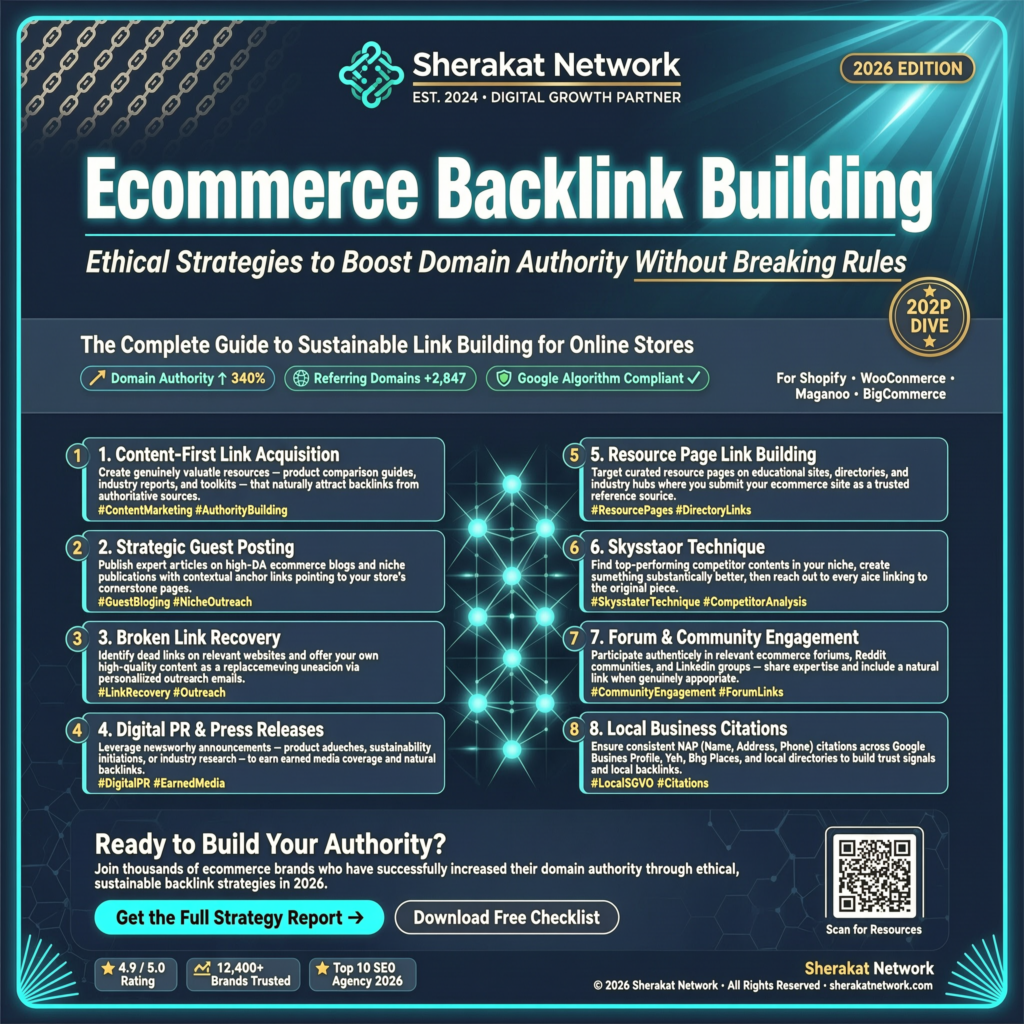
Here is the exact 8-step process I use for ethical, sustainable ecommerce link building.
Step 1: Audit Your Current Link Profile
Before you build anything, know where you stand. A link audit reveals whether your profile is healthy, where the easy wins are, and if anything needs cleaning up.
Action:
- Run your site and your top three competitors through Ahrefs, Semrush, or Moz.
- Note your Domain Rating (DR) or Authority Score and compare to competitors.
- Check the anchor text distribution. Heavy exact-match commercial anchors are a warning sign.
- Flag links from sites under DR 30 that look off-topic, paid, or networked.
- Look for unnatural spikes or drops in referring domains. A sudden climb can signal a low-quality campaign you inherited.
If you find a cluster of genuinely manipulative links, build a disavow file and submit it in Google Search Console. For most sites, this is no longer urgent—Google ignores rather than penalizes most junk—but it still matters if you have inherited a manipulated profile.
Step 2: Conduct a Backlink Gap Analysis
The backlink gap is the difference between the referring domains pointing at you and the ones pointing at competitors who outrank you. It is the most reliable shortlist of links worth pursuing because someone has already proven those sites will link to a page like yours.
Action:
- Export your top competitors’ backlinks.
- Filter hard: drop nofollow links with no traffic value, foreign-language pages, and anything from a site you would not want your brand next to.
- What remains is your replicable list: pages where a link to you would genuinely add value for that page’s readers.
- Sort by referring-domain quality so you work the highest-value opportunities first.
The best link prospects are not “high DR sites.” They are sites already linking to three of your competitors and not yet to you.
Step 3: Create Linkable Assets
A linkable asset is content so useful, unique, or newsworthy that other sites want to reference it. This is the foundation of ethical link building.
Types of Linkable Assets for Ecommerce:
- Ultimate Guides: Comprehensive resources that become the authoritative reference on a topic. Example: “The Ultimate Guide to Choosing the Perfect Leather Briefcase.” Gardening store Burpee generated hundreds of links with a detailed planting guide.
- Original Research and Data: Surveys, customer data analysis, or industry reports. A supplement brand might survey 1,000 customers on sleep habits and publish findings. Ben & Jerry’s has generated significant press coverage through data-driven social impact reports.
- Tools and Interactives: Useful tools that provide value. YouGarden offers a “plant finder” tool that helps customers select plants based on conditions. Staples hosts a local business directory aligned with its mission of supporting independent companies.
- Creative Promotions: Charitable initiatives, celebrity collaborations, or timely campaigns. REI’s #OptOutside campaign, which closes stores on Black Friday, generated coverage in Forbes, The Guardian, and Fox Weather. Our Place’s partnership with Selena Gomez drove widespread media attention.
- Product Comparisons and Roundups: Honest comparisons of products in your category. These attract links from review sites and comparison shoppers.
Step 4: Target Informational Keywords
When linking to ecommerce stores, sites often use affiliate links with nofollow tags, limiting SEO value. To earn dofollow editorial links, create content that site admins can reference naturally.
Action:
- Identify informational keywords in your niche (e.g., “how to clean leather boots,” “what is a light roast coffee”).
- Create comprehensive, fact-dense guides that answer these questions thoroughly.
- Include relevant statistics, original insights, and practical frameworks.
- Outreach to sites that link to existing guides, offering your superior resource as a replacement.
Step 5: Structured Guest Posting
Structured guest posting gives you something passive tactics cannot: control. You choose publications with the right topical alignment, reinforce commercial categories, manage anchor text, and control link velocity to avoid sudden spikes.
What to Look For in Guest Post Prospects:
- The site publishes in your category or an adjacent one.
- Their target audience matches your customer.
- They have real editorial standards (not just sponsored articles).
- Your link would be naturally useful within an article.
- You can find the editor’s or author’s name, not just a contact form.
- You are proud to be associated with the site.
Anchor Text Guidelines:
- Avoid heavy exact-match commercial anchors (e.g., “buy leather briefcase”).
- Mix branded anchors (“Brand Name”), partial matches (“premium leather bags”), URL anchors, and natural phrases.
- Keep anchor text descriptive and under six words.
Cost Expectations:
- Premium guest posts often cost between $692 and $957.
- High-tier placements can exceed $3,000.
- Strong niche placements are often available in the $200–$300 range if you filter properly.
Risk Layer: Google has repeatedly stated that links intended to manipulate rankings may violate its policies. Any serious ecommerce link-building strategy must account for link attributes including nofollow, sponsored, and ugc tags, disclosure requirements, natural anchor text distribution, gradual link velocity, and contextual relevance. Reckless link building creates long-term risk. Strategic link building creates a long-term moat.
Step 6: Digital PR
Digital PR is about doing something notable and reaching out to journalists to cover it. Well-thought-out campaigns can build hundreds of high-quality links.
What Media Outlets Cover:
- Interesting or timely products
- Creative promotions that offer significant value
- Charitable and socially responsible initiatives
- Partnerships with celebrities
How to Execute:
- Identify a newsworthy angle. This could be a product launch, a charity initiative, or a data-driven report.
- Build a media list of journalists who cover your industry.
- Craft a pitch that emphasizes the story, not the product. Focus on why readers would care.
- Follow up persistently but professionally.
- Track coverage and links earned.
Step 7: Unlinked Brand Mentions
This technique is particularly effective for established brands because they tend to have many references across the web.
Action:
- Use tools like Google Alerts, Brand24, or Mention to find references to your brand.
- Check if brand mentions include a link back to your site.
- If there is no link, reach out to the site editor and request one. Explain that the mention would be more useful to readers with a link.
These are “easy wins.” They require minimal effort but provide legitimate link equity.
Step 8: Broken Competitor Link Building
Broken link building involves identifying links on competitors’ sites that point to “broken” pages that return 4xx or 5xx errors.
Action:
- Use Ahrefs or Semrush to identify external links to competitors’ sites that return errors.
- Identify which of those broken pages have related content on your site.
- Reach out to the site that linked to the broken page, informing them of the broken link and suggesting your related resource as a replacement.
This is a helpful, value-add approach that editors appreciate.
Why It’s Important
For Rankings
The correlation between backlinks and rankings is well-documented. A study of 432,000 keywords found that over 99% of AI Overview citations come from pages already in the top 10 organic results. If you are not ranking, you are not being cited.
For Brand Authority
Being present consistently in credible editorial contexts strengthens the signal that your brand is a real, established entity. This increases the likelihood of being included in AI Overviews and cited by AI platforms when they respond to queries in your category.
For Long-Term Revenue
Authority built through a solid guest post can keep delivering value for months or years. Paid ads stop the moment your budget runs out. Authority keeps working. When you evaluate link building based on revenue impact rather than content production cost, it is one of the most defensible SEO investments available.
For Competitive Moat
A strong backlink profile is difficult to replicate. If you have earned editorial links from respected industry publications, a competitor cannot simply “buy” their way into those same placements. The relationships and trust you build are a durable competitive advantage.
Sustainability in the Future
Authority and AI Search
AI search engines like ChatGPT, Perplexity, and Google’s AI Overviews rely on trusted, authoritative sources to construct their answers. A domain with a strong backlink profile is more likely to be cited in AI-generated responses. This creates a compounding effect: traditional rankings drive AI citations, and AI citations strengthen brand authority.
The Rise of GEO Service Placements
Generative Engine Optimization (GEO) targets visibility in AI-driven answer engines. Building mentions and contextual placements on authoritative sources that AI models are trained to reference is becoming as important as traditional PageRank signals, particularly for brand-level queries in competitive verticals.
Quality as the Only Sustainable Strategy
The days of cheap, scalable link schemes are over. Google’s updates have systematically identified and devalued link networks, AI-generated guest-post farms, and sites publishing thin content solely to embed paid links. The tactics that survive share one trait: they earn links from people who chose to link because the thing you made was worth citing.
Common Misconceptions
Myth 1: “A bad link will get me penalized.”
Reality: In 2026, a bad link usually will not hurt you. It will waste you. That is the more expensive problem at scale. Google ignores rather than penalizes most junk links. The real cost is the time and budget spent acquiring links that return nothing.
Myth 2: “I can just wait for links to come naturally.”
Reality: 94% of all content gets zero backlinks. If you wait, you are statistically likely to be in the 94%. Deliberate outreach is required.
Myth 3: “High Domain Rating is all that matters.”
Reality: A link from a site with DR 28 on your specific topic outperforms a link from a DR 80 general directory. Relevance, editorial context, and real readership matter more than DR alone.
Myth 4: “Guest posting is dead because of Google updates.”
Reality: Low-quality guest posting is dead. High-quality guest posting on editorial sites with real readership remains highly effective. The key is editorial integrity and contextual relevance.
Myth 5: “I should chase as many links as possible.”
Reality: Link velocity matters. Sudden spikes look unnatural. Gradual, consistent acquisition produces more stable rankings. A single relevant, editorial link can outperform ten weak links.
Recent Developments (2025-2026)
1. Google’s Link Spam Updates
The December 2024 link spam update targeted link networks that had operated undetected for years. The October 2025 spam update went further, naming AI-generated guest-post farms and sites publishing thin machine-written content only to embed paid links as their own violation category. Google now treats large-scale link buying as a domain-level risk.
2. HARO Discontinued
HARO, the press-query service that built thousands of links for SEO teams, was discontinued by Cision on December 9, 2024. The brand was revived by Featured.com in April 2025, but the free, high-volume version many guides recommended no longer exists.
3. AI Overviews Magnify Authority
Over 99% of AI Overview citations come from pages already in the top 10 organic results. Authority built through ethical link building now drives both traditional rankings and AI citation visibility.
4. The Rise of GEO Service Placements
Building mentions and contextual placements on authoritative sources that AI models are trained to reference is becoming as important as traditional PageRank signals for brand-level queries.
Success Stories
Case Study 1: The Premium Leather Goods Brand
Problem: A premium leather goods brand had high-quality products and an impeccably designed site but could not rank for “buy leather briefcase” or other commercial terms. Competitors with higher authority dominated the first page.
Solution:
- Audited competitors’ backlink profiles and identified the top 50 relevant sites linking to them.
- Created an “Ultimate Guide to Choosing the Perfect Leather Briefcase.”
- Launched a digital PR campaign around a charitable initiative (donating a portion of profits to leather workers’ education).
- Secured structured guest posts on 20 niche editorial sites.
Results (8 months):
- Domain Rating increased from 32 to 47.
- Page one rankings for five primary category terms.
- Organic revenue grew by 180%.
Case Study 2: The Eco-Friendly Supplement Brand
Problem: A D2C supplement brand had strong on-page SEO but struggled to acquire links. Their informational content was good, but nobody was linking to it.
Solution:
- Conducted a customer survey of 2,000 users on sleep and stress patterns.
- Published original research: “The State of Sleep in America: 2026 Report.”
- Outreach to health and wellness journalists with the data angle.
- Secured 25 editorial links from publications including Healthline and MindBodyGreen.
Results (6 months):
- 25 high-quality editorial dofollow links.
- Organic traffic increased by 250%.
- The research report continues to earn links 18 months post-publication.
Real-Life Examples
Example A: A Tactic to Avoid (Low-Quality Guest Posting)
Scenario: A store buys 50 guest posts from an automated marketplace at $50 each. The posts appear on sites with DR 60 but zero real traffic, AI-generated content, and no editorial oversight. The links are placed in the footer.
Result: Google identifies the network. The links are not indexed. The store sees zero ranking improvement. The $2,500 was wasted.
Example B: A Tactic That Works (Structured Guest Posting)
Scenario: A store invests in 10 guest posts at $200–$300 each on niche editorial sites with real traffic and high relevance. The content is written by a subject matter expert, not AI. The links are placed contextually within the article.
Result: Each link passes authority. DR improves gradually. Rankings move up over 4–6 months. The store gains referral traffic from each placement. Within a year, the cost is recouped multiple times over through organic revenue.
Conclusion and Key Takeaways
Ecommerce link building in 2026 is not about shortcuts. It is about building genuine authority through quality, relevance, and editorial integrity.
The 10 Commandments of Ecommerce Link Building (2026):
- Thou Shalt Prioritize Quality Over Quantity: One relevant editorial link outperforms ten weak directory links.
- Thou Shalt Audit Thy Own Profile: Know what you have before building more.
- Thou Shalt Conduct a Backlink Gap Analysis: Target the sites already linking to your competitors.
- Thou Shalt Create Linkable Assets: Original research, ultimate guides, and interactive tools earn links naturally.
- Thou Shalt Pursue Digital PR: Newsworthy initiatives attract journalist coverage and editorial links.
- Thou Shalt Use Structured Guest Posting: Control your link velocity, anchor text, and topical alignment.
- Thou Shalt Monitor Link Velocity: Gradual, consistent acquisition is safer than sudden spikes.
- Thou Shalt Avoid Link Networks and Automated Guest Post Farms: These are now detected and devalued.
- Thou Shalt Think Long-Term: Authority takes 6–12 months to build but compounds over time.
- Thou Shalt Measure What Matters: Track DR growth, organic traffic trends, and revenue—not just link count.
Your 7-Day Action Plan:
- Day 1: Audit your current backlink profile and compare to your top three competitors.
- Day 2: Identify 30 link prospects from your competitors’ profiles that you can replicate.
- Day 3: Brainstorm three linkable asset ideas (research, guide, tool, promotion) relevant to your niche.
- Day 4: Draft outreach templates for guest posting and unlinked mention requests.
- Day 5: Begin outreach to 10 prospects with personalized messages.
- Day 6: Review and refine your guest post content quality checklist.
- Day 7: Schedule recurring time (10–15 hours/month) for ongoing link acquisition.
FAQs (Frequently Asked Questions)
Q1: What is link building, and why does it matter for ecommerce?
A: Link building is the process of acquiring hyperlinks from other websites to your own. For ecommerce, it signals authority to search engines, directly impacting rankings for product and category pages. Without authority, ranking is extremely difficult.
Q2: Is guest posting still effective in 2026?
A: Yes, but with important caveats. Low-quality guest posting on spammy sites is dead. High-quality guest posting on editorial sites with real readership and topical relevance remains highly effective.
Q3: What is a “backlink gap analysis”?
A: Identifying the sites linking to your competitors but not to you. It reveals your most valuable link prospects because someone has already proven those sites will link to a page like yours.
Q4: Can I buy links for my ecommerce store?
A: Google’s guidelines discourage purchasing links intended to manipulate rankings. Paid links without proper disclosure (nofollow/sponsored tags) violate guidelines and create long-term risk.
Q5: What is the difference between dofollow and nofollow links?
A: Dofollow links pass link equity. Nofollow links do not pass equity but can still drive referral traffic and brand awareness. A natural profile has a mix of both.
Q6: How many backlinks do I need to rank?
A: The number varies by niche, but top-ranking pages typically have significantly more backlinks than lower-ranking pages. The key is not quantity alone but quality, relevance, and editorial integrity.
Q7: What is a linkable asset?
A: Content so useful, unique, or newsworthy that other sites want to reference it. Examples: ultimate guides, original research, interactive tools, and creative promotions.
Q8: How do I find sites that accept guest posts?
A: Use search operators like “write for us” + your niche, analyze competitors’ guest post profiles, and check curated vendor databases. Filter for real editorial standards.
Q9: What is anchor text and why does it matter?
A: Anchor text is the clickable text in a hyperlink. Over-optimization with exact-match commercial anchors is a red flag. Natural profiles lean toward branded and URL anchors.
Q10: How much does a quality guest post cost?
A: Premium placements often cost $692–$957. Strong niche placements are available in the $200–$300 range if you filter properly. High-tier placements can exceed $3,000.
Q11: What is link velocity?
A: The rate at which your site acquires new backlinks. Sudden spikes can look unnatural. Gradual, consistent acquisition is safer.
Q12: What are Google’s link spam updates?
A: The December 2024 and October 2025 updates targeted link networks and AI-generated guest-post farms. Google now treats large-scale link buying as a domain-level risk.
Q13: Is HARO still useful for link building?
A: HARO was discontinued by Cision in December 2024. The brand was revived by Featured.com in April 2025, but the free, high-volume version no longer exists.
Q14: What is Digital PR?
A: Doing something notable and reaching out to journalists to cover it. Well-thought-out campaigns can build hundreds of high-quality editorial links.
Q15: How do I find unlinked brand mentions?
A: Use tools like Google Alerts, Brand24, or Mention to find references to your brand. If there is no link, reach out to the site editor and request one.
Q16: What is broken link building?
A: Identifying broken links on competitors’ sites and suggesting your related resource as a replacement. It is helpful, value-add outreach.
Q17: How does AI search affect link building?
A: Over 99% of AI Overview citations come from pages already in the top 10 organic results. Authority built through link building now drives both traditional rankings and AI citation visibility.
Q18: What is GEO service placement?
A: Building mentions and contextual placements on authoritative sources that AI models are trained to reference. It is becoming as important as traditional PageRank signals.
Q19: Should I disavow bad links?
A: For most sites, disavowing is no longer urgent—Google ignores rather than penalizes most junk. It still matters if you have inherited a genuinely manipulated profile.
Q20: How long does link building take to show results?
A: Typically 4–6 months before meaningful ranking gains, with full compounding effects taking 6–12 months of consistent effort.
Q21: What are the metrics to track for link building?
A: Track growth in referring domains, organic traffic trends for non-branded keywords, ranking improvements for target pages, and referral traffic from earned links.
Q22: Can I build links without a budget?
A: Yes, but it takes significant time. Options include unlinked brand mentions, broken link building, and genuine relationship building. Expect 10–15 hours per month.
Q23: What is the cost of an in-house link building team?
A: An SEO analyst, content writer, outreach coordinator, and tools budget costs $120,000–$180,000 annually for a small but functional team.
Q24: Should I outsource link building?
A: Nearly 2,000 SEO professionals currently outsource rather than build internal teams. Specialist services offer existing publisher relationships and infrastructure that a new team cannot replicate quickly.
Q25: What is “parasite SEO”?
A: Leveraging high-authority platforms (like Medium or LinkedIn) to rank content quickly while building your own domain authority in parallel.
Q26: How do I evaluate a link prospect?
A: Check relevance, real editorial standards, traffic trends, outbound link profile, and whether you would be proud to be associated with the site.
Q27: What is the 94% statistic?
A: 94% of all content gets zero backlinks. If you are not actively building links, you are statistically likely to be in that 94%.
Q28: Why is relevance more important than DR?
A: A link from a site with DR 28 on your specific topic outperforms a link from a DR 80 general directory. Relevance, editorial standards, and real readership matter more.
Q29: What are “link networks”?
A: Groups of sites that exchange or sell links systematically. Google’s December 2024 update specifically targeted these, treating them as a domain-level risk.
Q30: What is the single most important link-building tactic for ecommerce?
A: Structured guest posting on niche editorial sites. It offers control over link velocity, anchor text, and topical alignment—essential for stable, predictable ecommerce SEO growth.
About the Author
This guide was written by the Sherakat Network SEO and digital strategy team. With over a decade of combined experience in ecommerce optimization and authority building, the team has helped hundreds of online stores grow organic revenue through ethical, sustainable link acquisition. We believe that authority is earned, not bought.
Free Resources
- Backlink Audit Checklist (2026 Edition):
- Guest Post Outreach Template:
- Link Prospect Tracking Spreadsheet:
- Digital PR Campaign Planning Template:
Discussion
What has been your experience with ecommerce link building? Have you seen success with a particular tactic, or are you struggling to get started? Share your experience or ask your questions in the comments below. The Sherakat Network community includes forward-thinking store owners who have navigated this landscape.
Internal & External Links (Naturally Integrated)
Internal Links:
- For the foundational SEO concepts that support link building, visit our main SEO category page .
- Need templates and tools to execute your link-building strategy? Our Resources section has outreach templates and prospect trackers.
- If you are building a new store from scratch, our Start Online Business 2026 Complete Guide covers platform selection and initial setup.
- Once you have built authority, you need to optimize your pages to convert. Read our guide on Product Page SEO Optimization .
- Your link-building strategy should also consider your overall site architecture. See our article on Ecommerce Site Architecture for SEO .
- For the broader shift towards AI-driven search, revisit our guide on The AI Answer Era: GEO & AEO Strategy .
- Explore all our insights on the Sherakat Network Blog for weekly updates.
- Have specific link-building questions or need a custom audit? Contact us here .
External Links:
- Running an ecommerce business is stressful. Maintain your focus with the Mental Health Complete Guide – burnout kills the sustained effort needed for effective link building.
- If your link-building efforts lead to more orders, ensure your supply chain can handle the volume with this guide on Global Supply Chain Management .
- Leverage AI & Machine Learning trends to automate parts of your outreach and content creation.
- Managing a remote team of content writers or SEO specialists? Read up on Remote Work Productivity .
- Stay informed about Climate Policy & Agreements – sustainability angles are powerful for digital PR campaigns.
- Understand the Culture & Society trends that influence what journalists cover and what content earns links.