

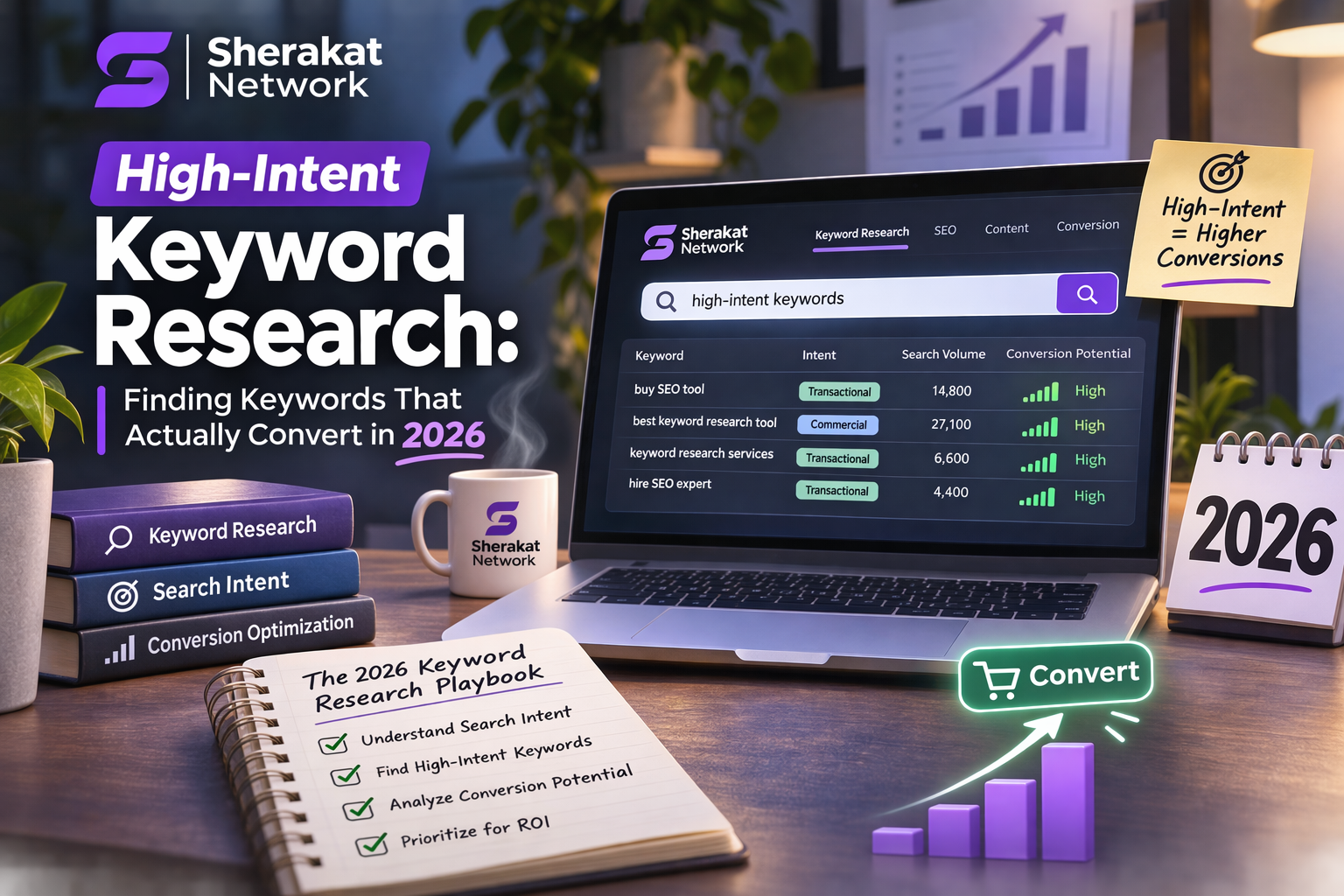

Introduction: Why This Matters
In my experience, the most expensive mistake in SEO isn’t targeting the wrong keyword. It’s targeting the right keyword for the wrong reason.
I’ve watched businesses celebrate ranking number one for a term with 50,000 monthly searches—only to discover that the traffic converts at 0.3%. I’ve also watched a single page ranking position four for a query with 90 monthly searches generate six figures in annual revenue. The difference wasn’t content quality. It wasn’t backlinks. It was intent.
What I’ve found is that traditional keyword research optimizes for visibility. High-intent keyword research optimizes for outcomes. And in 2026, with AI Overviews consuming informational clicks and search volume data growing increasingly unreliable, the gap between those two approaches has become the difference between a content strategy that pays for itself and one that produces nothing but a prettier spreadsheet.
This guide exists because high-intent keyword research is no longer optional. It’s the only keyword strategy that survives the AI search era. Informational queries—the ones that used to drive traffic and build authority—are being summarized by AI engines before users ever see a link. Transactional and commercial queries, the ones where users are ready to act, remain resistant to AI substitution because they require something AI can’t provide: a decision.
By the end of this guide, you’ll understand how to identify high-intent keywords, how to avoid the AI Overview trap, how to prioritize by business value rather than vanity metrics, and how to build content that captures buyers at the moment they’re ready to spend. Whether you’re a beginner learning to distinguish a keyword from a conversion opportunity or a professional pivoting your strategy, this framework will change how you approach keyword research. For broader context on how this fits into your overall SEO strategy, explore our SEO resource library.
Background / Context: Why Intent Became the Only Metric That Matters
Keyword research used to be a volume game. Find a term with high search volume, low difficulty, write content, rank, collect traffic, monetize. The model worked because search results were a list of links, users clicked through to find answers, and informational content could build an audience that eventually converted.
That model is collapsing under two pressures.
Pressure one: AI Overviews are eating informational clicks. AI Overviews now appear on a significant share of informational queries, and when they do, click-through rates collapse. The top-ranking page can see its CTR drop by more than half when an AI summary sits above it. If AI can answer a question directly—what is X, how to do Y, X vs Y—the user no longer needs to visit a webpage. The traffic that informational keywords once delivered is evaporating .
Pressure two: Search volume data is less reliable than ever. Google Keyword Planner rounds low volumes to zero. Tools estimate rather than measure. And the conversational, specific queries that actually drive purchases often appear as zero-volume in traditional tools because they’re too niche or too new to register . A keyword with 90 monthly searches that converts at 11% is worth more than a keyword with 18,000 searches that converts at 1.2% .
The result is a strategic inversion. In 2019, the winning strategy was to capture broad attention and nurture it toward conversion. In 2026, the winning strategy is to capture decision-stage intent directly. You don’t need 100,000 visitors. You need 100 visitors who are ready to act.
This shift mirrors broader changes in how information systems prioritize specificity over scale. The global supply chain moved from mass production to just-in-time precision. AI and machine learning systems evolved from general models to specialized applications. Keyword research is following the same trajectory: from broad to specific, from traffic to intent.
Key Concepts Defined
Before diving into the framework, let’s establish the language of high-intent keyword research.
High-Intent Keyword: A search query where the user is close to making a decision or taking action. High-intent keywords include terms like “buy,” “hire,” “pricing,” “cost,” “best [product] for [use case],” “vs,” “alternative,” and “near me.” These queries signal that the user has moved past initial research and is evaluating options or preparing to act .
Transactional Intent: The user is ready to purchase or take a specific action. Examples: “hire SEO consultant,” “buy CRM software,” “book dental appointment.” Transactional keywords are the highest-intent category and typically convert at the highest rates.
Commercial Intent: The user is comparing options and moving toward a decision. Examples: “best CRM for small business,” “Asana vs Monday,” “SEO audit pricing.” Commercial keywords are high-intent but require more nurturing than transactional queries .
Informational Intent: The user wants to learn something. Examples: “what is SEO,” “how does keyword research work,” “AI Overviews explained.” Informational keywords are the lowest-intent category and are most vulnerable to AI Overview substitution.
Buyer-Ready Query: A query that indicates the user has a defined problem and is actively seeking a solution they can implement or purchase. The distinction between a buyer-ready query and a generic informational query is specificity: “how to manage remote teams” is informational; “remote team management software for agencies under 50 people” is buyer-ready.
AI-Proof Keyword: A keyword that AI Overviews cannot fully satisfy. These include tool-based queries (calculator, checker, generator), pricing queries, local queries, and complex queries requiring personal judgment or human experience .
Bottom-of-Funnel (BoFu) Keyword: A keyword that captures users in the decision stage of their journey. BoFu keywords convert at three to eight times the rate of top-of-funnel keywords and should be prioritized first in any high-intent strategy .
Conversion Potential: The likelihood that a user searching for a keyword will take a desired action (purchase, inquiry, signup). Conversion potential is a function of intent, specificity, and alignment between the query and your offering.
How It Works: The Step-by-Step Framework
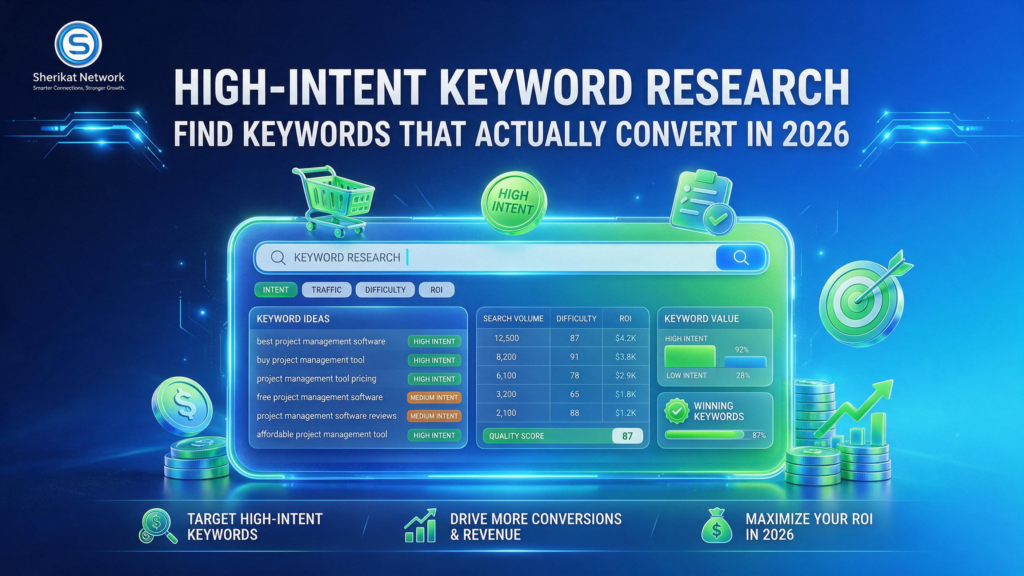
This is the core of the guide. Follow these steps in order. Each builds on the previous one.
Step 1: Start with Jobs-to-Be-Done, Not Keywords
High-intent keyword research begins with understanding what your audience is trying to accomplish, not with a keyword tool.
The jobs-to-be-done approach: Talk to your sales team, your support team, and your existing customers. Ask: What were you trying to solve before you found us? What language did you use to describe the problem? What alternatives did you consider?
A project management SaaS might discover that customers weren’t searching for “project management software.” They were searching for “how to stop losing track of client deadlines” or “tool to manage remote team time zones.” Those are the jobs. The keywords follow.
Why this matters: High-intent keywords are specific because the jobs they address are specific. Starting with jobs ensures you’re targeting queries that reflect real decision-making, not abstract topic categories.
Step 2: Generate High-Intent Seed Keywords
For each job-to-be-done, generate seed keywords across four intent categories.
Transactional seeds:
- “hire [service]”
- “buy [product]”
- “book [appointment]”
- “[service] pricing”
- “[product] cost”
Commercial seeds:
- “best [product] for [use case]”
- “[product] vs [alternative]”
- “[product] reviews”
- “[product] alternatives”
- “top [service] for [industry]”
Local seeds:
- “[service] near me”
- “[service] in [city]”
- “[product] store near me”
AI-proof seeds:
- “[task] calculator”
- “[task] checker”
- “[task] generator”
- “[task] template”
- “[product] compatibility checker”
What you’re building: A seed list of 20-30 high-intent terms. Not hundreds. Enough to see patterns and prioritize .
Step 3: Expand with Intent-Focused Tools
Feed your seeds into keyword tools, but filter aggressively for intent.
Expansion sources:
- Google Autocomplete: Type your seed and watch the suggestions. High-intent modifiers like “pricing,” “for small business,” and “vs” appear quickly .
- People Also Ask: The PAA box for high-intent seeds reveals related commercial questions. “Best CRM for small business” generates PAA questions like “What is the cheapest CRM for small business?” and “How much does a CRM cost?” .
- Reddit and Quora: These platforms show the actual language people use when asking for recommendations. Threads like “What’s the best [product] for [specific situation]?” are goldmines of high-intent phrasing .
- Competitor gap tools: Ahrefs Content Gap and Semrush Keyword Gap show high-intent keywords competitors rank for that you don’t .
What to filter for:
- Queries containing transactional modifiers (“buy,” “hire,” “pricing,” “cost”)
- Queries containing comparative modifiers (“vs,” “best,” “alternative,” “review”)
- Queries containing specificity (“for [industry],” “for [company size],” “with [feature]”)
- Queries containing local modifiers (“near me,” “in [city]”)
Step 4: Vet with the BID Method
Not every high-intent keyword is worth targeting. The BID method filters candidates by three criteria :
Business Potential: Does this keyword align with what you actually sell? A keyword with high intent but no relevance to your offering is a trap. If you sell enterprise software, a query for “free CRM for freelancers” has intent but no business potential.
Intent: Is the user ready to act, or still exploring? Transactional queries score highest. Commercial queries score medium-high. Informational queries score low for this framework.
Difficulty: Can you realistically rank? For new sites, target KD under 30. For established sites, KD under 50. A high-intent keyword you can’t rank for is worthless .
The BID score: Rate each keyword 1-5 on each criterion. Multiply the scores. Prioritize the highest totals. A keyword scoring 5 on business potential, 5 on intent, and 3 on difficulty (75) beats a keyword scoring 3, 3, and 5 (45)—even though the second is easier to rank.
Step 5: Check for AI Overview Vulnerability
Before committing to any keyword, search it and assess whether an AI Overview appears.
Keywords most vulnerable to AI Overviews:
- “What is X”
- “How to do Y”
- “X vs Y”
- “Tips for Z”
- “Beginner guide to [topic]”
- Generic “best ways to” queries
Keywords resistant to AI Overviews:
- Tool-based queries (calculator, checker, generator, template)
- Pricing and cost queries (AI can’t quote your specific pricing)
- Local queries (AI can’t verify current local availability)
- Complex queries requiring personal judgment
- Queries with specific constraints (“for a 5-person agency using QuickBooks”)
The AI-proof test: If an AI Overview appears and fully answers the query, skip it. If an AI Overview appears but leaves a gap—specific pricing, local availability, tool functionality, personal recommendation—target the gap. If no AI Overview appears, proceed.
Step 6: Prioritize Bottom-of-Funnel First
Most content programs fail because they write 50 top-of-funnel articles before addressing bottom-of-funnel queries. This is backwards.
The BoFu-first strategy: Write the 10-20 queries that capture users closest to purchase first. These pages convert at three to eight times the rate of ToFu content, and the briefs are easier because the audience is in-market and knows what they want .
Prioritization order:
- Transactional queries: “Hire [service],” “buy [product],” “[service] pricing”
- Commercial comparison queries: “[Product] vs [alternative],” “best [product] for [use case]”
- Commercial review queries: “[Product] reviews,” “[Product] alternatives”
- Local high-intent queries: “[Service] near me,” “[Service] in [city]”
- AI-proof tool queries: “[Task] calculator,” “[Task] checker”
What to deprioritize: Broad informational queries that AI Overviews already answer comprehensively. These are traffic builders at best and wasted effort at worst.
Step 7: Map Keywords to Content Formats That Convert
High-intent keywords require high-intent content formats. A blog post won’t rank for a transactional query.
| Keyword Type | Example | Content Format |
|---|---|---|
| Transactional | “Hire SEO consultant” | Service page with pricing, process, CTA |
| Commercial comparison | “Asana vs Monday” | Comparison table with decision framework |
| Commercial review | “Best CRM for HVAC” | Roundup with criteria, pros/cons, recommendations |
| Pricing | “SEO audit cost” | Pricing explainer with scope, deliverables, FAQ |
| Local | “Dentist near me” | Local landing page with location, hours, booking CTA |
| Tool-based | “Keyword difficulty checker” | Free tool or calculator page |
The format rule: Match the SERP. If the first page shows comparison tables, build a comparison table. If it shows pricing pages, build a pricing page. Fighting the dominant format wastes effort .
Step 8: Structure Content for Both Conversion and Citation
High-intent content serves two masters: human conversion and AI citation.
For human conversion:
- Place the primary CTA above the fold and repeat it after each major section
- Include pricing or cost information early—users searching high-intent queries want numbers
- Add trust signals: case studies, testimonials, credentials
- Remove friction: clear next steps, minimal form fields
For AI citation:
- Open each section with a standalone direct answer (40-60 words)
- Use question-phrased headings
- Include comparison tables and structured data
- Keep paragraphs short (2-4 sentences)
The dual-optimization principle: The same structure that makes content easy for humans to scan makes it easy for AI to extract. Clarity serves both .
Step 9: Track Conversions, Not Just Rankings
High-intent keyword research only works if you measure what matters.
Metrics to track:
- Conversion rate by keyword: Which queries drive inquiries, purchases, or signups?
- Revenue per keyword: Which keywords produce actual business value?
- Assisted conversions: High-intent keywords often appear late in the journey. Track whether they assist earlier research.
- AI citation frequency: Are your high-intent pages being cited in AI answers? Use Google Search Console’s generative AI report or tools like Profound .
What to ignore:
- Raw traffic volume from informational keywords
- Rankings without conversion data
- Vanity metrics that don’t connect to revenue
The iteration mindset: High-intent keywords change as your business changes. Review quarterly. Double down on keywords that convert. Cut keywords that produce traffic but no action.
Why It’s Important
High-intent keyword research isn’t a refinement of traditional keyword research. It’s a strategic pivot from measuring attention to measuring outcomes.
The conversion math. A keyword with 90 monthly searches converting at 11% produces roughly 10 conversions per month. A keyword with 18,000 searches converting at 1.2% produces roughly 216 conversions per month—but requires vastly more content, authority, and time to rank. For most businesses, the high-intent keyword is the better first target .
The AI Overview reality. Informational queries are increasingly answered by AI summaries. The traffic that informational keywords once delivered is shrinking. High-intent queries—especially transactional, pricing, local, and tool-based queries—remain resistant because AI can’t complete the action. It can explain how to hire a consultant. It can’t hire one for you .
The competitive opportunity. Most businesses are still chasing high-volume keywords. The competition for high-intent, low-volume queries is significantly lower. A new site can rank for “HIPAA compliant hosting for therapy practices” while it has no chance against established competitors for “web hosting” .
What happens if you ignore this: You build an audience of people who are interested but not ready to buy. You rank for keywords that AI Overviews summarize before users click. You present traffic growth to stakeholders while revenue stagnates. The keywords were “good” by traditional metrics. They just weren’t good for your business. For more on building a sustainable business around your content, explore our complete online business guide.
Sustainability in the Future
High-intent keyword research is not a static skill. Here’s what to watch.
AI Overviews will continue expanding. As AI engines improve at answering transactional queries—pulling pricing data, comparing features, recommending products—some high-intent queries will become vulnerable. The defense is to target queries that require human judgment, local verification, or tool interaction.
Prompt-based research will complement keyword research. Users are increasingly asking AI engines conversational, high-intent questions: “What’s the best accounting software for a freelancer who invoices in multiple currencies?” These prompts are richer than keywords and reveal intent that tools miss. For a complete guide to prompt research, see our prompt-based keyword research article.
Conversion tracking will become more sophisticated. As AI referral traffic grows and referrer data becomes less reliable, businesses will need new ways to attribute conversions to high-intent keywords. First-party data, self-reported attribution, and AI citation tracking will become standard.
The sustainable approach: Build high-intent content around jobs-to-be-done, not keyword lists. Prioritize queries that AI can’t fully satisfy. Track conversions, not just rankings. And accept that the definition of “high-intent” will evolve as AI search evolves. For resources on building sustainable SEO systems, explore our resources section.
Common Misconceptions
Misconception 1: “High-intent keywords are always low volume.” Not necessarily. Some high-intent keywords have substantial volume, especially in competitive B2B categories. The point isn’t that high-intent keywords are small—it’s that intent matters more than volume.
Misconception 2: “I should only target transactional keywords.” No. Commercial comparison and review queries are also high-intent and often easier to rank for than pure transactional terms. A balanced high-intent strategy includes transactional, commercial, local, and tool-based queries.
Misconception 3: “Informational content is worthless.” Informational content still builds authority and supports conversion paths. The point is that it should not be your primary keyword strategy in 2026. Use it to support high-intent pages, not to chase traffic for its own sake.
Misconception 4: “If a keyword has an AI Overview, I should skip it.” Not always. If the AI Overview leaves a gap—specific pricing, local availability, tool functionality—you can target the gap. The question is whether AI fully satisfies the query or merely introduces it.
Misconception 5: “Conversion rate is the only metric that matters.” Conversion rate without volume is meaningless. A keyword converting at 50% with one monthly search produces almost nothing. Track conversion and volume and revenue potential together.
Misconception 6: “High-intent keywords are obvious.” Some are. But many are hidden in sales calls, support tickets, and forum questions. The best high-intent keywords often don’t appear in keyword tools because they’re too specific or too conversational .
Misconception 7: “Once I rank for a high-intent keyword, I’m done.” High-intent keywords require ongoing optimization. Competitors improve. Prices change. User expectations shift. Content needs regular updates to maintain conversion rates.
Recent Developments
Three developments in 2025-2026 have reshaped high-intent keyword research.
1. AI Overviews expanded on commercial queries. Analysis found AI Overviews now appear on significantly more commercial-intent searches than six months prior. This has forced businesses to reassess which “best X” and “X vs Y” keywords still drive clicks and which are summarized away .
2. The BID method gained traction as a vetting framework. Sam Oh from Ahrefs popularized the Business potential, Intent, Difficulty framework for prioritizing keywords. It replaces the old volume-plus-difficulty model with a business-value-first approach .
3. Tools added AI visibility filters. Ahrefs introduced an AI visibility filter showing which ranking keywords trigger AI Overviews. Semrush added tracking across ChatGPT, Perplexity, and Google SGE. These features make it easier to identify which high-intent keywords are vulnerable and which are citation opportunities .
Success Stories
Case Study: The B2B Service Provider’s Zero-Volume Goldmine
A compliance consulting firm was targeting broad keywords like “HIPAA compliance services” with little success. They analyzed sales call transcripts and found that prospects were searching for ultra-specific queries: “HIPAA compliant email for therapy practice,” “business associate agreement template for small clinic,” “HIPAA risk assessment cost.”
These queries registered zero or near-zero in keyword tools. But each represented a buyer with a specific, urgent problem. The firm created dedicated pages for each query, with clear pricing, process explanations, and consultation CTAs. Within four months, the pages ranked page one and generated 12 qualified leads—more than their broad service page had produced in a year.
The key insight: The best high-intent keywords were invisible to tools because they were too specific. They were visible in sales conversations .
Case Study: The SaaS Company’s AI-Proof Tool Strategy
A project management SaaS was struggling to rank for “best project management software” against enterprise competitors. They pivoted to tool-based high-intent keywords: “project timeline calculator,” “billable hours tracker template,” “meeting cost calculator.”
These queries had lower volume but clear intent and were resistant to AI Overviews because they required interactive tools. The company built free tools for each query, optimized the pages for the tool keyword, and added CTAs to the full product. Within six months, the tools drove 2,400 monthly visits and 180 trial signups—a 40% increase in trial conversions.
The key insight: AI can explain a concept. It can’t run a calculator. Tool-based keywords are AI-proof .
Case Study: The Local Service Business’s Pricing Query Capture
A plumbing company was ranking for “plumber near me” but losing to directory sites. They analyzed high-intent queries and found a gap: “how much does a plumber charge to fix a leak.” The SERP showed forum posts and generic articles—no local pricing transparency.
The company created a detailed pricing page: what a leak repair costs in their service area, what factors affect the price, what’s included, and a booking CTA. The page ranked position two within three weeks and became their highest-converting page, generating 30% of all service bookings.
The key insight: Pricing queries are high-intent and AI-resistant. Users want local, specific numbers that AI can’t provide .
Real-Life Examples
Example 1: The “Best X for Y” Opportunity
Search “best CRM for HVAC companies.” The first page likely contains generic software reviews and comparison sites, not content written specifically for HVAC businesses. A CRM vendor targeting HVAC companies can create a page that addresses HVAC-specific needs—dispatch integration, service history tracking, seasonal scheduling—and rank faster than they could for “best CRM” .
Example 2: The “X vs Y” Decision Query
Search “Asana vs Monday for agencies.” Users searching this query are comparing two specific tools for a specific context. A comparison page that addresses agency-specific needs—client collaboration, resource allocation, billing integration—can capture users at the decision moment. Generic comparison pages miss the specificity .
Example 3: The “Alternative to X” Migration Query
Search “alternative to Mailchimp for small business.” Users searching this query are dissatisfied with their current tool and actively seeking a replacement. A page that explains why users switch, what to look for, and how to migrate captures high-intent traffic that generic “best email marketing” pages miss .
Example 4: The Local “Near Me” Intent
A dentist ranking for “dentist near me” competes with directories. A dentist ranking for “emergency dentist open Saturday near me” captures a user with an urgent, specific need. The second query has lower volume but vastly higher conversion potential .
Example 5: The Tool-Based Query
A finance software company creates a “freelance tax calculator.” The page ranks for “freelance tax calculator,” captures users with a specific need, and offers a free tool that demonstrates the software’s value. The query is high-intent, AI-resistant, and converts at a higher rate than informational blog posts .
These examples connect to broader patterns in how information systems evolve. The global supply chain optimized through specificity and real-time data. AI and machine learning evolved from general models to specialized applications. Keyword research is following the same trajectory: from broad to specific, from traffic to intent.
Conclusion and Key Takeaways
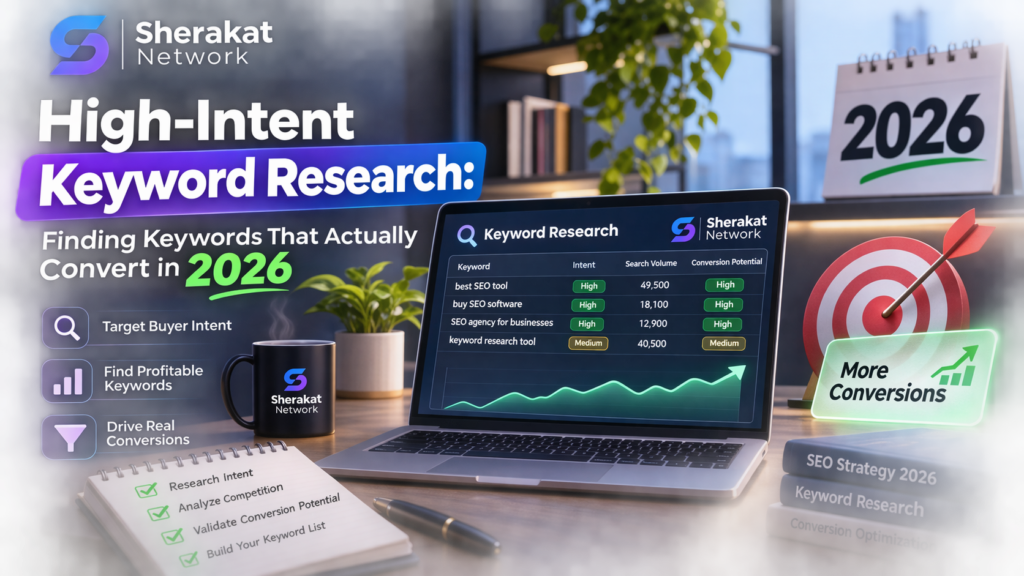
High-intent keyword research isn’t about finding fewer keywords. It’s about finding the right keywords—the ones where users are ready to act, where AI can’t fully satisfy the query, and where your offering solves a real problem.
Key Takeaways:
- Start with jobs-to-be-done, not keyword tools
- Prioritize transactional and commercial queries over informational ones
- Check every keyword for AI Overview vulnerability—skip queries AI fully answers
- Use the BID method (Business potential, Intent, Difficulty) to vet candidates
- Target AI-proof keywords: tools, pricing, local, and complex queries
- Write bottom-of-funnel content first—it converts at 3-8x the rate of top-of-funnel
- Match content format to SERP intent—comparisons need comparison tables, pricing needs pricing pages
- Track conversions and revenue, not just rankings
- Review quarterly and double down on what converts
Your next step: Open your sales call transcripts or support tickets. Find three questions customers asked before they bought. Turn each into a high-intent keyword. Check each for AI Overview vulnerability. Write one page this month that answers the question and makes it easy to act. For more strategic guidance, explore our complete online business guide and our full SEO resource library.
Frequently Asked Questions ()FAQs
Q1: What is a high-intent keyword?
A: A search query where the user is close to making a decision or taking action. High-intent keywords include terms like “buy,” “hire,” “pricing,” “best [product] for [use case],” and “near me” .
Q2: How is high-intent different from commercial intent?
A: Commercial intent is a category of high intent—users comparing options. Transactional intent is the highest level of high intent—users ready to act. High-intent is the umbrella term for both.
Q3: Should I ignore informational keywords entirely?
A: No. Informational content builds authority and supports conversion paths. But it should support high-intent pages, not dominate your keyword strategy in 2026.
Q4: How do I find high-intent keywords?
A: Start with jobs-to-be-done from sales calls and support tickets. Use Google Autocomplete, People Also Ask, Reddit, and competitor gap tools. Filter for transactional and commercial modifiers .
Q5: What is the BID method?
A: A vetting framework: Business potential + Intent + Difficulty. Rate each keyword 1-5 on each criterion, multiply the scores, and prioritize the highest totals .
Q6: How do I check if a keyword has an AI Overview?
A: Search it in Google. If an AI-generated summary appears above traditional results, the keyword has an AI Overview.
Q7: Should I skip keywords with AI Overviews?
A: Only if the AI Overview fully answers the query. If it leaves a gap—pricing, local availability, tool functionality—target the gap.
Q8: What are AI-proof keywords?
A: Queries AI can’t fully satisfy: tool-based queries (calculator, checker), pricing queries, local queries, and complex queries requiring human judgment .
Q9: Why should I prioritize bottom-of-funnel keywords?
A: BoFu keywords convert at three to eight times the rate of ToFu keywords. They pay back faster and require less content to see results .
Q10: How many high-intent keywords should I target?
A: Start with 10-20. Prioritize the ones with the highest BID scores and clearest conversion paths.
Q11: What content format works best for high-intent keywords?
A: Match the SERP. Transactional queries need service pages. Comparison queries need comparison tables. Pricing queries need pricing explainers. Tool queries need tools .
Q12: How do I track conversions from high-intent keywords?
A: Use Google Search Console and Analytics to track conversion rates by landing page. Add self-reported attribution (“How did you find us?”) for AI referrals. Track revenue per keyword where possible.
Q13: What if a high-intent keyword has zero search volume?
A: Zero-volume keywords can be the most valuable if they represent specific, urgent problems. Mine them from sales calls, support tickets, and forums. A single conversion can justify the content .
Q14: How often should I review high-intent keyword strategy?
A: Quarterly. Search behavior shifts, competitors improve, and AI Overviews expand. What worked six months ago may need adjustment.
Q15: Can I rank for high-intent keywords with a new site?
A: Yes, if you target specific, low-competition high-intent queries. “CRM for HVAC companies” is winnable for a new site. “Best CRM software” is not.
Q16: What’s the biggest mistake in high-intent keyword research?
A: Targeting high-intent keywords that don’t align with your offering. A query can have high intent but no business potential if you don’t sell what the user wants.
Q17: How do I find high-intent keywords competitors miss?
A: Look at sales call transcripts, support tickets, and forum questions. These reveal specific, conversational queries that tools miss .
Q18: Do high-intent keywords work for local businesses?
A: Especially for local businesses. “Emergency dentist open Saturday” converts far better than “dentist near me.” Local high-intent queries are AI-resistant because AI can’t verify real-time local availability .
Q19: What’s the role of pricing pages in high-intent strategy?
A: Pricing queries are among the highest-intent queries. Users searching “SEO audit cost” are close to buying. A pricing page with transparent numbers, scope, and a CTA captures them .
Q20: How do I optimize high-intent content for AI citation?
A: Use question-phrased headings, standalone answers at the start of sections, comparison tables, and short paragraphs. Structure serves both humans and AI .
Q21: Can high-intent keywords be informational?
A: Some are. “How much does X cost” is informational in format but high-intent in substance. The distinction is whether the user is close to acting, not whether the query starts with “how.”
Q22: What’s the difference between a high-intent keyword and a buyer keyword?
A: They’re often used interchangeably. Buyer keywords are a subset of high-intent keywords—specifically those that indicate purchase readiness.
Q23: How do I handle high-intent keywords with strong competitors?
A: Target the specificity gap. If competitors dominate “best CRM,” target “best CRM for [specific industry].” If they dominate “SEO services,” target “SEO audit for SaaS companies” .
Q24: Should I use high-intent keywords for PPC too?
A: Yes. High-intent keywords often have lower CPC than broad terms and higher conversion rates. The same research applies to paid campaigns .
Q25: What’s the fastest way to see results from high-intent keyword research?
A: Find a specific, low-competition high-intent query in your sales transcripts. Write a dedicated page this week. Optimize for conversion. Track results for 30 days.
Q26: How do I know if a keyword is “high-intent enough”?
A: Ask: Would someone searching this be ready to take action? If the answer is “maybe” or “they’re still learning,” it’s not high-intent enough for this strategy.
Q27: What’s the role of case studies in high-intent content?
A: Case studies reduce risk for buyers close to a decision. A comparison page or pricing page that includes a case study converts better than one that doesn’t.
Q28: Can I repurpose informational content into high-intent content?
A: Yes. Take a popular informational article and add a section addressing the high-intent question: pricing, comparison, or next steps. The informational content builds authority; the high-intent section captures conversions.
Q29: How do I measure the ROI of high-intent keyword research?
A: Track revenue or leads generated from high-intent pages. Compare to the cost of creating and maintaining those pages. High-intent pages typically pay back faster than informational content.
Q30: What’s the one thing I should do differently after reading this guide?
A: Open your sales call transcripts. Find one specific, high-intent question a customer asked before buying. Write a page that answers it completely and makes the next step obvious. For more guidance, explore our SEO category.
About Author
[Sana Ullah Khan Kakar, Content and Article Writing Specialist]
This guide was written based on hands-on experience conducting high-intent keyword research for B2B SaaS companies, local service businesses, and content publishers since 2015. The strategies outlined here have been tested across hundreds of keyword campaigns, from single-location service providers to multi-national software platforms.
Free Resources
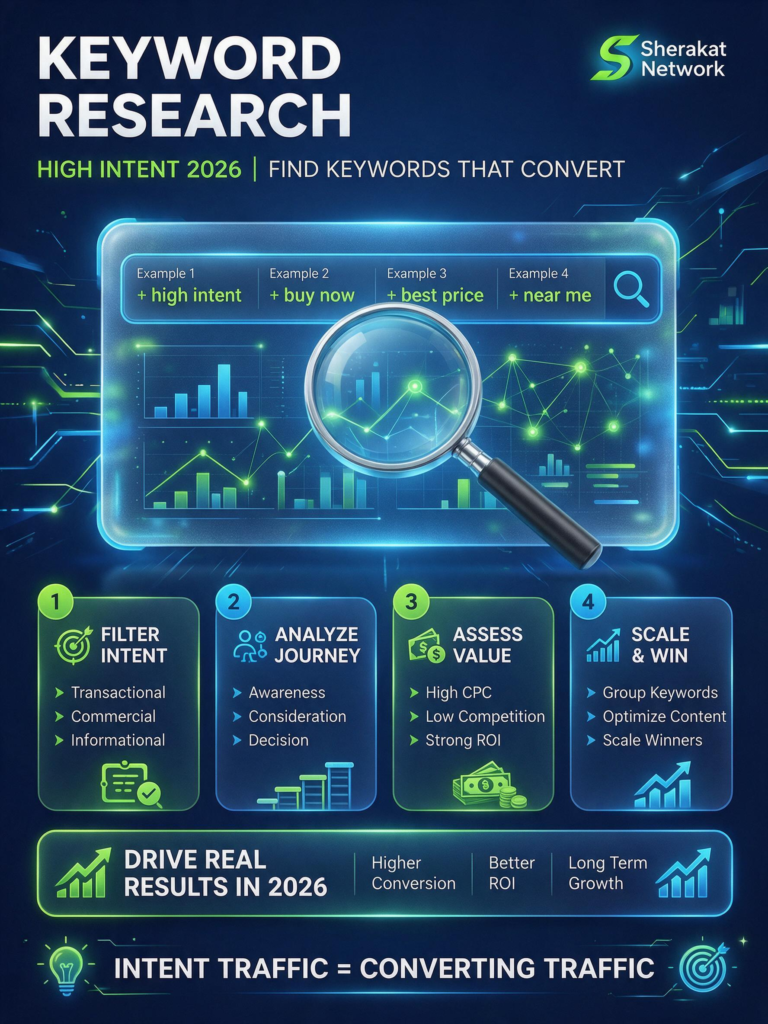
High-Intent Keyword Research Tools:
- Google Search Console — conversion tracking and striking distance queries
- Google Autocomplete — high-intent modifier discovery
- AnswerThePublic — question-based commercial queries
- Reddit and Quora — real high-intent language
- Ahrefs AI visibility filter — identifies keywords triggering AI Overviews
- Semrush AI tracking — brand mentions across ChatGPT, Perplexity, SGE
Recommended Reading on Sherakat Network:
- Start Online Business 2026 Complete Guide
- The Alchemy of Alliance: A Comprehensive Guide to Building a Successful Business Partnership
- SEO Category
- Resources Category
- Blog Category
External Resources:
- The Daily Explainer: Mental Health Complete Guide
- The Daily Explainer: Global Supply Chain Management Guide
- World Class Blogs: AI and Machine Learning
- World Class Blogs: Remote Work and Productivity
- World Class Blogs: Climate Policy Agreements
- World Class Blogs: Culture and Society
Discussion
What’s your experience with high-intent keyword research? Have you found queries that convert far better than their search volume suggests? Share your insights in the comments below.
If you found this guide helpful, consider sharing it with someone who’s chasing traffic but not seeing conversions. The strategies here work—but only if you prioritize intent over volume.
Have questions? Reach out via our contact page.