


Introduction: Why This Matters
In my experience, the most frustrating SEO problem is the one you accidentally create yourself.
I’ve watched site owners publish dozens of blog posts, each targeting a slightly different variation of the same keyword, convinced they’re building comprehensive coverage. They’re not. They’re building an internal competition where every page loses. Google can’t decide which page deserves to rank, so it ranks none of them well—or it constantly flip-flops between them, driving neither to the top.
What I’ve found is that keyword cannibalization is the silent killer of content strategy. It doesn’t announce itself with a penalty or a dramatic traffic crash. It shows up as stagnation: pages that rank position 8-15 for months, never breaking through. Traffic that plateaus despite consistent publishing. Search Console data that shows the same query triggering multiple URLs, with average positions that seem random.
This guide exists because keyword cannibalization has become more common in 2026, not less. AI Overviews have reduced click-through rates on informational queries, making it harder to distinguish between “this page isn’t ranking because of competition” and “this page isn’t ranking because it’s competing with itself.” Content teams under pressure to publish more are creating more overlapping pages, not fewer. And the tools that should catch this problem often miss it because they’re designed to find new keywords, not diagnose internal conflicts.
By the end of this guide, you’ll understand exactly what keyword cannibalization is, how to find it in your own site, how to fix it without losing traffic, and how to prevent it from happening again. Whether you’re a beginner who just realized your last five blog posts cover the same topic or a professional auditing a large content library, this framework will give you a repeatable process. For broader context on building a sustainable content strategy, explore our complete online business guide.
Background / Context: Why Cannibalization Became a Bigger Problem
Keyword cannibalization isn’t new. SEO professionals have been warning about competing pages for over a decade. But three shifts in 2025-2026 have made it more prevalent and more damaging.
Shift one: AI Overviews changed the cost of ambiguity. When Google returned ten blue links, a page ranking position 8 for a query might still get 2-3% of clicks. Today, with AI Overviews appearing on a significant share of informational queries, click-through rates for positions below the top few have collapsed . A page stuck at position 9 because it’s competing with three other pages on your own site isn’t just underperforming—it’s essentially invisible. The margin for error has shrunk.
Shift two: Content volume pressure increased overlap. Businesses are publishing more content than ever, driven by the belief that more pages equal more traffic. But research shows that only 1.94% of pages get between one and ten monthly search visits from Google . Publishing more pages without a clear differentiation strategy increases the risk that new pages cannibalize existing ones rather than adding incremental value.
Shift three: Search Console became more revealing but harder to interpret. Google Search Console’s Performance report shows which queries trigger your pages, but it doesn’t explicitly flag cannibalization. You need to know what to look for—multiple URLs ranking for the same query with fluctuating positions—and interpret the pattern correctly. Many site owners see the fluctuation and assume it’s normal ranking volatility. It’s often cannibalization .
The result is a problem that’s easy to create, hard to spot, and costly to ignore. The businesses that succeed with content in 2026 are the ones that treat every page as a strategic asset with a defined purpose—not just another entry in the publishing calendar. This principle connects to broader patterns in how systems optimize. The global supply chain eliminates redundant processes to improve efficiency. AI and machine learning systems avoid duplicate training data to prevent overfitting. Content strategy is no different: redundancy wastes resources and dilutes performance.
Key Concepts Defined
Before diving into the framework, let’s establish the language of keyword cannibalization.
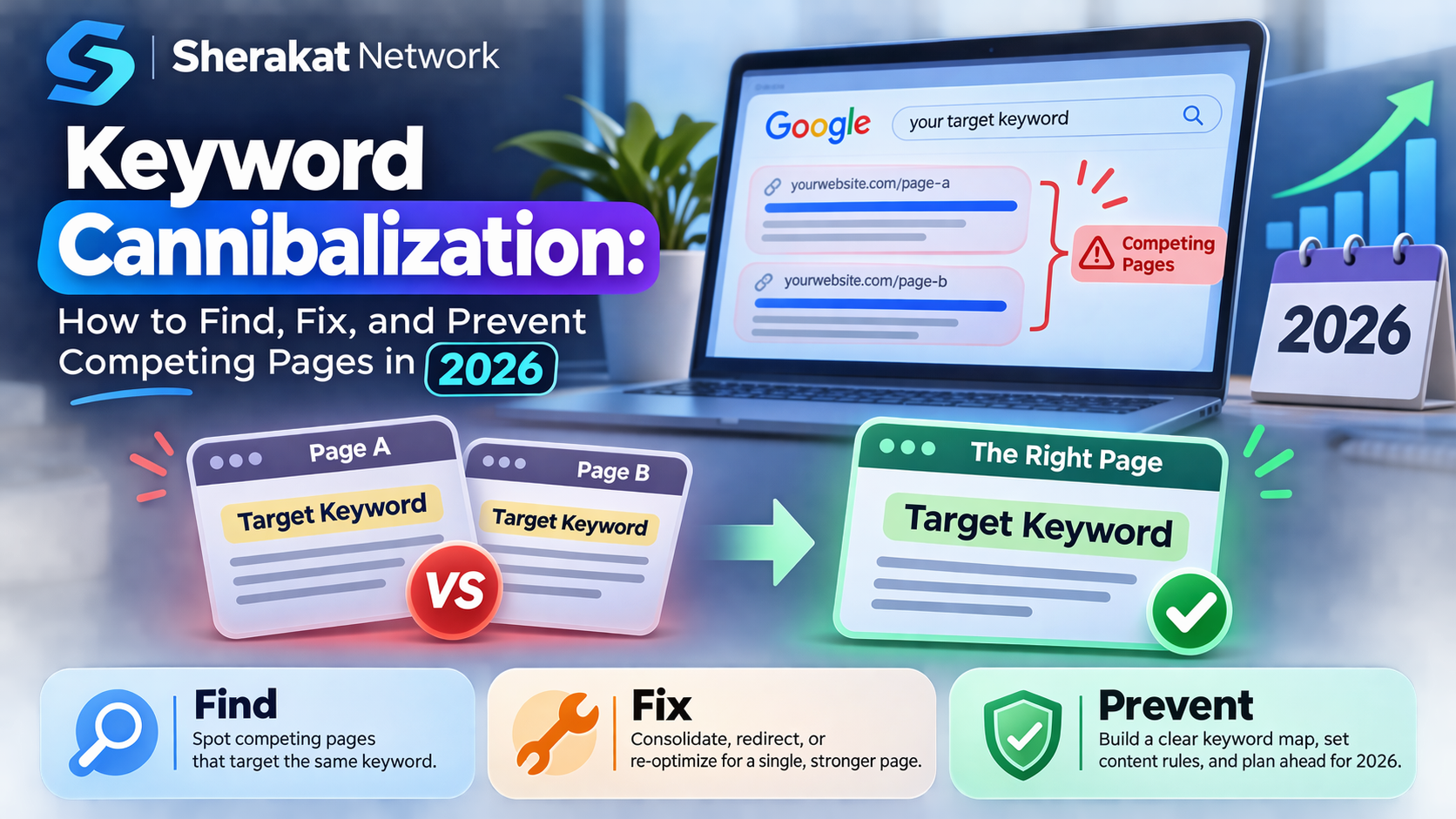
Keyword Cannibalization: A situation where multiple pages on the same website target the same keyword or search intent, causing them to compete against each other in search results. Google struggles to determine which page is most relevant, leading to fluctuating rankings, diluted authority, and reduced traffic for all involved pages.
Search Intent Overlap: The underlying cause of most cannibalization. Two pages can target different keywords but still cannibalize each other if they satisfy the same user intent. “How to fix a leaky faucet” and “leaky faucet repair guide” are different phrases but the same intent—one page should cover both.
Internal Competition: The symptom of cannibalization. Pages competing for the same query show fluctuating average positions in Search Console, with no page establishing dominance. One week Page A ranks position 6, the next week Page B ranks position 9, and neither improves.
Content Consolidation: The primary fix for cannibalization. Merging two or more competing pages into one comprehensive resource that fully addresses the shared intent. The consolidated page inherits the authority and relevance signals of all merged pages.
Canonical Tag: An HTML attribute that tells search engines which URL is the “primary” version of a page. Useful for near-duplicate content, but not a fix for true cannibalization—canonicalizing two pages that address different aspects of the same intent doesn’t solve the underlying problem.
Keyword Mapping: A pre-publication process where every target keyword is assigned to exactly one page. Keyword mapping prevents cannibalization by design rather than fixing it after the fact.
Striking Distance Query: A query where a page ranks position 11-20. These queries are often cannibalization victims—the page would rank higher if it weren’t competing with another page on the same site.
SERP Overlap: The degree to which two keywords return similar search results. High SERP overlap indicates that one page could potentially rank for both keywords, reducing the need for separate pages.
How It Works: The Step-by-Step Framework
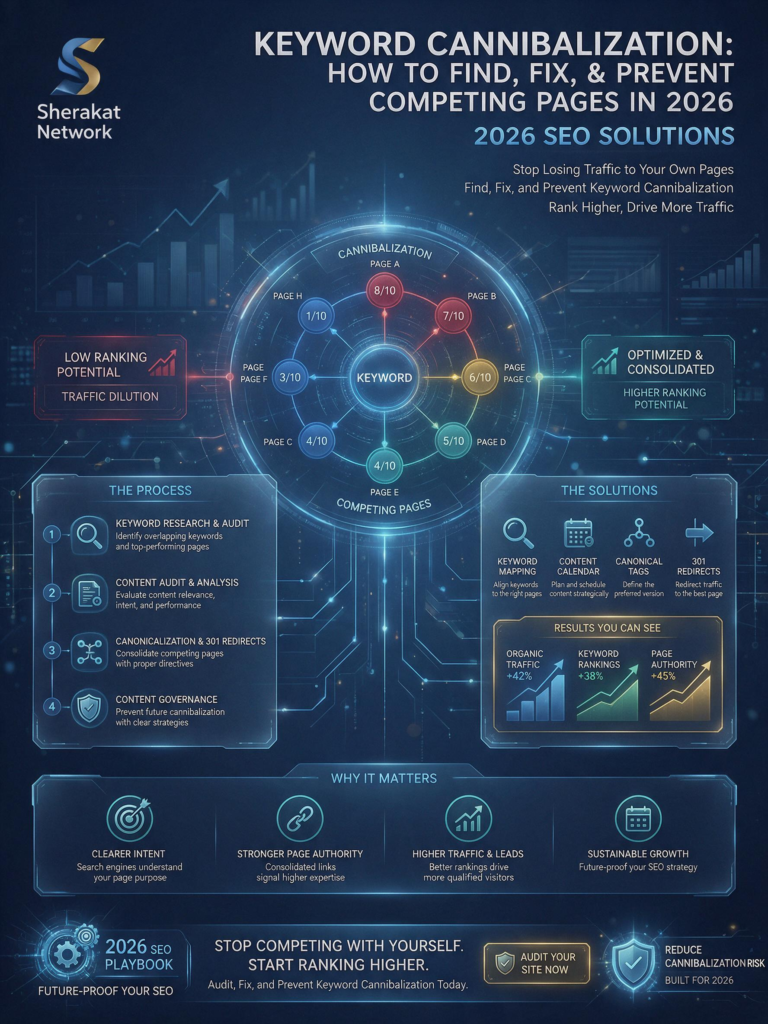
This is the core of the guide. Follow these steps in order to diagnose and fix cannibalization on your site.
Step 1: Audit Search Console for Competing URLs
Google Search Console is your primary diagnostic tool. The Performance report shows which queries trigger your pages and which URLs appear—and the patterns reveal cannibalization.
The audit process:
- Open Google Search Console and navigate to Performance > Search Results.
- Enable the “Queries” tab and sort by impressions.
- For each high-impression query, click the query to filter results to that query alone.
- Switch to the “Pages” tab. This shows which URLs appeared for that query.
What you’re looking for: Multiple URLs appearing for the same query, especially with average positions in the 5-20 range. If Page A ranks position 7 one week and Page B ranks position 12 the next, they’re competing .
The regex trick: Use regex filters to find queries containing core terms that might have multiple pages. For example, filtering for “keyword|SEO|search” shows all queries related to your core topic, making it easier to spot patterns.
What to document: For each cannibalization candidate, record:
- The query
- The competing URLs
- Their average positions
- Their impressions and clicks
This becomes your cannibalization audit sheet.
Step 2: Run a Site Search for Your Target Keywords
Search Console shows what Google sees. Site search shows what your own site contains.
The process:
- Go to Google and search
site:yourdomain.com "target keyword". - Review the results. How many pages on your site mention this keyword or phrase?
- For each result, ask: Is this page targeting the keyword, or just mentioning it?
The distinction matters: A blog post that mentions “keyword research” in passing while discussing content strategy isn’t targeting that keyword. A page titled “Keyword Research Guide” is. Cannibalization occurs when two or more pages are targeting the same intent, not when one page mentions a term that another page targets.
The manual check: Open the pages that appear to be targeting the same keyword. Read their titles, H1s, and introductory paragraphs. Do they address the same question? Would a user searching the keyword be satisfied by either page? If yes, they’re competing.
Step 3: Map Keywords to Pages (The One-to-One Rule)
The most reliable way to find cannibalization is to create a keyword map—a spreadsheet that assigns every target keyword to exactly one page.
The keyword map structure:
| Target Keyword | Assigned URL | Page Title | Intent |
|---|---|---|---|
| keyword research for beginners | /blog/keyword-research-beginners/ | Keyword Research for Beginners | Informational |
| high volume low competition keywords | /blog/high-volume-low-competition/ | High Volume Low Competition Keywords | Informational |
| keyword cannibalization | /blog/keyword-cannibalization/ | Keyword Cannibalization Guide | Informational |
The rule: If a keyword appears twice in the map, you have cannibalization. If two keywords have the same intent but different pages, you likely have cannibalization.
How to build the map:
- Export all indexed pages from Search Console or your sitemap.
- For each page, identify the primary keyword it targets based on title, H1, and content focus.
- Add each page and keyword to the spreadsheet.
- Sort by keyword or intent to reveal duplicates.
What the map reveals: Most sites find 10-30% of their content is competing with itself. The map makes the problem visible and quantifiable.
Step 4: Assess Intent Overlap (Not Just Keyword Overlap)
Keyword cannibalization isn’t always about the exact same phrase. Pages targeting different keywords can cannibalize each other if they serve the same intent.
The intent overlap test: For two pages you suspect are competing, ask:
- Would a user searching Keyword A be satisfied by the page targeting Keyword B?
- Do both pages answer the same core question?
- Do both pages serve the same stage of the buyer journey?
Example: A page titled “How to Start a Blog” and a page titled “Blogging for Beginners” target different keywords but the same intent. A user searching either query wants the same thing: a beginner’s guide to starting a blog. These pages are cannibalizing each other even if the exact keywords differ.
The SERP overlap check: Search both keywords in Google and compare the top 10 results. If the results are largely the same, the keywords share intent and likely should be covered by one page.
Step 5: Choose Your Fix (Consolidate, Differentiate, or Redirect)
Once you’ve identified cannibalizing pages, you have three options. The right choice depends on the relationship between the pages.
Option A: Consolidate
Merge two or more competing pages into one comprehensive resource. This is the best option when:
- The pages cover the same intent
- Neither page is individually strong enough to rank well
- A single, more comprehensive page would serve users better
How to consolidate:
- Choose the page with the strongest existing signals (backlinks, rankings, age) as the “primary” URL.
- Merge the best content from the secondary pages into the primary page.
- Redirect the secondary pages to the primary page with 301 redirects.
- Update internal links to point to the primary page.
- Resubmit the primary page for indexing in Search Console.
Option B: Differentiate
Refocus one or both pages on distinct angles of the topic. This is the best option when:
- Both pages have unique value
- The topic is broad enough to support multiple pages
- You can clearly define non-overlapping scopes
How to differentiate:
- Define a narrow scope for each page.
- Update titles, H1s, and content to reflect the new focus.
- Add internal links between the pages to clarify their relationship.
- Ensure each page has a distinct primary keyword.
Example: A page on “keyword research tools” and a page on “free keyword research tools” could be differentiated: the first covers paid and free tools, the second covers only free options. If the scope difference is meaningful to users, differentiation works.
Option C: Redirect
If one page is clearly inferior and adds no unique value, redirect it to the stronger page without merging content. This is appropriate when:
- The secondary page has no meaningful content that isn’t already covered
- The page has no backlinks or rankings worth preserving
- Keeping the page adds no user value
Step 6: Execute the Fix Without Losing Traffic
The execution matters as much as the diagnosis. A botched consolidation can cause more damage than the cannibalization itself.
Pre-consolidation checklist:
- Document the current state: Record rankings, traffic, and backlinks for every page involved. This is your baseline.
- Check for backlinks: If a secondary page has valuable backlinks, consider whether they should be redirected to the primary page or whether the secondary page should remain as a separate resource.
- Preserve the best content: Read all competing pages. Identify the sections, examples, and data that are unique and valuable. These must be included in the consolidated page.
Execution steps:
- Update the primary page: Add the merged content, improve the structure, and ensure it comprehensively addresses the shared intent.
- Set up 301 redirects: Redirect each secondary URL to the primary URL. Use a single redirect, not a chain.
- Update internal links: Find every internal link pointing to secondary pages and update them to point to the primary page.
- Update the sitemap: Remove secondary URLs and ensure the primary URL is included.
- Request indexing: Use Search Console’s URL Inspection tool to request indexing for the updated primary page.
What to expect: Rankings may fluctuate for 2-4 weeks after consolidation. The primary page may temporarily drop before recovering and exceeding previous performance. This is normal—Google needs to re-evaluate the consolidated page.
Step 7: Prevent Future Cannibalization (The Pre-Publication Process)
Fixing cannibalization is expensive. Preventing it is cheap. The solution is a pre-publication workflow that catches overlap before content is published.
The keyword mapping rule: Every new content idea must be checked against the keyword map before writing begins. If a keyword or intent already has an assigned page, the new idea either:
- Adds a distinct section to the existing page (preferred)
- Targets a clearly different intent (acceptable)
- Is rejected (if neither condition is met)
The intent check: Before writing, ask: “What query will this page rank for, and what page currently ranks for that query?” If the answer is “this page” and “an existing page,” you have a cannibalization risk.
The internal linking discipline: When publishing a new page, link to related existing pages with descriptive anchor text that clarifies the relationship. This helps Google understand the distinction between pages and reduces the risk of overlap.
The quarterly audit: Run the Search Console cannibalization audit quarterly. Content libraries grow, and overlap accumulates over time. Regular audits catch problems before they compound.
Why It’s Important
Keyword cannibalization isn’t just an SEO technicality. It’s a direct drain on the resources you invest in content.
The wasted investment. Every page that cannibalizes another page is a page that isn’t reaching its potential. The writing time, the editing, the design, the promotion—all of it is partially wasted because the page is competing with itself. For a site with 100 pages and 20% cannibalization, that’s 20 pages worth of investment producing less than it should.
The ranking ceiling. Cannibalization creates a ceiling on rankings. No page can break through to the top positions because Google keeps switching between competing URLs. The site as a whole underperforms its potential authority .
The traffic uncertainty. Cannibalization makes traffic forecasting impossible. If you don’t know which page will rank for a query next week, you can’t predict traffic. This uncertainty compounds across a content library.
The AI Overview vulnerability. In 2026, pages that rank position 8-15 because of cannibalization are essentially invisible. AI Overviews consume the clicks that lower-ranked pages once received. A page stuck at position 9 due to internal competition isn’t just underperforming—it’s not performing at all.
What happens if you ignore this: You keep publishing. The site grows. But the traffic doesn’t grow proportionally. You assume the problem is competition, or algorithm changes, or the market. The real problem is that your own pages are fighting each other. Fixing cannibalization often produces the fastest traffic gains available to an established site—because you’re unlocking potential that already exists. For more on building a sustainable content strategy, explore our SEO resource library.
Sustainability in the Future
Keyword cannibalization is evolving. Here’s what to watch.
AI Overviews will make cannibalization more costly. As AI summaries consume more informational clicks, the margin for ranking errors shrinks. Pages stuck at position 8-15 due to internal competition will see traffic decline faster than pages at the top. The incentive to fix cannibalization grows.
Content consolidation will become standard practice. The “more pages equals more traffic” myth is dying. Research shows that only 1.94% of pages get meaningful search visits . The businesses that win will be those that consolidate ruthlessly and publish strategically.
Tools will get better at detecting overlap. Current tools are designed to find new keywords, not diagnose internal conflicts. Expect to see features that flag overlapping pages and recommend consolidation—but until then, manual audits remain essential.
The sustainable approach: Build a keyword map before publishing. Audit quarterly. Consolidate aggressively. Treat every page as a strategic asset with a defined purpose, not just another entry in the content calendar. This discipline will separate the sites that grow efficiently from the ones that grow by accumulating technical debt. For resources on building sustainable SEO systems, explore our resources section.
Common Misconceptions
Misconception 1: “Cannibalization only happens with identical keywords.” No. Pages targeting different keywords but the same intent cannibalize each other. “How to start a blog” and “blogging for beginners” are different phrases with the same intent.
Misconception 2: “Canonical tags fix cannibalization.” Canonical tags tell Google which URL is primary for duplicate content. They don’t fix intent overlap between pages with distinct content. If two pages address the same query differently, canonicalization doesn’t solve the competition.
Misconception 3: “Cannibalization is always bad.” Some overlap is natural and acceptable. A category page and a blog post might both mention the same topic without competing for the same query. The problem is when pages are targeting the same intent, not when they’re topically related.
Misconception 4: “Consolidation always means deleting pages.” Consolidation means merging valuable content into one comprehensive page, then redirecting. You’re preserving the best of each page, not deleting it.
Misconception 5: “I’ll fix cannibalization after I finish my content calendar.” Cannibalization compounds. Every new page that overlaps with an existing page makes the problem worse. Fix it now, or the cleanup becomes exponentially larger.
Misconception 6: “Ranking fluctuations mean Google is testing my site.” Ranking fluctuations often mean Google is choosing between your competing pages. If position 7 one week is Page A and position 7 the next week is Page B, that’s cannibalization, not testing.
Misconception 7: “Cannibalization only affects large sites.” Small sites cannibalize faster because they have fewer pages and less authority to spread across them. A 20-page site with 5 competing pages has a worse cannibalization ratio than a 500-page site with 20 competing pages.
Recent Developments
Three developments in 2025-2026 have made keyword cannibalization a more urgent priority.
1. AI Overviews reduced tolerance for ranking ambiguity. When pages rank position 8-15 due to cannibalization, they now get essentially zero clicks. The threshold for “good enough” rankings has risen. Fixing cannibalization is no longer an optimization—it’s a survival requirement for informational content .
2. Research quantified the page performance distribution. Ahrefs data shows that only 1.94% of pages get between one and ten monthly search visits from Google . The vast majority of pages get nothing. Cannibalization is one of the primary reasons pages underperform—they’re competing with sibling pages instead of external competitors.
3. Content consolidation emerged as a recognized strategy. As publishing volume increased across the industry, the businesses that consolidated and optimized existing content outperformed those that published more. The principle: one comprehensive page beats three fragmented pages, both for users and for search engines.
Success Stories
Case Study: The SaaS Blog’s Three-Page Problem
A project management SaaS had published three separate articles over eighteen months: “How to Manage Remote Teams,” “Remote Team Management Tips,” and “Best Practices for Managing Remote Employees.” Each targeted a slightly different keyword. None ranked above position 12.
The Search Console audit revealed that all three pages appeared for the query “manage remote teams,” with average positions fluctuating between 11 and 18 across the three URLs. Google couldn’t decide which page was most relevant because they all addressed the same intent.
The fix: consolidation. The team merged all three articles into the strongest URL, preserving the unique sections from each, and redirected the other two. Within six weeks, the consolidated page ranked position 4 for the primary query and began appearing in AI Overview citations for related sub-queries.
The key insight: Three pages at position 15 are worth less than one page at position 4. Consolidation unlocked ranking potential that individual pages couldn’t achieve.
Case Study: The E-commerce Store’s Category Overlap
An online store selling ergonomic chairs had a category page for “ergonomic chairs” and a blog post titled “What to Look for in an Ergonomic Chair.” Both targeted the same commercial intent—users researching ergonomic chair purchases. The category page ranked position 9, the blog post position 14, and neither improved.
The fix: differentiation, not consolidation. The category page was updated to focus on product listings and specifications. The blog post was updated to focus on buying criteria and comparison factors, with a clear internal link to the category page. Each page now had a distinct purpose: the blog post for research, the category page for purchase.
Within a month, the blog post moved to position 6 for informational queries, and the category page moved to position 5 for transactional queries. They were no longer competing—they were serving different stages of the journey.
The key insight: Not all cannibalization requires consolidation. Sometimes the fix is clarifying the distinct purpose of each page.
Case Study: The Local Service Site’s Service Page Sprawl
A plumbing company had created separate service pages for “drain cleaning,” “clogged drain repair,” “slow drain fix,” and “drain unclogging.” Each page was 300-400 words, targeting a slight variation of the same service. None ranked above position 15 for any query.
The keyword map revealed four pages targeting the same intent: a user with a clogged drain who needs it fixed. The fix: consolidation into one comprehensive “Drain Cleaning and Repair” page covering all variations, with a 1,500-word guide, pricing information, and a booking CTA.
Within three months, the consolidated page ranked position 3 for “drain cleaning [city]” and position 5 for “clogged drain repair,” generating more service calls than all four pages combined had produced in the previous year.
The key insight: Service pages cannibalize when they’re variations of the same offering. One strong page beats four weak ones.
Real-Life Examples
Example 1: The “Beginner’s Guide” Problem
A finance blog published “Investing for Beginners,” “How to Start Investing,” and “Beginner Investing Tips” within six months. All three targeted the same intent: teaching novices how to invest. Search Console showed all three ranking position 10-20 for overlapping queries. Consolidating them into one comprehensive guide moved the page to position 5 within two months.
Example 2: The Product Comparison Overlap
A software review site had a page for “CRM Comparison” and separate pages for “CRM vs CRM” comparisons (e.g., “Salesforce vs HubSpot”). The comparison hub page cannibalized the individual comparison pages because both targeted comparative intent. The fix: the hub page became a navigation resource linking to individual comparisons, not a standalone comparison itself. Rankings for individual comparisons improved.
Example 3: The Blog Category Page Conflict
A content site had a category page for “Marketing” and a blog post titled “Marketing Basics.” Both appeared for “marketing basics” queries. The category page was not intended to rank for that query—it was a navigation page. The fix: de-optimize the category page for the query (remove the keyword from the title, reduce content depth) and strengthen the blog post. The category page returned to its navigation function; the blog post ranked.
Example 4: The Location Page Overlap
A service business had a “Plumber [City]” page and a “Plumbing Services [City]” page. Both targeted local plumber queries. Consolidating them into one location page with comprehensive service information improved local pack rankings and organic position simultaneously.
These examples connect to broader patterns in how systems optimize. The global supply chain eliminates redundant inventory to improve efficiency. AI and machine learning systems avoid duplicate training examples to prevent bias. Content strategy follows the same principle: redundancy wastes resources and dilutes performance.
Conclusion and Key Takeaways
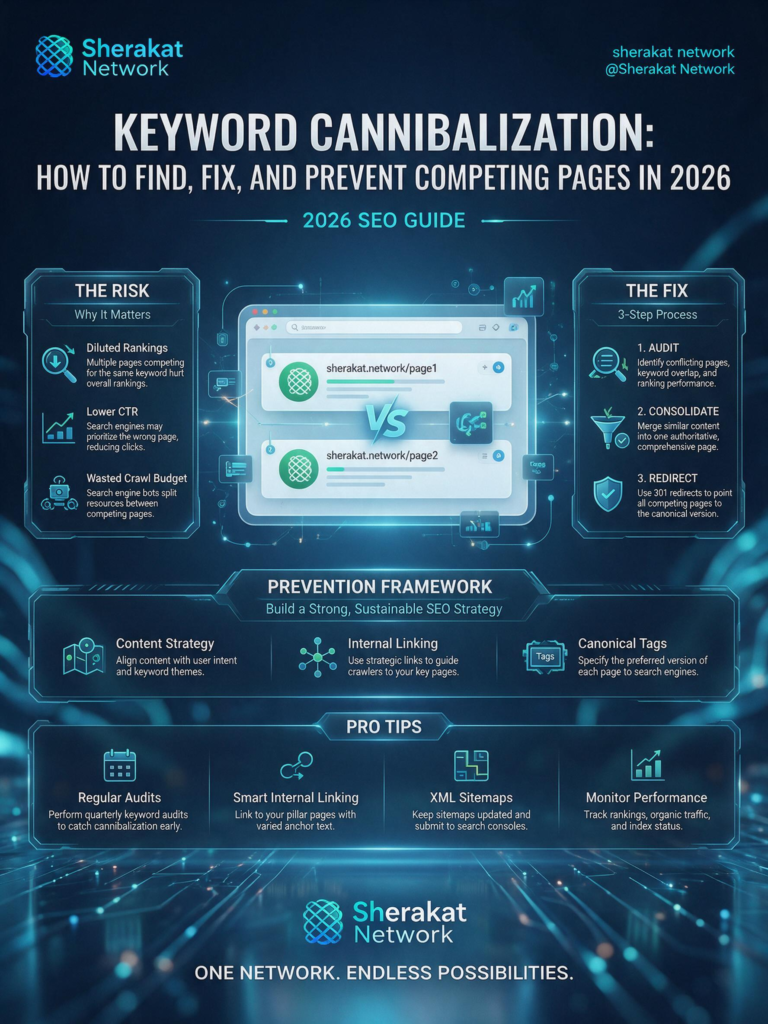
Keyword cannibalization is the silent killer of content strategy. It doesn’t announce itself with penalties or crashes. It shows up as stagnation—pages that never break through, traffic that plateaus, potential that never materializes.
Key Takeaways:
- Cannibalization occurs when multiple pages target the same keyword or the same search intent
- Search Console reveals cannibalization through multiple URLs ranking for the same query with fluctuating positions
- Build a keyword map: every target keyword should belong to exactly one page
- Intent overlap matters more than exact keyword overlap—pages serving the same goal compete even with different phrases
- Three fixes exist: consolidate (merge), differentiate (clarify distinct purposes), or redirect (remove inferior pages)
- Consolidation preserves the best content from each page and redirects the rest
- Expect 2-4 weeks of ranking fluctuation after consolidation before improvement
- Prevent future cannibalization with a pre-publication keyword check
- Audit quarterly—content libraries accumulate overlap over time
Your next step: Open Google Search Console. Find one query where two or more of your URLs appear with average positions in the 5-20 range. That’s a cannibalization candidate. Read both pages. Decide: consolidate, differentiate, or redirect. Execute this week. For more strategic guidance, explore our complete online business guide and our full SEO resource library.
Frequently Asked Questions (FAQs)
Q1: What exactly is keyword cannibalization?
A: When multiple pages on the same site target the same keyword or search intent, causing them to compete against each other. Google struggles to determine which page is most relevant, leading to fluctuating rankings and reduced performance for all involved pages.
Q2: How do I know if my site has cannibalization?
A: Check Search Console for queries where multiple URLs appear with average positions in the 5-20 range. Build a keyword map and look for duplicate assignments. Search site:yourdomain.com "target keyword" to see how many pages mention the term.
Q3: Is cannibalization always bad?
A: Not always. Some topical overlap is natural. The problem is when pages are targeting the same intent, not when they’re topically related. A category page and a blog post can mention the same topic without competing for the same query.
Q4: What’s the difference between keyword cannibalization and duplicate content?
A: Duplicate content is identical or near-identical text. Cannibalization is different pages targeting the same intent with distinct content. Cannibalization is about competition, not duplication.
Q5: Should I consolidate or differentiate?
A: Consolidate when pages cover the same intent and neither is strong enough alone. Differentiate when both pages have unique value and the topic can support distinct scopes. Redirect when one page adds no value.
Q6: Will consolidation hurt my traffic?
A: Short-term fluctuation is normal for 2-4 weeks. Long-term, consolidation typically improves traffic by concentrating authority and relevance signals into one stronger page.
Q7: What happens to backlinks when I consolidate?
A: 301 redirects pass most link equity from secondary pages to the primary page. Check for valuable backlinks before redirecting—you want to preserve that authority.
Q8: How do I prevent cannibalization in the future?
A: Build a keyword map before publishing. Every target keyword should belong to exactly one page. Check new content ideas against the map before writing.
Q9: Can canonical tags fix cannibalization?
A: No. Canonical tags address duplicate content, not intent overlap between distinct pages. If two pages address the same query differently, canonicalization doesn’t solve the competition.
Q10: How often should I audit for cannibalization?
A: Quarterly for active content sites. Content libraries grow, and overlap accumulates. Regular audits catch problems before they compound.
Q11: What if both pages have valuable backlinks?
A: Consolidate into the page with stronger overall signals (rankings, traffic, backlinks) and redirect the other. The redirect passes link equity. Alternatively, if both pages have unique value, differentiate their scopes and keep both.
Q12: Does cannibalization affect local SEO?
A: Yes. Location pages for the same service in different areas can cannibalize if they’re not clearly differentiated. Service pages targeting the same service with slight variations also cannibalize. Consolidation or differentiation applies.
Q13: What’s the most common cause of cannibalization?
A: Publishing new content without checking whether existing content already covers the topic. Content volume pressure and the misconception that more pages equal more traffic.
Q14: Can I have two pages targeting the same keyword with different formats (blog vs video)?
A: Yes, if the formats serve different user preferences and don’t compete for the same SERP features. A blog post and a YouTube video can coexist. Two blog posts targeting the same keyword cannot.
Q15: How do I handle cannibalization between a category page and a blog post?
A: Differentiate their purposes. The category page should serve navigation and product listing. The blog post should serve information and research. Update titles and internal linking to clarify the distinction.
Q16: What if I can’t decide which page to keep?
A: Choose the page with the strongest existing signals: highest rankings, most backlinks, best content quality, oldest age. The other page’s best content merges into the winner.
Q17: Does cannibalization affect AI Overview citations?
A: Yes. Pages stuck at position 8-15 due to cannibalization are rarely cited in AI Overviews. Consolidation improves both traditional rankings and AI citation eligibility.
Q18: How long does it take to see results after fixing cannibalization?
A: Rankings may fluctuate for 2-4 weeks. Meaningful improvement typically appears within 4-8 weeks. Full recovery can take 2-3 months for established sites.
Q19: What’s a keyword map?
A: A spreadsheet that assigns every target keyword to exactly one page. It prevents cannibalization by design rather than fixing it after the fact.
Q20: Can internal linking cause cannibalization?
A: No. Internal linking itself doesn’t cause cannibalization. But linking two pages with the same anchor text can confuse Google about which page is primary. Use distinct anchor text for distinct pages.
Q21: Should I delete or redirect secondary pages?
A: Redirect, don’t delete. Deletion loses any backlinks and authority. A 301 redirect to the primary page preserves link equity and user experience.
Q22: How do I find cannibalization on a large site with thousands of pages?
A: Export Search Console data and filter for queries with multiple URLs. Use tools like Screaming Frog or Semrush to identify pages with overlapping keyword targets. Prioritize high-impression queries first.
Q23: What if the cannibalizing pages have different search intents?
A: Then they’re not truly cannibalizing. Different intents justify separate pages. Verify intent overlap by searching both queries and comparing SERP results. If the results are different, the pages serve different needs.
Q24: Does cannibalization affect paid search?
A: Not directly. Cannibalization is an organic search phenomenon. But the underlying principle—multiple assets targeting the same intent—can waste resources in paid campaigns too.
Q25: What’s the relationship between cannibalization and topical authority?
A: Cannibalization reduces topical authority. When pages compete instead of reinforcing each other, Google sees your site as less clear about what it’s an authority on. Consolidation strengthens topical authority.
Q26: Can I fix cannibalization by just adding more content to one page?
A: Sometimes. If the weaker page has minimal unique content, adding its useful sections to the stronger page and redirecting is consolidation. If both pages have substantial unique content, consider differentiation instead.
Q27: How do I explain cannibalization to non-SEO stakeholders?
A: “We have multiple pages trying to answer the same question. Google doesn’t know which one to show, so it shows both poorly. Merging them into one better page will improve our rankings.”
Q28: What if the cannibalizing pages are in different languages?
A: Pages in different languages serve different markets and don’t cannibalize each other if hreflang is implemented correctly. Cannibalization occurs within the same language-region target.
Q29: Does cannibalization affect new sites more than established sites?
A: New sites cannibalize faster because they have fewer pages and less authority to spread across them. A 20-page site with 5 competing pages has a worse cannibalization ratio than a 500-page site with 20 competing pages.
Q30: What’s the one thing I should do differently after reading this guide?
A: Open Search Console. Find one query where two of your URLs appear with positions in the 5-20 range. Read both pages. Decide: consolidate, differentiate, or redirect. Execute this week. For more guidance, explore our SEO category.
About Author
[Sana Ullah Khan Kakar, Content and Article Writing Specialist]
This guide was written based on hands-on experience auditing and fixing keyword cannibalization for sites ranging from 20-page blogs to 5,000-page content libraries since 2015. The frameworks outlined here have been tested across hundreds of consolidation projects, from local service businesses to multi-national SaaS platforms.
Free Resources
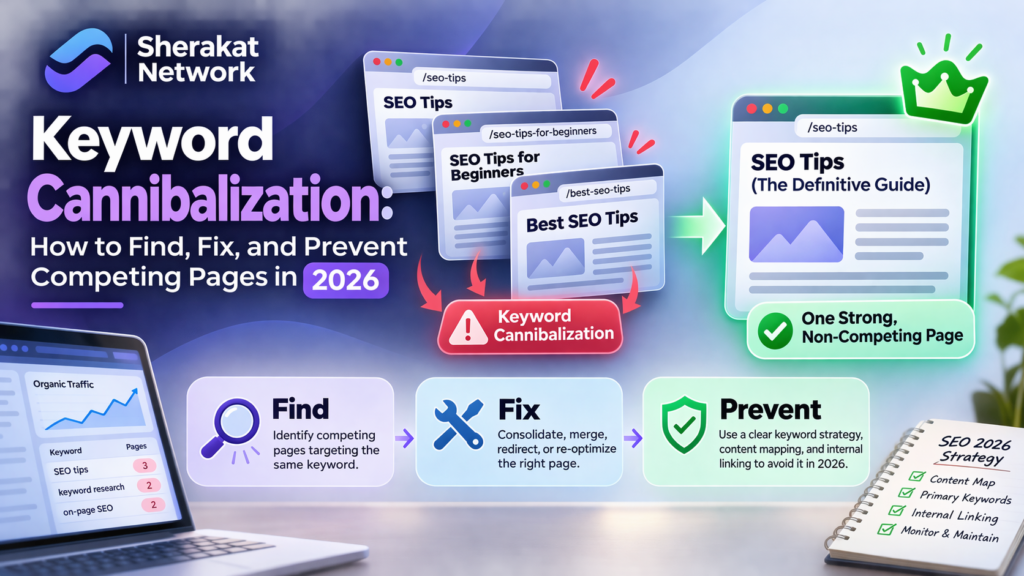
Keyword Cannibalization Tools:
- Google Search Console — identify competing URLs for the same query
- Google Search operators —
site:yourdomain.com "keyword"to find overlapping pages - Screaming Frog — crawl and analyze page titles, H1s, and content overlap
- Semrush Keyword Gap — identify keyword overlap between pages
- SEO PowerSuite Rank Tracker — monitor ranking fluctuations across pages
Recommended Reading on Sherakat Network:
- Start Online Business 2026 Complete Guide
- The Alchemy of Alliance: A Comprehensive Guide to Building a Successful Business Partnership
- SEO Category
- Resources Category
- Blog Category
External Resources:
- The Daily Explainer: Mental Health Complete Guide
- The Daily Explainer: Global Supply Chain Management Guide
- World Class Blogs: AI and Machine Learning
- World Class Blogs: Remote Work and Productivity
- World Class Blogs: Climate Policy Agreements
- World Class Blogs: Culture and Society
Discussion
What’s your experience with keyword cannibalization? Have you discovered competing pages on your own site? Fixed a cannibalization problem and seen traffic improve? Share your insights in the comments below.
If you found this guide helpful, consider sharing it with someone who’s publishing content without a keyword map. The strategies here work—but only if you actually run the audit.
Have questions? Reach out via our contact page.