

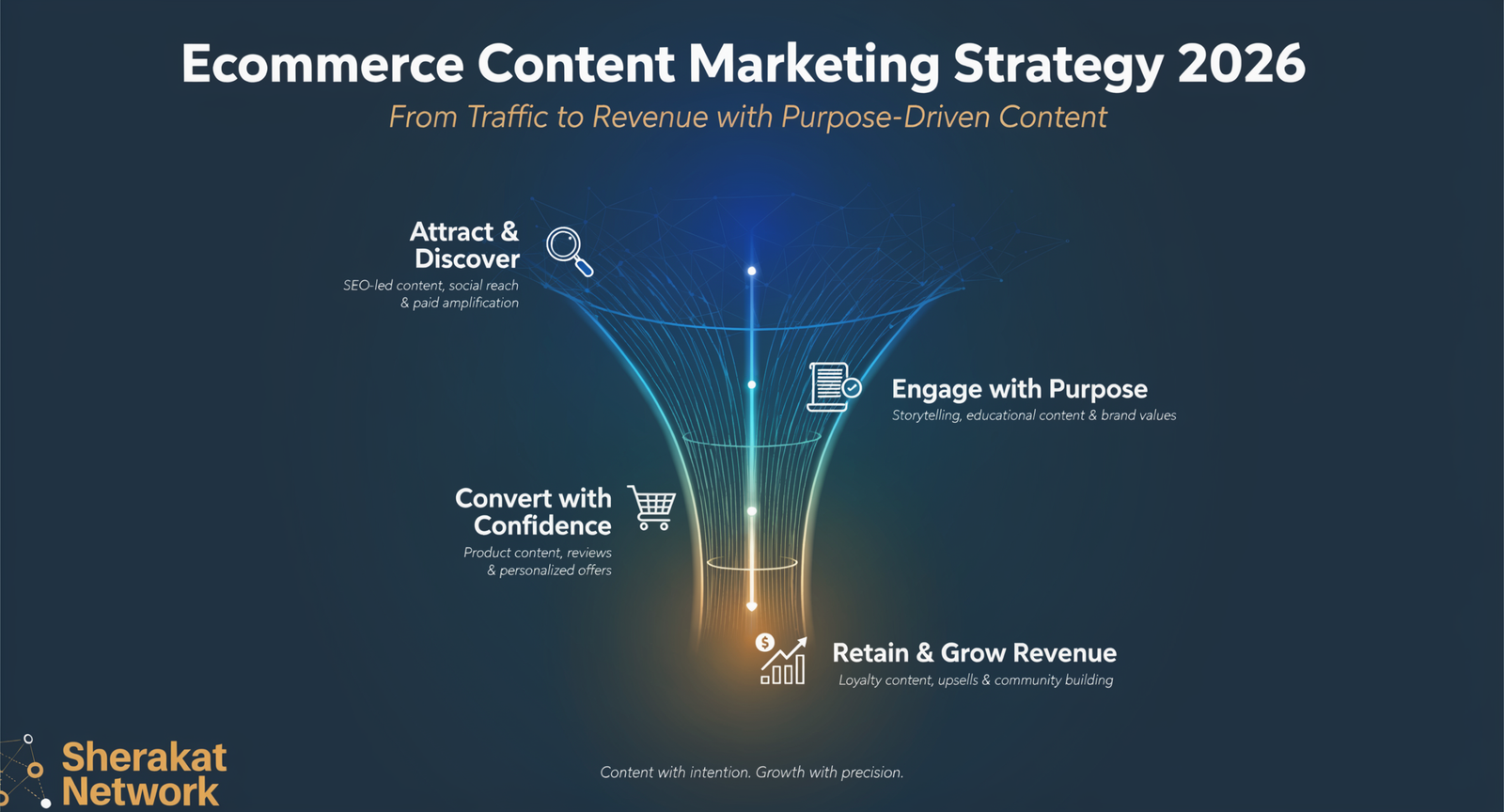

Introduction – Why This Matters
In my experience working with ecommerce brands, I have seen the same pattern repeat: store owners invest heavily in product photography, site design, and paid ads, yet they treat content marketing as an afterthought—a blog post here, a social media update there, with no real strategy behind it.
What I’ve found is that content marketing is now the only tool for getting discovered in oversaturated digital marketplaces . Shoppers don’t land directly on product pages anymore. They discover brands through blog posts, comparison guides, video tutorials, and social content long before they ever click “Add to Cart.” According to a HubSpot survey, 56% of consumers have made a purchase after reading a blog post .
Let me share a story. A client selling specialty coffee equipment had beautiful product pages but almost no organic traffic. They had a blog, but it was a graveyard—one post every few months, no clear strategy. We shifted to a purpose-driven content strategy: weekly blog posts answering common customer questions, monthly buying guides, and video tutorials on brew methods. Within six months, their organic traffic tripled. The blog posts weren’t just driving traffic—they were creating a community of coffee enthusiasts who trusted the brand.
The products hadn’t changed. The content strategy had.
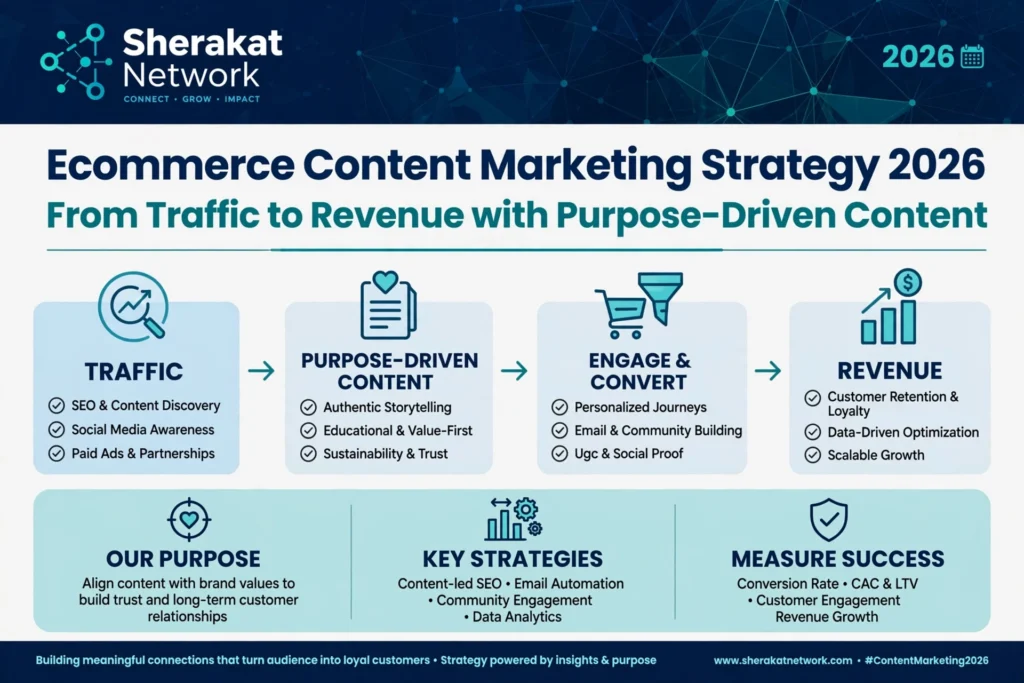
This article is your complete professional guide to ecommerce content marketing for 2026. We will cover the strategies that work, the content types that convert, and the execution framework to turn content into revenue.
Background / Context
Why Content Marketing Matters More Than Ever
In 2026, the path to purchase is no longer linear. Shoppers encounter brands through multiple touchpoints—search results, social media, email, video, AI assistants—before they ever visit a product page. Content marketing is what creates those touchpoints.
The Evolution of Content Marketing in Ecommerce:
- Then (2010–2020): Content was about “blog posts for SEO.” Write a post, hope it ranks, maybe get some traffic.
- Now (2026): Content is the primary driver of brand discovery, authority, trust, and conversion. It feeds SEO, social media, email marketing, and AI search. Without it, your store is invisible.
Key Statistics for 2026:
- 53% of all website visits come from organic search, showing that search engines still dominate ecommerce traffic .
- Top-ranking pages average 1,447 words per post—comprehensive content outranks thin content .
- 94% of content gets zero backlinks. Deliberate content strategy is required to earn links .
- Top-ranking pages have 3.8 times more backlinks than lower-ranking pages .
- Pages with rich snippets (enabled by schema markup) see a 20–30% lift in click-through rate .
The Shift to “Answer-First” Content
The biggest change in 2026 is the rise of AI search. Google’s AI Overviews, ChatGPT, and other answer engines now generate responses directly on the search results page. To be cited by these systems, your content must be structured for extraction—not just ranking .
Traditional SEO content focused on keyword placement and backlinks. Answer-first content focuses on clarity, specificity, and verifiable facts .
Key Concepts Defined
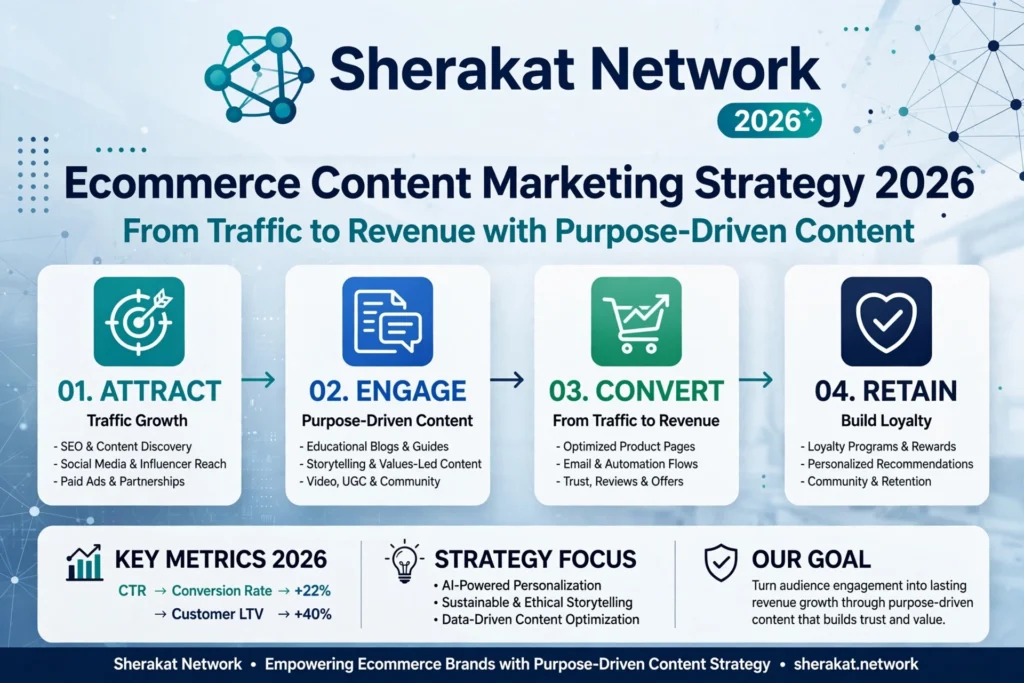
Content Marketing Strategy
A planned approach to creating, publishing, and distributing content that attracts, engages, and converts your target audience. It is not random blogging—it is purposeful content aligned with business goals.
Topic Clusters
A content structure built around a central “pillar” page that covers a broad topic, supported by “cluster” pages that cover specific subtopics. All pages link back to the pillar. This signals topical authority to search engines .
Content Decay
The natural decline in traffic to previously high-performing content over time. Search intent changes, competitors publish better resources, and statistics become outdated .
Answer-First Content
Content structured to provide a direct, concise answer to a user’s question within the first 40–60 words. Designed for easy extraction by AI systems .
User-Generated Content (UGC)
Content created by your customers—reviews, photos, videos, testimonials, social posts. UGC builds trust, adds fresh content to product pages, and feeds into organic and paid channels .
Lead Magnets
Valuable content offered in exchange for a visitor’s email address—eBooks, guides, checklists, discounts. Builds your email list for nurturing campaigns .
Content Repurposing
Transforming a single piece of content into multiple formats: blog post → YouTube video → social clips → email newsletter → podcast episode. Maximizes the value of each piece .
How It Works (Step-by-Step Breakdown)
Here is the exact 8-step content marketing process I use for ecommerce stores.
Step 1: Define Your Content Pillars
A content pillar is a broad topic area that aligns with your products and your customers’ interests. Think of it as the “hub” of your content strategy.
How to Identify Pillars:
- List your main product categories.
- List the problems your products solve.
- List the questions customers ask before buying.
- Group these into 3-5 broad themes.
Example: For a camping gear store, pillars might be:
- “Camping Gear Guides” (informational)
- “Camping Recipes” (lifestyle)
- “Camping Destinations” (inspiration)
Why Pillars Matter: Instead of publishing random blog posts, you build authority in specific topics. Search engines reward depth over breadth .
Step 2: Build Topic Clusters Around Each Pillar
For each pillar, create a “pillar page” (a comprehensive 2,500+ word guide) and 5-10 “cluster pages” (shorter, specific posts) that link back to the pillar .
Example Pillar + Clusters:
- Pillar: “The Ultimate Guide to Choosing a Camping Tent”
- Clusters:
- “4-Season vs. 3-Season Tents: Which Do You Need?”
- “How to Set Up a Tent in High Wind”
- “Best Tents for Car Camping”
- “Ultralight Tents for Backpackers”
- “Tent Maintenance: How to Make Your Tent Last”
Internal Linking: Every cluster page links to the pillar page. The pillar page links to all cluster pages. This distributes authority and helps Google understand your site’s structure .
Step 3: Generate Topic Ideas Based on Real Data
The worst mistake in content marketing is guessing what your audience wants. Instead, use actual data .
Where to Find Content Ideas:
- Search Console: Look at queries your site already appears for (positions 10–30). These are “low-hanging fruit” .
- Google’s “People Also Ask”: Search your seed keywords and scroll to the PAA box. These are exact questions your customers are asking .
- Site Search Data: If you have internal search on your store, check what visitors are typing. That’s demand waiting to be satisfied .
- Amazon Autocomplete: Type your keywords into Amazon and see what shoppers are actively searching for .
- Competitor Analysis: See what content your competitors are publishing that’s getting traffic.
Step 4: Create High-Value Content Types
Not all content is created equal. For ecommerce, certain types consistently outperform .
| Content Type | Purpose | Example | Where It Fits |
|---|---|---|---|
| Buying Guides | Commercial intent. Helps shoppers compare options. | “Best Coffee Makers Under $200” | Top of funnel → Category page |
| Comparison Pages | Direct product comparisons. High conversion potential. | “Nike Air Max vs. Adidas Ultraboost” | Mid-funnel → Product pages |
| How-To Guides | Informational. Builds trust and authority. | “How to Clean Leather Boots” | Top of funnel → Product pages |
| Product Use Cases | Shows how products solve specific problems. | “Best Hiking Shoes for Winter” | Mid-funnel → Product pages |
| Original Research | Unique data earns links and media coverage. | “The State of Sleep in America 2026” | Top of funnel → Homepage |
| FAQs | Addresses purchase objections directly. | “Is This Tent Waterproof? FAQ” | Bottom of funnel → Product page |
| Interactive Content | Tools, quizzes, calculators. High engagement. | “Find Your Perfect Fit: Sizing Tool” | Any stage → Category/Product |
| Video Content | Tutorials, demos, unboxings. Increases dwell time. | “How to Brew Pour-Over Coffee” | Mid-funnel → Product pages |
| Customer Stories | Social proof. Builds trust and relatability. | “How [Customer] Solved [Problem] With Us” | Bottom of funnel → Product/Homepage |
Step 5: Optimize for SEO and AI Search
Traditional SEO is not dead; it’s simply not enough . Your content must work in two worlds: search engines and AI-driven platforms .
Traditional SEO Optimization:
- Use your primary keyword in the first 100 words.
- Include secondary keywords naturally in H2s and body text.
- Use descriptive URLs, meta titles, and meta descriptions.
- Add schema markup (Product, FAQ, HowTo, Article) .
AI-Optimized Content (Answer-First) :
- Start with a 40–60 word direct answer to the question.
- Use clear headings that match real questions (not creative puns).
- Include named entities (your brand name and exact product names) so AI can connect the claim to the source.
- Write specific facts, not vague promises. “Premium quality” is ignored; “3000mm hydrostatic head rating” is cited.
- Include date stamps and keep guides updated annually.
Example Transformation:
- Before (Generic SEO Content): “Our camping tent is the best on the market. It’s durable and spacious and perfect for any adventure.”
- After (Answer-First Content): “The Trailblazer 4-Person Tent sets up in 5 minutes with color-coded poles. It features a 3000mm hydrostatic head rating, meaning it withstands heavy downpours. At 6.2 lbs, it’s lightweight enough for backpacking yet spacious enough for two adults and two kids.”
Step 6: Repurpose, Refresh, and Distribute
Creating content is only half the battle. The other half is making sure it gets seen .
Repurpose Content:
- Write a detailed blog post → Turn it into a YouTube video → Break the video into clips for TikTok/Instagram Reels → Create social posts with core information → Send a summary in your email newsletter .
Refresh Content (Content Decay):
Content naturally declines in traffic over time. Refresh high-performing but aging content by :
- Adding new keywords.
- Removing outdated information.
- Updating old statistics with current data.
- Adding new sections based on recent trends.
- Updating the publication date.
Distribute Content:
- Share blog posts on social media (multiple times, not just once).
- Answer questions on Reddit, Quora, and Facebook Groups, linking back to relevant content.
- Feature content in email newsletters.
- Pitch your original research to journalists (this builds links).
Step 7: Include Clear Calls to Action (CTAs)
Content without a CTA is a missed opportunity. Every piece of content should guide the reader toward the next step .
Types of CTAs for Ecommerce Content:
| Content Type | CTA Example |
|---|---|
| Buying Guide | “See Our Top Picks” (link to category page) |
| Comparison Post | “Shop the Comparison” (link to both product pages) |
| How-To Guide | “Shop the Supplies” (link to relevant products) |
| FAQs | “Have Questions? Contact Us” |
| Customer Story | “Shop [Customer’s] Favorites” |
| Newsletter/Signup | “Get More Guides Like This” |
Pro Tip: Use descriptive anchor text, never “click here.” Example: “Shop our complete collection of waterproof hiking boots” .
Step 8: Measure and Iterate
Content marketing is not a “set it and forget it” activity. You must measure what works and double down .
Metrics to Track:
- Organic Traffic: Are your blog posts and guides driving visitors?
- Engagement Time: Are visitors staying to read, or bouncing immediately?
- Conversion Rate: Are content visitors converting to email subscribers or customers?
- Backlinks: Are other sites linking to your content assets?
- Keyword Rankings: Are your target keywords improving?
Tools to Use:
- Google Analytics 4 (GA4): Track traffic, engagement time, and conversions by landing page .
- Google Search Console: See which queries bring visitors to each page .
- Ahrefs or Semrush: Track keyword rankings and backlinks .
Why It’s Important
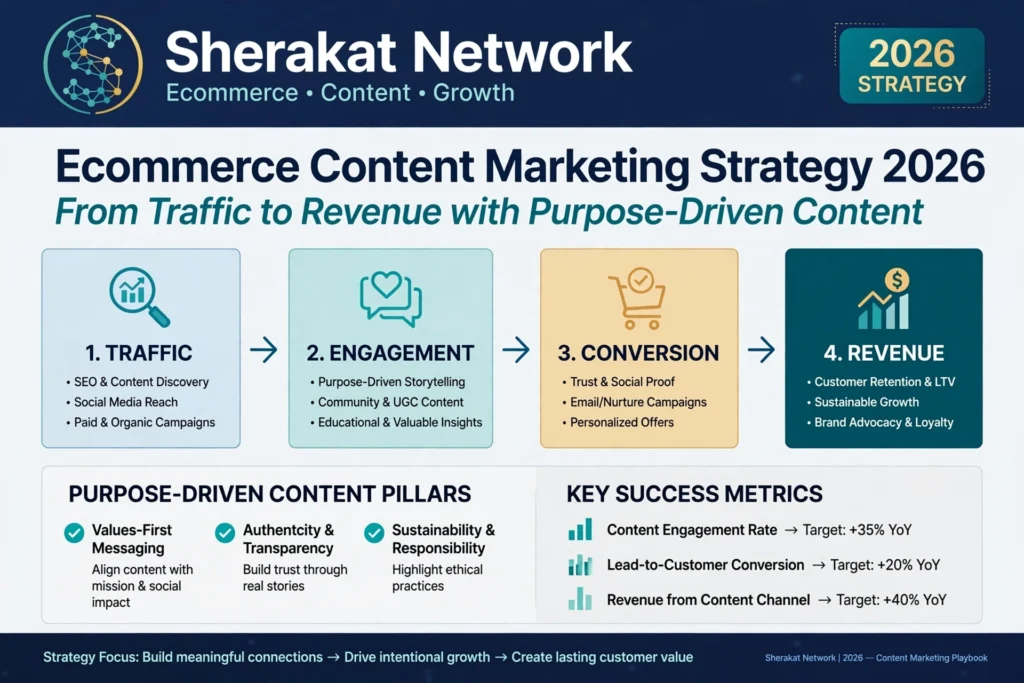
For Brand Discovery
Content is how shoppers find you. 53% of website visits come from organic search . Without content optimized for search, you are invisible to the majority of potential customers.
For Building Trust and Authority
Content marketing builds trust. When you publish valuable, accurate information, you establish your brand as a reliable authority. This fosters trust and encourages customers to engage with and purchase from your store . As one source notes: “The same answers that earn customer trust are what search engines and AI tools use to decide whether your page is worth recommending” .
For SEO and AI Visibility
Content drives SEO. The more valuable content you publish, the better your chances of ranking in search results . In 2026, content also drives AI citation visibility. The content that is structured, fact-based, and answer-first is the content that gets cited by AI Overviews and chatbots .
For Conversion
Content doesn’t just bring traffic—it converts. 56% of consumers have made a purchase after reading a blog post . Buying guides, comparison posts, and FAQs remove hesitation and guide shoppers toward checkout.
For Customer Retention
Content keeps customers engaged after the purchase. Newsletters, tutorials, and community content turn one-time buyers into loyal advocates.
Sustainability in the Future
AI Search Will Demand More Structure
As AI search grows, content must become more structured and answer-oriented. “Answer-first” content—direct, concise, and specific—will dominate . Fluffy marketing copy with no specifics will be ignored.
Topic Authority Will Outrank Keyword Optimization
Search engines are moving toward rewarding expertise across entire topics rather than individual keyword matches. Topic clusters will become the standard for demonstrating authority .
User-Generated Content Will Grow in Value
Reviews, Q&A, and customer photos add fresh, unique content automatically. AI systems value authentic user-generated content because it signals trust and real-world experience .
Video Content Will Become Non-Negotiable
Video increases dwell time, which signals relevance to search engines. Social commerce platforms (TikTok, Instagram) are increasingly where consumers discover products. Video content will be essential .
Common Misconceptions
Myth 1: “Product pages are enough for SEO.”
Reality: Product pages often have thin or duplicate content. They rarely target informational or commercial-intent keywords that drive discovery. Product blogs and guides capture shoppers who aren’t ready to buy yet .
Myth 2: “Blogging is dead.”
Reality: Blogging is very much alive, but the approach has changed. In 2026, successful blogs are data-driven, answer-first, and part of a broader topic cluster strategy. Random, superficial blog posts are dead .
Myth 3: “I should only create content about my products.”
Reality: Content that only promotes products is ignored. Content that solves problems, educates, and adds value builds trust and attracts links. Product mentions should be natural, not forced .
Myth 4: “I don’t need to refresh old content.”
Reality: Content decays naturally. Search intent changes, statistics become outdated, and competitors publish better resources. Refreshing existing content delivers some of the fastest SEO wins .
Myth 5: “Guest posting is just for link building.”
Reality: Guest posting builds relationships and adds value. When you contribute to another brand’s blog, you’re not just borrowing their audience—you’re adding value to it. Quality, insight, and relevance matter more than the link .
Recent Developments (2025-2026)
1. Answer-First Content for AI Search
AI search engines choose content they can extract, verify, and summarize quickly. Pages with direct answers, clear headings, and specific facts are cited more often . Fluffy content is ignored.
2. Topic Clusters Become Standard
Search engines reward content that demonstrates expertise across an entire topic. Instead of publishing random articles, successful ecommerce sites are building comprehensive content hubs around their core products and customer questions .
3. User-Generated Content Gains More Weight
Reviews, Q&A, and customer photos add fresh, unique content automatically. AI systems value authentic UGC because it signals trust and real-world experience .
4. Content Repurposing and Distribution Are Critical
In a saturated space, even the best content can go unnoticed if it is not promoted. Creating once and distributing across formats (blog, video, social, email) is the new standard .
5. Data-Driven Topic Generation
Successful content strategies now rely on real data—Search Console, site search, Amazon autocomplete—rather than guessing what audiences want .
Success Stories
Case Study 1: The Specialty Coffee Brand
Problem: A D2C coffee brand had beautiful product pages but almost no organic traffic. The blog was a graveyard—one post every few months, no clear strategy.
Solution:
- Conducted keyword research using Search Console and “People Also Ask.”
- Identified three content pillars: Brew Methods, Coffee Origins, and Equipment Guides.
- Created a “Pillar + Cluster” structure around each pillar.
- Published weekly blog posts, monthly buying guides, and video tutorials.
- Repurposed blog posts into Instagram Reels and email newsletters.
Results (6 months):
- Organic traffic tripled.
- Blog posts were driving qualified traffic to product pages (60% of blog readers visited a product page).
- Revenue from organic search increased 150%.
- The brand became a trusted resource in the coffee community.
Case Study 2: The Outdoor Gear Store
Problem: A camping gear store with thousands of products was barely getting traffic. Product pages were thin and duplicated.
Solution:
- Created a “Camping 101” content hub with 20+ buying guides and how-to articles.
- Internal linked every guide to relevant category and product pages.
- Added FAQ sections to product pages with questions from the blog content.
- Encouraged customer reviews and Q&A on all product pages.
Results (4 months):
- The content hub earned 25 backlinks from outdoor blogs and publications.
- Organic traffic increased 280%.
- Blog visitors converted at 4.5% vs. the site average of 2.1%.
- Category pages saw ranking improvements due to internal links from blog posts.
Real-Life Examples
Example A: A Content Strategy That Fails
Blog Content: Random posts about “5 Reasons to Love Camping,” “Top 10 Hiking Destinations,” and “How We Started Our Business.” No clear pillar, no internal links to products, no CTAs.
Result: Low traffic. Low engagement. No conversions. Wasted time.
Example B: A Content Strategy That Works
Blog Content: “How to Choose a 4-Season Tent” (pillar), “4-Season vs. 3-Season Tents” (cluster), “Tent Setup in High Wind” (cluster), “Best Tents for Backpacking” (buying guide). Each post links to tent category pages and specific product pages. Each post ends with “Shop Tents” CTA.
Result: High traffic. High engagement. Blog readers click through to products. Conversions follow.
Conclusion and Key Takeaways
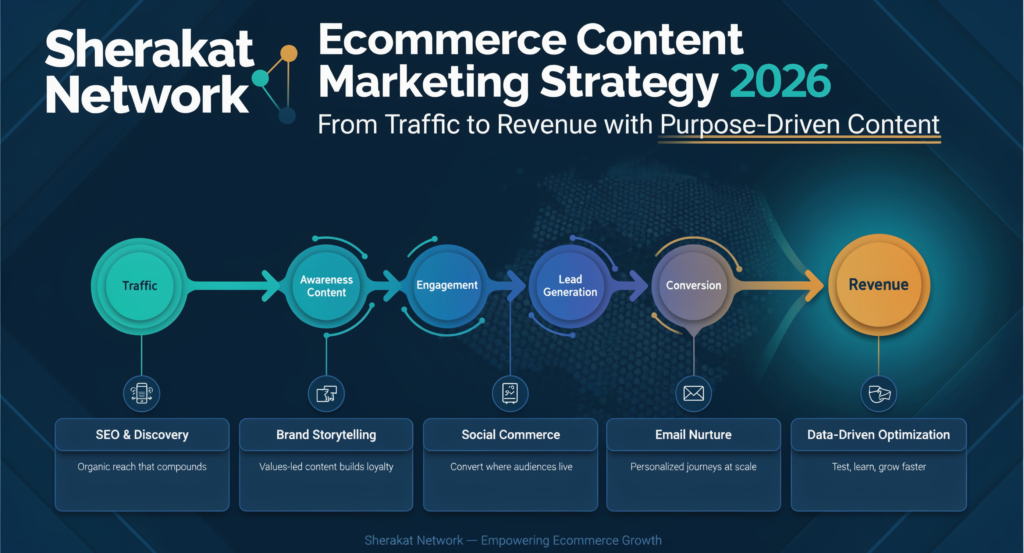
Content marketing is not optional in 2026. It is the primary way shoppers discover brands, build trust, and make purchase decisions.
The 10 Commandments of Ecommerce Content Marketing (2026):
- Thou Shalt Define Content Pillars: Build your strategy around 3-5 broad topic areas aligned with your products.
- Thou Shalt Build Topic Clusters: Pillar pages + cluster pages that interlink demonstrate topical authority.
- Thou Shalt Use Data for Topic Ideas: Search Console, site search, and Amazon autocomplete reveal what your audience actually wants.
- Thou Shalt Create Answer-First Content: Start with direct, concise answers; write like you want to be quoted by AI .
- Thou Shalt Include Clear CTAs: Every piece of content should guide the reader to the next step.
- Thou Shalt Repurpose and Distribute: Create once, distribute across formats (blog, video, social, email) .
- Thou Shalt Refresh Aging Content: Combat content decay by updating statistics and keywords .
- Thou Shalt Encourage User-Generated Content: Reviews, Q&A, and customer photos add fresh content and build trust.
- Thou Shalt Target Long-Tail Commercial Keywords: “Best coffee maker under $200” converts better than “coffee maker.”
- Thou Shalt Measure and Iterate: Track traffic, engagement, and conversions. Double down on what works.
Your 7-Day Action Plan:
- Day 1: Identify your 3-5 content pillars based on products and customer questions.
- Day 2: Build a topic cluster outline for one pillar (1 pillar page + 5 cluster topics).
- Day 3: Conduct keyword research for each cluster topic using Search Console and “People Also Ask.”
- Day 4: Write one pillar page or one cluster post. Include internal links and a CTA.
- Day 5: Identify 3 older posts to refresh (update statistics, add new sections, update the date).
- Day 6: Create a social media/email distribution plan for your new content.
- Day 7: Repurpose one blog post into a video or social content.
FAQs (Frequently Asked Questions)
Q1: What is content marketing and why does it matter for ecommerce?
A: Content marketing is creating and sharing valuable content to attract and retain customers. It matters because 56% of consumers have made a purchase after reading a blog post, and 53% of website visits come from organic search .
Q2: What is the difference between content marketing and SEO?
A: Content marketing creates the content. SEO optimizes it so people can find it. They work together: content drives SEO, and SEO makes content discoverable.
Q3: What is a topic cluster?
A: A pillar page (comprehensive guide) supported by cluster pages (specific posts on subtopics), all interlinked. It signals expertise to search engines .
Q4: How often should I publish content?
A: Consistency matters more than frequency. Weekly blog posts are a solid starting point. Increase output as you scale.
Q5: How long should blog posts be?
A: Top-ranking pages average 1,447 words . Short, shallow posts rarely rank. But aim for quality and depth, not just word count.
Q6: What is “answer-first” content?
A: Content structured with a direct, concise answer to a question in the first 40-60 words. Designed for AI extraction and citation .
Q7: What is content decay?
A: The natural decline in traffic to previously high-performing content over time . Refresh aging content by updating statistics, adding new sections, and updating publication dates.
Q8: Should I only create blog posts?
A: No. Use multiple formats: blog posts, videos, infographics, social content, email newsletters, and interactive tools .
Q9: How do I find content topics?
A: Use Google Search Console, “People Also Ask,” site search data, Amazon autocomplete, and competitor analysis .
Q10: How do I optimize content for AI search?
A: Prioritize clarity, write direct answers, use clear headings, include named entities, use schema markup, and build topic clusters .
Q11: What is the 80/20 content rule?
A: 80% organic, educational content (blogs, guides) and 20% paid promotion (ads, influencer content). Test content organically, then promote the best performers .
Q12: What is UGC and why does it matter?
A: User-generated content—reviews, photos, testimonials, social posts. It builds trust, adds fresh content, and feeds organic and paid channels .
Q13: How do I repurpose content?
A: Write a blog post → YouTube video → social clips → email newsletter → podcast episode. Maximize the value of each piece .
Q14: What is a lead magnet?
A: Valuable content offered in exchange for an email address—eBooks, guides, checklists, discounts. Builds your email list .
Q15: How do I measure content marketing success?
A: Track organic traffic, engagement time, conversion rate, backlinks, and keyword rankings using GA4, Search Console, and Ahrefs/Semrush .
Q16: What is a buying guide?
A: Content that helps shoppers compare options and make purchase decisions. Example: “Best Coffee Makers Under $200.” High commercial intent.
Q17: What is a comparison page?
A: Content directly comparing two or more products. High conversion potential. Example: “Nike Air Max vs. Adidas Ultraboost.”
Q18: How do I add CTAs to content?
A: Use descriptive anchor text like “Shop the complete collection of waterproof hiking boots,” never “click here.” Link to relevant category or product pages .
Q19: What is internal linking and why does it matter?
A: Links from your blog posts to product pages distribute authority and guide readers toward conversion. It also helps Google understand your site’s structure .
Q20: How do I use Google’s “People Also Ask” for content ideas?
A: Search your seed keyword, scroll to the PAA box, and capture the questions. These are exact questions your customers are asking .
Q21: What is seasonal content?
A: Content planned around seasonal events, holidays, and shopping periods. Example: “Best Mother’s Day Gifts.” Capture demand before competitors do .
Q22: Is guest posting still effective?
A: Yes, but focus on quality and relevance. Approach guest posting as a way to add value to another audience, not just to get a link .
Q23: How do I create content clusters?
A: Choose a pillar topic, write a comprehensive guide, then write 5-10 specific posts on subtopics. Link all clusters back to the pillar .
Q24: What is content distribution?
A: Actively promoting your content through social media, email, communities, and partnerships. Even great content needs promotion .
Q25: How do I refresh old content?
A: Add new keywords, remove outdated info, update statistics, add new sections, and update the publication date .
Q26: What is dwell time and why does it matter?
A: How long visitors stay on a page. Google’s RankBrain algorithm favors pages with high dwell time, meaning longer, engaging content ranks better .
Q27: How do I use video in content marketing?
A: Create tutorials, product demos, unboxings, and behind-the-scenes content. Video increases dwell time and engagement .
Q28: What is original research content?
A: Publishing data that does not already exist elsewhere, like customer surveys or industry reports. These earn links and media coverage .
Q29: How do I optimize content for mobile?
A: Use short paragraphs, clear headings, readable fonts (16px+), and responsive images. Most shoppers browse on mobile .
Q30: What is the biggest mistake in content marketing?
A: Creating content without a clear strategy. Random, promotional, or low-quality content doesn’t build trust or drive conversions. Start with audience needs, not what you want to say.
About the Author
This guide was written by the Sherakat Network content and SEO team. With over a decade of combined experience in ecommerce content strategy and digital marketing, the team has helped hundreds of online stores transform content into a reliable channel for traffic and revenue. We believe that great content doesn’t just rank—it builds relationships.
Free Resources
- Content Marketing Strategy Template (2026 Edition):
- Topic Cluster Planning Workbook:
- Content Repurposing Checklist:
- Content Calendar Template (Google Sheets):
Discussion
What is the biggest challenge you face with content marketing for your ecommerce store? Or have you seen a content strategy transform your traffic? Share your experience or ask your questions in the comments below. The Sherakat Network community includes forward-thinking store owners who have navigated these challenges.
Internal & External Links (Naturally Integrated)
Internal Links:
- For the foundational SEO concepts that support content marketing, visit our main SEO category page .
- Need templates and tools to execute your content strategy? Our Resources section has content planning templates and SEO guides.
- If you are building a new store from scratch, our Start Online Business 2026 Complete Guide covers platform selection and initial setup.
- Once you have created content, you need to optimize your product pages to convert. Read our guide on Product Page SEO Optimization .
- Your content strategy should consider your overall site architecture. See our article on Ecommerce Site Architecture for SEO .
- For the broader shift towards AI-driven search, revisit our guide on The AI Answer Era: GEO & AEO Strategy .
- Explore all our insights on the Sherakat Network Blog for weekly updates.
- Have specific content marketing questions or need a custom strategy? Contact us here .
External Links:
- Running an ecommerce business is stressful. Maintain your focus with the Mental Health Complete Guide – burnout kills the creativity needed for effective content creation.
- If your content marketing efforts lead to more orders, ensure your supply chain can handle the volume with this guide on Global Supply Chain Management .
- Leverage AI & Machine Learning trends to understand the technology behind AI-driven content discovery.
- Managing a remote team of content writers? Read up on Remote Work Productivity .
- Stay informed about Climate Policy & Agreements – sustainability content is a growing SEO and trust differentiator.
- Understand the Culture & Society trends that influence what content resonates with audiences.