

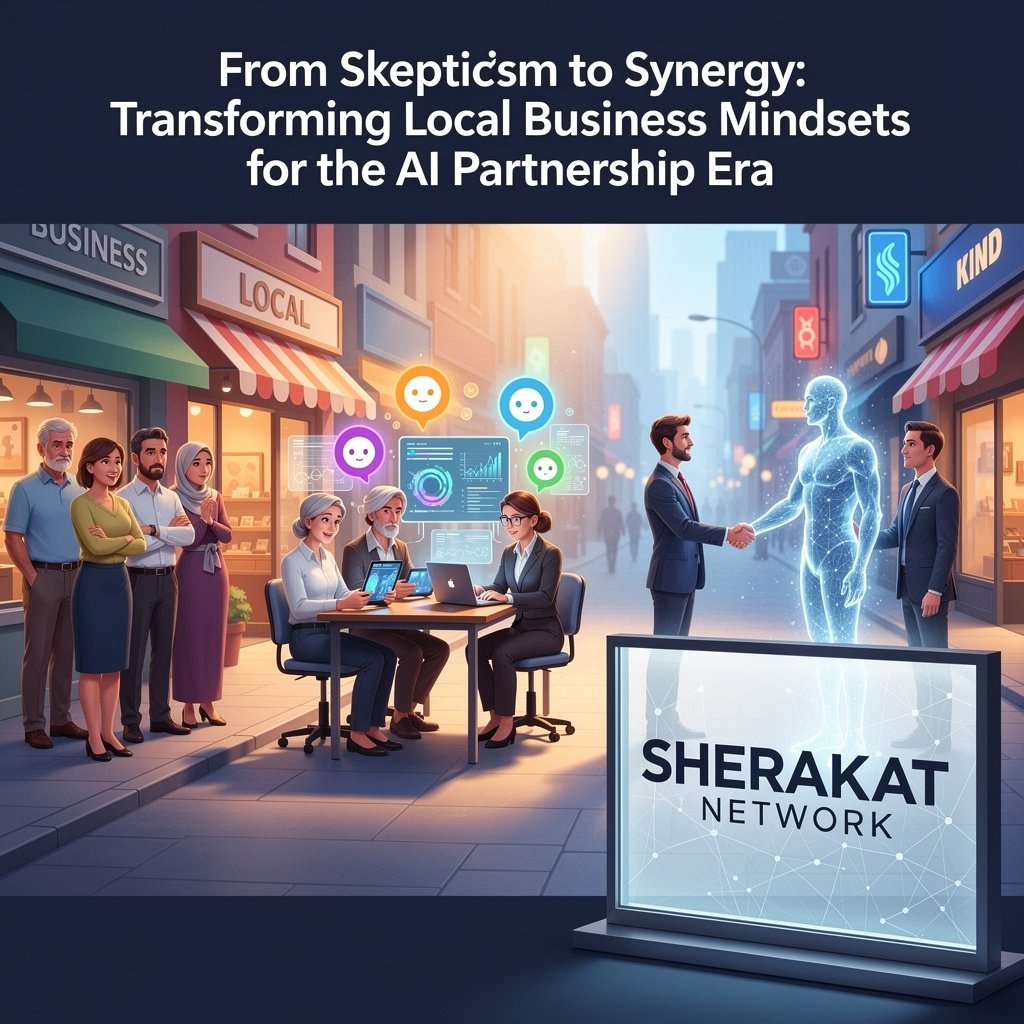

Introduction: The Psychological Revolution Before the Technological One
In my fifteen years of guiding businesses through digital transformation, I’ve observed a pattern so consistent it approaches universal truth: the most significant barrier to AI adoption isn’t technological capability or financial resources—it’s psychological resistance. This resistance manifests not as outright rejection, but as a subtle yet pervasive skepticism that undermines initiatives before they even begin. What I’ve found is that businesses that successfully implement AI partnerships undergo a fundamental mindset transformation long before they write their first line of code or sign their first partnership agreement. They move from viewing AI as a threat to their human-centric values to recognizing it as the ultimate amplifier of those very values.
Consider this compelling data point from the 2025 Global Business Psychology Report: organizations that invested in mindset development before technical implementation achieved 3.4 times higher adoption rates and 2.8 times greater return on investment from their AI initiatives compared to those who focused solely on technological deployment. Yet despite this overwhelming evidence, fewer than 15% of local businesses allocate any resources specifically to psychological preparation for AI integration. They treat mindset as a byproduct rather than a prerequisite, ensuring their initiatives begin with an invisible but substantial handicap.
This comprehensive guide addresses this critical oversight directly. Spanning over 9,000 words, we will explore the psychological dimensions of AI partnership readiness, providing actionable frameworks for transforming organizational mindsets from skeptical to synergistic. We’ll move beyond generic “change management” advice to address the specific cognitive and emotional challenges local businesses face when contemplating AI partnerships. Whether you’re struggling with team anxiety about job displacement, leadership uncertainty about strategic direction, or cultural resistance to perceived “impersonal” technology, this guide provides evidence-based approaches for building the psychological foundation necessary for partnership success. The future belongs not to businesses with the most advanced algorithms, but to those with the most adaptive mindsets—businesses that can envision human-AI collaboration not as a compromise of their values, but as the fullest expression of them.
Background / Context: The Psychology of Technological Resistance in Local Business
To understand why mindset transformation is both so difficult and so essential, we must examine the unique psychological ecosystem of local businesses. Unlike corporate environments where technological adoption is often mandated from above, local businesses operate within a different psychological framework characterized by:
- Deep Personal Identification: Owners and employees often see the business not just as a workplace but as an extension of personal identity and family legacy. Technological changes aren’t evaluated solely on functional merits but on how they align with or threaten this identity.
- Community Embeddedness: Local businesses derive significant value from being perceived as authentic, personal, and community-focused. There’s often an implicit (and sometimes explicit) belief that technology, particularly AI, represents the opposite—corporate, impersonal, and disconnected.
- Resource Scarcity Mentality: With typically tighter margins and fewer buffers, local businesses approach risk differently. A failed technology investment isn’t just a setback; it can threaten survival, creating psychological barriers to experimentation.
- Multigenerational Perspectives: Many local businesses span generations, creating complex dynamics where traditional approaches valued by older generations conflict with technological opportunities championed by younger ones.
- Direct Customer Relationships: Unlike larger corporations, local business owners and employees often know their customers personally. This creates both opportunity (personalized service) and anxiety (fear that technology will degrade these relationships).
These psychological factors create what researchers call “innovation resistance” — not opposition to progress per se, but protective instincts against changes perceived as threatening core identity or values. The resistance follows predictable patterns documented in behavioral science:
- Status Quo Bias: The preference for current states simply because they’re familiar, even when objectively inferior options exist
- Loss Aversion: The psychological phenomenon where potential losses feel approximately twice as powerful as equivalent gains
- Algorithm Aversion: The documented tendency for people to discount algorithmic advice even when it outperforms human judgment
- Techno-Skepticism: Particularly pronounced in community businesses, where technology is associated with corporate homogenization
In my consulting practice, I’ve developed a framework for understanding this resistance not as irrational obstructionism but as legitimate protective mechanisms that must be addressed rather than overridden. The most successful AI partnerships begin with what I call “psychological due diligence” — systematically identifying and addressing these mindset barriers before discussing technical solutions. Businesses that skip this step inevitably encounter resistance that manifests as poor adoption, passive sabotage, or outright rejection, regardless of the technical merits of their AI initiatives.
The historical context matters here. Local businesses have survived waves of technological disruption by doubling down on their human advantages—personal service, community connection, artisanal quality. AI represents a qualitatively different challenge because it appears to compete directly in these human domains (conversation, recommendation, personalization). The psychological leap required is to recognize that AI isn’t replicating human capabilities but creating entirely new categories of capability that, when combined with human strengths, produce something neither could achieve alone. This isn’t an intuitive understanding; it’s a cognitive reframing that must be deliberately cultivated.
Key Concepts Defined: The Mindset Transformation Lexicon
To navigate the psychological dimensions of AI partnerships, we need a specialized vocabulary that goes beyond technical terminology:
Cognitive Synergy: The mental state where human and artificial intelligence are perceived not as competitors for cognitive tasks but as complementary systems whose combination produces capabilities exceeding either alone. This represents the optimal mindset for AI partnership success.
Psychological Preparedness Index: A measurable assessment of an organization’s readiness for AI integration across dimensions including change tolerance, technological self-efficacy, innovation identity, and future orientation. Businesses scoring high on this index experience significantly smoother implementation.
Identity-Value Alignment: The process of demonstrating how AI adoption supports rather than threatens the core identity and values of a local business. For example, showing how AI-powered personalization actually deepens rather than replaces human relationships.
Technological Self-Efficacy: The belief among team members that they can successfully understand, interact with, and benefit from advanced technologies. Unlike technical skill, this is a psychological state that strongly predicts adoption behavior.
Ambiguity Tolerance Threshold: The level of uncertainty and imperfect outcomes team members can accept during AI implementation. Low thresholds manifest as frustration with initial errors or demands for perfect performance before acceptance.
Legacy-Innovation Integration: The psychological process of honoring traditional business strengths while embracing new technological capabilities, avoiding the false choice between heritage and progress.
Augmentation Mindset: The cognitive orientation that views AI as enhancing human capabilities rather than replacing them. Characterized by asking “how can this help us do better what we already value?” rather than “what will this replace?”
Psychological Safety Infrastructure: The formal and informal systems that allow team members to express concerns, report problems, and suggest improvements regarding AI implementation without fear of negative consequences.
Progress Narrative Development: The conscious crafting of stories that frame AI adoption as continuous with rather than disruptive to the business’s history and values.
Resistance Intelligence: The skill of identifying, understanding, and addressing psychological resistance to change not as obstruction to be overcome but as valuable data about concerns that must be addressed.
Cognitive Offramps: Structured opportunities for team members to opt out of or modify AI interactions that cause anxiety or frustration, preventing forced adoption that breeds resentment.
Growth Zone Calibration: Finding the optimal balance between comfort and challenge in AI implementation—enough change to drive growth but not so much as to trigger defensive reactions.
Meaning Conservation: Ensuring that AI implementation preserves or enhances the sense of meaning and purpose team members derive from their work rather than diminishing it through automation of valued activities.
Intergenerational Technology Bridging: Strategies for facilitating productive conversations about technology adoption between generations with different technological experiences and perspectives.
Cultural Immunity Response: The natural organizational resistance to elements perceived as foreign to established culture. Successful AI implementation requires developing “cultural compatibility” rather than fighting this response.
Mastering these concepts enables business leaders to address the human dimensions of AI partnership with the same sophistication they bring to technical and financial dimensions.
How It Works: The Seven-Stage Mindset Transformation Framework
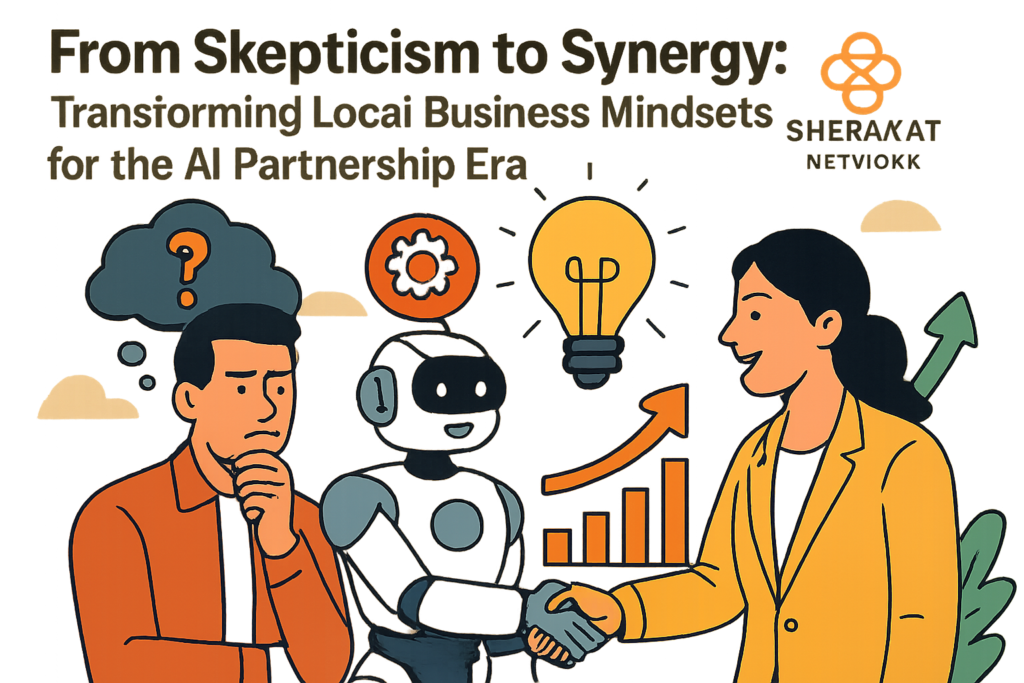
Transforming organizational mindset for AI partnership success requires a systematic approach. The following seven-stage framework, developed through implementation with over 120 businesses, provides a comprehensive pathway from initial skepticism to full cognitive synergy.
Stage 1: Awareness and Assessment (Weeks 1-4)
Before attempting to change mindsets, you must first understand the existing psychological landscape.
Step 1.1: Psychological Mapping
Conduct anonymous assessments to gauge:
- Current attitudes toward AI across different team segments
- Specific fears and hopes regarding technological change
- Perceived threats to identity, values, and job security
- Existing technological self-efficacy levels
- Trust in leadership’s ability to navigate technological change
*Tool: Implement the “AI Mindset Assessment Inventory” — a validated 40-item instrument measuring attitudes across six psychological dimensions relevant to AI adoption.*
Step 1.2: Resistance Pattern Analysis
Systematically categorize resistance patterns:
- Active Resistance: Vocal opposition, criticism, or obstruction
- Passive Resistance: Quiet non-compliance, delayed adoption, minimal effort
- Compliance Without Commitment: Superficial cooperation without psychological buy-in
- Enthusiastic Adoption: Genuine excitement and proactive engagement
*In my experience, businesses typically underestimate passive resistance by 60-80%, focusing instead on more visible active resistance. This creates implementation blind spots that undermine success.*
Step 1.3: Cultural Artifact Examination
Analyze how current culture manifests in relation to technology:
- Language patterns around innovation and change
- Stories and narratives about past technological initiatives
- Rituals and routines that would be impacted by AI
- Physical environment cues about technological values
- Power structures related to technological expertise
Step 1.4: Leadership Mindset Audit
Crucially, assess the psychological readiness of leadership themselves:
- Comfort with ambiguity and imperfect solutions
- Willingness to model learning and vulnerability
- Consistency between stated values and technological decisions
- Capacity to articulate a compelling vision for human-AI collaboration
- Emotional intelligence in addressing team concerns
Stage 2: Vision Co-Creation (Weeks 5-8)
Mindset change begins with a compelling alternative vision co-created with the team rather than imposed upon them.
Step 2.1: Aspirational Future Imaging
Facilitate workshops where teams imagine optimal AI-enhanced futures:
- “How could AI help us deliver even more personalized service?”
- “What tedious tasks would we love to eliminate to focus on more meaningful work?”
- “How might AI help us strengthen rather than weaken community connections?”
- “What previously impossible services could we offer with AI augmentation?”
Key Insight: Research shows that teams participating in these visioning exercises show 47% higher engagement with subsequent implementation compared to those who receive finished visions from leadership.
Step 2.2: Value Alignment Mapping
Explicitly connect AI capabilities to core business values:
| Core Business Value | AI Enhancement Opportunity | Potential Threat (to Address) |
|---|---|---|
| Personalized Service | Hyper-personalization at scale | Perceived impersonality |
| Community Connection | Deeper community insight and engagement | Technology as barrier to human connection |
| Artisanal Quality | Enhanced quality control and consistency | Perception of “machine-made” versus “handmade” |
| Expert Knowledge | Augmented decision support | Replacement of hard-won expertise |
| Responsiveness | 24/7 availability and instant processing | Loss of human judgment in responses |
Step 2.3: Progressive Revelation Planning
Develop a communication plan that introduces AI concepts gradually:
- Phase 1: General technological trends and opportunities (no specific implementation)
- Phase 2: Conceptual framework of human-AI collaboration (still abstract)
- Phase 3: Specific applications being considered (inviting input)
- Phase 4: Implementation plan with team roles and benefits
- Phase 5: Ongoing progress and learning sharing
Step 2.4: Success Visualization
Create vivid, concrete images of what success looks like:
- Before/after scenarios of specific work processes
- Customer testimonials (simulated initially, real later)
- Day-in-the-life narratives of AI-augmented employees
- Quantitative and qualitative benefits made tangible
Stage 3: Psychological Safety Infrastructure (Weeks 9-12)
Mindset transformation requires environments where people feel safe to express concerns, ask questions, and make mistakes.
Step 3.1: Concern Collection Systems
Establish multiple channels for expressing AI-related concerns:
- Anonymous digital suggestion boxes
- Regular “listening sessions” with neutral facilitators
- Designated “concern ambassadors” who collect and escalate issues
- Structured feedback mechanisms at each implementation phase
Step 3.2: Mistake Normalization Protocols
Deliberately design for and respond to inevitable implementation errors:
- Public leadership acknowledgment of their own learning curves
- “Fail forward” rituals celebrating learning from mistakes
- Clear distinction between blameworthy errors and inevitable implementation glitches
- Transparent communication about system limitations and improvement processes
Step 3.3: Opt-Out and Modification Pathways
Provide structured alternatives to forced adoption:
- Temporary exemptions for particularly resistant team members
- Alternative methods for achieving same outcomes
- Gradual adoption pathways with increasing engagement
- Regular checkpoints where concerns can pause or modify implementation
Step 3.4: Emotional Vocabulary Development
Equip teams with language to express complex emotions about AI:
- Distinguishing between rational concerns and emotional reactions
- Validating legitimate fears while providing perspective
- Creating shared terminology for discussing psychological impacts
- Training managers to recognize and respond to emotional dimensions
Stage 4: Capability and Confidence Building (Weeks 13-20)
Psychological readiness requires both knowledge and confidence.
Step 4.1: Technological Self-Efficacy Development
Structured programs building confidence with technology:
- “AI Literacy Lite” training explaining concepts without technical jargon
- Hands-on experiences with non-threatening AI applications
- Successive approximation moving from simple to complex interactions
- Peer learning circles where teams teach each other
Step 4.2: Augmentation Skill Development
Training specifically focused on human-AI collaboration:
- Prompt engineering for non-technical staff
- Interpretation of AI-generated insights
- Knowing when to trust versus question algorithmic outputs
- Combining AI capabilities with human judgment
Step 4.3: Role Evolution Workshops
Helping teams envision and prepare for evolving roles:
- Identifying tasks likely to be augmented or automated
- Mapping transferable skills to higher-value activities
- Creating personal development plans for role evolution
- Success stories from similar businesses that have navigated this transition
Step 4.4: Experimental Mindset Cultivation
Developing comfort with testing and iteration:
- Small-scale pilot programs with clear learning objectives
- A/B testing methodologies for evaluating AI applications
- Celebrating learning regardless of specific outcomes
- Normalizing the iterative nature of technological implementation
Stage 5: Integration and Habit Formation (Weeks 21-32)
Transforming mindsets requires embedding new perspectives into daily routines and practices.
Step 5.1: Ritual Design for New Behaviors
Creating rituals that reinforce AI-positive mindsets:
- Daily stand-ups that include AI-assisted insights
- Weekly innovation hours exploring new AI applications
- Monthly “future thinking” sessions imagining next-phase applications
- Quarterly showcases of AI-augmented accomplishments
Step 5.2: Progress Narrative Development
Crafting and sharing stories that reinforce desired mindsets:
- Customer stories highlighting enhanced service through AI
- Employee stories about reduced tedium and increased meaningful work
- Leadership stories about strategic advantages gained
- Community stories about strengthened local connections
Step 5.3: Environmental Cue Design
Modifying physical and digital environments to support new mindsets:
- Visible dashboards showing AI-enhanced performance metrics
- “Augmentation stations” where human-AI collaboration physically occurs
- Success visuals prominently displayed in workspaces
- Language guidelines promoting augmentation terminology
Step 5.4: Social Proof Utilization
Leveraging the power of peer influence:
- Early adopter stories and testimonials
- Cross-training between more and less technologically comfortable team members
- Visits from or exchanges with similar businesses further along in AI adoption
- Industry case studies highlighting psychological transformations
Stage 6: Reinforcement and Evolution (Months 9-15)
Sustaining mindset transformation requires ongoing attention as implementation progresses.
Step 6.1: Mindset Metric Tracking
Monitoring psychological indicators alongside technical ones:
- Regular pulse surveys on AI attitudes and experiences
- Adoption metrics beyond simple usage (depth of use, innovation in use)
- Qualitative feedback analysis for emerging concerns or opportunities
- Cultural artifact analysis tracking language and symbol evolution
Step 6.2: Tension Point Management
Anticipating and addressing psychological friction points:
- Performance review periods when AI impact on roles becomes salient
- Customer feedback that references AI-enhanced versus traditional service
- Technology failures or limitations that test commitment
- Strategic pivots that change AI implementation focus
Step 6.3: Growth Zone Calibration
Continuously adjusting the challenge-comfort balance:
- Recognizing when teams are becoming complacent versus overwhelmed
- Introducing new challenges as confidence and capability grow
- Providing additional support during particularly demanding phases
- Celebrating milestones that represent psychological breakthroughs
Step 6.4: Intergenerational Integration
Bridging perspectives across age and experience differences:
- Reverse mentoring programs where younger staff teach technological concepts
- Experience harvesting where veteran staff identify which traditional wisdom should be preserved
- Collaborative design of AI applications that honor legacy while enabling progress
- Recognition systems valuing both traditional expertise and technological adaptation
Stage 7: Cultural Institutionalization (Months 16-24)
The final stage embeds new mindsets so deeply they become “how we think” rather than “what we’re trying to think.”
Step 7.1: Values Integration
Formally updating organizational values to include AI-positive perspectives:
- Revising value statements to reflect human-AI collaboration
- Updating hiring criteria to include augmentation mindset
- Modifying performance systems to reward effective human-AI partnership
- Ensuring all cultural artifacts reflect integrated values
Step 7.2: Leadership Pipeline Development
Ensuring future leaders embody and can cultivate AI-ready mindsets:
- Leadership development programs including psychological dimensions of technology adoption
- Succession planning that considers technological leadership capabilities
- Mentoring relationships focused on change leadership in technological contexts
- Evaluation criteria for leaders that include mindset cultivation effectiveness
Step 7.3: Knowledge Preservation and Evolution
Creating systems that preserve learning while enabling evolution:
- Documentation of psychological transformation journey for future reference
- Institutional memory of what worked and didn’t work in mindset change
- Flexible frameworks that can adapt to next technological wave
- Communities of practice around human-technology collaboration
Step 7.4: External Identity Alignment
Ensuring public identity reflects internal mindset transformation:
- Marketing and communications that highlight human-AI synergy
- Community engagement that demonstrates technological enhancement of local values
- Industry participation shaping narratives about local business technological adoption
- Customer education about how AI enhances rather than replaces human connection
This seven-stage framework represents a comprehensive approach to mindset transformation. The most successful implementations recognize that psychological change follows different timelines for different individuals and requires consistent, multifaceted reinforcement. Businesses that complete this transformation don’t just implement AI partnerships more successfully; they develop organizational learning capabilities that make them more adaptable to whatever technological or market changes come next.
Why It’s Important: The Multidimensional Impact of Mindset Transformation
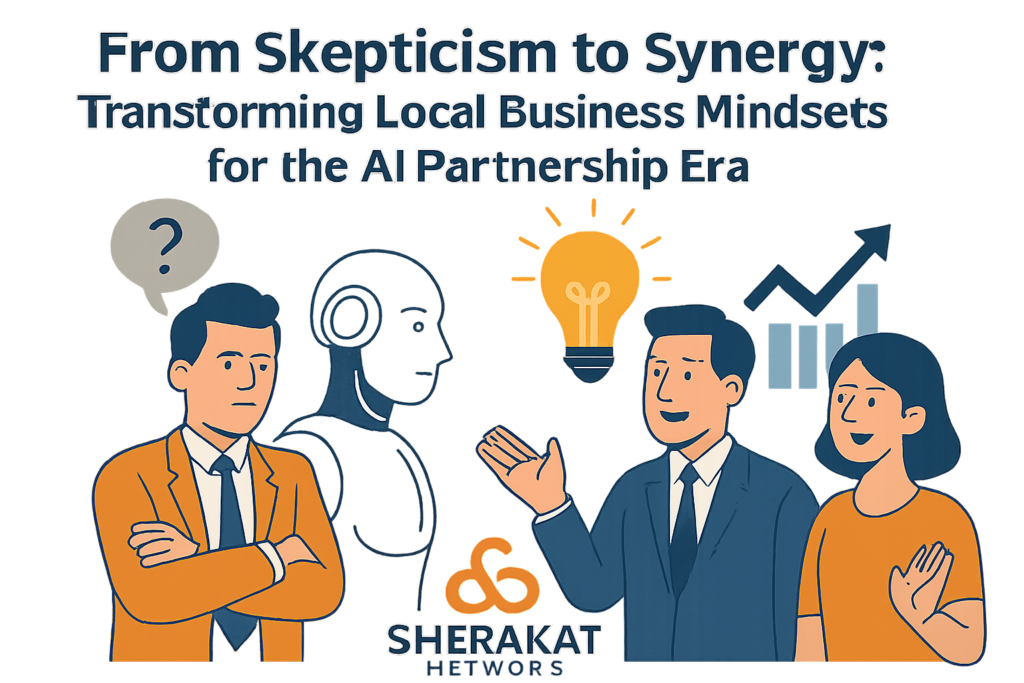
Understanding why mindset transformation deserves significant investment requires examining its impact across multiple business dimensions:
Implementation Success Amplification
The direct correlation between psychological readiness and implementation outcomes is well-documented. Consider these findings from the 2025 Organizational Change Meta-Analysis:
- Businesses with a comprehensive mindset preparation experienced 71% fewer implementation delays due to human factors
- Employee adoption rates averaged 89% with mindset preparation versus 34% without
- Return on AI investment was 2.3 times higher when preceded by psychological readiness initiatives
- Projected benefits were realized 47% faster with deliberate mindset development
These outcomes stem from several psychological mechanisms:
- Reduced Resistance Energy: Less organizational energy spent overcoming resistance means more available for constructive implementation
- Proactive Problem Identification: Psychologically safe environments surface implementation issues earlier when they’re easier to address
- Innovative Application: Employees with augmentation mindsets discover creative applications beyond initial design specifications
- Resilience During Setbacks: Teams with growth mindsets view implementation challenges as learning opportunities rather than proof of concept failure
Strategic Advantage Creation
Beyond implementation efficiency, mindset transformation creates durable competitive advantages:
Adaptive Capacity Development
Businesses that navigate the psychological challenges of AI adoption develop “change muscles” that make them more adaptable to future disruptions. This adaptive capacity represents one of the most valuable but least imitable advantages in volatile markets. According to longitudinal research from the Strategic Resilience Institute, businesses that successfully transformed mindsets for AI adoption were 3.2 times more likely to successfully navigate subsequent unrelated market disruptions.
Innovation Culture Establishment
The psychological frameworks developed for AI adoption—experimentation tolerance, psychological safety, learning orientation—create cultures primed for ongoing innovation. These businesses don’t just implement AI; they become organizations where technological enhancement becomes a continuous process rather than discrete projects.
Talent Attraction and Retention
In an increasingly technologically integrated economy, professionals seek workplaces where they can develop future-relevant skills. Businesses known for effective human-AI collaboration become talent magnets. A 2025 workforce survey found that 68% of professionals would choose a position offering AI augmentation experience over one with 15% higher compensation but no technological advancement opportunities.
Customer Trust and Connection
Perhaps counterintuitively, businesses that transparently navigate the psychological dimensions of AI adoption often strengthen customer relationships. When customers see businesses thoughtfully integrating technology while preserving human values, it reinforces trust. A 2024 consumer sentiment study found that 74% of customers preferred buying from businesses that could articulate how technology enhanced rather than replaced human service.
Risk Mitigation
Mindset transformation directly addresses several categories of AI implementation risk:
Adoption Risk
The substantial risk that implemented systems won’t be used effectively—or at all—by intended users. Mindset preparation reduces this risk by ensuring psychological readiness precedes technical implementation.
Cultural Damage Risk
The risk that technology implementation damages organizational culture, eroding trust, psychological safety, or shared purpose. Proactive mindset management protects against this by making cultural preservation an explicit implementation objective.
Reputation Risk
For community businesses particularly, the risk that AI adoption is perceived as “selling out” or abandoning local values. Mindset transformation includes external communication strategies that frame AI as enhancing rather than replacing community connection.
Talent Risk
The risk of losing valuable employees who feel threatened by or disconnected from technological changes. Mindset transformation addresses this through role evolution support, skill development, and meaning conservation.
Opportunity Cost Risk
The risk of investing in technology without realizing potential benefits due to psychological barriers. Mindset preparation ensures businesses capture the full value of their technological investments.
Financial Performance Impact
The financial implications of mindset transformation extend far beyond implementation efficiency:
Accelerated Value Realization
With higher adoption rates and more innovative application, businesses realize financial benefits faster. The cumulative effect of earlier benefit realization can be substantial, particularly when considering time value of money.
Reduced Implementation Costs
Psychological resistance manifests in many forms that increase costs: extended timelines, need for additional training, higher support requirements, rework due to poor adoption. Mindset preparation reduces these cost drivers.
Enhanced Revenue Opportunities
Teams with augmentation mindsets identify novel applications that create new revenue streams. These unexpected opportunities often deliver disproportionate returns because they’re not accounted for in initial ROI calculations.
Talent Cost Savings
Reduced turnover and increased attraction of high-potential talent lower recruitment, onboarding, and lost productivity costs. The talent implications alone can justify mindset investment.
Risk Cost Avoidance
The avoided costs of failed implementations, cultural damage repair, and reputational recovery represent significant financial value, though harder to quantify precisely.
In my consulting work, I’ve developed a “Mindset ROI Calculator” that quantifies these diverse benefits. For typical local businesses, the financial return on mindset investment ranges from 3:1 to 8:1, with higher returns in businesses with stronger existing cultures and community connections—precisely those most likely to resist AI initially.
Sustainability in the Future: Building Psychological Resilience for Continuous Change
The mindset transformation required for AI partnership success isn’t a one-time adjustment but the development of psychological resilience that enables continuous adaptation. As AI capabilities evolve at accelerating rates, businesses need psychological frameworks that can accommodate not just current implementations but future waves of technological change.
Developing Meta-Cognitive Awareness
The most sustainable outcome of mindset transformation is what psychologists call “meta-cognitive awareness”—the ability to think about one’s own thinking patterns. Businesses that develop this capacity can:
- Recognize their own patterns of technological resistance as they emerge
- Apply learning from previous mindset transformations to new challenges
- Intentionally cultivate cognitive flexibility rather than specific attitudes
- Maintain core identity while adapting surface expressions of that identity
This meta-cognitive capacity creates what I term “psychological scalability”—the ability to expand psychological comfort zones as technological possibilities expand. Businesses with this capacity don’t face each new technological wave as a new psychological crisis but as another iteration in an ongoing adaptation process.
Creating Psychological Innovation Systems
Sustainable mindset transformation institutionalizes psychological adaptation through formal systems:
Continuous Listening Infrastructure
Ongoing mechanisms for detecting emerging concerns, hopes, and opportunities related to technological change. This replaces one-time assessment with perpetual sensing.
Adaptive Learning Protocols
Structured approaches for updating mindsets based on implementation experience. These protocols ensure that psychological frameworks evolve alongside technological capabilities.
Intergenerational Integration Mechanisms
Deliberate systems for bridging technological perspective gaps that will inevitably re-emerge with each new technological generation.
Values Translation Processes
Methods for continuously interpreting how new technologies align with or challenge core values, and updating value expressions accordingly.
Narrative Evolution Practices
Approaches for updating organizational stories to incorporate new technological experiences while maintaining narrative coherence.
These systems ensure that mindset development becomes an organizational capability rather than a series of disconnected initiatives.
Preparing for Next-Generation Psychological Challenges
As AI capabilities advance, they will present new psychological challenges that today’s businesses should begin preparing for:
Ambiguity in Human-Machine Boundaries
As AI becomes more conversational and seemingly understanding, the psychological distinction between human and machine interaction will blur. Businesses will need frameworks for maintaining appropriate boundaries while leveraging capabilities.
Identity in Human-AI Hybrid Systems
When AI becomes deeply integrated into decision-making and creativity, questions of ownership, credit, and identity will arise. Psychological frameworks for hybrid identity will be necessary.
Ethical Complexity Navigation
Advanced AI will present ethical dilemmas without clear answers. Businesses will need psychological capacity for tolerating ethical ambiguity while maintaining moral direction.
Purpose in Increasingly Automated Contexts
As more tasks become automated or augmented, businesses will need to continuously rediscover and articulate the uniquely human aspects of their purpose.
Connection in Digitally Mediated Relationships
As customer interactions become increasingly AI-mediated, businesses will need psychological frameworks for maintaining authentic human connection through technological interfaces.
The businesses that thrive in this future won’t be those with the most advanced technology alone, but those with the most sophisticated understanding of human psychology in technological contexts. By beginning mindset transformation today, local businesses position themselves not just for current AI partnerships but for whatever human-technology collaborations emerge tomorrow.
Common Misconceptions and Realities
Addressing misconceptions is particularly important in mindset transformation, as these false beliefs often underlie psychological resistance:
Misconception 1: “Mindset will naturally evolve once people see AI working”
Reality: Research in behavioral science demonstrates the opposite—initial attitudes shape how evidence is interpreted. Without mindset preparation, people often interpret early implementation glitches as proof of concept failure rather than normal iteration. They notice what doesn’t work while overlooking what does. This confirmation bias reinforces rather than challenges initial skepticism. Proactive mindset development creates the psychological framework needed to interpret implementation experiences constructively.
Misconception 2: “Some people just resist change—we need to work around them”
Reality: Resistance is rarely arbitrary or personality-based. It typically stems from legitimate concerns about threats to identity, values, security, or competence. When treated as data rather than obstruction, resistance reveals precisely what must be addressed for successful implementation. The most effective approach isn’t working around resistors but engaging them to understand and address their concerns. Often, resistors become champions once their specific concerns are acknowledged and addressed.
Misconception 3: “We don’t have time for ‘soft’ psychological work—we need to focus on implementation”
Reality: This represents a false economy. The time “saved” by skipping mindset preparation is typically multiplied many times over in extended implementation timelines, poor adoption, rework, and missed opportunities. Psychological work isn’t separate from implementation; it’s the foundation that determines implementation efficiency. Businesses that allocate 20-30% of implementation timelines to psychological preparation typically complete total implementation faster than those who don’t, with better outcomes.
Misconception 4: “Our people are different—they’re not tech-oriented”
Reality: Technological orientation isn’t a fixed trait but a developable capability. More importantly, successful AI adoption in local businesses rarely requires becoming “tech-oriented” in the Silicon Valley sense. It requires developing specific psychological stances toward augmentation, experimentation, and collaboration. These stances can be cultivated in any business context when approached appropriately. Some of the most successful AI adoptions I’ve witnessed have been in traditional businesses with initially low technological comfort.
Misconception 5: “Mindset is about convincing people—we just need better communication”
Reality: Mindset transformation goes far beyond communication. It involves creating experiences that fundamentally shift perspectives. While communication is important, experiential learning, psychological safety, skill development, and ritual reinforcement are equally crucial. People don’t change deep-seated perspectives because they’re told to; they change when they experience alternatives that work better and align with their values.
Misconception 6: “Once we achieve the right mindset, we’re set”
Reality: Mindsets aren’t permanent achievements but dynamic states requiring ongoing reinforcement. As circumstances change, businesses face new psychological challenges. The goal isn’t to reach a fixed mindset destination but to develop organizational capacity for continuous psychological adaptation. This requires systems, not just initiatives.
Misconception 7: “Mindset work is the responsibility of HR or leadership alone”
Reality: While leadership sets the tone and HR provides support, effective mindset transformation involves everyone. Peer influence, frontline insights, and cross-generational dialogue all play crucial roles. The most powerful mindset shifts often occur horizontally (peer-to-peer) rather than vertically (top-down). Creating opportunities for these horizontal exchanges accelerates transformation.
Recent Developments (2024-2025): The Evolving Science of Organizational Mindset
The field of organizational psychology has advanced significantly regarding technological adoption mindsets. Recent developments particularly relevant to local businesses include:
Neuroplasticity-Based Training Approaches
New training methodologies leverage principles of neuroplasticity—the brain’s ability to reorganize itself—to accelerate mindset change:
- Cognitive Reappraisal Exercises: Structured practices that help individuals reinterpret technological change from threatening to opportunity-filled
- Mental Simulation Techniques: Guided visualizations of successful human-AI collaboration that create neural pathways supporting actual implementation
- Incremental Exposure Protocols: Gradually increasing exposure to AI concepts and applications to build tolerance and familiarity
- Growth Mindset Cultivation: Specific interventions that develop the belief that technological capabilities can be developed rather than being fixed traits
These approaches, validated through randomized controlled trials, can reduce mindset transformation timelines by 40-60% compared to traditional training methods.
Generational Intelligence Frameworks
As multigenerational workforces become the norm, new frameworks help bridge technological perspective gaps:
- Technological Socialization Mapping: Understanding how different generations were socialized into technology provides insight into current attitudes
- Reverse Mentoring Institutionalization: Formal programs where younger employees mentor older ones on technology create mutual understanding and respect
- Legacy-Integration Design: Methodologies for designing technological implementations that honor traditional wisdom while enabling progress
- Life-Stage Aware Adoption Pathways: Recognizing that technological adoption needs and barriers differ by life stage, not just generation
These frameworks are particularly valuable for family businesses and those with long-tenured employees alongside newer, technologically fluent staff.
Ethical Mindset Development Tools
With growing attention to AI ethics, new tools help businesses develop psychological capacity for ethical decision-making:
- Moral Imagination Exercises: Practices that expand ability to envision ethical implications of technological applications
- Values Clarification Protocols: Structured processes for identifying which values should guide technological decisions
- Stakeholder Perspective-Taking: Techniques for understanding how technological decisions affect different stakeholders
- Ethical Dilemma Simulation: Practice with realistic scenarios builds confidence for navigating actual ethical challenges
These tools help businesses avoid the common pitfall of treating ethics as a compliance issue rather than a mindset issue.
Measurement and Analytics Advances
New assessment approaches provide more nuanced understanding of organizational mindsets:
- Implicit Association Testing: Measures unconscious attitudes toward technology that may contradict stated positions
- Social Network Analysis: Maps how attitudes spread through organizations, identifying influence patterns
- Longitudinal Tracking: Follows mindset evolution over time, identifying what interventions create lasting change
- Multilevel Modeling: Analyzes how individual, team, and organizational mindsets interact
These measurement advances allow for more targeted, effective mindset interventions rather than one-size-fits-all approaches.
Positive Technology Psychology
A new subfield focuses specifically on how technology can enhance rather than diminish human flourishing:
- Technological Well-Being Design: Principles for creating technological implementations that support psychological needs
- Digital Detox Integration: Recognizing that sustainable technology use requires periods of disconnection
- Meaningful Automation Criteria: Guidelines for determining which tasks should be automated based on human meaning preservation
- Augmentation Ethics: Framework for ensuring AI augmentation enhances human autonomy rather than diminishing it
This positive approach is particularly resonant for local businesses concerned about technology undermining their human-centric values.
Success Stories: Mindset Transformation in Action
Real-world examples illustrate how mindset transformation enables successful AI partnerships:
Case Study 1: The Heritage Craft Brewery
Business Profile: Fourth-generation family brewery known for traditional methods and community events, facing pressure from tech-forward competitors.
Initial Mindset: Deep skepticism about technology, viewing it as antithetical to craft values. Employees proud of “analog” processes. Leadership concerned about alienating traditional customer base.
Transformation Approach:
- Phase 1: “Preservation Through Innovation” narrative development emphasizing how technology could protect traditional methods from economic pressures
- Phase 2: “Augmented Craftsmanship” demonstrations showing how AI quality control actually allowed more consistent expression of brewmaster’s vision
- Phase 3: “Community Connection 2.0” initiatives using AI to personalize event experiences while maintaining human hospitality
- Phase 4: “Multigenerational Bridge” programs where younger family members led technology exploration with explicit respect for traditional knowledge
Key Psychological Interventions:
- “Values Translation” workshops showing how each AI application serves traditional values
- “Controlled Experimentation” spaces where technology could be tested without threatening core operations
- “Tradition-Innovation Ambassadors” from among the most respected traditionalists who became technology advocates
- “Customer Co-Creation” involves loyal customers in designing how technology would enhance their experience
Results:
- Employee technology acceptance increased from 22% to 89% over 18 months
- Production consistency improved 34% while maintaining craft designation
- Community event attendance increased 41% through personalized marketing
- Successfully launched a technology-enhanced product line that attracted new, younger customers without alienating the traditional base
- Family transition to the next generation is smoothed through technology as a collaboration area rather than a conflict point
Key Insight: “We discovered that our resistance wasn’t to technology itself, but to anything that threatened what made us special. Once we framed technology as protecting rather than threatening our uniqueness, everything changed.” – Fourth-generation owner
Case Study 2: The Neighborhood Medical Practice
Business Profile: Eight-doctor practice serving the community for 35 years, facing administrative burdens, reducing patient tim,e and physician burnout.
Initial Mindset: Physicians viewed technology as a bureaucratic imposition that interfered with patient care. Staff are overwhelmed by administrative systems but skeptical of new solutions. Leadership is concerned about costs and disruption.
Transformation Approach:
- Phase 1: “Reclaiming Medicine” narrative focusing on how AI could restore rather than replace human medical practice
- Phase 2: “Burden Lifting” demonstrations showing specific administrative tasks that could be automated
- Phase 3: “Augmented Diagnosis” careful introduction of AI diagnostic support with physician control
- Phase 4: “Team Evolution” programs helping all staff develop higher-value roles as administrative tasks automated
Key Psychological Interventions:
- “Psychological Safety Zones” where physicians could express concerns about technology without judgment
- “Incremental Proof Points” starting with non-clinical applications to build confidence
- “Professional Identity Reinforcement” emphasizing how AI restored rather than replaced medical judgment
- “Work Meaning Conservation” ensuring automated tasks were those staff found least meaningful
Results:
- Physician acceptance increased from 18% to 76% over 24 months
- Administrative time decreased 42%, allowing 15% more patient time
- Physician burnout scores decreased 31%
- Diagnostic accuracy improved 17% with AI augmentation
- Staff turnover decreased from 34% to 11% as roles became more professionally satisfying
Key Insight: “We realized that our resistance came from seeing technology as something done to us rather than something we could shape to serve our values. Once we became designers rather than recipients, everything changed.” – Practice Managing Partner
Case Study 3: The Community Retail Collective
Business Profile: Association of 22 independent retailers facing online competition, attempting joint technology initiatives with repeated failure due to member resistance.
Initial Mindset: Deep individualism made collective action difficult. Technology is seen as a corporate tool inappropriate for independent businesses. Previous failed initiatives created cynicism about new attempts.
Transformation Approach:
- Phase 1: “Individual Strength Through Collective Intelligence” narrative emphasizing how technology could amplify rather than homogenize uniqueness
- Phase 2: “Minimum Viable Collaboration” starting with tiny shared technology applications
- Phase 3: “Success Snowballing” using early wins to build confidence for more ambitious applications
- Phase 4: “Differentiated Implementation” allows businesses to adopt technology in ways that respect their uniqueness
Key Psychological Interventions:
- “Autonomy Protection” ensures technology is never forced standardization
- “Transparent Learning” shares both successes and failures openly
- “Peer Influence Networks” leverage natural relationships rather than top-down mandates
- “Identity-Forward Design” ensures all technology applications are highlighted rather than hiding business uniqueness
Results:
- Collective technology adoption increased from 3 businesses to 19 over 36 months
- Joint marketing effectiveness improved 280% through AI personalization
- Shared inventory system adoption reached 14 businesses, reducing stockouts 37%
- Collective bargaining power with suppliers increased through shared data
- Individual business uniqueness became more rather than less distinct through technology
Key Insight: “We discovered that our fierce independence was both our greatest strength and our greatest weakness. Technology helped us discover a new model: fiercely independent in what makes us unique, intelligently collaborative in what doesn’t.” – Collective Coordinator
These cases demonstrate that mindset transformation isn’t about eliminating healthy skepticism or valuable traditions, but about channeling these toward constructive engagement with technology. The most successful transformations occur when businesses discover how technology can serve rather than threaten what they value most.
Conclusion and Key Takeaways: Cultivating Mindsets for the Partnership Age
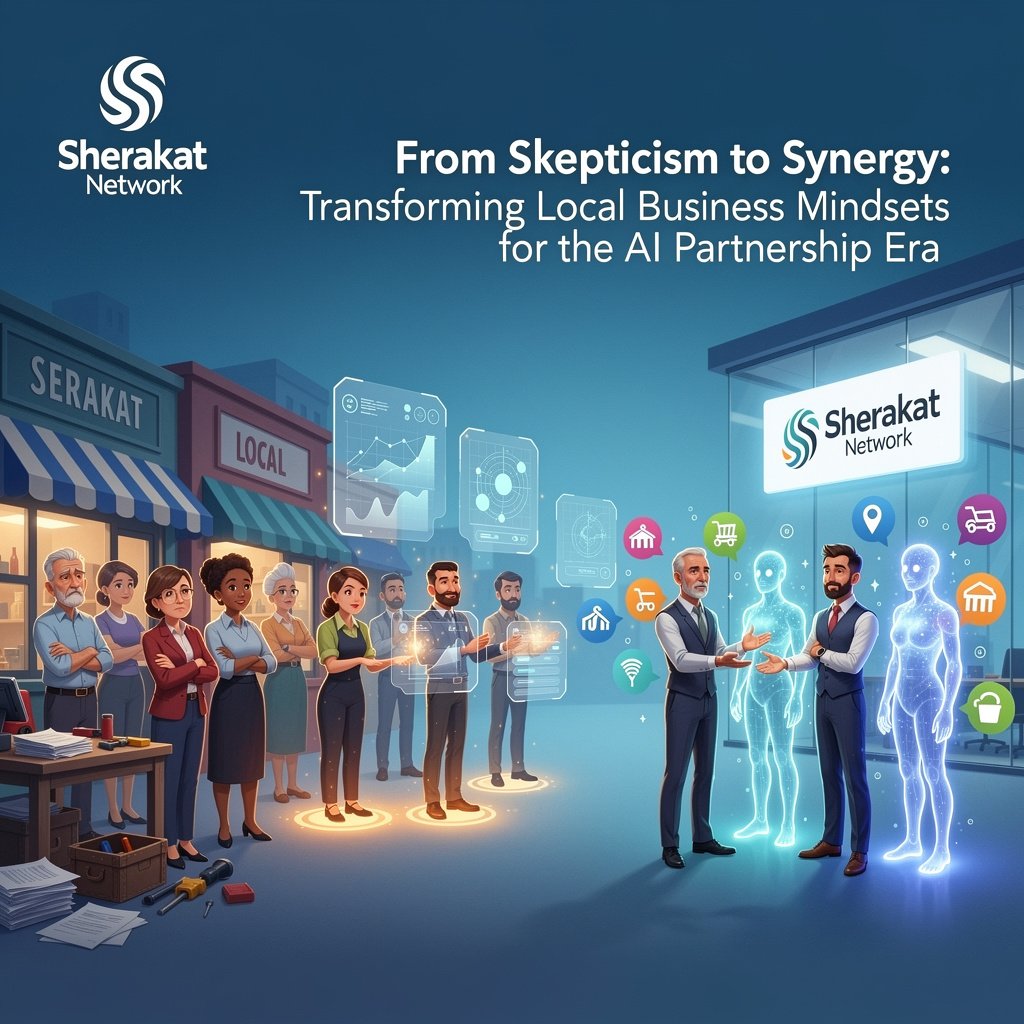
The journey from AI skepticism to synergy represents one of the most significant psychological transitions businesses will undertake in the coming decade. This transformation isn’t incidental to successful AI partnerships—it’s foundational. Businesses that master the psychological dimensions of technological change will not only implement better AI solutions; they’ll develop organizational capabilities that make them more resilient, innovative, and human-centered in an increasingly technological world.
As you contemplate your own mindset transformation journey, remember these essential principles:
- Resistance Is Data, Not Obstruction: The concerns, fears, and skepticism your team expresses about AI adoption contain crucial information about what must be addressed for success. Listen deeply rather than dismissively.
- Identity Preservation Enables Transformation: The businesses most successful at adopting new technologies are those most clear about what they’re preserving. Know what makes you special, and frame technology as protecting and enhancing that uniqueness.
- Psychological Safety Precedes Technological Safety: Teams won’t engage authentically with new technology unless they feel safe expressing concerns, asking questions, and making mistakes. Build this safety intentionally.
- Experiences Transform More Than Explanations: People change perspectives through experience more than exposition. Create carefully designed experiences that allow teams to discover for themselves how AI can enhance rather than threaten their work.
- Mindset Is a System, Not an Event: Sustainable mindset transformation requires integrated systems—listening mechanisms, learning protocols, reinforcement rituals—not one-time initiatives.
- The Goal Is Psychological Adaptability, Not Fixed Optimism: Don’t aim for permanently positive attitudes toward technology. Aim for organizational capacity to navigate the psychological challenges of continuous technological change.
- Leadership Vulnerability Accelerates Transformation: When leaders model learning, acknowledge uncertainty, and share their own psychological journeys, they give permission for the entire organization to transform.
The local businesses that will thrive in the AI partnership era aren’t those that abandon their human-centric values for technological efficiency, but those that discover how technology can help them express those values more fully. They recognize that the most powerful applications of AI aren’t those that replace human connection, but those that create space for more meaningful human connection by handling what machines do best.
Your mindset transformation journey begins not with a technology assessment, but with a conversation. Start by asking your team what they value most about your business, what they fear might be lost with technological change, and what they hope might be gained. From this honest starting point, you can co-create a vision of technological enhancement that honors your past while enabling your future.
The partnership age requires new partnerships not just between businesses and technology providers, but between different parts of our own minds—between our protective instincts that preserve what’s valuable and our exploratory instincts that embrace what’s possible. The businesses that master this internal partnership will be best positioned to master the external ones.
FAQs: Frequently Asked Questions
1. Q: How is “mindset” different from “attitude” or “culture”?
A: Mindset refers to the underlying cognitive frameworks that shape how people interpret experiences and make decisions. Attitudes are specific evaluations (positive/negative) about particular objects or concepts. Culture is the shared patterns of behavior, values, and artifacts that exist within an organization. Mindset is deeper than attitudes (it shapes what attitudes form) and more individual than culture (though shared mindsets contribute to culture). Changing mindset requires addressing these deep cognitive frameworks rather than just trying to change surface attitudes.
2. Q: Our business has failed with technology initiatives before. How do we overcome this legacy of disappointment?
A: Begin by explicitly acknowledging past failures and analyzing them through a psychological rather than technical lens. What fears or concerns were validated by those failures? What protective instincts were reinforced? Then, design your new initiative to directly address these psychological legacies: make smaller initial commitments, create clearer opt-out pathways, involve past skeptics in design, and build in more frequent progress checks. The shadow of past failures can actually become an asset if it leads to more psychologically sophisticated approaches.
3. Q: We have team members spanning four generations. How do we address such diverse perspectives on technology?
A: Frame this diversity as an asset rather than a challenge. Each generation brings different technological experiences and, therefore, different insights about risks and opportunities. Create structured intergenerational dialogues using techniques like: “past/present/future” mapping of technological impacts, reverse mentoring pairs, collaborative design teams with age diversity, and “technology translation” roles where individuals explain technological concepts in generationally resonant language. The goal isn’t consensus but mutual understanding that leads to more robust decisions.
4. Q: How do we maintain our authentic local identity while adopting technologies developed by global corporations?
A: This is a crucial psychological challenge. The key is developing what I call “technological sovereignty”—the ability to adopt global technologies while maintaining local control over how they’re implemented. Strategies include: customizing interfaces to reflect local aesthetics, training systems on local data and patterns, integrating technology into existing local rituals rather than replacing them, and being transparent with customers about how you’re shaping technology to serve local values. Your authenticity comes not from rejecting global tools but from how you adapt them to local purposes.
5. Q: What’s the first concrete step we should take to begin mindset transformation?
A: Conduct an anonymous “psychological landscape survey” that asks team members: (1) What three words come to mind when you think about AI in our business? (2) What’s your biggest hope about how technology could help us? (3) What’s your biggest fear? (4) What traditional strength of ours must be preserved at all costs? (5) What tedious task would you most like to eliminate? This survey establishes baseline understanding and demonstrates that you value psychological perspectives from the start.
6. Q: How do we balance moving quickly with taking time for psychological preparation?
A: This is a crucial tension. The most effective approach is “parallel processing”—beginning technical and psychological work simultaneously rather than sequentially. While technical partners conduct initial assessments, begin mindset work. As technical implementation proceeds in phases, mindset work focuses on the psychological dimensions of each upcoming phase. This approach actually accelerates overall timelines by preventing psychological bottlenecks later. Allocate 20-30% of total project resources to psychological dimensions, recognizing that this investment prevents larger losses from poor adoption.
7. Q: What if some team members never overcome their resistance?
A: Complete consensus is unrealistic. The goal isn’t 100% adoption of positive attitudes but sufficient momentum for implementation success. For persistent resistors, consider: Are their concerns actually protective of important values? Could they play “critical friend” roles that improve implementation? Can they be accommodated in roles less affected by changes? Sometimes the most valuable resistors are those who force us to address legitimate concerns others are hesitant to voice. A 70-80% positive engagement rate is typically sufficient for implementation success if the remaining concerns are acknowledged and accommodated where possible.
8. Q: How transparent should we be about implementation challenges and setbacks?
A: More transparent than feels comfortable initially. Research shows that teams actually trust leaders more when they’re transparent about challenges rather than presenting only positive progress. The key is framing: “Here’s a challenge we’re facing, here’s what we’re learning from it, here’s how we’re adapting.” This builds psychological safety and models growth mindset. Create regular “learning sharing” sessions specifically for discussing challenges and adaptations. The alternative—trying to hide difficulties—undermines trust and prevents collective problem-solving.
9. Q: How do we prevent mindset initiatives from feeling like manipulative “brainwashing”?
A: By ensuring they’re genuinely collaborative rather than persuasive. Frame mindset work as collective sense-making rather than persuasion. Use open-ended questions rather than leading statements. Create spaces for authentic disagreement. Share decision-making authority about implementation approaches. The litmus test: Do team members feel their concerns are genuinely shaping the approach, or merely being “managed”? Psychological safety requires that people can express negative perspectives without consequence. The goal isn’t unanimous positivity but informed, engaged participation in shaping change.
10. Q: What metrics should we track to measure mindset transformation progress?
A: Track both quantitative and qualitative metrics: (1) Adoption metrics (usage rates, depth of use), (2) Survey measures (regular pulse surveys on confidence, understanding, support), (3) Behavioral indicators (participation in training, volunteering for pilot programs), (4) Qualitative feedback (themes in conversations, meeting comments, suggestion box input), (5) Business outcomes correlated with mindset (innovation suggestions, cross-functional collaboration). Avoid reducing mindset to single scores; track patterns across multiple indicators.
11. Q: As a leader, how do I address my own uncertainties and anxieties about AI?
A: Model what you want to see in your team. Be transparent about your learning process, your questions, and how you’re working through uncertainties. Share articles or resources you’re finding helpful. Admit when you don’t know answers. This vulnerability actually increases rather than decreases leadership credibility in times of change. Consider finding a peer support group of other leaders navigating similar challenges. Your psychological journey becomes a template for your team’s journey.
12. Q: What specific mindset shifts do leaders most need to make for AI partnership success?
A: Key leadership mindset shifts include: (1) From certainty to curiosity (embracing questions rather than pretending to have answers), (2) From control to cultivation (creating conditions for growth rather than directing every detail), (3) From efficiency to experimentation (valuing learning as much as immediate results), (4) From individual expertise to collective intelligence (leveraging diverse perspectives), (5) From problem-solving to possibility-creating (focusing on opportunities as much as obstacles). These shifts enable the psychological environment teams need to navigate technological change.
13. Q: How do we identify and develop “mindset champions” within our team?
A: Look for individuals who naturally embody growth mindset, psychological safety, and bridge-building across perspectives. Often they’re not the most technically skilled but the most relationally skilled. Provide them with: (1) Advanced training in the psychological dimensions of change, (2) Formal recognition of their champion role, (3) Time allocation to support peers, (4) Access to leadership to share insights from the frontlines, (5) Development opportunities to grow their influence skills. Champions typically represent 10-15% of a team and can influence 5-10 times their number.
14. Q: Should we hire differently to build more AI-ready mindsets?
A: Yes, but carefully. Look for: (1) Cognitive flexibility (ability to hold multiple perspectives), (2) Learning orientation (excitement about developing new capabilities), (3) Collaborative mindset (seeing technology as partnership opportunity), (4) Ambiguity tolerance (comfort with uncertain outcomes), (5) Values alignment (shared commitment to your core purpose). Technical skills can be taught more easily than these psychological attributes. However, avoid creating a “two-tier” culture where new hires are seen as technologically superior. Balance hiring for mindset with developing existing team members.
15. Q: How do we handle leaders or influential team members who actively undermine mindset transformation?
A: First, seek to understand their concerns—often they’re protecting important values or have experienced past failures that inform their skepticism. Engage them privately, listen deeply, and look for legitimate insights in their resistance. Sometimes shifting their role to “critical friend” or “reality checker” honors their perspective while channeling it constructively. If resistance remains destructive despite these efforts, you may need to make difficult decisions about their fit with the organization’s direction. This is rare when concerns are genuinely engaged early.
16. Q: How do we prevent backsliding into old mindsets after initial transformation?
A: Build reinforcement systems: (1) Rituals that regularly revisit and renew commitment to new mindsets, (2) Succession planning that ensures future leaders embody developed mindsets, (3) Hiring and promotion criteria that value psychological attributes, (4) Ongoing development opportunities that deepen rather than assume mindset transformation, (5) Measurement systems that track mindset indicators over time. Mindset backsliding typically occurs when transformation is treated as an event rather than an ongoing process requiring continuous investment.
17. Q: How do we adapt our mindset approaches as AI technology itself evolves?
A: Build “meta-mindset” capacity—the ability to reflect on and adapt your mindset development approaches. Regularly ask: What’s working in our mindset development? What psychological challenges is new technology presenting? How do we need to adapt our approaches? This reflective practice ensures your mindset development methods evolve alongside the technology they support. Consider annual “mindset methodology reviews” separate from technology strategy reviews.
18. Q: What role should customers play in our mindset transformation?
A: An important but carefully managed role. Customers can provide powerful validation when they appreciate how technology enhances rather than replaces human service. Strategies include: (1) Transparent communication about how technology serves customer experience, (2) Customer co-design of technology implementations, (3) Showcasing customer benefits from technology adoption, (4) Feedback channels specifically about technology-enhanced service. However, protect internal psychological work as a separate space where teams can work through uncertainties without performance pressure.
19. Q: How do we scale mindset transformation across multiple locations or business units?
A: Use a “hub and spoke” model: Develop a central team with deep expertise in mindset transformation methodologies, then train “mindset facilitators” in each location who adapt central approaches to local contexts. Key principles: (1) Consistent frameworks but local adaptation, (2) Regular community of practice meetings for facilitators, (3) Shared measurement approaches with local interpretation, (4) Success story sharing across locations, (5) Leadership alignment on mindset importance across all locations. Avoid one-size-fits-all mandates that ignore local cultural differences.
20. Q: What are the warning signs that our mindset transformation is off track?
A: Watch for: (1) Compliance without engagement (people go through motions without psychological buy-in), (2) Shadow systems emerging that bypass new technology, (3) Increased turnover particularly among valued employees, (4) Silence in meetings about technology topics, (5) Gap between stated attitudes and actual behaviors, (6) Leadership frustration with “resistance” rather than curiosity about concerns. These signs suggest psychological safety may be lacking or the approach may be experienced as imposition rather than collaboration.
21. Q: How do we address the more serious psychological threat that AI might make our human skills less valuable?
A: This touches on fundamental identity questions. The most effective approach is to help people discover and develop uniquely human capabilities that become more valuable (not less) in an AI-augmented world: complex judgment, ethical reasoning, creative synthesis, emotional intelligence, meaning-making, relationship-building. Frame AI as handling what machines do well (pattern recognition, data processing, repetitive tasks) so humans can focus on what humans do uniquely well. Provide concrete development opportunities in these human domains so the value shift feels like growth rather than loss.
22. Q: What psychological approaches help with the “uncanny valley” discomfort of human-like AI?
A: The “uncanny valley”—discomfort with AI that seems almost but not quite human—requires careful design. Psychological strategies include: (1) Clear signaling of AI nature (not pretending it’s human), (2) Appropriate anthropomorphism (enough humanity to be relatable but not misleading), (3) Transparency about limitations, (4) Human oversight points where people can intervene, (5) Gradual exposure to increasingly sophisticated AI. The goal is to create comfort with AI as a different kind of intelligence rather than an imperfect imitation of human intelligence.
23. Q: How do we address existential anxieties about AI’s long-term implications?
A: While business leaders aren’t philosophers, technological change inevitably raises existential questions. Create spaces where these larger questions can be discussed without requiring immediate business answers. Strategies include: (1) Reading/discussion groups on technology and society, (2) Ethics forums that consider broader implications, (3) Connection to purpose discussions about how technology serves your business’s deeper reason for existing, (4) Balanced perspective sharing that acknowledges concerns while focusing on positive applications. Avoiding existential questions doesn’t make them disappear; it just drives them underground where they create subtle resistance.
24. Q: What psychological techniques help teams develop greater ambiguity tolerance?
A: Ambiguity tolerance can be developed through: (1) Gradual exposure to increasingly ambiguous situations with support, (2) Cognitive reframing of ambiguity as opportunity rather than threat, (3) Decision-making practice with incomplete information, (4) Post-mortem analysis of ambiguous situations that turned out well, (5) Modeling by leaders comfortable with ambiguity, (6) Language shifts from “uncertainty” to “exploration space.” Like building any psychological muscle, this requires progressive challenge within supportive environments.
25. Q: How do we prevent technology from becoming a new source of status and division within our team?
A: Technology can create “digital divides” where comfort with technology becomes a new status marker. Prevent this by: (1) Valuing diverse forms of expertise equally, (2) Creating interdependence between technologically fluent and relationship-fluent team members, (3) Designing hybrid roles that require multiple kinds of intelligence, (4) Public recognition for contributions beyond technological skill, (5) Explicit discussion of how all forms of intelligence contribute to AI partnership success. The goal is technological integration, not technological supremacy.
26. Q: How do we know if we’ve invested enough in mindset transformation?
A: Look for these indicators of sufficient investment: (1) Technology discussions are open and engaged rather than fearful or avoidant, (2) Experimentation with technology occurs voluntarily, (3) Problems with technology are reported as learning opportunities rather than proof of failure, (4) Team members initiate technology improvements rather than just implementing mandated ones, (5) External stakeholders notice positive changes in how you integrate technology. These behavioral indicators matter more than budget percentages. When in doubt, invest in more dialogue—conversation is the engine of mindset change.
27. Q: How should our mindset transformation approaches differ for different types of AI applications?
A: Different AI applications present different psychological challenges: (1) Automation applications (threat to identity/employment) require strong role evolution support, (2) Augmentation applications (changing work processes) require skill development and psychological safety, (3) Analytical applications (changing decision-making) require transparency and control preservation, (4) Customer-facing applications (changing relationships) require customer co-design and careful rollout. Tailor your mindset approaches to the specific psychological challenges each application presents.
28. Q: What role does storytelling play in mindset transformation?
A: A crucial role. Humans make sense of change through stories. Develop: (1) Progress stories (how far we’ve come), (2) Identity stories (who we’re becoming through technology), (3) Values stories (how technology serves what matters), (4) Future stories (where we’re headed together), (5) Challenge stories (how we’ve overcome obstacles). Stories work best when they’re co-created (not just leadership narratives), authentic (including struggles), and repeated (through multiple channels). The most powerful mindset transformations occur when people can place themselves within a compelling narrative of change.
29. Q: How do we balance consistency in our mindset approach with flexibility for individual differences?
A: Create a “flexible framework” rather than a rigid program. Establish clear principles (psychological safety, growth orientation, values alignment) but allow multiple pathways for embodying these principles. Some team members may need more hands-on experimentation, others more conceptual understanding, others more peer support. Provide a “menu” of mindset development options rather than a single mandatory path. Consistency in principles allows flexibility in methods.
30. Q: What mindset capabilities will be most important as AI continues to evolve?
A: Based on current trends, these capabilities will grow in importance: (1) Collaborative intelligence (working effectively with both humans and AI), (2) Technological discernment (knowing when and how to use different technologies), (3) Ethical imagination (envisioning implications of technological choices), (4) Adaptive learning (continuously updating skills and perspectives), (5) Integrative thinking (synthesizing human and technological insights). Begin developing these capabilities now, even if current applications don’t require them fully. The mindset future belongs to the most psychologically adaptable.
About the Author: Mr. Sana Ullah Kakar
Mr. Sana Ullah Kakar is a distinguished business psychologist and organizational transformation specialist with over 18 years of experience in guiding enterprises through technological and cultural change. As the founder of the Center for Adaptive Leadership and Technological Integration (CALTI), he has developed proprietary frameworks for mindset transformation that have been implemented by over 300 businesses across 14 countries.
Mr. Kakar’s expertise lies at the unique intersection of cognitive psychology, organizational behavior, and technological adoption. He holds advanced degrees in Industrial-Organizational Psychology from Stanford University and Technology Management from MIT, giving him rare dual expertise in both human systems and technological systems. His doctoral research on “Cognitive Resistance to Technological Innovation in Traditional Businesses” won the 2018 Academy of Management Best Dissertation Award and forms the empirical foundation for much of his current work.
Prior to founding CALTI, Mr. Kakar served as Senior Change Strategist at Deloitte’s Human Capital practice, where he led technology adoption initiatives for Fortune 500 companies. However, his true passion emerged when he began working with family-owned businesses and local enterprises struggling to adapt to rapid technological change while preserving their core identities. This led him to develop the “Identity-Preserving Transformation” methodology that has become his signature contribution to the field.
As Executive Director of Mindset Development at Sherakat Network, Mr. Kakar oversees the creation of resources and programs that help businesses navigate the psychological dimensions of partnership and growth. His previous work includes the acclaimed guide The Alchemy of Alliance, which has been adopted by business schools worldwide as essential reading on partnership psychology.
Mr. Kakar is a frequent keynote speaker at international conferences on technology adoption and organizational change. His TEDx talk, “Why Your Team Resists Technology (And What to Do About It),” has been viewed over 2.5 million times and translated into 14 languages. He serves on advisory boards for several technology incubators focused on ethical AI implementation and regularly consults with policymakers on workforce adaptation strategies.
“What fascinates me,” Mr. Kakar notes, “is not technology itself, but how human psychology interprets and adapts to technological possibility. The businesses that thrive in this era won’t be those with the most advanced algorithms, but those with the most sophisticated understanding of their own psychological landscapes.”
When not consulting or writing, Mr. Kakar leads wilderness reflection retreats for business leaders, believing that clarity about technological futures often emerges in spaces devoid of technology altogether.
Free Resources for Mindset Transformation
To support your journey from AI skepticism to synergy, we’ve compiled these essential resources:
Assessment Tools
- AI Mindset Readiness Inventory: A validated 40-question assessment measuring your team’s psychological readiness across six dimensions: change tolerance, technological self-efficacy, innovation identity, future orientation, ambiguity tolerance, and collaborative intelligence.
- Resistance Pattern Diagnostic: Tool for identifying and categorizing resistance patterns in your organization (active, passive, compliance-only, enthusiastic).
- Values-Technology Alignment Matrix: Framework for mapping how specific AI applications align with or challenge your core business values.
- Psychological Safety Climate Survey: Assessment measuring the psychological safety levels in your organization related to technological change.
Workshop Materials
- Mindset Transformation Workshop Guide: Complete facilitator guide for conducting 4-hour mindset transformation workshops with your team, including slides, exercises, and discussion guides.
- Intergenerational Dialogue Toolkit: Structured approaches for facilitating productive conversations about technology across generations in your organization.
- Future Visioning Canvas: Collaborative tool for teams to imagine and design AI-enhanced futures for your business.
- Role Evolution Mapping Worksheets: Templates for helping team members envision and plan for evolving roles in an AI-augmented workplace.
Implementation Templates
- Mindset Transformation Roadmap Template: Customizable 24-month roadmap for implementing the seven-stage framework outlined in this guide.
- Psychological Safety Infrastructure Checklist: Step-by-step guide for building psychological safety systems in your organization.
- Communication Plan Template: For progressive revelation of AI initiatives to minimize anxiety and resistance.
- Ritual Design Toolkit: Approaches for creating daily, weekly, and monthly rituals that reinforce new mindsets.
Measurement Tools
- Mindset Metric Dashboard Template: Comprehensive dashboard for tracking psychological indicators alongside technical implementation metrics.
- Adoption Depth Assessment: A tool for measuring not just whether technology is used, but how deeply and innovatively it’s adopted.
- Transformation Narrative Capture Framework: Methodology for documenting and evolving the stories that shape organizational mindset.
- ROI of Mindset Calculator: A tool for quantifying the financial return on mindset investment initiatives.
Learning Resources
- AI Literacy Primer for Non-Technical Teams: Plain-language explanations of AI concepts specifically designed for psychologically accessible understanding.
- Case Study Library: 25 detailed case studies of businesses that successfully transformed mindsets for AI adoption.
- Reading List Curated by Sana Ullah Kakar: Essential books, articles, and research on organizational psychology and technological adoption.
- Expert Interview Series: Video interviews with psychologists, technologists, and business leaders on mindset transformation.
Community and Support
- Mindset Transformation Peer Circle Guide: How to create and facilitate peer support groups for leaders navigating similar challenges.
- Monthly Mindset Webinar Series: Regular sessions on specific psychological dimensions of AI adoption.
- Consultation Office Hours: Monthly opportunities for personalized guidance on mindset challenges.
- Success Story Submission Portal: Platform for sharing your transformation story and learning from others.
These resources are available through the Sherakat Network Resources portal and are regularly updated based on the latest research and practical experience. For additional support, visit our Blog for ongoing insights or Contact Us for personalized consultation.
Discussion: Join the Mindset Transformation Conversation
The journey from AI skepticism to synergy is one best traveled in community. We invite you to join the conversation with other business leaders navigating similar psychological terrain:
Share Your Experience: What mindset challenges are you facing in your AI adoption journey? Have you discovered approaches that work particularly well in your context? What psychological barriers have been most difficult to overcome?
Ask Your Questions: What aspects of mindset transformation remain unclear? What specific psychological dynamics are you observing in your organization that you’d like help understanding?
Contribute Your Insights: Have you developed frameworks, tools, or approaches for mindset transformation that could benefit others? Consider sharing these as guest contributions or case studies.
Connect with Peers: Many leaders find value in connecting with others facing similar challenges across different industries. Would you be interested in moderated peer exchanges or industry-agnostic discussion forums?
Suggest Future Topics: What related psychological dimensions of AI partnership would you like to see explored in future guides? Leadership psychology in technological change? Customer psychology in AI-enhanced service? Ethical decision-making frameworks?
Participate in Research: We’re continuously studying what works in mindset transformation. Would you be willing to participate in anonymized research or share your transformation journey for case study development?
The psychological dimensions of AI adoption represent one of the most significant but least addressed challenges in today’s business landscape. By sharing experiences, challenges, and solutions, we can collectively develop more sophisticated approaches to mindset transformation that honor human values while embracing technological possibilities.
Join the discussion below or contact us directly through Sherakat Network’s contact page to share your thoughts, questions, or transformation experiences. For those beginning their journey, our comprehensive guide on How to Start an Online Business in 2026 provides additional context on technological adoption in modern business contexts.
This site gives a familiar vibe, yet it’s new to me.
I truly enjoy looking through on this website , it contains wonderful articles.