

Introduction: Why Mastering AI is Non-Negotiable for Modern Affiliates
The landscape of affiliate marketing is undergoing a seismic shift, and the catalyst is artificial intelligence. If you’re still manually researching keywords, drafting every product description from scratch, and guessing at audience intent, you’re not just working hard—you’re working at a growing disadvantage. By 2026, industry analysts project that over 60% of high-performing affiliate marketers will be using AI not as a novelty, but as a core, integrated component of their daily workflow. This isn’t about replacing human creativity; it’s about augmenting it with superhuman efficiency and insight.
In my experience, the affiliates who thrive in this new era aren’t necessarily the ones with the biggest budgets, but those who are most adept at leveraging intelligent tools to do more with less. I’ve seen solo entrepreneurs using a strategic suite of AI applications out-compete small teams, not by working 24/7, but by working smarter. The key insight most marketers miss is that AI’s greatest value lies not in creating finished content, but in accelerating the research, ideation, and optimization processes—freeing you to focus on strategy, relationship-building, and authentic persuasion. This guide will provide you with a complete, step-by-step framework for building your own AI-powered affiliate workflow, ensuring you work with both cutting-edge efficiency and unwavering ethical integrity.
Background / Context: From Manual Grind to Intelligent System
To appreciate the revolution, it helps to understand the evolution. Affiliate marketing began as a simple handshake agreement—a link, a sale, a commission. For years, success was largely driven by volume: publishing more content, building more backlinks, and casting a wider net. This “manual grind” phase demanded immense time for technical SEO, content production, and data analysis. While tools like Google Analytics and keyword planners brought some efficiency, the cognitive burden on the marketer remained high.
The shift began with the advent of sophisticated machine learning algorithms used by platforms like Amazon and Google, which changed how consumers discovered products. Affiliates had to adapt to these opaque, AI-driven systems. Now, we’ve entered the symbiotic phase. Today’s most powerful tools, from Jasper and SurferSEO to Scale AI and ChatGPT-4o, are built for marketers, not just used by them. They allow us to converse with data, generate insights at the speed of thought, and personalize content at a scale previously reserved for Fortune 500 companies. This evolution mirrors broader digital trends discussed in resources on artificial intelligence and machine learning, where AI is becoming a fundamental business partner.
Key Concepts Defined
- AI-Powered Workflow: A structured process where artificial intelligence tools are seamlessly integrated into each stage of affiliate marketing—from niche discovery to content creation and performance analysis—to enhance speed, quality, and effectiveness.
- Large Language Model (LLM): A type of AI, like GPT-4 or Claude, trained on vast amounts of text data. It can understand, generate, and manipulate human-like text. It’s your brainstorming partner, draft writer, and editor.
- Generative AI: AI that creates new content—text, images, audio, or video—based on the patterns it has learned. It’s the engine behind content creation tools.
- Predictive Analytics: The use of AI to analyze historical data and identify patterns to make predictions about future outcomes, such as sales trends or content performance.
- Ethical AI Use in Marketing: The practice of employing AI tools transparently, avoiding plagiarism or misinformation, respecting data privacy, and ensuring the final content maintains a genuine, human touch that serves the audience.
- Prompt Engineering: The skill of crafting precise, detailed instructions (prompts) to guide an AI tool to produce the desired output. This is a critical new competency for digital marketers.
How It Works: The 7-Step AI-Powered Affiliate Workflow
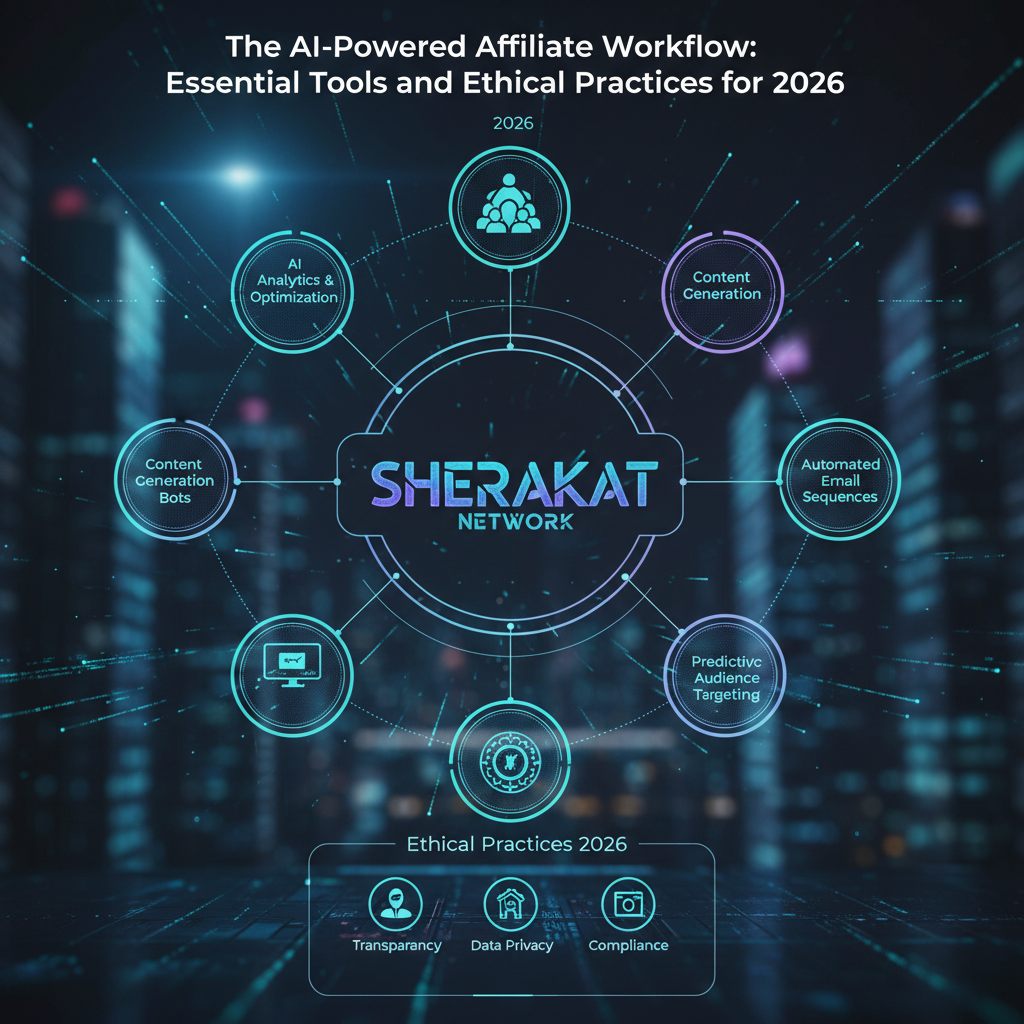
This framework transforms AI from a scattered tool into a coherent system. Follow these steps in sequence for maximum impact.
Step 1: Strategic Niche & Opportunity Identification
Instead of guessing, use AI to analyze the market.
- Tool Action: Use an AI research platform (like Jasper’s Chat or Perplexity AI) to analyze search trends, forum discussions (Reddit, niche forums), and competitor gaps. Prompt: “Analyze the current pain points and unanswered questions in the [Your Niche] space for beginner audiences in 2026. Identify 5 subtopics with high commercial intent but medium competition.”
- Human Touch: You evaluate the suggestions against your personal knowledge and passion. AI provides the map; you choose the destination.
Step 2: Hyper-Targeted Keyword & Content Strategy
Move beyond basic keyword lists to semantic topic clusters.
- Tool Action: Input a seed keyword into an AI-enhanced SEO tool like SurferSEO or Frase. Use it to generate a full content brief that includes semantically related terms, questions to answer, and optimal content structure based on top-ranking pages.
- Human Touch: You interpret the “why” behind the AI’s suggestions, ensuring the strategy aligns with your audience’s journey, not just search volume. For more on building strategic foundations, explore our guide on building a successful business partnership, as the same principles of alignment apply.
Step 3: Efficient Content Creation & Drafting
Break the blank page barrier.
- Tool Action: Use your LLM (ChatGPT, Claude) with a detailed prompt. Provide the content brief from Step 2 and command: “Act as an expert affiliate marketer in [Niche]. Write a detailed, informative, and engaging draft for a blog post titled [Your Title]. Structure it with H2s and H3s, include practical tips, and integrate the primary keyword naturally.”
- Human Touch: This is where you shine. The AI draft is your raw material. Rewrite for personality, inject personal anecdotes, add nuanced opinions, and ensure the recommendation is genuinely helpful, not just optimized.
Step 4: Multi-Format Content Repurposing
Maximize the value of every piece of core content.
- Tool Action: Take your finished blog post and use AI to atomize it.
- For Social Media: Prompt: “Convert the key points of this article into 5 engaging Twitter/X threads and 3 LinkedIn carousel post ideas.”
- For Email: Prompt: “Create a 3-part email sequence summarizing this guide to nurture my subscriber list.”
- For Video: Use a tool like Descript or Opus Clip to turn the text into a video script or auto-generate highlights from a long-form talk.
- Human Touch: You curate and refine the outputs, ensuring each format’s unique tone and audience expectations are met.
Step 5: Performance Optimization & A/B Testing
Continuously improve based on data, not hunches.
- Tool Action: Use AI-powered CRO tools like Mutiny or Omniconvert to generate and test multiple versions of your landing page headlines, call-to-action buttons, or email subject lines simultaneously.
- Human Touch: You set the strategic goals for the tests (e.g., increase click-through rate vs. increase time-on-page) and interpret the results in the context of your overall brand message.
Step 6: Personalized Audience Engagement
Move beyond “Dear [First Name]” to genuine personalization.
- Tool Action: Implement an AI chatbot (like ManyChat or Intercom) on your site that can answer common visitor questions based on your content library, qualifying leads 24/7. Use email marketing AI (HubSpot, Brevo) to segment audiences based on behavior and trigger personalized follow-ups.
- Human Touch: You design the conversation flows, monitor for edge cases, and step in for complex, high-touch interactions that build real relationships.
Step 7: Predictive Analysis & Strategic Forecasting
Plan your next move with confidence.
- Tool Action: Connect your analytics, ad, and affiliate data to a BI tool with AI capabilities (like Microsoft Power BI or Google Looker Studio). Ask it to identify seasonal trends, predict future commission revenue, or flag underperforming content that needs updating.
- Human Touch: You use these insights to make strategic decisions about budget allocation, content calendar shifts, and new partnership opportunities.
Why It’s Important: The Competitive Edge of an AI Workflow
Adopting this workflow is critical for three fundamental reasons:
- Exponential Efficiency Gains: AI automates the most time-consuming, repetitive tasks—research, data crunching, initial drafting. What used to take 10 hours for content creation can now take 2, allowing you to scale your output or deepen your quality. This efficiency is crucial for building any modern venture, as highlighted in our resource on how to start an online business in 2026.
- Data-Driven Decision Making: It removes guesswork. From keyword selection to headline testing, every decision can be informed by AI analysis of vast datasets, leading to higher conversion rates and better resource allocation.
- Sustainable Scalability: A manual process hits a ceiling dictated by your time and energy. An AI-augmented workflow scales. You can manage more content, engage with a larger audience, and analyze more complex funnels without a linear increase in effort or burnout.
Sustainability in the Future: Building a Resilient AI Practice
To ensure your AI use is future-proof, focus on sustainability:
- Skill Sustainability: Continuously develop your prompt engineering and AI tool curation skills. The tools will evolve, but your ability to command them effectively is your permanent asset.
- Ethical Sustainability: Build trust with your audience by being transparent. Consider discreet disclosures like “Edited with AI” or “Insights powered by AI analysis.” Never present fully AI-generated text as purely your own lived experience. This commitment to authenticity aligns with building the trust economy in affiliate marketing.
- Economic Sustainability: Treat AI tools as productivity investments. Calculate their cost against the hours they save or the revenue lift they generate. Start with one or two core tools and expand as you see clear ROI.
Common Misconceptions

- Misconception: “AI will write my entire blog and I won’t have to do anything.”
- Reality: AI is a collaborator, not a replacement. The most successful content is AI-informed but human-created. Your unique voice, critical thinking, and personal stories are irreplaceable.
- Misconception: “Using AI is cheating or will get me penalized by Google.”
- Reality: Google’s guidelines state they reward “helpful, reliable, people-first content.” If you use AI to mass-produce shallow, unoriginal content, you’ll be penalized. If you use it to enhance your process for creating better content, you’ll be rewarded. The distinction is in the outcome, not the tool.
- Misconception: “I need to use every AI tool to stay competitive.”
- Reality: Tool fatigue is real. Master a simple stack that covers your core workflow: one LLM for ideation/drafting, one SEO tool for strategy, and one analytics tool for insight. Depth beats breadth.
Recent Developments (2025-2026)
The AI tool landscape is advancing rapidly. Key developments you need to know:
- Search Generative Experience (SGE): Google’s AI-powered search results are changing SEO. Affiliate content must now directly answer complex queries in a comprehensive, conversational format to earn visibility.
- Multi-Modal AI: Tools like GPT-4o can now process and generate text, images, and audio simultaneously. This enables the creation of rich, multi-format content assets from a single prompt.
- AI Agents & Automation: Platforms like Zapier now offer AI agents that can perform multi-step tasks across different apps based on a simple command (e.g., “Find the top-performing affiliate link from last week and create a social media post about it”).
- Rise of Vertical-Specific AI: Specialized AI tools are emerging for e-commerce, SEO, and social media management, offering deeper functionality than general-purpose LLMs.
Real-Life Example: A Before and After Scenario
BEFORE (Manual Process):
Sarah, a affiliate in the home fitness niche, spends 8 hours researching a new yoga mat brand, writing a 2,000-word review, and creating 3 social posts. She publishes one piece of content per week. A/B testing is done infrequently due to time constraints.
AFTER (AI-Powered Workflow):
- Sarah uses Perplexity AI to research and validate the product opportunity in 30 minutes.
- She uses SurferSEO to generate a full SEO-optimized outline in 15 minutes.
- She uses Claude to produce a detailed first draft in 20 minutes, which she then spends 90 minutes personalizing with her own workout experiences and photos.
- She uses ChatGPT to repurpose the post into 10 tweet ideas, a newsletter summary, and 5 FAQ answers for her chatbot in 15 minutes.
- She uses the A/B testing feature in her email platform to test two subject lines automatically.
Result: Sarah produces the same high-quality, personalized review in under 3 hours and generates a month’s worth of supporting promotional material. She can now publish 2-3 deep pieces per week, dramatically increasing her traffic and commission potential.
Conclusion and Key Takeaways
Integrating AI into your affiliate marketing workflow is no longer a futuristic concept—it’s a present-day imperative for efficiency, insight, and scale. The goal is not to become an AI expert, but to become a marketer who expertly leverages AI.
Key Takeaways:
- AI is a Force Multiplier: It amplifies your efforts, allowing you to compete at a higher level by automating the grind and enhancing your creativity.
- The Human-AI Partnership is Key: Your value lies in strategy, storytelling, empathy, and ethical judgment. AI provides the speed and scale. Forge a strong partnership, just as you would in any business venture (explore different business partnership models for inspiration).
- Start with a System, Not Just Tools: Implement the 7-step workflow to ensure AI tools work together coherently toward your business goals.
- Ethics Build Trust: Transparent and responsible use of AI will protect your brand and foster long-term audience loyalty in an increasingly skeptical digital world.
- Continuous Learning is Mandatory: The field is moving fast. Dedicate time weekly to explore new tools and techniques to maintain your edge.
Begin by auditing your current process. Identify one bottleneck—be it research, drafting, or repurposing—and introduce a single AI tool to address it. Master that step, then move to the next. This gradual, intentional integration is the path to building a sustainable, future-proof affiliate business.
FAQs: Your AI Affiliate Marketing Questions Answered
Q1: Is it against AdSense policy to use AI-generated content?
A: Google AdSense policy focuses on quality, not origin. They prohibit auto-generated content, which they define as content generated programmatically without adding value. If you use AI as a tool to assist in creating original, valuable, and edited content, you are compliant. The key is significant human oversight and value addition.
Q2: What’s the most important skill for using AI in marketing?
A: Prompt engineering. The ability to give clear, contextual, and detailed instructions to an AI model is what separates generic outputs from highly useful ones. It’s a learnable skill that dramatically improves your results.
Q3: Won’t all AI content sound the same? How do I keep my unique voice?
A: This is a major risk if you rely solely on AI outputs. Your voice comes from your personal editing. Always edit AI drafts heavily. Inject your slang, your humor, your specific anecdotes, and your nuanced opinions. Use the AI text as a structure to build upon, not the final product.
Q4: What are the must-have, budget-friendly AI tools for a beginner affiliate?
A: Start with this core, affordable stack:
- Ideation & Drafting: ChatGPT Plus or Claude (subscription).
- SEO & Content Planning: Frase.io or SurferSEO (subscription, start with basic plan).
- Grammar & Tone: Free version of Grammarly.
- Graphics: Canva (free tier has AI features like Magic Write and background remover).
Q5: How do I use AI to find profitable affiliate niches or products?
A: Use conversational AI like Perplexity AI. Prompt: “Act as a market researcher. Analyze emerging consumer trends in sustainable living for 2026. Identify 3 specific product categories with high affiliate potential (good margins, growing demand, not oversaturated) and list the major brands in each space.”
Q6: Can AI help me with link-building and outreach?
A: Absolutely. Use an LLM to:
- Analyze a target website’s content to personalize outreach emails.
- Draft multiple variations of outreach emails for A/B testing.
- Generate ideas for guest post topics tailored to a specific site’s audience.
Q7: How can I use AI to improve my email marketing as an affiliate?
A: AI can help segment your list based on engagement, generate personalized subject line variations, write email sequences based on user actions (e.g., clicked a link for product X), and even predict the best time to send emails to individual subscribers.
Q8: Is there an AI tool that can manage my entire affiliate business?
A: Not a single “silver bullet” tool yet, but AI agents are getting close. You can use platforms like Zapier or Make to create automated workflows (Zaps) that connect your AI tools, analytics, and CRM. For example, a Zap could trigger an AI to write a social post whenever a new blog article is published.
Q9: How do I stay updated on the latest AI tools for marketers?
A: Follow reputable marketing tech blogs, subscribe to newsletters like “The Neuron” or “Ben’s Bites,” and join communities like “AI for Marketers” on LinkedIn or Slack. Dedicate 30 minutes a week to this.
Q10: What’s the biggest ethical pitfall when using AI for affiliate content?
A: Plagiarism and factual inaccuracy. AI can “hallucinate” false facts or inadvertently paraphrase copyrighted material. You are responsible for fact-checking every claim and running all final text through a plagiarism checker before publishing. Never trust AI-generated facts without verification.
About the Author
Sana Ullah Kakar is a digital strategist with over a decade of experience in performance marketing and affiliate partnerships. Having built and scaled multiple online revenue streams, they now focus on demystifying advanced technologies for entrepreneurs. They believe in a balanced, ethical approach where AI enhances human creativity to build more sustainable and profitable digital businesses. Connect with our community through our contact page for more insights.
Free Resources

- AI Prompt Library for Affiliates: A downloadable Google Doc with 50+ tested prompts for niche research, content creation, email marketing, and analytics.
- AI Tool Stack Comparison Sheet: A regularly updated spreadsheet comparing features, pricing, and best-use cases for 30+ popular AI marketing tools.
- Weekly AI in Marketing Digest: Subscribe to our newsletter within the Sherakat Network blog for curated news, tool updates, and case studies.
Discussion
We want to hear from you! What stage of AI adoption are you at? Which step of the 7-step workflow are you most excited to implement, or which one seems most daunting? Have you encountered a specific challenge or had a major win using AI in your affiliate business? Share your thoughts and questions in the comments below. Let’s build this knowledge together.