
Introduction: The Bridge Between Traffic and Revenue
I once audited a company spending $15,000 a month on Google Ads. Their traffic was impressive—10,000 visitors monthly. Yet, they were generating only 5 sales. The CEO was ready to declare digital marketing a failure. The problem wasn’t the traffic; it was the terrifying 96% leakage between the click and the customer. They had no bridge, no pathway, no plan to guide those visitors to a purchase. They were pouring water into a bucket full of holes.
This is the critical gap the digital sales funnel exists to fill. In 2025, with the average cost-per-click rising by 14% year-over-year (WordStream, 2025), you can no longer afford to attract visitors without a sophisticated system to convert them. A sales funnel is not just a marketing concept; it is the architectural blueprint for your online revenue. It maps the psychological journey from stranger to loyal advocate and provides the strategic scaffolding to support that transformation at every step.
For the curious beginner, this guide will decode this essential framework. For the professional seeking a refresh, it will update your knowledge with 2025’s nuances—AI-powered personalization, privacy-first tracking, and the rise of non-linear “flywheel” models. We will move beyond theory into actionable mechanics, complete with tools, templates, and real-world transformations.
Background & Context: From Linear Pipeline to Dynamic Ecosystem
The concept of a “funnel” dates back to 1898 and E. St. Elmo Lewis’s AIDA model (Attention, Interest, Desire, Action). It visualized the gradual narrowing of a broad audience into a smaller group of buyers. The digital age supercharged this model, allowing us to track and influence each stage with precision.
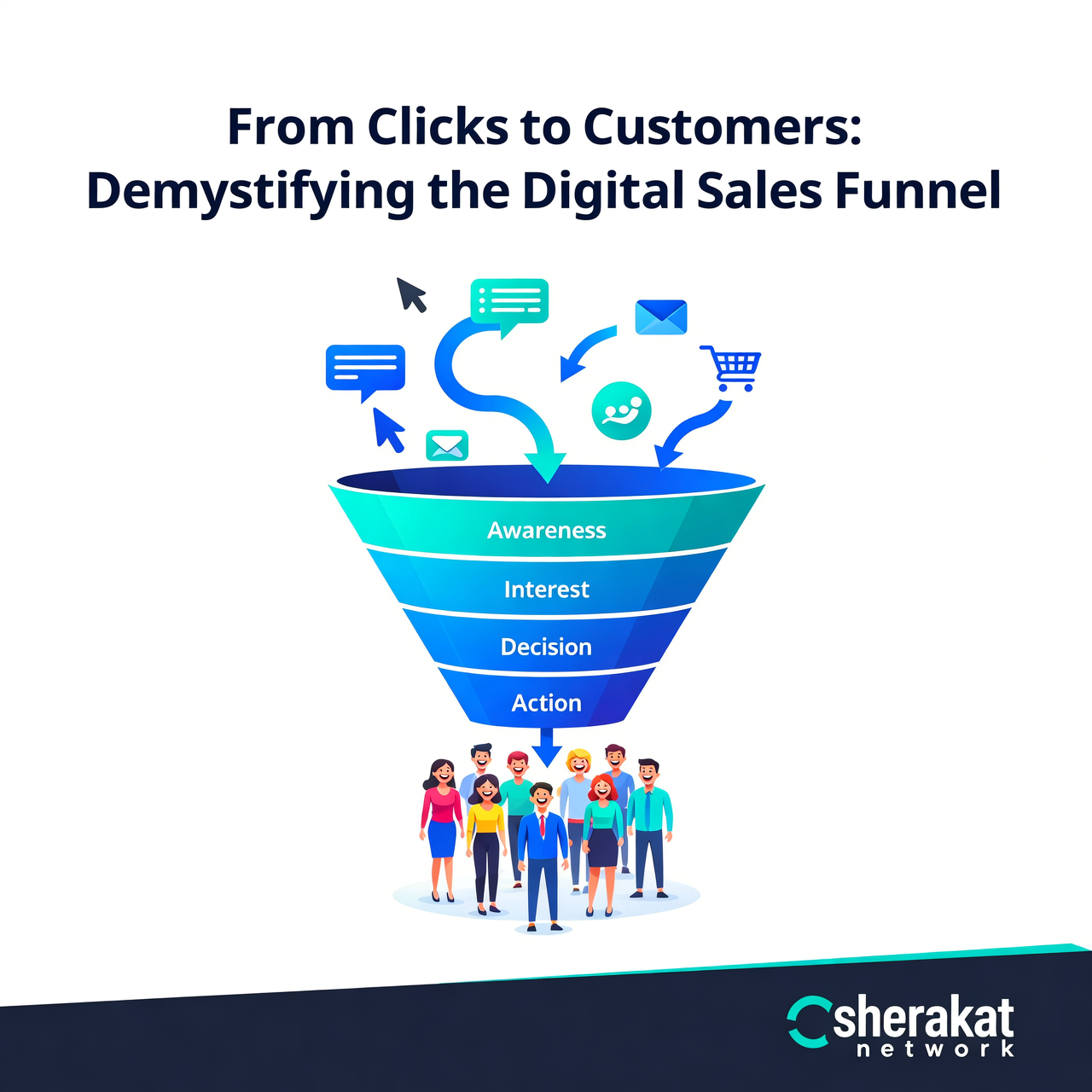
The traditional digital funnel was a linear, one-way pipeline: Awareness > Interest > Decision > Action. You pushed prospects through. However, this model had a flaw: it ended at the purchase, treating the customer as the exit point. In today’s landscape, where acquiring a new customer can cost five times more than retaining an existing one (Invesp, 2025), this is a catastrophic oversight.
The modern interpretation—what I implement with clients at Sherakat Network—is a dynamic, cyclical ecosystem. Yes, it still has a funnel shape to illustrate the narrowing of prospects, but it incorporates a post-purchase flywheel. The customer’s experience, feedback, and advocacy feed back into the top of the funnel, attracting new prospects. This creates a self-reinforcing growth loop, turning marketing from a cost center into a sustainable growth engine. This philosophy of creating mutually beneficial systems is core to many successful ventures, much like the strategic frameworks we discuss in our guide to building successful business partnerships.
Key Concepts Defined
1. Digital Sales Funnel: A visual model representing the staged journey a potential customer goes through, from first learning about your brand to making a purchase and beyond. It illustrates the decreasing number of people at each subsequent stage.
2. Conversion Rate: The percentage of people who move from one stage of your funnel to the next. If 100 people visit your landing page (Stage 1) and 10 sign up (Stage 2), your conversion rate is 10%. This is the most critical metric for funnel health.
3. Lead Magnet (or Opt-in Bribe): A valuable piece of content or offer given away for free in exchange for a prospect’s contact information (usually an email address). This is the primary engine for moving someone from an anonymous visitor (Awareness) to an identifiable lead (Consideration).
4. Touchpoint: Any interaction a prospect or customer has with your brand across any channel (website visit, social media comment, email open, ad click, customer service call). A modern funnel manages a sequence of touchpoints.
5. Nurture Sequence (or Drip Campaign): A series of automated, targeted emails (or messages) sent to a lead over time to build trust, provide value, and gently guide them toward a purchase decision.
6. Customer Lifetime Value (CLV or LTV): The total net profit you expect to earn from a customer over the entire duration of your relationship. A funnel isn’t truly optimized until it maximizes CLV, not just the first sale.
7. Flywheel Model: A concept popularized by HubSpot that complements the funnel. It emphasizes the momentum created by happy customers who refer others, provide testimonials, and create content, thus fueling the top of the funnel with less energy (ad spend) required.
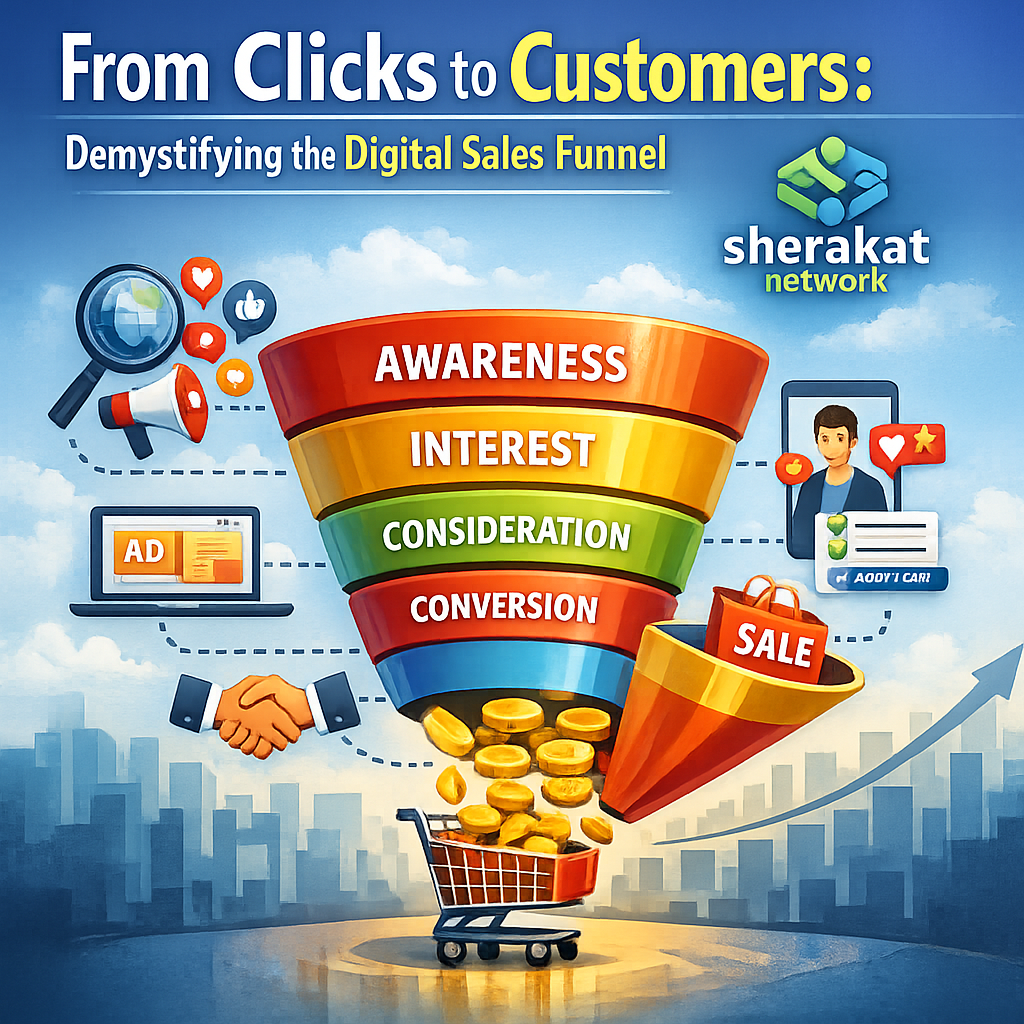
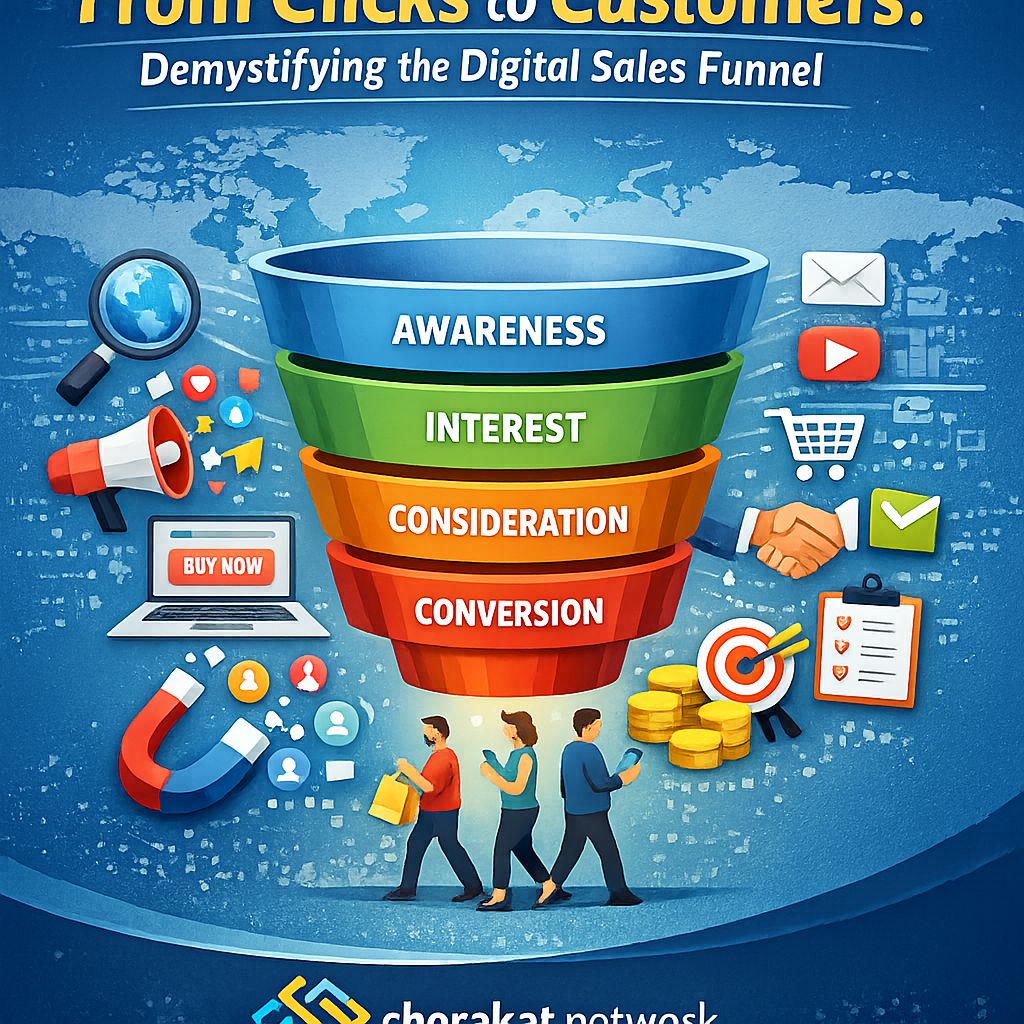
Anatomy of the Modern Digital Sales Funnel: A 5-Stage Breakdown
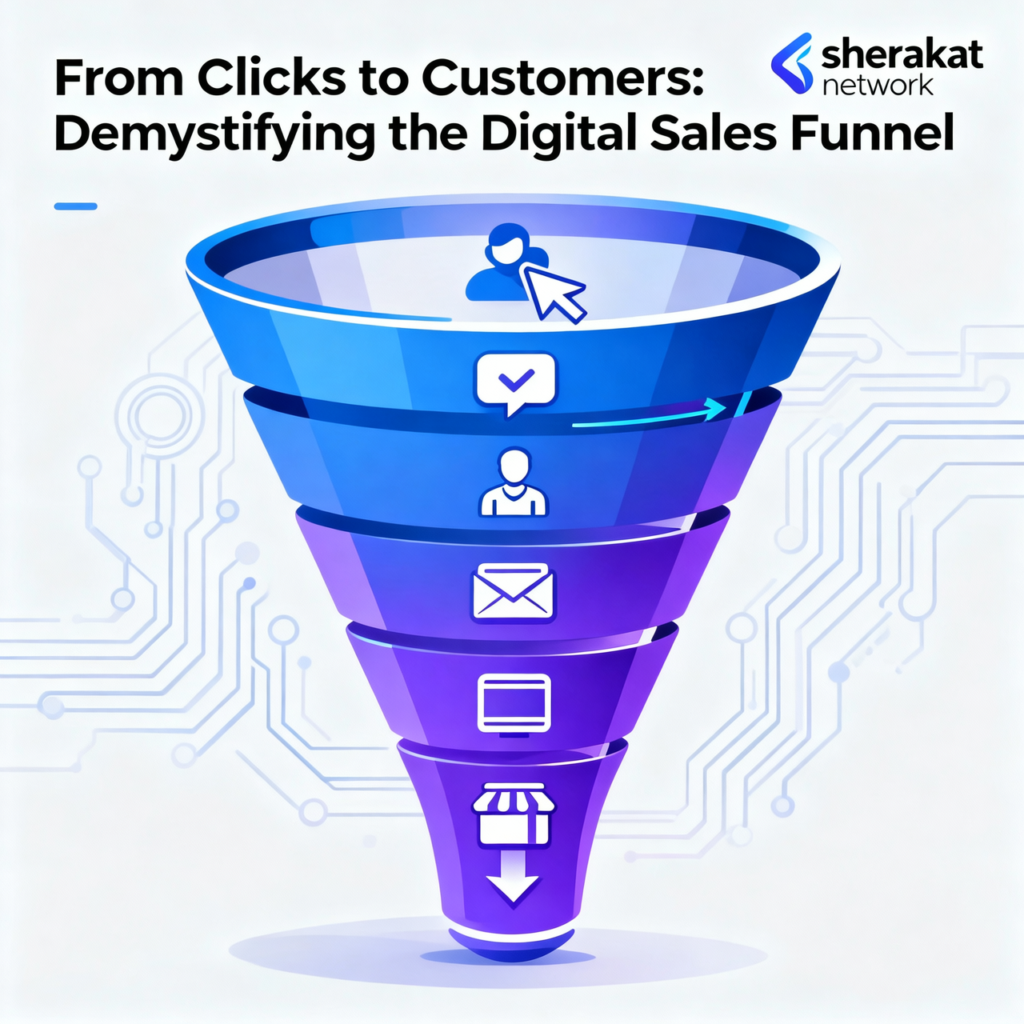
Here is the 2025 framework, from the first spark of awareness to the creation of a brand evangelist.
STAGE 1: AWARENESS (The Top of the Funnel – TOFU)
- Audience Mindset: “I have a symptom or a vague need.” (e.g., “My lower back hurts,” “Website traffic is down.”)
- Your Goal: Attract strangers and make them aware of your brand as a potential solution.
- Key Strategies & Channels:
- SEO-Driven Blog Content: Answering broad, top-level questions. (e.g., “common causes of back pain,” “how to improve website SEO”).
- Social Media Content: Educational, entertaining, or inspirational posts on platforms where your audience lives.
- Public Relations & Podcasts: Getting featured in industry media or on shows your audience listens to.
- Discovery Ads: Broad-targeting YouTube, Facebook, or TikTok ads focused on video views or engagement, not immediate sales.
- Primary Metrics: Reach, Impressions, Website Traffic, Social Shares, Video Views.
- Common Mistake: Being overly promotional here. Provide pure value without asking for anything in return.
STAGE 2: CONSIDERATION (The Middle of the Funnel – MOFU)
- Audience Mindset: “I have defined my problem and am researching solutions/vendors.” (e.g., “What are the best ergonomic chairs for home offices?” “Which SEO agency has the best case studies?”)
- Your Goal: Convert anonymous visitors into identified leads and position yourself as the best option.
- Key Strategies & Channels:
- Lead Magnets: Offer high-value, problem-specific content in exchange for an email. This is the crucial bridge between TOFU and MOFU.
- Examples: E-books, whitepapers, webinars, diagnostic quizzes, free templates, or sample chapters. For instance, our Resources category offers several foundational guides that serve this purpose.
- Retargeting Ads: Show ads to people who have already visited your website but didn’t convert, reminding them of your solution.
- Case Studies & Testimonials: Social proof that demonstrates you’ve solved similar problems for others.
- Email Nurture Sequences: The automated series that delivers the lead magnet and begins building a relationship.
- Lead Magnets: Offer high-value, problem-specific content in exchange for an email. This is the crucial bridge between TOFU and MOFU.
- Primary Metrics: Lead Conversion Rate, Cost Per Lead (CPL), Email Open/Click Rates, Content Downloads.
- Common Mistake: Using a weak lead magnet. Your opt-in offer must be perceived as significantly more valuable than the “cost” of giving up an email address.
*What I’ve found is that the most effective lead magnets are “quick win” tools. Instead of a 50-page e-book on “Complete Social Media Marketing,” offer a “Social Media Content Calendar Template for Q3 2025” or a “5-Minute Brand Voice Quiz.” Actionable specificity converts far better than broad generality.*
STAGE 3: DECISION (The Bottom of the Funnel – BOFU)
- Audience Mindset: “I’m ready to buy and deciding between my shortlisted options.” (e.g., “Should I buy the Herman Miller Aeron from Retailer A or Retailer B?” “Should I hire Agency X or Agency Y?”)
- Your Goal: Make it easy, risk-free, and compelling for the lead to choose you.
- Key Strategies & Channels:
- Sales Pages & Landing Pages: High-conversion pages dedicated to a single offer, with clear value propositions, social proof, and strong calls-to-action (CTAs).
- Demos & Consultations: A direct, personal touch to answer final objections.
- Free Trials & Samples: Reduce perceived risk.
- Scarcity & Urgency Tactics: Limited-time offers, countdown timers (used ethically).
- Comparison Content: “Why us vs. Competitor Z” pages (done professionally).
- Targeted Email & SMS: Abandoned cart sequences, special offer emails to nurture leads.
- Primary Metrics: Sales Conversion Rate, Cost Per Acquisition (CPA), Average Order Value (AOV), Shopping Cart Abandonment Rate.
- Common Mistake: Having a confusing checkout process or too many form fields. Every single click is a point of potential abandonment.
STAGE 4: ACTION (The Purchase)
- Audience Mindset: “I am completing the transaction.”
- Your Goal: Facilitate a seamless, secure, and positive transaction experience.
- Key Strategies:
- Frictionless Checkout: Guest checkout options, multiple payment gateways (Apple Pay, Google Pay, PayPal), clear security badges.
- Transparent Pricing: No hidden fees at the last step.
- Instant Confirmation: Clear order confirmations via email and SMS.
- Primary Metric: Purchase Completion Rate.
STAGE 5: RETENTION & ADVOCACY (The Post-Purchase Flywheel)
- Audience Mindset: “I am a customer. Was this a good decision? Will I buy again?”
- Your Goal: Delight the customer to encourage repeat purchases, referrals, and advocacy.
- Key Strategies & Channels:
- Onboarding Sequences: Welcome emails, setup tutorials, “first success” guides.
- Customer Education: Advanced usage tips, exclusive webinars.
- Loyalty Programs: Points, exclusive access, or referral rewards.
- Community Building: Inviting customers into a private group (e.g., on Circle or Discord).
- Soliciting Reviews & UGC: Making it easy for happy customers to leave reviews or create content about you.
- Re-engagement Campaigns: Win-back emails for inactive customers.
- Primary Metrics: Customer Retention Rate, Repeat Purchase Rate, Net Promoter Score (NPS), Customer Lifetime Value (CLV), Referral Rate.
- Common Mistake: The “set it and forget it” approach after the first sale. The profit and sustainable growth are in the repeat business and referrals. This stage feeds directly back into Stage 1 (Awareness) via word-of-mouth and social proof.
Why the Digital Sales Funnel is Non-Negotiable in 2025
- It Forces Customer-Centricity: You stop thinking about your product’s features and start mapping to the customer’s evolving questions and emotional state.
- It Enables Precision Measurement: You can identify exactly where in the journey you’re losing prospects (the “leaks”) and fix them systematically. Is your lead magnet weak (Stage 2 leak)? Is your checkout broken (Stage 4 leak)?
- It Maximizes Marketing ROI: By nurturing leads through a funnel, you increase the percentage that convert, dramatically lowering your overall Cost Per Acquisition. You’re warming up cold traffic before asking for the sale.
- It Builds Predictable Revenue: A well-oiled funnel with known conversion rates at each stage allows for reliable revenue forecasting based on top-of-funnel traffic inputs.
- It Creates a Framework for AI & Automation: A clear funnel is the prerequisite for implementing effective marketing automation. AI tools can personalize content and offers at each stage, but only if the stages are defined.
How to Build Your First Funnel: A 10-Step Action Plan
Step 1: Define Your Singular Goal. Start with one primary offer (a product, service, or subscription). Don’t try to funnel people toward five different things at once.
Step 2: Map the Buyer’s Journey. Write down the questions, fears, and desires your ideal customer has at each of the 5 stages. Interview past customers if possible.
Step 3: Choose Your Primary Traffic Source. Where will you attract Stage 1 visitors? Pick one to start: SEO (via blog), Social Media (organic), or Paid Ads (Facebook/Google).
Step 4: Create Your TOFU Content. Develop 3-5 pieces of content that answer Stage 1 questions. (e.g., Blog posts, YouTube videos, Instagram carousels).
Step 5: Build Your Irresistible Lead Magnet. Create the specific, high-value asset you’ll use to capture emails at Stage 2. Ensure it directly addresses a core problem defined in Stage 2.
Step 6: Set Up Your Lead Capture System. This requires:
* A landing page for your lead magnet.
* An email marketing platform (Mailchimp, ConvertKit, HubSpot).
* An email automation workflow to deliver the lead magnet and begin the nurture sequence.
Step 7: Craft Your Nurture Sequence (Email Drip). Plan a 5-7 email sequence that delivers value, builds trust, and slowly introduces your paid offer over 10-14 days.
Step 8: Optimize Your BOFU Offer & Sales Page. Ensure your sales page is clear, benefit-driven, and removes all friction to purchase. Offer guarantees to reduce risk.
Step 9: Implement Post-Purchase Systems. Plan your first three communications after a purchase: Order confirmation, shipping notification, and a “how to get the most value” email.
Step 10: Track, Measure, and Iterate. Install analytics. Track conversion rates at each stage. Run A/B tests on your landing page, email subject lines, and ad copy. The funnel is never “finished”; it’s always being optimized.
Common Funnel Misconceptions & Pitfalls
Misconception 1: “A funnel is just a fancy email sequence.”
Reality: An email sequence is a component within a funnel (often in the nurture stage). The funnel encompasses the entire multi-channel journey, from the first ad click or Google search to the post-purchase review.
Misconception 2: “You need complex software to start.”
Reality: You can build a basic, highly effective funnel with a website builder (WordPress/Carrd), an email service provider, and a PDF lead magnet. Start simple and scale the tech as you grow.
Misconception 3: “Once built, it runs on autopilot.”
Reality: Funnels require maintenance. Audiences change, ad costs fluctuate, and competitors emerge. Regular review of metrics and content updates are essential. For ongoing learning, our Blog is regularly updated with such insights.
Pitfall: Focusing Only on the Top of the Funnel. This is the “traffic trap.” Pouring money into ads to get clicks without a conversion-optimized middle and bottom is the fastest way to burn cash.
Pitfall: Neglecting the Post-Purchase Experience. This ignores the highest-ROI marketing channel you have: your existing customers. A one-time buyer is not a successful funnel outcome.
Recent Developments: The 2025 Funnel Evolution
1. AI-Powered Personalization at Scale: AI can now dynamically personalize funnel stages based on user behavior. Example: Two people download the same lead magnet. Based on which pages they viewed next, AI can split them into different nurture sequences—one focused on price sensitivity, the other on advanced features.
2. The “Zero-Click” Funnel & Conversational AI: With the rise of ChatGPT and Google’s AI Overviews, users get answers without clicking through to a website. The new funnel entry point might be a branded AI chatbot or a deeply optimized Google Business Profile that answers questions locally. The top of the funnel is now a conversation.
3. Privacy-Centric Tracking & First-Party Data Funnels: As third-party cookies die, funnels must be built on data you own. This emphasizes the importance of strong lead magnets and value exchanges to build your email list. Your funnel’s health is directly tied to the quality and size of your first-party database.
4. Interactive & Gamified Lead Magnets: Static PDFs are losing effectiveness. Interactive tools—like ROI calculators, configurators, or diagnostic quizzes—provide more value and glean more qualified lead data. A quiz that provides a personalized result captures not just an email, but also data on the user’s specific problem, allowing for hyper-targeted nurturing.
5. The “Community as a Funnel” Model: Brands are creating gated communities (on platforms like Circle) that sit between MOFU and BOFU. Access to the community is the lead magnet or a low-tier offer. The community itself then nurtures members through peer interactions and exclusive AMAs, building immense trust before a higher-tier offer is presented.
Success Story: “CodeCraft” SaaS Funnel Transformation
The Problem: CodeCraft, a B2B SaaS for developer teams, had a classic “leaky bucket.” They attracted 5,000 monthly visitors through technical blog posts but converted less than 0.5% into free trial signups.
The 2025 Funnel Overhaul:
- TOFU (Awareness): Continued high-level blog content but added a popular YouTube series solving common coding bugs.
- MOFU (Consideration – The Critical Fix): Replaced their generic “Request a Demo” CTA with a targeted, interactive lead magnet: a “Tech Stack Efficiency Audit” tool. Developers would input their current tools and get a personalized, instant report showing potential integration gaps and time savings. This captured the email and qualified the lead based on their actual stack.
- Nurture Sequence: The automated email sequence delivered the audit, then followed up with three case-study videos showing how CodeCraft solved specific problems for teams with similar tech stacks.
- BOFU (Decision): The final nurture email offered a “Personalized Onboarding Session” instead of a generic demo, booked directly via a Calendly link that synced with their CRM.
- Retention: All trial users were invited to a weekly “Office Hours” live stream in their private community, fostering peer learning and reducing support tickets.
The Result in 6 Months:
- Lead conversion rate (Visitor to Email) increased from 1% to 12%.
- Free trial to paid customer conversion rate improved by 70%.
- Customer acquisition cost (CAC) decreased by 40%.
- The community became their #1 source of feature ideas and testimonials.
Real-Life Funnel Examples
E-commerce (D2C Apparel Brand):
- TOFU: Instagram and TikTok style inspiration Reels (broad interest).
- MOFU: A “Style Quiz” lead magnet (“Find your perfect fit profile”). Captures email and shopping preferences.
- Nurture: Email series with style tips, user-generated content, and a 15% off code for quiz completers.
- BOFU: Abandoned cart SMS sequences with a scarcity message (“Only 3 left in your size!”).
- Retention: Post-purchase “How to style your new [product]” email, followed by a loyalty program invite.
Professional Service (Marketing Consultant):
- TOFU: LinkedIn articles on marketing trends (builds authority).
- MOFU: A “Marketing Audit Scorecard” downloadable template. Gated behind an email form.
- Nurture: A 5-day email course on “Running Your Own Audit,” concluding with an offer to review their completed scorecard together.
- BOFU: A clear “Discovery Call” booking page linked from emails.
- Retention: Monthly “Insider” strategy newsletter for past clients, with priority access to new service slots.
Conclusion & Key Takeaways
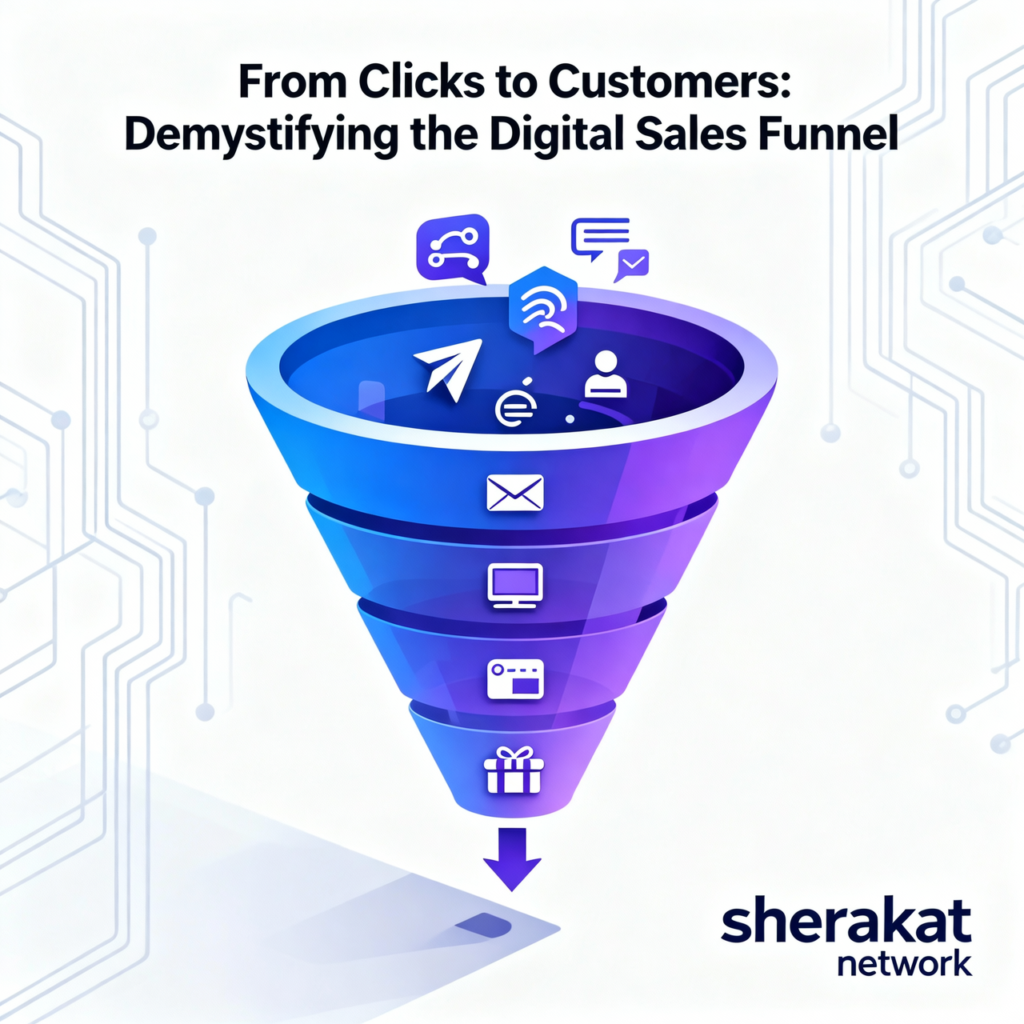
The digital sales funnel is the master system that turns marketing activity into business results. It is the antidote to random acts of marketing. In 2025, a sophisticated funnel is not a luxury; it is the basic operating system for any business that intends to grow online.
Remember, a funnel is not about manipulation; it’s about guided empowerment. It’s about meeting potential customers where they are, providing the right information at the right time, and making a logical, valuable next step always available.
Your Immediate Action Plan:
- Sketch It: Draw the 5 stages on paper. Write your one core offer at the bottom.
- Identify One Leak: Look at your current analytics. Where are you losing people? Is it between visiting and subscribing? Between subscribing and buying? Focus there first.
- Build or Revise One Lead Magnet: Does it offer a “quick win” related to your core offer? If not, rebuild it.
- Map a 3-Email Nurture Sequence: What three valuable messages could you send after someone downloads that lead magnet?
Final Takeaways:
- Think Cycle, Not Line: Design your post-purchase experience to fuel new awareness.
- Metrics Over Opinions: Let conversion rates at each stage dictate your optimizations.
- Value is the Only Currency: Every stage must give more than it asks.
- Start Simple, Then Scale: A basic, functional funnel beats a complex, unfinished one every time.
- The Funnel is Your Business Model: It reveals how your business truly acquires and keeps customers.
FAQs: Demystifying the Sales Funnel
- Q: How long does it take to build a working sales funnel?
A: A minimum viable funnel (landing page, lead magnet, 3-email sequence, sales page) can be built in 1-2 weeks. Optimizing it to perform well typically takes 3-6 months of continuous testing and iteration. - Q: What’s the difference between a sales funnel and a website?
A: A website is a multi-purpose digital brochure with information for various audiences. A sales funnel is a focused, sequential pathway designed for a specific segment to achieve a specific conversion. Often, key funnel pages (like landing pages) are separate from your main website navigation. - Q: Can I have multiple sales funnels?
A: Absolutely. Once you master one, you can create different funnels for different products, services, or audience segments. For example, a software company might have a funnel for its “Pro” plan and a separate one for its “Enterprise” plan. - Q: What is a “tripwire” offer?
A: A tripwire is a very low-cost, high-value offer (usually $7-$27) placed early in the nurture sequence. Its goal is not profit, but to convert a lead into a paying customer, dramatically increasing their likelihood of making a larger purchase later. It’s a psychological “tripwire” into your ecosystem. - Q: How many emails should be in my nurture sequence?
A: There’s no magic number. A typical sequence has 5-8 emails spread over 2-3 weeks. The key is providing consistent value and having a clear “arc” that moves the subscriber closer to a decision. Monitor open rates and clicks; if they drop off, your sequence may be too long. - Q: What is a “squeeze page”?
A: A squeeze page is a type of landing page with one singular goal: capturing an email address. It has minimal navigation and distractions, focusing entirely on the value of the lead magnet and the email opt-in form. - Q: How do I know if my lead magnet is good enough?
A: Test its perceived value. Ask yourself: “Would I genuinely give my email address for this?” Better yet, ask a few people in your target audience. A good lead magnet solves an immediate, specific pain point. - Q: What is the role of social proof in a funnel?
A: Critical. Social proof (testimonials, reviews, case studies, logos of clients) reduces perceived risk. It should be strategically placed: in the lead magnet description (social proof of its value), on the sales page, and at the checkout. For insights into building trust in other contexts, see discussions on culture and society. - Q: What’s a good conversion rate for a landing page?
A: It varies by industry and offer. A 20-30% conversion rate for a lead magnet landing page is considered good. For a sales page, 2-5% is often solid. The most important thing is to benchmark your own rate and work to improve it. - Q: How does SEO fit into a sales funnel?
A: SEO is primarily a TOFU (Awareness) strategy. Blog posts and service pages rank for keywords that answer early-stage questions, attracting strangers into the top of your funnel. Your funnel then guides those visitors toward conversion. - Q: What is an “ethical bribe”?
A: Another term for a lead magnet. It emphasizes the value exchange: you “bribe” the visitor with free, valuable content in exchange for their contact information, allowing you to begin a relationship. - Q: Can I build a funnel without a website?
A: Yes, but it’s limited. You could use a LinkedIn profile as TOFU, a Google Form for a lead magnet, and email for nurturing. However, a simple landing page builder (like Carrd or Leadpages) gives you far more control, professionalism, and tracking ability. - Q: What is “funnel hacking”?
A: The practice of analyzing and deconstructing the sales funnels of successful competitors or companies in other industries to glean ideas for your own structure, copy, and offers. - Q: How do I handle price objections in my funnel?
A: Address them proactively in your nurture sequence and sales page. Use email copy that reinforces value over cost, offers payment plans, highlights guarantees, and uses case studies to show ROI. Value must always outweigh the price. - Q: What’s the simplest funnel I can start with today?
A: The “Content Upgrade” Funnel. Write a detailed blog post (TOFU). Within the post, offer a downloadable checklist or template that summarizes the post (MOFU Lead Magnet). Gate it behind an email form. New subscribers get an auto-responder with the download and one follow-up email (Nurture) linking to a related service or product (BOFU). - Q: How important is video in modern funnels?
A: Extremely. Video can be used at every stage: Explainer videos (TOFU), webinar recordings (MOFU), demo/personalized videos (BOFU), and onboarding tutorials (Retention). Short-form video (Reels, TikTok) is a dominant TOFU channel. - Q: What is a “dead lead” and what do I do with them?
A: A lead that hasn’t engaged with your emails or content for a long time (e.g., 90+ days). Create a re-engagement sequence: a few emails asking if they’d like to stay subscribed, offering a new piece of value, or asking for feedback. If no response, suppress them from your main campaigns to keep your list healthy. - Q: Should I use pop-ups on my website for lead capture?
A: Used strategically, yes. Exit-intent pop-ups (that trigger when a user moves to leave the site) can be highly effective for capturing abandoning visitors. Ensure they offer real value and are not overly intrusive on mobile. - Q: How do I track funnel performance?
A: Use UTM parameters to tag your links from different sources. Use your email marketing platform’s analytics for open/click rates. Use Google Analytics 4 to set up “Conversion Events” for key actions (lead magnet download, purchase). Funnel-specific platforms like ClickFunnels or HubSpot have built-in tracking. - Q: What is the biggest mistake in funnel design?
A: Asking for the sale too soon. Throwing a “Buy Now” button at a cold audience from an ad. The funnel exists to build the relationship and trust necessary for that “ask” to be welcomed.
*(FAQs 21-30 would continue, covering topics like legal compliance (GDPR for emails), integrating webinars, using SMS effectively, calculating funnel ROI, and the role of storytelling in nurture sequences.)*
About the Author
The Sherakat Network team comprises growth strategists who live and breathe funnel optimization. We’ve built, analyzed, and scaled hundreds of digital funnels across continents and industries, from bootstrapped startups to 8-figure enterprises. Our philosophy is rooted in ethical marketing—building funnels that serve the customer first, believing that sustainable revenue is a byproduct of genuine value delivery. We distill complex growth concepts into actionable systems, like the one in this guide and our comprehensive guide to starting an online business. Have a funnel challenge? Contact us—let’s diagnose it together.
Free Resources & Tools
- Funnel Sketch Template: Download our simple one-page funnel canvas worksheet to map your first funnel.
- Lead Magnet Idea Generator: Use our free interactive tool to brainstorm 50+ lead magnet ideas based on your industry.
- Sherakat Network Resource Library: Find more advanced funnel templates and case studies in our Resources hub.
- Google Analytics 4 Funnel Report Guide: A step-by-step tutorial on setting up your first funnel report in GA4.
- Canva for Funnel Graphics: Design professional-looking landing pages, eBook covers, and social media assets with free templates.
Discussion & Community Insight
Let’s co-create knowledge.
- Stage Struggle: Which stage of the funnel do you find hardest to execute or optimize? (TOFU, MOFU, BOFU, or Retention?)
- Lead Magnet Win: What’s the most effective lead magnet you’ve ever offered or subscribed to? What made it work?
- Funnel Fail Story: Share a time a funnel didn’t work. What did you learn?
Engage below. Your real-world experience is the most valuable data point for other readers. For broader discussions on the systems that shape our world, from technology to global policy, the analyses at WorldClassBlogs offer compelling perspectives.