



Introduction: Why Hyperautomation Matters Now More Than Ever
In today’s relentlessly competitive digital landscape, efficiency isn’t just a goal—it’s a prerequisite for survival. Businesses are drowning in a sea of repetitive, manual tasks that drain resources, stifle innovation, and introduce human error. You’ve likely heard of Robotic Process Automation (RPA), the technology that mimics human actions to automate routine tasks. But what if you could go beyond simple task automation? What if you could automate entire processes, including decision-making, data interpretation, and even complex problem-solving?
Enter Hyperautomation.
Hyperautomation is not merely a buzzword; it’s a disciplined, business-driven approach to identify, vet, and automate as many business and IT processes as possible. It represents a fundamental shift from automating discrete tasks to orchestrating entire operational workflows with intelligence and context. For any business leader, entrepreneur, or manager, understanding and leveraging hyperautomation is no longer optional. It is the key to unlocking unprecedented levels of productivity, agility, and strategic insight, allowing human talent to focus on what they do best: innovation, customer engagement, and complex decision-making. This comprehensive guide will demystify hyperautomation, providing you with the knowledge to harness its power for your organization’s growth. For more foundational business concepts, explore our extensive collection of articles in our Resources category.
Background & Context: The Evolution from Macro to Hyper
The journey to hyperautomation began with simple macros and scripts that automated repetitive digital actions. Then came Robotic Process Automation (RPA), which was a game-changer. RPA bots could interact with user interfaces just like a human, logging into applications, copying data between systems, and filling out forms. This brought significant efficiency gains, but it had limitations. RPA is “dumb”; it follows strict rules without understanding context or handling exceptions well.
The next evolutionary step was the integration of cognitive technologies. As Artificial Intelligence (AI), Machine Learning (ML), and Natural Language Processing (NLP) matured, they provided the “brain” to RPA’s “hands.” This fusion gave birth to Intelligent Automation, and subsequently, Hyperautomation. The term was coined by Gartner, naming it a top strategic technology trend, highlighting its potential to redefine operational models. Hyperautomation is the end-to-end automation of business processes, fueled by a toolkit of integrated technologies that work in concert. To understand how strategic alliances can complement your technological transformation, consider reading The Alchemy of Alliance: A Comprehensive Guide to Building a Successful Business Partnership on our Blog.
Key Concepts Defined: Deconstructing the Hyperautomation Toolkit
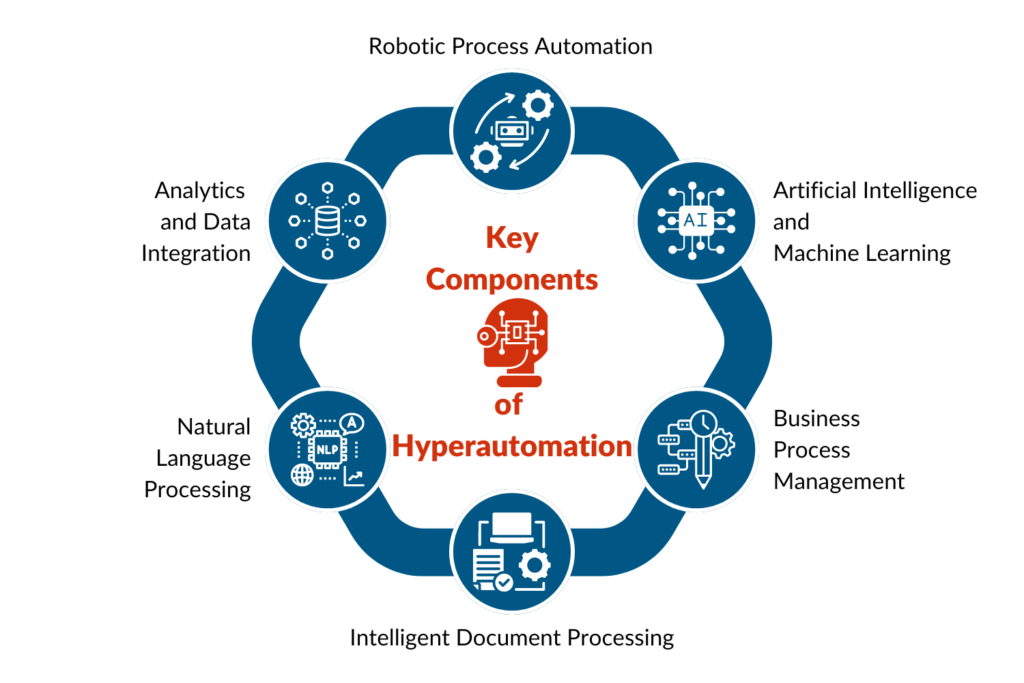
To fully grasp hyperautomation, it’s essential to understand its core components:
- Robotic Process Automation (RPA): The foundational layer. Software robots that emulate human actions to execute rule-based, repetitive tasks across digital systems.
- Artificial Intelligence (AI) & Machine Learning (ML): The intelligence layer. AI enables systems to mimic human intelligence, while ML allows them to learn and improve from data without explicit programming. This enables handling unstructured data, predicting outcomes, and making data-driven decisions.
- Process Mining & Task Mining: The discovery tools. Process mining uses event log data from IT systems to visually map out how processes actually run, identifying bottlenecks and variations. Task mining does this at a user-interaction level, analyzing keystrokes and clicks to understand individual task flows.
- Natural Language Processing (NLP): Allows machines to understand, interpret, and generate human language. This is crucial for automating customer service chats, analyzing emails, and processing documents.
- Optical Character Recognition (OCR): Converts different types of documents (scanned paper documents, PDFs, images) into editable and searchable data.
- Intelligent Business Process Management Suites (iBPMS): Platforms that manage, automate, and optimize complex business processes involving human and system interactions, often incorporating AI and analytics.
Hyperautomation is the strategic integration of all these tools into a unified, scalable automation fabric. For a deeper look into operational frameworks, this external guide on Global Supply Chain Management provides excellent context on optimizing complex processes.
How Hyperautomation Works: A Step-by-Step Breakdown
Implementing hyperautomation is a strategic journey, not a one-off project. Here is a detailed, step-by-step breakdown:
Step 1: Discovery & Analysis (The “What”)
This is the most critical phase. Using process and task mining tools, you analyze your current operational landscape. The goal is to identify which processes are the best candidates for automation. Look for processes that are:
- High-volume and repetitive.
- Rule-based with clear instructions.
- Prone to human error.
- Time-consuming and costly.
- Reliant on multiple, disconnected systems.
Step 2: Process Prioritization & Selection
Not all processes are created equal. Use a scoring matrix to evaluate candidates based on complexity, potential ROI, feasibility, and strategic impact. Start with a few low-complexity, high-impact processes to build momentum and demonstrate quick wins.
Step 3: Tool Selection & Design (The “How”)
Based on the selected processes, choose the right combination of technologies from your hyperautomation toolkit. A simple data entry task might only need RPA and OCR. A complex invoice processing workflow might require RPA + OCR + ML for data validation + NLP for handling supplier emails. Design the future-state, automated process flow, outlining how the technologies will interact.
Step 4: Development & Integration
This is the build phase. Developers and automation engineers configure the RPA bots, train the ML models, and integrate all components with your existing enterprise systems (ERPs, CRMs, etc.). This creates a cohesive digital workforce. Understanding your core systems is key; resources like this external article on Management Information Systems can be invaluable.
Step 5: Testing & Quality Assurance
Rigorously test the automated process in a controlled environment. This includes unit testing, integration testing, and User Acceptance Testing (UAT) to ensure it handles all possible scenarios, including exceptions, accurately and efficiently.
Step 6: Deployment & Monitoring
Launch the automation into the live environment. Initially, it’s often wise to run the automated process in parallel with the manual process to validate performance. Continuously monitor key performance indicators (KPIs) like processing time, error rate, and cost savings.
Step 7: Governance, Scaling & Continuous Improvement
Hyperautomation is not a “set it and forget it” solution. Establish a Center of Excellence (CoE) to govern the automation lifecycle, manage the digital workforce, and ensure security and compliance. Use the insights gained from the automated processes to refine and improve them further, and then scale the approach to other areas of the business. If you’re planning a new venture to leverage these technologies, our Complete Guide to Start an Online Business is an excellent starting point.
Why Hyperautomation is Important: The Multifaceted Benefits
The strategic implementation of hyperautomation delivers transformative benefits across the organization:
- Dramatic Increase in Operational Efficiency: By automating end-to-end processes, businesses can achieve 24/7 operation, reduce process cycle times by up to 90%, and handle peak volumes without additional human resources.
- Significant Cost Reduction: It directly reduces labor costs associated with manual tasks and minimizes costs related to errors, rework, and compliance penalties.
- Enhanced Accuracy & Compliance: Bots execute processes with 100% accuracy based on their rules, eliminating human error. Every action is logged, creating a transparent, auditable trail that simplifies regulatory compliance.
- Improved Employee Morale & Strategic Focus: By offloading mundane, repetitive tasks, employees can be upskilled to focus on higher-value, creative, and strategic work, leading to increased job satisfaction and innovation.
- Greater Business Agility & Scalability: Hyperautomation allows businesses to quickly adapt to market changes, scale operations up or down rapidly, and launch new products and services faster.
- Data-Driven Decision Making: By digitizing processes, hyperautomation generates a wealth of data. AI and analytics can mine this data to provide unprecedented insights into operational bottlenecks, customer behavior, and market trends.
Common Misconceptions and Pitfalls to Avoid
As with any powerful trend, misconceptions abound. Let’s debunk the most common ones:
- Misconception: Hyperautomation is just a fancy name for RPA.
Reality: While RPA is a crucial component, hyperautomation is a holistic strategy that involves combining RPA with AI, ML, and other tools to automate complex processes that require judgment and learning. - Misconception: It will lead to massive job losses.
Reality: Hyperautomation primarily targets tasks, not jobs. It augments the human workforce, taking over the tedious parts of a role and freeing up people for more meaningful work. It creates new roles in automation management, data science, and AI supervision. - Misconception: It’s only for large enterprises with big budgets.
Reality: The democratization of cloud-based automation platforms (aaS – Automation as a Service) has made hyperautomation accessible and affordable for SMEs. Starting small with a specific process can yield a quick ROI. - Misconception: It’s a purely IT-driven initiative.
Reality: For hyperautomation to succeed, it must be a business-led initiative with strong IT partnership. The business side understands the processes, pain points, and strategic goals. - Misconception: Once implemented, the work is done.
Reality: Hyperautomation requires continuous monitoring, maintenance, and improvement. Processes change, exceptions occur, and the underlying technologies evolve. - Misconception: It’s 100% foolproof and doesn’t require human oversight.
Reality: Humans are essential for designing, governing, and managing the automation. They handle edge cases, train AI models, and make strategic decisions based on the outputs. Just as mental wellbeing is crucial for a productive team, as discussed in this external resource on Mental Health and Psychological Wellbeing, a healthy balance between human and machine effort is vital.
Recent Developments and The Future of Hyperautomation
The field of hyperautomation is dynamic and rapidly advancing. Key recent developments include:
- The Rise of Generative AI: Tools like ChatGPT are being integrated into hyperautomation platforms to automate content creation, generate code for bots, summarize complex documents, and enhance customer interaction bots with more human-like conversational abilities.
- Hyperautomation-as-a-Service (HaaS): Cloud providers are offering end-to-end hyperautomation suites, lowering the barrier to entry and allowing businesses to leverage world-class technology without massive upfront investment.
- AI-Driven Discovery: Process and task mining tools are becoming more intelligent, using AI to not only discover processes but also to recommend the best automation opportunities and even generate initial automation code.
- Focus on Sustainability: By optimizing logistics, reducing waste in manufacturing, and improving energy management in buildings, hyperautomation is becoming a key tool for achieving corporate sustainability (ESG) goals.
- Democratization for Citizen Developers: Low-code/no-code automation platforms are empowering non-technical business users (“citizen developers”) to build and deploy their own automations for departmental tasks, accelerating digital transformation.
The future points towards a “self-optimizing enterprise,” where hyperautomation systems can proactively identify inefficiencies and reconfigure themselves for optimal performance.
Conclusion & Key Takeaways
Hyperautomation is the logical and necessary culmination of the digital transformation journey. It moves businesses beyond siloed automation to a state of integrated, intelligent operational excellence. It is not a destination but a continuous discipline of leveraging technology to make business operations smarter, faster, and more resilient.
Key Takeaways:
- Think Holistically: Hyperautomation is a business strategy, not just a technology. It requires a shift from automating tasks to re-engineering entire processes.
- Start with Discovery: Use process mining to understand your actual processes before you automate. You can’t improve what you don’t measure.
- Build a Coalition: Success depends on collaboration between business leaders who understand the processes and IT experts who can implement the technology.
- Start Small, Scale Fast: Begin with a high-ROI, low-complexity process to prove value and build confidence before expanding your automation footprint.
- Plan for Governance: From the start, establish a Center of Excellence to manage, secure, and scale your hyperautomation initiatives responsibly.
- The Human Element is Irreplaceable: Hyperautomation’s ultimate goal is to augment human potential, not replace it. Invest in upskilling your workforce to thrive in a collaborative human-digital environment.
The journey to a hyperautomated enterprise is an exciting one, filled with opportunities for growth and innovation. To discuss how these strategies can be tailored to your specific business needs, feel free to reach out to us through our Contact Us page.
Frequently Asked Questions (FAQs)
1. What is the main difference between RPA and Hyperautomation?
RPA is a technology that automates individual, repetitive tasks by mimicking human UI interactions. Hyperautomation is a strategic framework that uses RPA along with AI, ML, process mining, and other tools to automate entire, complex processes, including decision-making and analysis.
2. Is Hyperautomation secure?
When implemented with a proper governance framework, hyperautomation can enhance security. Bots follow strict rules and provide a full audit trail. However, security must be a primary consideration in the design phase, managing access credentials for bots and ensuring data privacy.
3. How much does it cost to implement Hyperautomation?
Costs vary widely based on the scale, technologies chosen (cloud vs. on-premise), and complexity of processes. It can range from a few thousand dollars for a small, cloud-based departmental automation to millions for an enterprise-wide transformation. The focus should be on ROI, which is often significant.
4. Can Hyperautomation handle unstructured data like emails and invoices?
Yes, this is one of its key strengths. By integrating RPA with AI technologies like OCR (for scanned documents) and NLP (for understanding text in emails), hyperautomation can interpret, categorize, and process unstructured data effectively.
5. What are the best first processes to automate with Hyperautomation?
Ideal starter processes are rule-based, high-volume, and prone to error. Examples include: employee onboarding/offboarding, invoice processing, customer data updates, report generation, and IT service desk ticket routing.
6. How long does it take to see a return on investment (ROI) from Hyperautomation?
Many organizations see a positive ROI within 6 to 12 months for their initial projects. The timeline depends on the complexity of the process automated and the efficiency gains achieved. Quick-win projects can show value in a matter of weeks.
7. What new job roles are created by Hyperautomation?
This trend creates demand for roles like Automation Architect, RPA Developer, ML Engineer, Data Scientist, Automation Process Analyst, and Hyperautomation Strategy Lead.
8. Does my business need to be “digitally mature” to start?
While a basic level of digital process is helpful, hyperautomation can often be the catalyst that drives digital maturity. Starting with a single, well-defined process is a great way to begin the journey regardless of your current state.
9. How does Hyperautomation relate to Business Process Management (BPM)?
Hyperautomation can be seen as the evolution of BPM. Traditional BPM focuses on modeling and improving processes, often with human workflow. Hyperautomation actively executes and automates those improved processes using a suite of advanced technologies. For more on business structures, see our guide on Business Partnership Models.
10. Can Hyperautomation make strategic decisions?
Not on its own. Hyperautomation can provide data-driven insights, predictions, and recommendations based on AI/ML models. However, the final strategic decision, especially those involving ethical considerations or long-term vision, still rests with human leaders.
11. What are the biggest challenges in implementing Hyperautomation?
Common challenges include cultural resistance to change, selecting the wrong processes for automation, lack of a clear strategy, poor data quality, and underestimating the importance of ongoing governance and maintenance.
12. How do I choose the right Hyperautomation platform for my business?
Evaluate platforms based on your specific needs: ease of use (low-code capabilities), strength of AI/ML integration, scalability, security features, vendor support, and total cost of ownership. It’s often wise to start with trials or proofs-of-concept.
Hi friends, how is the whole thing, and what you would
like to say on the topic of this paragraph, in my view its
genuinely awesome for me.
I have to thank you for the efforts you’ve put in penning this website.
I really hope to view the same high-grade blog posts from you in the future as
well. In truth, your creative writing abilities has motivated
me to get my very own website now 😉
Hey would you mind letting me know which webhost you’re working with?
I’ve loaded your blog in 3 completely different internet browsers and I must say
this blog loads a lot quicker then most. Can you suggest a good hosting provider at a fair price?
Thanks a lot, I appreciate it!
I’m not sure where you’re getting your information, but great topic.
I needs to spend some time learning much more or understanding more.
Thanks for magnificent information I was looking for this info for my mission.
Hi there, just wanted to mention, I liked this post. It was inspiring.
Keep on posting!