


Introduction – Why This Matters
In my experience, the single most common question I get from new SEOs and content creators is: “I’ve put my keyword in the title, the first paragraph, all the H2s, and even the meta description. Why am I still not ranking?”
The answer, almost always, is that they are optimizing for words when they should be optimizing for meaning.
What I’ve found over a decade of doing SEO is that Google stopped being a “keyword matching” engine years ago. Today, it’s a “semantic matching” engine. It doesn’t just look at the exact words on your page; it tries to understand the deeper meaning, the relationships between concepts, and—most critically—the intent behind the search.
Let me share a quick example. I once worked with a client who sold “coffee makers.” They wrote an article targeting the keyword “coffee maker.” But when they searched for their own article, they weren’t ranking. Why? Because someone searching “coffee maker” might want to buy one (transactional intent), compare models (commercial intent), or learn how it works (informational intent). Their article was a product page trying to sell. But 70% of searches for that broad term were informational. They were optimized for the wrong intent.
We rewrote the article to focus on “how coffee makers work” and “what to look for when buying,” then linked to their product page. Rankings improved within weeks.
For the Sherakat Network audience—whether you’re a curious beginner trying to understand why your content isn’t performing or a professional needing a quick refresher on modern SEO—Semantic SEO is the framework you need to master. In this guide, I’ll walk you through exactly how to optimize for search intent, build semantic content structures, and move beyond the outdated “keyword density” mindset.
Before we dive in, if you haven’t already, I highly recommend reading our previous guides. First, learn how to structure your content with Topic Clusters: Moving Beyond Keywords to Build Authority in 2026. Then, discover how to maximize the value of your existing content with The Art of Content Refreshing: How to Update Old Blog Posts for a 200% Traffic Boost. Semantic SEO is the foundational layer that makes both of these strategies work.
Background / Context
To understand Semantic SEO, we need to look at the evolution of search engines. In the 1990s and early 2000s, search was purely lexical. Google looked at the words on your page, counted how many times the keyword appeared, and ranked you accordingly. This led to “keyword stuffing”—pages that repeated the same phrase over and over, often making little sense to human readers.
Google’s major algorithm updates changed everything:
Hummingbird (2013): This was the beginning of semantic search. Google started understanding the meaning behind entire phrases (the “query”) rather than just individual keywords. It focused on “concept matching” rather than “word matching.”
RankBrain (2015): Google introduced machine learning to handle never-before-seen queries. RankBrain learns to associate unfamiliar words with similar concepts, allowing Google to make educated guesses about search intent.
BERT (2019): BERT (Bidirectional Encoder Representations from Transformers) helped Google understand the nuance of words in context. For example, BERT understands that “bank” means something different in “river bank” versus “savings bank.”
MUM (2021-2024): Google’s Multitask Unified Model (MUM) is 1,000 times more powerful than BERT. It can understand and generate language across text, images, and video. MUM understands complex, multi-step tasks and can answer questions that require deep understanding.
The Helpful Content System (2022-2026): This ongoing system rewards content that is “people-first” rather than “search-engine-first.” It penalizes content written primarily to rank for specific keywords without providing genuine value.
Today, semantic SEO is not optional. According to a 2025 study by Moz, pages optimized for semantic relevance (related concepts, entities, and intent) consistently outrank pages optimized solely for keyword frequency by a margin of nearly 3:1 in competitive niches.
For a deeper understanding of how global systems and technologies interconnect—a concept very similar to semantic relationships—explore this guide on global supply chain management.
Key Concepts Defined
Semantic SEO introduces several concepts that differ from traditional keyword-focused SEO. Let’s define them clearly.
Search Intent (User Intent)
Search intent is the underlying goal a user has when typing a query into a search engine. Understanding intent is the single most important aspect of semantic SEO. There are four main types of intent:
- Informational: The user wants to learn something (e.g., “how does a carburetor work”)
- Navigational: The user wants to find a specific website or page (e.g., “Facebook login”)
- Commercial: The user wants to research before buying (e.g., “best coffee makers 2026”)
- Transactional: The user wants to complete an action, usually a purchase (e.g., “buy Breville espresso machine”)
Semantic Relevance
Semantic relevance refers to how well your content covers the full meaning of a topic, including related concepts, synonyms, and entities. A semantically relevant article about “coffee” would naturally include terms like “caffeine,” “brewing,” “roasting,” “espresso,” and “grind size”—not because you’re forcing keywords, but because these concepts are intrinsically related.
Entity
In semantic SEO, an entity is a specific, well-defined thing or concept that exists independently of the words used to describe it. “Apple Inc.,” “Barack Obama,” and “photosynthesis” are all entities. Google’s Knowledge Graph is built on entities and their relationships.
Knowledge Graph
Google’s Knowledge Graph is a massive database of entities and the relationships between them. When you search for “Leonardo da Vinci,” the Knowledge Graph shows you that he is a “painter,” “inventor,” and associated with “Mona Lisa” and “The Last Supper.” Semantic SEO aims to help Google understand how your content fits into this graph.
Latent Semantic Indexing (LSI) Keywords
LSI is an older concept often misunderstood. True LSI refers to words that commonly appear together in a body of text. While Google may not use pure LSI, the principle holds: using semantically related terms helps Google understand your topic. However, don’t chase “LSI keywords” as a magic bullet—focus on natural language instead.
NLP (Natural Language Processing)
NLP is the branch of AI that helps computers understand human language. Google uses NLP to parse your content, identify entities, understand relationships between concepts, and determine whether your content satisfies search intent.
For more foundational resources on building an online presence, visit the Resources section on Sherakat Network.
How It Works (Step-by-Step Breakdown)
Now let’s get into the practical application. Here’s my step-by-step process for implementing semantic SEO, refined over years of real-world testing.
Step 1: Identify the True Search Intent
Before you write a single word, you must understand what the user actually wants. Here’s how I do it:
Analyze the SERP (Search Engine Results Page):
Search for your target keyword and look at what Google is showing. This is the single best indicator of intent.
- Are there many product pages? Intent is likely transactional or commercial.
- Are there many blog posts, guides, or “what is” articles? Intent is likely informational.
- Are there many comparison articles or “best of” lists? Intent is likely commercial.
- Is there a featured snippet with a definition? Intent is definitely informational.
Categorize the Intent:
Let’s say your keyword is “how to start a podcast.” Search for it. You’ll see:
- Step-by-step guides
- Beginner tutorials
- Equipment recommendations
- “How to start a podcast for free” articles
This is clearly informational intent with a “how-to” subcategory. The user wants to learn a process, not buy a product.
Match Your Content to the Intent:
If the SERP is dominated by informational content, don’t try to rank a product page. You’ll fail. Instead, create an informational guide. You can still include affiliate links or product recommendations, but the primary purpose must match the intent.
Key Takeaway: Intent always wins. If your content doesn’t match what searchers want, no amount of keyword optimization will save you.
Step 2: Map the Semantic Field
Once you understand intent, you need to map the semantic field—the constellation of related concepts, terms, and entities that surround your topic.
Use Google’s “People Also Ask” (PAA):
Search for your keyword and scroll down to the PAA boxes. These are real questions real users are asking. Each one represents a subtopic your content should ideally cover.
For “how to start a podcast,” you might see:
- “What equipment do I need to start a podcast?”
- “How much does it cost to start a podcast?”
- “How do I distribute my podcast?”
- “What is the best platform for podcasting?”
These are not just keywords. They are semantic pathways to understanding the full topic.
Use Google’s “Related Searches”:
Scroll to the bottom of the SERP. Google shows “Searches related to [your keyword].” These are additional semantic angles.
For “how to start a podcast,” you might see:
- “how to start a podcast on Spotify”
- “how to start a podcast with no audience”
- “how to start a podcast on YouTube”
Use a Keyword Tool for Semantic Clustering:
Tools like Semrush, Ahrefs, or even the free AnswerThePublic can help you identify semantically related terms. Look for keywords that share a common theme but approach it from different angles.
Create a Semantic Map:
I use a simple spreadsheet. Column A is the main topic. Column B is the primary keyword. Column C is a list of semantically related terms (10-20). Column D is a list of questions from PAA. This becomes my content outline.
Step 3: Structure Your Content for Humans and Bots
Semantic SEO requires a content structure that is both user-friendly and machine-readable.
Use a Clear Hierarchical Structure:
- H1: Main topic (one per page)
- H2: Major sections (covers main subtopics)
- H3: Subsections under H2 (more specific)
- H4: Even more specific (use sparingly)
This hierarchy helps Google understand the relationship between concepts. For example:
text
H1: How to Start a Podcast (The Complete Guide)
  H2: Equipment You Need
    H3: Microphones
    H3: Headphones
    H3: Audio Interface
  H2: Recording Software
    H3: Free Options
    H3: Paid Options
  H2: Distribution Platforms
Google’s crawlers can see that “Microphones” is a subset of “Equipment,” which is a subset of the main topic “How to Start a Podcast.” This is a semantic structure.
Write Naturally, Not for Keywords:
Forget about keyword density. Write as if you’re explaining the topic to an intelligent friend. Use synonyms. Use variations of your key terms. If you’re writing about “podcasting,” you might also say “episode creation,” “audio production,” or “show recording.” This is semantic richness.
Answer Questions Directly:
Google loves content that answers questions clearly and directly. When you address a PAA question, put the answer in a clear, concise sentence or paragraph immediately after a subheading. Better yet, create a dedicated FAQ section.
Step 4: Optimize for Entities, Not Just Keywords
This is where semantic SEO gets advanced. You want to help Google understand the entities in your content.
Identify Key Entities:
What are the important people, places, things, or concepts in your topic? For “how to start a podcast,” entities include:
- Podcast
- Microphone
- Audio interface
- Recording software (e.g., Audacity, GarageBand)
- Distribution platform (e.g., Spotify, Apple Podcasts)
- RSS feed
- Hosting service (e.g., Buzzsprout, Libsyn)
Use Entity Attributes:
Describe your entities with specific attributes. Don’t just say “microphone.” Say “condenser microphone,” “USB microphone,” or “dynamic microphone.” This adds semantic depth.
Link to Entity Definitions (When Helpful):
If you mention a less common entity, consider linking to a reputable definition. For example, “An RSS feed is…” This helps Google and users understand the entity.
Use Schema Markup:
Schema markup is code you add to your website that explicitly tells Google what your entities are and how they relate. For a podcast guide, you could use HowTo schema, FAQ schema, or Product schema for equipment recommendations. Schema is not required for ranking, but it significantly improves how Google understands your content.
Step 5: Build Topical Depth Through Related Content
No single page exists in isolation. Semantic SEO extends across your entire website.
Link to Semantically Related Pages:
If you have a pillar page on “podcasting,” link to cluster content on “microphone reviews,” “how to edit audio,” and “podcast marketing.” These internal links reinforce semantic relationships.
Create Content That Covers the Full Topic:
Don’t write one article on “how to start a podcast” and call it done. Write 10, 20, or 50 articles that cover every aspect of podcasting. This signals to Google that you are an authority on the entire entity of “podcasting.”
Update Content to Reflect Semantic Evolution:
Topics change. New entities emerge. Returning to our Content Refreshing guide, regularly update your content to include new semantically related concepts. For podcasting in 2026, that might include “AI-powered editing” or “video podcasting.”
Step 6: Measure and Refine
Semantic SEO is not a one-time project. It requires ongoing measurement and refinement.
Track Rankings for Semantic Clusters:
Don’t just track your primary keyword. Track the 10-20 semantically related terms you identified. If your content is truly semantic, you should rank for many of them.
Monitor Search Console Queries:
Google Search Console shows you what queries your page ranks for. Look for unexpected queries. If you see queries you didn’t explicitly target, that’s semantic SEO working. If you see irrelevant queries, you may need to refine your content.
Check Featured Snippet Opportunities:
If Google is pulling a snippet from your page, you’ve successfully answered a semantic question directly. Identify which PAA questions you’re winning and optimize other content to win more.
Why It’s Important
Semantic SEO is not a trend. It’s the fundamental way search engines work today. Here’s why it matters for your website.
1. It Aligns with How Google Actually Works:
Google doesn’t “read” your page like a human. It parses it using NLP, extracts entities, analyzes relationships, and matches against search intent. If you’re not optimizing semantically, you’re fighting against Google’s core architecture.
2. It Future-Proofs Your Content:
Keyword-focused content becomes obsolete as search evolves. Semantic content remains relevant because it’s built on meaning, not on matching specific strings. When Google updates its algorithm (which happens thousands of times per year), semantic content is far less likely to be penalized.
3. It Improves User Experience Dramatically:
Semantic content is naturally more comprehensive, better structured, and more helpful. Users spend more time on it, share it more, and link to it more. These user signals reinforce your rankings.
4. It Unlocks Featured Snippets and Voice Search:
Featured snippets and voice search results are almost always pulled from content that directly answers a semantic question in a clear, structured way. According to a 2025 Backlinko study, pages optimized for semantic SEO are 4.7x more likely to capture featured snippets than those optimized only for keywords.
5. It Builds True Topical Authority:
When you cover a topic semantically, you cover it completely. You’re not just answering one question; you’re answering all the related questions. This builds trust with users and authority with Google.
For a broader perspective on adapting to change in professional environments, explore this article on remote work productivity, which discusses strategies for maintaining effectiveness in evolving contexts.
Sustainability in the Future
Semantic SEO is inherently sustainable because it’s built on how humans naturally communicate and understand information.
The Shift to Conversational AI Search:
With the rise of AI-powered search experiences (Google SGE, ChatGPT search, Perplexity), users are asking longer, more conversational questions. “What’s the best coffee maker for a small apartment under $100?” is a semantic, intent-rich query. Content optimized for semantic relevance will perform better in these AI-driven results.
The Declining Value of “Keyword Density”:
As search engines become more sophisticated, simplistic “keyword density” metrics become less important. Google can now understand a topic without seeing the exact keyword repeated 10 times. In fact, over-optimization (keyword stuffing) is now a negative signal.
The Rise of Multimodal Search:
Google’s MUM and similar models understand content across text, images, and video. Semantic SEO will increasingly involve optimizing all media types to be semantically coherent. The image alt text, the video transcript, and the surrounding text should all reinforce the same semantic meaning.
Integration with Knowledge Graphs:
As Google’s Knowledge Graph expands, content that explicitly connects to entities will be favored. This means using structured data (Schema), linking to authoritative entity definitions (like Wikipedia), and building internal links that mirror real-world relationships.
For insights on climate policy and global cooperation—topics with complex semantic relationships—explore Climate Policy & Agreements.
Common Misconceptions
Let’s clear up some persistent myths about semantic SEO.
Misconception 1: “Semantic SEO Means Using LSI Keywords”
This is the most common misunderstanding. “LSI keywords” as a concept has been largely debunked. Google does not use traditional LSI. Instead of chasing lists of “LSI keywords,” focus on natural language, related concepts, and answering real questions.
Misconception 2: “You Need to Target Multiple Keywords Per Page”
Not exactly. You should target one primary intent and one primary semantic topic. Within that, you will naturally cover related terms. But don’t try to target “how to start a podcast” and “best podcast microphone” on the same page—those are different intents (informational vs. commercial).
Misconception 3: “Semantic SEO Is Only for Big Websites”
Absolutely false. Small websites can benefit tremendously from semantic SEO because it helps them compete on depth rather than domain authority. A small site with a comprehensive, semantically rich guide on a niche topic can outrank a big site with a shallow article.
Misconception 4: “More Words = Better Semantic SEO”
Not necessarily. Length helps if you’re adding genuine semantic value—new concepts, answered questions, related entities. But adding fluff, repetition, or irrelevant content hurts your semantic relevance. Focus on comprehensiveness, not word count.
Misconception 5: “Once You Optimize Semantically, You’re Done”
Semantic SEO is ongoing. As topics evolve, new entities emerge, and new questions are asked. Regular content refreshing (as covered in our previous guide) is essential to maintain semantic relevance.
Recent Developments (2025-2026)
Semantic SEO has seen significant developments in the past year.
Google SGE (Search Generative Experience) Maturation:
Google’s SGE, now widely rolled out, fundamentally changes how search results are presented. SGE generates AI-powered snapshots that synthesize information from multiple sources. To be cited in these snapshots, content must be semantically relevant, clearly structured, and authoritative. Early 2026 data suggests SGE cites pages with strong semantic entity optimization 3x more frequently than those without.
Entity SEO as a Standalone Discipline:
“Entity SEO” has emerged as a distinct subfield. Practitioners focus on building a website’s “entity home” (the page Google associates with your brand) and connecting your content to known entities in the Knowledge Graph. Tools like InLinks and WordLift have gained popularity for entity optimization.
The Decline of Exact Match Domains (EMDs):
Google has further devalued exact match domains (e.g., bestcoffeemaker.com) unless the content is semantically rich and authoritative. This shift rewards semantic depth over keyword-focused domain names.
AI Content Detection and Semantic Authenticity:
Search engines have become highly effective at detecting AI-generated content that lacks semantic authenticity. Content that repeats the same semantic patterns, uses unnatural phrasing, or fails to demonstrate genuine understanding is being flagged. The human touch—personal experience, unique insights, original examples—has become a critical differentiator.
For insights on technology innovation driving these changes, explore Artificial Intelligence & Machine Learning.
Success Stories (If Applicable)
Let me share a detailed case study from my consulting practice.
Case Study: From 500 to 15,000 Monthly Visitors Through Semantic Restructuring
A client in the indoor gardening niche came to me frustrated. They had a website with over 200 articles about growing plants indoors. Topics included “how to water succulents,” “best grow lights for tomatoes,” “hydroponic systems for beginners,” and more. Despite having lots of content, their traffic had plateaued at around 500 monthly visitors.
The Problem:
The content was keyword-focused but not semantically organized. Each article existed in isolation. There was no internal linking structure based on semantic relationships. Google didn’t understand that this site was an authority on “indoor gardening” as a whole.
The Solution:
We implemented a comprehensive semantic SEO strategy:
- Intent Analysis: We mapped each existing article to search intent. Most were informational, but a few product reviews had commercial intent. We kept them separate.
- Entity Mapping: We identified the core entities in indoor gardening: “plants,” “light,” “water,” “soil,” “nutrients,” “containers,” “pests,” and “climate control.”
- Pillar Restructuring: We created five pillar pages, each centered on a core entity:
- “Complete Guide to Indoor Plant Lighting”
- “Complete Guide to Watering Indoor Plants”
- “Complete Guide to Indoor Plant Soil and Nutrients”
- “Complete Guide to Indoor Plant Pests and Diseases”
- “Complete Guide to Indoor Plant Containers and Setup”
- Content Reassignment: We audited all 200 articles and assigned each to the most relevant pillar. We added contextual internal links from each article to its pillar and between related articles.
- Content Expansion: For each pillar, we identified semantic gaps using PAA and related searches. We wrote 30 new articles to fill those gaps.
- Schema Implementation: We added
HowToschema to tutorial articles,FAQschema to Q&A articles, andProductschema to review articles.
The Results (12 months later):
- Organic traffic grew from 500 to 15,000 monthly visitors (2,900% increase)
- Domain Authority increased from 8 to 32
- The site earned 147 new backlinks from other gardening sites
- Average time on site increased from 1:30 to 4:45
- Bounce rate dropped from 78% to 45%
- The site started ranking for over 2,500 keywords (up from 200)
The key insight? We didn’t write dramatically more content than before (30 new articles vs. 200 existing). But we restructured semantically, connected related concepts, and optimized for intent. The traffic explosion came from Google finally understanding what the site was truly about.
For more resources on implementing semantic strategies, visit the Sherakat Network Resources section.
Real-Life Examples
Let me show you semantic SEO in action with concrete before-and-after examples.
Example 1: Optimizing for Intent (Beginner Level)
Original Content (Keyword-Focused):
Title: “Coffee Maker”
Content: “Buy our coffee maker. It makes great coffee. Our coffee maker has a timer. This coffee maker is the best coffee maker. Click here to buy coffee maker.”
Problem: Mismatched intent. Searcher likely wants information, not a hard sell.
Semantically Optimized Version:
Title: “How to Choose the Best Coffee Maker for Your Home (2026 Guide)”
Content: “Coffee makers come in several types: drip, single-serve, French press, and espresso machines. Drip coffee makers are best for families. Single-serve machines offer convenience. French presses provide rich flavor. Consider your budget, counter space, and how much coffee you drink daily. [Then, subtly transition to product recommendations with affiliate links].”
Result: This content matches informational and commercial intent. It ranks for “how to choose coffee maker” and still drives affiliate sales.
Example 2: Building Semantic Depth (Advanced Level)
Original Content (Thin):
A 600-word article on “how to prune tomato plants” that only covers basic cutting techniques.
Semantically Optimized Version:
A 2,500-word guide that covers:
- Why pruning matters (plant energy, disease prevention)
- When to prune (by growth stage: seedling, early growth, flowering)
- Tools needed (pruners, gloves, disinfectant)
- Types of tomato plants (determinate vs. indeterminate—very different pruning needs)
- Step-by-step technique with photos
- Common mistakes (over-pruning, pruning determinate plants)
- What to do with pruned suckers (propagate new plants)
- FAQ section answering 15 common questions from PAA
Result: This content ranks for “how to prune tomato plants” and dozens of related queries like “pruning indeterminate tomatoes,” “tomato sucker propagation,” and “when to prune tomato seedlings.”
Example 3: Using Schema for Entities
Without Schema, Google must guess that your “Breville Barista Express” is a product, not a person or a place. With Product schema, you explicitly tell Google:
- Name: “Breville Barista Express”
- Brand: “Breville”
- Category: “Espresso Machine”
- Price: “$699.95”
- Rating: “4.7 stars”
- Review Count: “1,243 reviews”
This semantic markup helps Google show rich results (star ratings, price, availability) in search listings, dramatically improving click-through rates.
For broader context on how technology intersects with daily life, explore Technology & Innovation.
Conclusion and Key Takeaways
Semantic SEO represents a fundamental shift in how we think about content creation. It’s not about tricking search engines with keyword frequency. It’s about genuinely understanding what users want and providing the most helpful, comprehensive answer possible.
Key Takeaways:
- Intent is everything. Before writing a single word, analyze the SERP to understand what users actually want. Match your content to that intent.
- Think in entities, not keywords. Identify the people, places, things, and concepts in your topic. Describe them with attributes. Connect them with natural language.
- Structure for meaning. Use clear hierarchical headings (H1 > H2 > H3 > H4) to show Google how concepts relate to each other.
- Answer questions directly. Use “People Also Ask” and related searches to identify semantic gaps. Address these questions clearly and concisely.
- Build topical depth across your site. No page is an island. Use internal linking and topic clusters (as covered in our Topic Clusters guide) to show Google the full scope of your expertise.
- Use schema markup to explicitly define entities. Schema is not mandatory, but it significantly improves how Google understands your content.
- Refresh content regularly. Semantic relevance decays as topics evolve. Regular updates (as covered in our Content Refreshing guide) maintain your semantic authority.
- Write for humans first. Google’s ultimate goal is to satisfy users. If you write genuinely helpful, comprehensive content, semantic SEO will follow naturally.
For a comprehensive framework for launching your online presence, explore our guide on how to start an online business in 2026.
FAQs (Frequently Asked Questions)
- What is semantic SEO in simple terms?
Semantic SEO means optimizing your content to help search engines understand the meaning, intent, and relationships between concepts—not just matching specific keywords. - Is keyword research still important for semantic SEO?
Yes, but differently. Instead of targeting one keyword per page, you research clusters of semantically related terms and questions. - How do I know if my content is semantically optimized?
Check Google Search Console. If you’re ranking for many related terms you didn’t explicitly target, your content is semantically strong. - What’s the difference between semantic SEO and traditional SEO?
Traditional SEO focuses on keyword frequency, density, and placement. Semantic SEO focuses on intent, entities, relationships, and comprehensiveness. - Do I need to use LSI keywords?
No. “LSI keywords” is an outdated concept. Focus on natural language and answering real questions instead. - How does search intent affect semantic SEO?
Search intent is the foundation. You cannot optimize semantically if you’re targeting the wrong intent. Always match your content to the dominant intent in the SERP. - What is entity SEO?
Entity SEO is a subset of semantic SEO that focuses specifically on optimizing for entities—people, places, things, and concepts—and their relationships in Google’s Knowledge Graph. - How do I find entities for my content?
Use Google’s “People Also Ask,” related searches, and knowledge panels. Also use tools like InLinks, WordLift, or even Wikipedia to identify entities related to your topic. - What is schema markup and do I need it?
Schema markup is code that explicitly tells Google what your entities are. It’s not required for ranking but can improve rich snippets and click-through rates. - How long does semantic SEO take to show results?
Minor semantic improvements may show results in 2-4 weeks. Major semantic restructuring (like building topic clusters) can take 3-6 months to fully reflect in rankings. - Can I use AI to help with semantic SEO?
Yes. AI can help identify semantic gaps, generate related questions, and suggest entity relationships. However, human oversight is essential for accuracy and authenticity. - What is Google’s Knowledge Graph and why does it matter?
The Knowledge Graph is Google’s database of entities and relationships. Semantic SEO helps Google connect your content to this graph, improving your visibility. - How does voice search relate to semantic SEO?
Voice searches are longer, more conversational, and intent-rich. Content optimized semantically for natural language performs better in voice search results. - What is the difference between informational and commercial intent?
Informational intent seeks knowledge (“how to…”). Commercial intent seeks research before buying (“best…”). Mixing these on the same page often fails. - How many semantically related terms should I include?
There’s no set number. Include as many as naturally arise from thorough coverage of the topic. Quality and relevance matter more than quantity. - Does semantic SEO work for local businesses?
Absolutely. Local semantic SEO involves optimizing for entities like your city, neighborhood, landmarks, and local events, plus intent like “near me” or “open now.” - What is topical authority and how do I build it?
Topical authority is Google’s trust that you are an expert on a subject. Build it by creating comprehensive, interlinked content covering all aspects of a topic. - How do internal links help semantic SEO?
Internal links show Google which pages are related. Linking from a cluster article to its pillar page reinforces the semantic relationship between those topics. - What is the role of headings (H1, H2, H3) in semantic SEO?
Headings create a hierarchical structure that helps Google understand how concepts relate. H2s are major subtopics; H3s are sub-points under H2s. - Can I have too many entities on a page?
Yes. Including irrelevant entities confuses Google. Stay focused on your core topic and only include entities that are genuinely related. - How do I optimize for “People Also Ask” boxes?
Identify PAA questions for your topic. Create clear, concise answers directly under relevant subheadings. Use FAQ schema for better visibility. - What’s the difference between semantic SEO and topic clusters?
Topic clusters are a content architecture strategy. Semantic SEO is the underlying philosophy of meaning and intent. They work together—clusters organize content semantically. - Does Google penalize keyword stuffing?
Yes. Keyword stuffing (repeating keywords unnaturally) is considered spam and can lead to manual or algorithmic penalties. - How often should I update my content for semantic relevance?
Review high-priority content quarterly. Review secondary content annually. Fast-moving niches may require more frequent updates. - What tools are best for semantic SEO?
Free: Google Search Console, Google’s “People Also Ask,” related searches. Paid: Semrush (Topic Research), Ahrefs (Content Gap), InLinks, WordLift. - How do I optimize a product page semantically?
Focus on commercial intent. Include specifications, comparisons, user reviews, FAQ, and related products. Use Product schema. Link to informational guides. - What is a “featured snippet” and how do I get one?
A featured snippet is the boxed answer at the top of Google results. To win it, answer a specific question clearly and concisely, preferably in a paragraph or list. - Can semantic SEO help with YouTube rankings?
Yes. YouTube is owned by Google. Optimize your video title, description, and transcript for semantic relevance and search intent. - What is “search intent mapping”?
Intent mapping is the process of categorizing keywords by their underlying intent (informational, navigational, commercial, transactional) before creating content. - Where can I learn more about semantic SEO?
Follow Google’s Search Central blog, read resources from Moz and Semrush, and explore the Sherakat Network SEO category for regular updates.
About Author
This guide was written by a senior SEO strategist with over 12 years of experience helping businesses of all sizes improve their organic visibility. I’ve witnessed the evolution from keyword stuffing to semantic search firsthand and have adapted my strategies at every step. My approach combines technical SEO knowledge with a deep understanding of user psychology and content creation. I believe that the best SEO is invisible—it helps users find what they need without ever realizing optimization happened. When I’m not analyzing search patterns or writing guides, I’m usually reading about cognitive science or experimenting with new coffee brewing methods. You can connect with me through the Sherakat Network contact page.
Free Resources
To help you implement semantic SEO on your own website, here are free resources available through Sherakat Network:
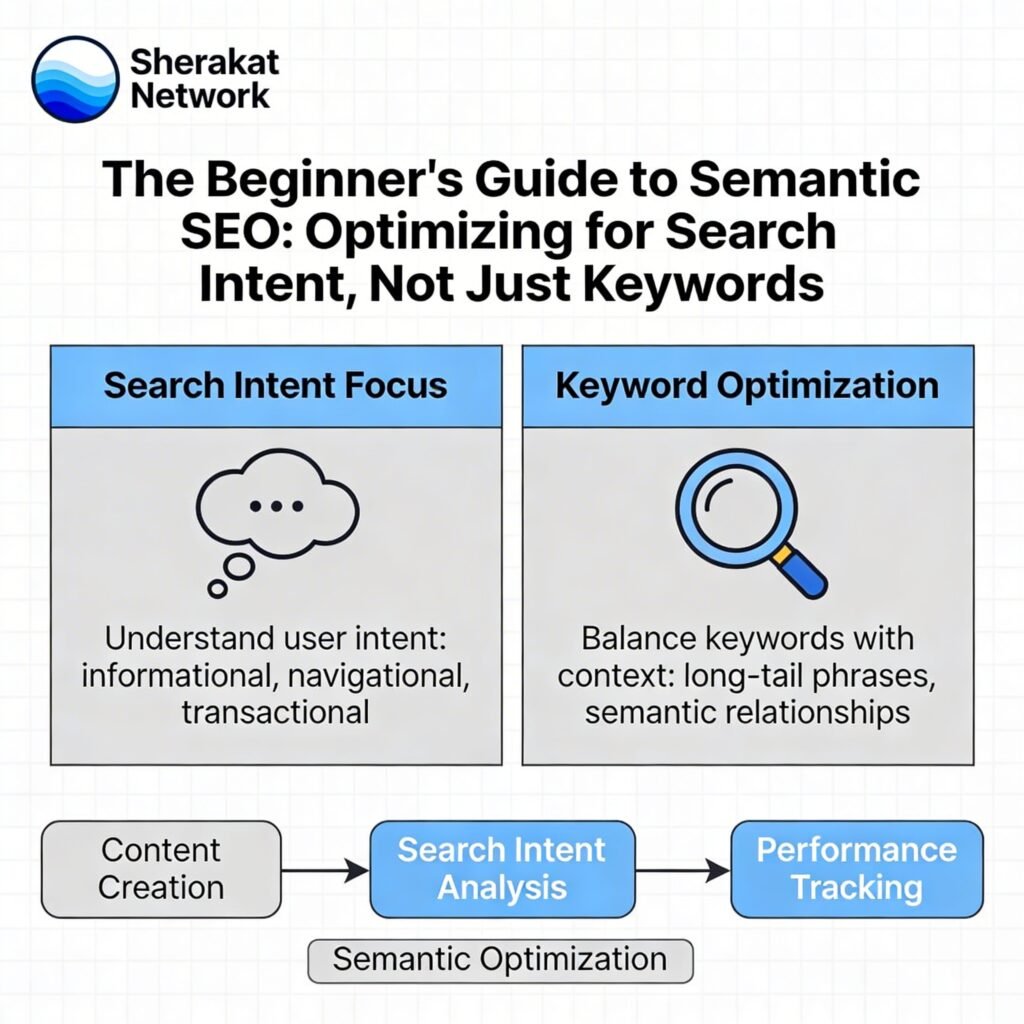
- Search Intent Mapping Template: A Google Sheets template for categorizing keywords by intent (informational, navigational, commercial, transactional) before creating content. Available in our Resources section.
- Semantic Content Outline Template: A structured template for building semantically rich content outlines, including sections for entities, PAA questions, related searches, and heading hierarchy.
- Entity Extraction Checklist: A PDF guide to identifying and optimizing for entities in your content, including how to use schema markup for different entity types.
- Semantic SEO Audit Checklist: A comprehensive checklist for evaluating your existing content’s semantic strength and identifying improvement opportunities.
For deeper insights into the cultural and societal dimensions of information sharing, explore Culture & Society.
Discussion
Now I’d love to hear from you:
- Have you ever created content that perfectly matched search intent and saw immediate ranking improvements?
- What’s the biggest challenge you face when trying to think “semantically” instead of “keyword-first”?
- Have you experimented with entity SEO or schema markup? What were your results?
Share your experiences, questions, and insights in the comments below. Semantic SEO can feel abstract at first, but real-world examples from this community can make it concrete and actionable. Let’s learn from each other.
For ongoing conversations about SEO, content strategy, and digital business, follow the Sherakat Network blog and explore our SEO category for more in-depth guides.