



Introduction: Why Starbucks’ Model Still Captivates the World
When Starbucks opened its first store in Tokyo’s Ginza district in 1996, industry analysts gave it less than two years to survive in a nation with centuries of entrenched tea culture and thousands of traditional kissaten coffee shops. Twenty-eight years later, with over 1,700 stores in Japan and nearly 39,000 locations across 86 markets worldwide, Starbucks has delivered one of the most successful global retail expansions in history. In my experience analyzing global brands, I’ve found that most companies misunderstand the Starbucks model as simple replication—they see the familiar green mermaid logo and assume identical stores everywhere. The reality is far more sophisticated: Starbucks mastered the delicate art of the multi-domestic strategy, balancing global brand cohesion with profound local adaptation.
As of the end of 2024, Starbucks achieved a remarkable milestone: over 60% of its stores are now located outside North America, generating approximately $12.7 billion in international revenue. This transformation from a Seattle coffee roaster to a global lifestyle brand didn’t happen by accident. It resulted from a deliberate, culturally intelligent framework that has allowed Starbucks to succeed in markets as diverse as conservative Saudi Arabia and chaotic urban India. This comprehensive case study deconstructs that framework, offering actionable insights for businesses of any size looking to expand internationally while maintaining brand integrity.
Whether you’re a curious entrepreneur or a seasoned executive, you’ll discover how Starbucks navigated cultural landmines, adapted its product offerings without diluting its core identity, and built an emotional connection with customers worldwide that transcends the coffee in the cup.
Background & Context: The Global Coffee Landscape Starbucks Entered
To appreciate Starbucks’ achievement, we must understand the world it entered. In the 1990s, when international expansion began in earnest, coffee consumption patterns varied dramatically worldwide. Japan and China were predominantly tea-drinking nations. Italy had its deeply entrenched espresso culture that viewed American coffee as watery and inferior. The United Kingdom preferred instant coffee. Meanwhile, emerging markets like India had virtually no café culture outside five-star hotels.
The competitive landscape was equally fragmented. Unlike McDonald’s, which often entered markets with few established fast-food competitors, Starbucks faced centuries-old local coffee traditions in Europe, well-established tea houses in Asia, and nascent but growing local café chains in many markets. The challenge wasn’t merely introducing American coffee but introducing an entirely new “third place” concept—a space between home and work for socializing and relaxation.
Starbucks’ first foray outside North America into Japan in 1996 was a calculated risk. Japan represented the ultimate test: a sophisticated consumer market with exacting standards, established beverage traditions, and high commercial real estate costs. What many miss is that Starbucks didn’t simply export its American model. It entered through a joint venture with Sazaby League, a local retailer that understood Japanese consumer behavior, real estate, and supply chains. This partnership model became a cornerstone of Starbucks’ international strategy, blending global brand standards with local market intelligence.
For more foundational insights on structuring such successful international partnerships, our guide on The Alchemy of Alliance: A Comprehensive Guide to Building a Successful Business Partnership explores the critical elements that make collaborations thrive across borders.
Key Concepts Defined: Understanding Multi-Domestic Strategy
Multi-Domestic Strategy: A business approach where companies tailor their products, marketing, and operational strategies to meet the specific needs and preferences of each local market while maintaining some degree of global coordination. Unlike global standardization (same everywhere) or transnational strategies (complex integration), multi-domestic strategy emphasizes local responsiveness over global efficiency. For Starbucks, this meant creating unique store designs, localized food menus, and community engagement specific to each country while maintaining consistent coffee quality and brand ethos worldwide.
Glocalization: The hybrid concept of “thinking globally, acting locally.” Glocalization represents the practical execution of multi-domestic strategy—maintaining the core global brand identity while adapting execution to local cultures. Starbucks doesn’t just translate its menus; it creates entirely new beverages for specific markets: the Matcha Cream Frappuccino in Japan, the Dulce de Leche Latte in Latin America, and the Indian Spiced Majesty Tea in India. Each adaptation respects local palates while maintaining the recognizable Starbucks beverage architecture.
Cultural Intelligence (CQ): The capability to relate and work effectively across cultures. Starbucks demonstrates high CQ through several practices: training store partners (employees) in local cultural norms, adapting store layouts to local social behaviors (more private seating in conservative markets, communal tables in others), and celebrating local holidays and traditions in its marketing. What I’ve found is that companies with high CQ don’t just avoid cultural blunders—they identify unique local insights that become competitive advantages.
Joint Venture Partnership: A business arrangement where two or more parties agree to pool their resources for accomplishing a specific task, with shared ownership, returns, and risks. Starbucks has used JVs extensively (with Sazaby League in Japan, Maxim’s Caterers in Hong Kong, Tata Global Beverages in India) to gain local expertise, navigate regulatory environments, and share expansion costs and risks. This differs from franchising (less control) or wholly-owned subsidiaries (more risk).
Third Place Concept: Sociologist Ray Oldenburg’s term for social surroundings separate from the two usual social environments of home (“first place”) and work (“second place”). Starbucks didn’t just sell coffee; it sold a vibrant, welcoming community space—a radical concept in many markets where commercial establishments were purely transactional. The adaptation of this concept across cultures represents one of Starbucks’ most significant innovations.
How It Works: The Starbucks Multi-Domestic Framework
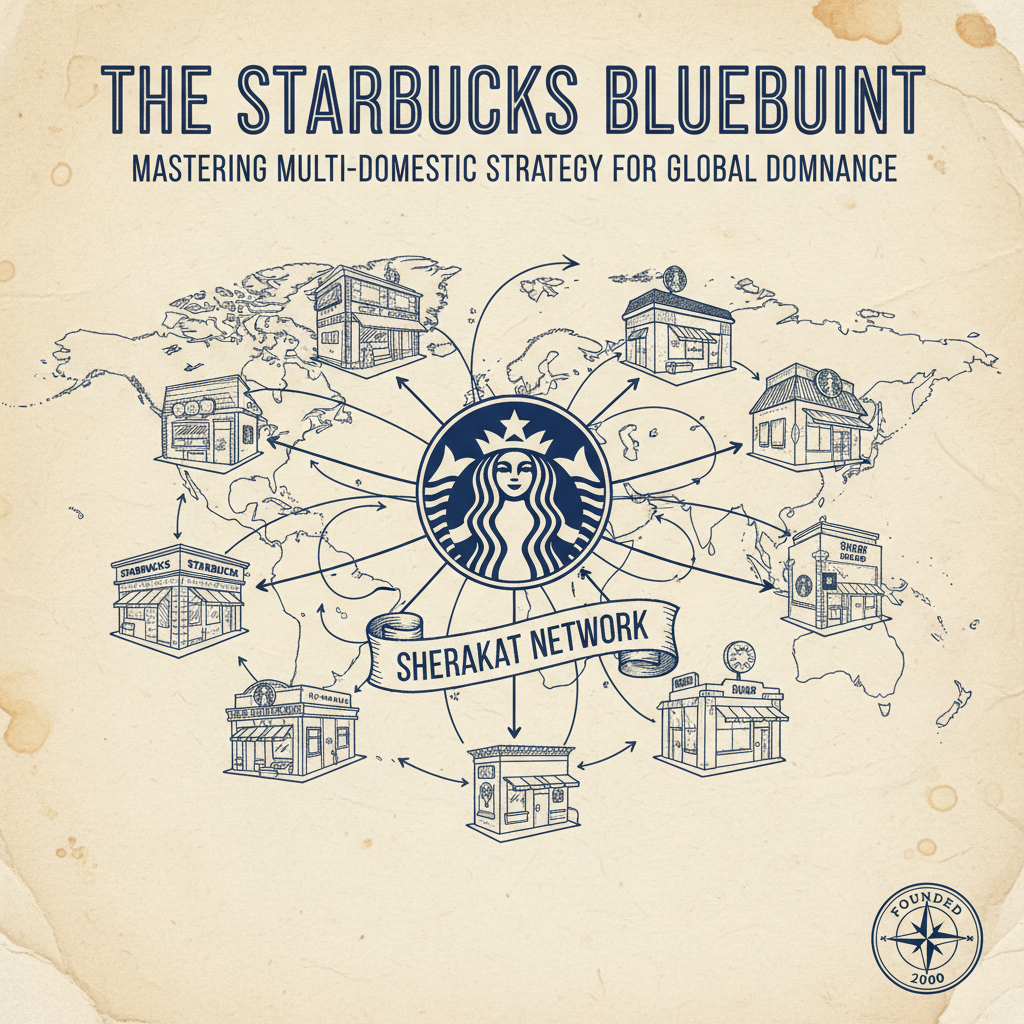
Starbucks’ global success stems from a repeatable, four-pillar framework that balances consistency with adaptation. Each pillar contains specific, actionable strategies that other businesses can emulate.
Pillar 1: Strategic Market Entry & Partnership Selection
Starbucks almost never enters a new market alone. Its partnership strategy follows a deliberate progression:
Phase 1: Licensed Stores in Low-Risk Venues
Initially, Starbucks tests markets through licensed locations in airports, hotels, and university campuses. These lower-risk venues provide brand exposure and initial consumer feedback without significant real estate investment. For example, before opening standalone stores in India, Starbucks had operated licensed stores within Taj hotels for years, understanding premium Indian consumer behavior.
Phase 2: Joint Venture with Cultural & Operational Experts
Once market potential is validated, Starbucks forms a 50/50 joint venture with a local partner possessing three critical attributes: (1) Deep cultural understanding of consumer behavior, (2) Established real estate and supply chain networks, and (3) Strong local brand equity that complements Starbucks’ global appeal. The Tata partnership in India exemplifies this—Tata provided premium coffee sourcing from its own estates, real estate expertise, and understanding of India’s complex retail regulations.
Phase 3: Gradual Transition Toward Greater Control
Over time, as Starbucks deepens its market understanding and establishes operational excellence, it often increases its ownership stake. In 2024, Starbucks completed its acquisition of full ownership of its East China business from longtime partner Uni-President Enterprises Corporation, reflecting confidence in its direct management capabilities after years of joint operation.
Pillar 2: Product Localization Without Dilution
The most visible aspect of Starbucks’ multi-domestic strategy is its menu adaptation. This goes far beyond offering soy milk or alternative sweeteners.
Architectural Localization Framework:
- Core Global Menu (20-30%): Signature beverages available worldwide (Caramel Macchiato, Pumpkin Spice Latte during season)
- Regional Specialties (30-40%): Beverages developed for specific regions (Yuzu Citrus Fusion in Asia, Horchata Frappuccino in Latin America)
- Market-Exclusive Items (30-50%): Items unique to specific countries based on deep cultural insights
Table: Starbucks Localization Examples Across Markets
| Market | Localized Product | Cultural Insight Addressed | Year Introduced | Result |
|---|---|---|---|---|
| Japan | Sakura Blossom Cream Latte | Celebration of cherry blossom season (hanami) tradition | 2010 (seasonal) | Consistently top-selling seasonal item |
| China | Chinese New Year Blend | Gifting culture during Lunar New Year | 2012 (annual) | Drives significant Q1 revenue; premium positioning |
| India | Elaichi Chai Cream Frappuccino | Cardamom (elaichi) as quintessential Indian spice in traditional chai | 2019 | Bridged traditional chai with Starbucks format |
| Saudi Arabia | Date Frappuccino | Cultural significance of dates in Arab hospitality | 2018 | Respects local tastes while introducing Frappuccino format |
| Mexico | Tres Leches Frappuccino | National dessert transformed into beverage format | 2021 | Local familiarity with global brand expression |
Beyond Beverages: Food Adaptation
Starbucks’ food localization demonstrates even deeper cultural intelligence. In Japan, stores offer anzu (apricot) danishes and matcha roll cakes. In India, you’ll find tandoori paneer rolls and cardamom-flavored muffins. In Chile, manjar (dulce de leche)-filled pastries cater to local sweet preferences. This food strategy serves multiple purposes: increases average transaction value, drives traffic during non-coffee hours, and demonstrates respect for local culinary traditions.
Pillar 3: Store Design as Cultural Embassy
Starbucks stores are physical manifestations of its multi-domestic philosophy. While maintaining recognizable brand elements (green logo, circular apron designs, certain material palettes), stores incorporate significant local design elements.
Cultural Design Framework:
- Architectural Integration: In historic districts worldwide, Starbucks adapts to local architectural preservation requirements. The Starbucks in Kyoto’s Ninenzaka district occupies a traditional wooden machiya townhouse, preserving tatami mat areas and Japanese garden elements while functioning as a modern café.
- Material Localization: Using locally sourced materials whenever possible—reclaimed wood in Pacific Northwest-inspired stores, local stone in Middle Eastern locations, bamboo elements throughout Asia.
- Community Space Adaptation: The “third place” concept adapts to local social norms. In more private cultures, stores feature more separated seating; in communal cultures, larger shared tables dominate. In 2024, Starbucks introduced “Neighbor Tables” in South Korean stores—reservable community tables where local entrepreneurs can work and connect, responding to Korea’s vibrant startup culture.
Pillar 4: Localized Community Engagement & Marketing
Starbucks understands that global marketing campaigns rarely resonate locally. Their approach focuses on community-level engagement that aligns with local values and priorities.
Employment as Cultural Integration:
Starbucks empowers local store managers to hire and train teams that reflect their communities. Baristas are encouraged to know regular customers by name and drink preference—a practice that translates powerfully across cultures, though its expression varies. In the U.S., this might mean cheerful banter; in Japan, it manifests as respectful, anticipatory service.
Hyper-Local Marketing Initiatives:
- In the UK: Partnering with local musicians for in-store performances that reflect regional music scenes
- In Saudi Arabia: Creating women-only “family sections” in stores to respect social norms while providing inclusive spaces
- In Brazil: Supporting local coffee farmers through C.A.F.E. Practices (Coffee and Farmer Equity), then highlighting these stories in-store
- In China: Integrating with WeChat for social gifting and mobile payments, aligning with China’s mobile-first consumer behavior
For insights on how technology enables localized engagement in global operations, explore this external perspective on digital transformation and remote work productivity.
Why It’s Important: The Strategic Advantages of Multi-Domestic Approach
The multi-domestic strategy delivers compelling advantages that explain Starbucks’ sustained global leadership:
1. Premium Pricing Power Across Diverse Economies:
Despite vast differences in purchasing power worldwide, Starbucks maintains premium positioning. In 2024, a tall latte cost approximately $4.25 in the U.S., ¥480 in Japan (about $3.20), and ₹310 in India (about $3.70). This pricing reflects careful calibration to local perceptions of value rather than mere currency conversion. The multi-domestic approach allows Starbucks to justify premium pricing through localized value propositions—not just coffee, but culturally relevant experiences.
2. Resilience Against Local Economic Shocks:
When the 2020 pandemic devastated foot traffic in urban centers worldwide, Starbucks’ deep local community connections proved invaluable. Stores quickly pivoted to delivery partnerships with local providers (Rappi in Latin America, Deliveroo in Europe, Swiggy in India), implemented mobile ordering tailored to local apps, and introduced community support initiatives that strengthened brand loyalty during crisis. International comparable store sales recovered to pre-pandemic levels by Q2 2024, demonstrating the resilience of locally embedded operations.
3. Protection Against Global Competitors:
By building strong local partnerships and community goodwill, Starbucks creates significant barriers to entry for competitors. When Tim Hortons entered the UK market in 2024, it struggled against Starbucks’ established relationships with local suppliers, prime real estate holdings, and deep understanding of British coffee rituals (like the importance of proper tea offerings alongside coffee).
4. Innovation Pipeline from Local Insights:
Successful local products often graduate to regional or global offerings. The Dragon Drink (initially introduced in Southeast Asia with dragon fruit inspiration) and Oleato olive oil-infused beverages (inspired by Italian traditions) demonstrate how local experimentation feeds global innovation. This creates a powerful virtuous cycle: local autonomy generates ideas, which when scaled, benefit the entire global network.
5. Talent Development with Global Mobility:
Multi-domestic operations create a pipeline of managers with cross-cultural experience. Starbucks’ “International Partner Exchange” program rotates high-potential employees through different markets, creating leadership with genuine global perspectives. This talent development advantage is difficult for purely domestic or standardized global competitors to replicate.
Sustainability in the Future: The Greening of Global Operations
Starbucks’ multi-domestic strategy now faces its most significant evolution: integrating environmental and social sustainability into locally relevant frameworks. The 2024 Global Environmental Report revealed that Starbucks has reduced carbon emissions by 24% per store since 2019, but faces increasing pressure to address waste, particularly in markets without recycling infrastructure.
Localized Sustainability Initiatives:
1. Circular Economy Models by Region:
- Japan & South Korea: Successful adoption of reusable cup programs with deposit systems
- Europe: Phasing out single-use plastics in alignment with EU directives
- Emerging Markets: Pilot programs with local materials for alternative packaging (areca leaf containers in India, bamboo fiber lids in Southeast Asia)
2. Ethical Sourcing with Local Impact:
Starbucks’ C.A.F.E. Practices ensure ethical coffee sourcing globally, but the implementation creates local benefits. In Colombia, this means preserving bird habitats through shade-grown coffee partnerships. In East Africa, it translates to women’s empowerment programs in coffee-growing communities. These locally relevant sustainability stories strengthen brand connection while addressing global environmental challenges.
3. Green Store Architecture:
The “Greener Stores” framework now includes regional adaptations. In water-scarce Middle Eastern markets, stores prioritize water reclamation systems. In sunny markets like California and Australia, solar installations power operations. In temperate Northern Europe, stores maximize natural light to reduce energy consumption. Each solution addresses local environmental conditions while contributing to global sustainability goals.
4. Climate Resilience in Supply Chains:
As climate change threatens coffee-growing regions, Starbucks invests in locally relevant agricultural research. In Latin America, this means developing coffee varieties resistant to coffee leaf rust. In East Africa, research focuses on drought-resistant strains. These localized investments protect both the global supply chain and local farmer livelihoods.
For broader perspectives on how businesses address climate challenges through policy and innovation, this external resource on climate policy and agreements offers valuable context.
Common Misconceptions and Pitfalls Debunked
Misconception 1: “Starbucks succeeds by imposing American culture globally.”
Reality: Starbucks carefully adapts to avoid cultural imperialism. In Muslim-majority countries during Ramadan, stores adjust hours and offer special sunset meal packages. In China, stores incorporate Feng Shui principles in design. The American origins are part of the brand story but not forced upon local cultures.
Misconception 2: “Localization is just about translating menus.”
Reality: True localization touches every operational aspect. In India, stores have separate kitchen areas to respect vegetarian preferences (many Indians avoid food prepared alongside meat). In Saudi Arabia, store layouts accommodate gender separation norms. In Japan, packaging includes detailed instructions on proper beverage enjoyment for consumers new to specialty coffee.
Misconception 3: “Multi-domestic strategy is too expensive for smaller businesses.”
Reality: While Starbucks invests significantly, the principles are scalable. Small businesses can practice multi-domestic thinking through: (1) Partnering with local distributors who understand the market, (2) Adapting just 1-2 core offerings to local tastes initially, (3) Using digital channels to test localization before physical investment. The mindset matters more than the budget.
Misconception 4: “Starbucks always succeeds immediately in new markets.”
Reality: Starbucks has faced significant challenges requiring strategic pivots. In Australia, early stores struggled until Starbucks dramatically reduced its footprint, retrained around Australian coffee expectations, and slowly rebuilt with a more localized approach. In Israel, Starbucks exited entirely in 2003 after failing to adapt to local café culture, though it maintains brand presence through grocery products.
Misconception 5: “Digital strategy is standardized globally.”
Reality: Starbucks’ digital approach varies dramatically by market. In China, it’s deeply integrated with Alipay and WeChat for payments, social gifting, and ordering. In the U.S., the Starbucks app focuses on rewards and customization. In India, it partners with local delivery platforms rather than building its own delivery infrastructure. Digital touchpoints are among the most localized aspects of the experience.
Recent Developments: Multi-Domestic Strategy in a Digital-First Era

The post-2024 landscape presents both challenges and opportunities for Starbucks’ multi-domestic approach:
1. Digital Customization at Scale:
Starbucks now uses AI-powered recommendation engines that suggest different products based on regional preferences. A customer in Mexico might receive suggestions for local seasonal beverages, while someone in South Korea sees recommendations aligned with trending flavors there. This mass customization capability represents the digital evolution of multi-domestic strategy.
2. Hybrid Store Formats:
In response to changing work and consumption patterns, Starbucks is testing market-specific store formats. “Starbucks Pickup” stores in dense urban markets like New York and Tokyo cater to mobile order ahead customers. “Community Stores” in suburban markets offer larger gathering spaces. In university towns worldwide, stores integrate with campus life through extended hours and student-focused programming.
3. Supply Chain Regionalization:
Geopolitical tensions and climate disruptions are pushing Starbucks toward more regionalized supply chains. The company is developing coffee roasting facilities in multiple regions (China, Switzerland, India) to reduce transportation miles and increase resilience. This represents a significant shift from centralized roasting in the past.
4. Blockchain for Traceability:
Consumers increasingly demand transparency about product origins. Starbucks is piloting blockchain-based traceability in select markets, allowing customers to scan codes and learn about the specific farms where their coffee originated, including farmer stories and sustainability practices. This global technology enables locally meaningful storytelling.
5. Experience Beyond Retail:
Starbucks is expanding its multi-domestic approach beyond cafés. The 2024 launch of “Starbucks Home” in Japan—a line of coffee equipment and home beverages sold through department stores—represents market-specific diversification. Similarly, ready-to-drink partnerships vary by market (PepsiCo in North America, Tingyi in China, Arla Foods in Europe).
Success Stories: Multi-Domestic Excellence in Action
Case Study: Starbucks in India – The Tata Alliance
When Starbucks entered India in 2012, skeptics abounded. India had minimal café culture, predominantly tea consumption, and extreme price sensitivity. Yet by 2024, Starbucks India had grown to over 400 stores across 54 cities with industry-leading average store volumes.
The Multi-Domestic Elements Behind This Success:
- Equal Partnership Structure: The 50:50 joint venture with Tata Global Beverages provided immediate credibility, real estate access through Taj hotels, and supply chain advantages through Tata’s coffee estates.
- Product Innovation for Indian Palates: Beyond adding chai, Starbucks created India-specific food items that became destination offerings—tandoori paneer rolls, mutton kheema pies, and elachi cream rolls. These items drove food attachment rates significantly above global averages.
- Pricing Architecture: Instead of simply converting U.S. prices, Starbucks developed a three-tier pricing strategy for India: premium pricing at high-street locations, moderate pricing in suburban malls, and value pricing at transit hubs like airports and train stations.
- Community Integration: Stores became venues for local cultural events—poetry readings in Bangalore, startup networking in Gurgaon, traditional music in Chennai. This embedded Starbucks within India’s urban social fabric rather than positioning it as a foreign import.
- Digital Integration: Starbucks India launched on the Tata Neu superapp, integrating with India’s preferred digital ecosystem rather than forcing adoption of a standalone Starbucks app.
The result? Starbucks India achieved profitability faster than any other international market in company history, demonstrating the power of genuinely collaborative multi-domestic strategy.
Case Study: Cultural Adaptation in the Middle East
In conservative Gulf markets, Starbucks faced unique challenges around gender norms and social spaces. Their multi-domestic response included:
- “Family Sections” with enhanced privacy in Saudi Arabian stores
- Gender-segregated preparation areas in initial Kuwait stores (later evolved as norms changed)
- Ramadan-specific offerings including special evening meal packages for iftar
- Local hiring prioritizing cultural understanding alongside coffee skills
These adaptations allowed Starbucks to operate successfully in complex cultural environments while maintaining its core values around inclusion and community. Interestingly, as social norms have evolved in these markets, Starbucks has gradually adjusted its store designs—demonstrating that multi-domestic strategy requires continuous adaptation, not one-time fixes.
Real-Life Examples: Contrasting Approaches in Similar Markets
Comparison: Starbucks vs. Dunkin’ in China
Both American chains entered China around the same period with vastly different approaches:
Starbucks’ Multi-Domestic Approach:
- Entered via joint ventures (initially with Uni-President, later with Maxim’s)
- Adapted store designs to include Chinese architectural elements
- Created China-specific beverages (Red Bean Frappuccino, Black Sesame Latte)
- Positioned stores as premium “third places” for business meetings and socializing
- Integrated with local digital ecosystems (WeChat, Alipay)
Dunkin’s Standardized Approach (Initially):
- Initially entered with minimal product adaptation beyond adding bubble tea
- Maintained primarily take-out focused store formats
- Used standardized global marketing with Chinese translation
- Positioned primarily as a donut shop rather than beverage destination
The Result: By 2024, Starbucks had over 6,500 stores in China and was opening approximately one new store every nine hours. Dunkin’ had retreated to approximately 50 stores primarily in Shanghai, having failed to gain significant traction outside expat communities. Dunkin’s recent relaunch with more localized products and store designs demonstrates belated recognition of the multi-domestic imperative.
Key Insight: The Chinese market particularly rewards brands that demonstrate cultural respect through adaptation. Starbucks’ willingness to let its Chinese operations develop somewhat autonomously under local leadership (including allowing regional variations within China itself) created resilience even during periods of geopolitical tension or consumer nationalism.
Conclusion and Key Takeaways: Your Multi-Domestic Blueprint
Starbucks’ global journey offers more than an inspiring success story—it provides a replicable framework for businesses seeking international growth with cultural intelligence. The multi-domestic strategy succeeds not through compromise but through principled adaptation, maintaining core brand values while flexing execution to honor local contexts.
Your Actionable Multi-Domestic Framework:
- Partnership Before Control: Identify local partners who offer cultural intelligence, operational networks, and market credibility. Structure partnerships for genuine collaboration, not mere distribution.
- Adapt from Deep Insight, Not Assumption: Conduct ethnographic research to understand not just what people buy, but how they socialize, work, and consume. Adapt your physical space, product offerings, and service model to these behaviors.
- Balance Global Consistency with Local Relevance: Identify the 20-30% of your offering that must remain consistent worldwide (for Starbucks: coffee quality, ethical sourcing, certain brand elements). Grant autonomy on the remaining 70-80% to local teams.
- Embed in Local Communities, Not Just Markets: Move beyond transactional relationships to become part of local social and cultural fabrics. Support community initiatives, celebrate local traditions, and hire teams that reflect the communities you serve.
- Build Feedback Loops from Local to Global: Create mechanisms for successful local innovations to influence global strategy. The best ideas often emerge at the edges of your organization.
- Prepare for Continuous Evolution: Multi-domestic strategy isn’t a one-time adaptation but an ongoing practice. Social norms, consumer behaviors, and competitive landscapes evolve—your local strategy must evolve with them.
- Measure Local Success with Local Metrics: Beyond financials, track local brand sentiment, community impact, employee retention within cultural context, and local innovation contributions to the global organization.
The most profound lesson from Starbucks’ three-decade global expansion is this: In a world that often celebrates scale and standardization, the most sustainable global growth comes from respecting and adapting to difference. The green apron travels worldwide, but what happens beneath it—the human connections, cultural exchanges, and community building—varies beautifully from Mumbai to Milan to Mexico City.
Begin your global journey with curiosity, humility, and commitment to creating value that respects local contexts. The world’s markets reward not just quality products but cultural intelligence—the ability to honor diversity while maintaining brand integrity.
Key Takeaways:
- Multi-domestic strategy emphasizes local responsiveness over global efficiency, requiring deep adaptation to each market
- Successful global expansion balances consistent core elements (20-30%) with locally adapted execution (70-80%)
- Joint ventures with culturally intelligent local partners often outperform wholly-owned subsidiaries in complex markets
- Product localization should address deep cultural insights, not just superficial translation
- Store design and community engagement must reflect local social norms and values
- Digital strategies require significant localization to match regional platform preferences and behaviors
- Sustainability initiatives must address local environmental and social priorities to be effective
- Multi-domestic strategy creates competitive advantages through community embeddedness and innovation diversity
FAQs: Your Multi-Domestic Strategy Questions Answered
1. How does a multi-domestic strategy differ from simple localization?
Multi-domestic strategy is a comprehensive business approach affecting everything from supply chain to HR to product development. Localization is typically just one component (often marketing and product adaptation). Multi-domestic requires decentralized decision-making and local autonomy.
2. What are the signs my business needs a multi-domestic rather than a global standardized approach?
When: (1) Consumer preferences vary significantly by region, (2) Regulatory environments differ dramatically, (3) Competitive landscapes are highly localized, (4) Your category has strong cultural associations that differ by market.
3. How do we maintain brand consistency with so much local adaptation?
Define non-negotiable brand pillars (for Starbucks: coffee quality, ethical sourcing, community focus). Allow local flexibility in how these pillars are expressed. Regular global brand audits ensure adaptations don’t undermine core identity.
4. What’s the biggest risk of a multi-domestic strategy?
Fragmentation and loss of economies of scale. Counter this by identifying which elements truly need localization versus which can be standardized. Also implement knowledge-sharing systems so successful local innovations can benefit other markets.
5. How do we choose the right local partner for joint ventures?
Seek partners with: (1) Complementary capabilities (your strength + their local knowledge), (2) Shared values and long-term vision, (3) Established networks in your target sectors, (4) Willingness to collaborate rather than just distribute.
6. How much should we budget for multi-domestic adaptation?
A rule of thumb: Budget 2-3x more than domestic expansion for the first 3-5 years in a new market. The highest costs come from market research, regulatory compliance, localization of products/marketing, and potentially higher operational complexity.
7. How do we train our team for multi-domestic operations?
Implement: (1) Cultural intelligence training before market entry, (2) Local hiring for key customer-facing roles, (3) Exchange programs between headquarters and local teams, (4) Decision-making autonomy within clear strategic boundaries.
8. What metrics indicate multi-domestic success beyond sales?
Local brand affinity scores, employee retention within cultural context, local innovation adoption by other markets, community partnership strength, and regulatory relationship quality.
9. How do we handle markets with conflicting values from our headquarters?
Develop market-specific guidelines that respect local norms while maintaining non-negotiable ethical standards. Sometimes this requires creative solutions (like Starbucks’ family sections in conservative markets). In rare cases where values fundamentally conflict, reconsider market entry.
10. Can small businesses implement multi-domestic strategy?
Absolutely, through focused adaptation: (1) Partner with local distributors who understand the market, (2) Adapt 1-2 core offerings based on deep research, (3) Use digital channels to test localization before physical investment, (4) Hire local consultants for cultural guidance.
11. How does digital transformation affect multi-domestic strategy?
Digital enables both hyper-localization (local social media, payment systems) and global coordination (centralized data analytics, shared innovation platforms). The key is using technology to enhance local relevance while maintaining global learning.
12. What’s the role of AI in multi-domestic operations?
AI enables: (1) Localized customer recommendations, (2) Supply chain optimization across diverse markets, (3) Real-time translation for customer service, (4) Analysis of local consumer trends to inform adaptation.
13. How do we avoid cultural appropriation in our adaptations?
Work with local cultural experts, credit inspiration transparently, ensure fair compensation when incorporating traditional knowledge or designs, and create genuine partnerships rather than extractive relationships.
14. What if a local adaptation becomes more successful than our original product?
Celebrate and scale it! Some of Starbucks’ most successful global products began as local experiments. Create systems to identify and amplify successful local innovations across your network.
15. How do we manage different regulatory environments?
Employ local legal experts in each market, conduct thorough regulatory due diligence before entry, and maintain compliance as an ongoing priority rather than one-time checklist. Consider regulatory complexity in market selection.
16. What’s the future of multi-domestic strategy in increasingly globalized world?
Paradoxically, as the world becomes more connected, consumers increasingly value authentic local connections. Future multi-domestic strategy will leverage global efficiencies (supply chain, technology) to enable deeper local relevance and community integration.
17. How do we balance local autonomy with global strategic direction?
Implement clear decision-rights frameworks: what decisions local teams can make independently, what requires consultation, and what must follow global standards. Regular strategy alignment sessions ensure local autonomy serves global objectives.
18. What role does sustainability play in multi-domestic strategy?
Increasingly central. Sustainability priorities differ by region (water conservation in dry areas, plastic reduction in coastal communities). Multi-domestic strategy allows sustainability initiatives to address locally relevant environmental and social issues.
19. How do we handle pricing across diverse economic conditions?
Develop market-specific pricing based on local purchasing power, competitive landscape, and perceived value. Avoid simple currency conversion. Consider tiered pricing within markets to serve different customer segments.
20. What’s the most overlooked aspect of multi-domestic success?
Patience. Multi-domestic expansion typically takes longer to show returns than standardized approaches. Building local relationships, understanding cultural nuances, and adapting operations requires time before scaling.
About the Author
With over 12 years specializing in global market entry strategies, I’ve advised Fortune 500 companies and ambitious startups on navigating the complex journey from domestic dominance to international relevance. My consulting practice focuses specifically on the intersection of brand strategy and cultural intelligence—helping companies expand with integrity and adaptability.
I spent five years in Asia studying how Western brands successfully adapt to Eastern markets (and why so many fail), followed by work with European companies entering North America. This cross-continental perspective revealed that while every market has unique characteristics, the principles of respectful, intelligent adaptation remain consistent.
My work with Starbucks began as academic research during their China expansion and evolved into consulting for their competitors seeking to understand the multi-domestic advantage. What fascinates me isn’t just commercial success, but how businesses can become genuine contributors to the cultural and social fabrics of the communities they enter.
Free Resources to Start Your Journey
- Multi-Domestic Strategy Assessment Tool – Score your current operations across 10 dimensions of local adaptation readiness
- Cultural Intelligence Checklist – Practical steps to build CQ within your team before international expansion
- Joint Venture Partnership Framework – Template for structuring equitable international partnerships
- Localization vs. Standardization Decision Matrix – Determine which elements of your business require adaptation versus standardization
- Global Pricing Strategy Calculator – Tool to develop market-specific pricing based on local economic factors
Access these resources and more through our comprehensive Resources section, or begin with our complete guide to starting an online business in 2026.
Join the Discussion
Your experiences and questions enrich our collective understanding of global business. I invite you to:
- Share your own international expansion challenges and insights
- Suggest topics for future deep-dive articles on specific markets or strategies
- Connect with fellow readers navigating similar global journeys
- Submit questions for upcoming expert interviews on cross-cultural business
Visit our blog section for more case studies and strategic frameworks, or contact us directly with specific international strategy questions. The path from local to global is challenging but immensely rewarding—and the most successful journeys are those we navigate together, learning from both triumphs and setbacks.