


Introduction – Why This Matters
In my experience, there comes a moment in every SEO learner’s journey when they realize that rankings aren’t just about keywords and links. They’ve mastered keyword research, perfected their on-page optimization, tackled technical SEO, and even started building backlinks. Yet something still feels missing. Their site is technically perfect, but it lacks something intangible—something that separates trusted authorities from the rest of the web.
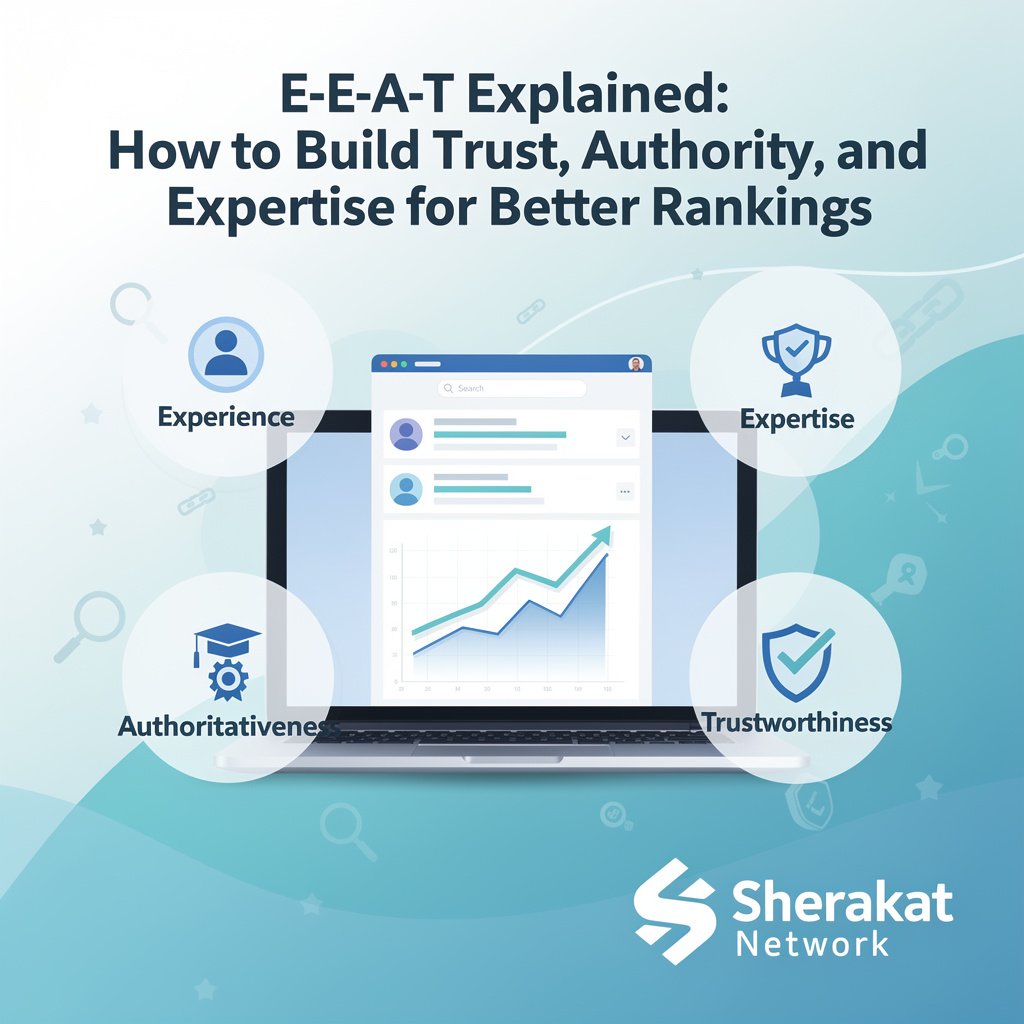
What I’ve found is that this missing element is trust. And in 2026, trust isn’t just a nice-to-have; it’s the foundation of Google’s entire quality evaluation system. It’s called E-E-A-T: Experience, Expertise, Authoritativeness, and Trustworthiness.
Here’s the reality: Google processes billions of searches every day. Its algorithms are remarkably sophisticated, but they can’t truly feel trust. Instead, they look for signals—clues in your content, your website structure, and your online reputation—that indicate whether your site deserves to be considered a trusted source. For certain topics, especially those that can impact a person’s health, finances, or safety (called YMYL or “Your Money or Your Life” topics), having strong E-E-A-T signals isn’t just important—it’s essential for ranking at all.
Think of E-E-A-T as the personality of your website. Your SEO fundamentals are the skeleton. Your keyword research and on-page optimization are the muscles. Your technical SEO is the nervous system. Your backlinks are the reputation. But E-E-A-T is the character, the integrity, the reason people—and search engines—choose to trust you over someone else.
In this guide, we’re going to demystify E-E-A-T. We’ll break down exactly what each letter means, why it matters more than ever in 2026, and most importantly, how you, as a beginner, can build these qualities into your website from day one.
Background / Context
To understand E-E-A-T, we need to look at its origins. The concept first appeared in Google’s Search Quality Rater Guidelines—a massive, publicly available document used by human quality raters around the world to evaluate the quality of search results. These raters don’t directly affect rankings, but their feedback helps Google train its algorithms to better understand what humans consider “high quality.”
Originally, it was just E-A-T: Expertise, Authoritativeness, and Trustworthiness. Then, in late 2022, Google added an extra E for Experience. This seemingly small change was hugely significant. It meant Google wanted to see not just book knowledge, but real, first-hand experience. Does a product reviewer actually own and use the product? Does a travel blogger write from personal visits, or just from reading other blogs? Does a recipe developer actually cook?
This shift reflects the evolution of search itself. In the early days, any content with the right keywords could rank. Then, algorithms got smart enough to assess expertise through factors like backlinks and content depth. Now, in the age of AI-generated content flooding the web, experience has become the ultimate differentiator. Anyone can generate a generic “How to tie a tie” article with AI. But only someone with real experience can describe the specific feel of the fabric, the common mistakes beginners make, and the little tricks that make it easier.
E-E-A-T is not a direct ranking factor, like Core Web Vitals or having keywords in your title tag. You can’t install an E-E-A-T plugin and watch your rankings soar. Instead, it’s a framework—a set of principles that guide Google’s understanding of quality. Your job as a website owner is to create content and build a site that, when evaluated against this framework, would be considered high quality by a human rater.
Key Concepts Defined
Before we dive into the how-to, let’s establish a clear understanding of each component of E-E-A-T.
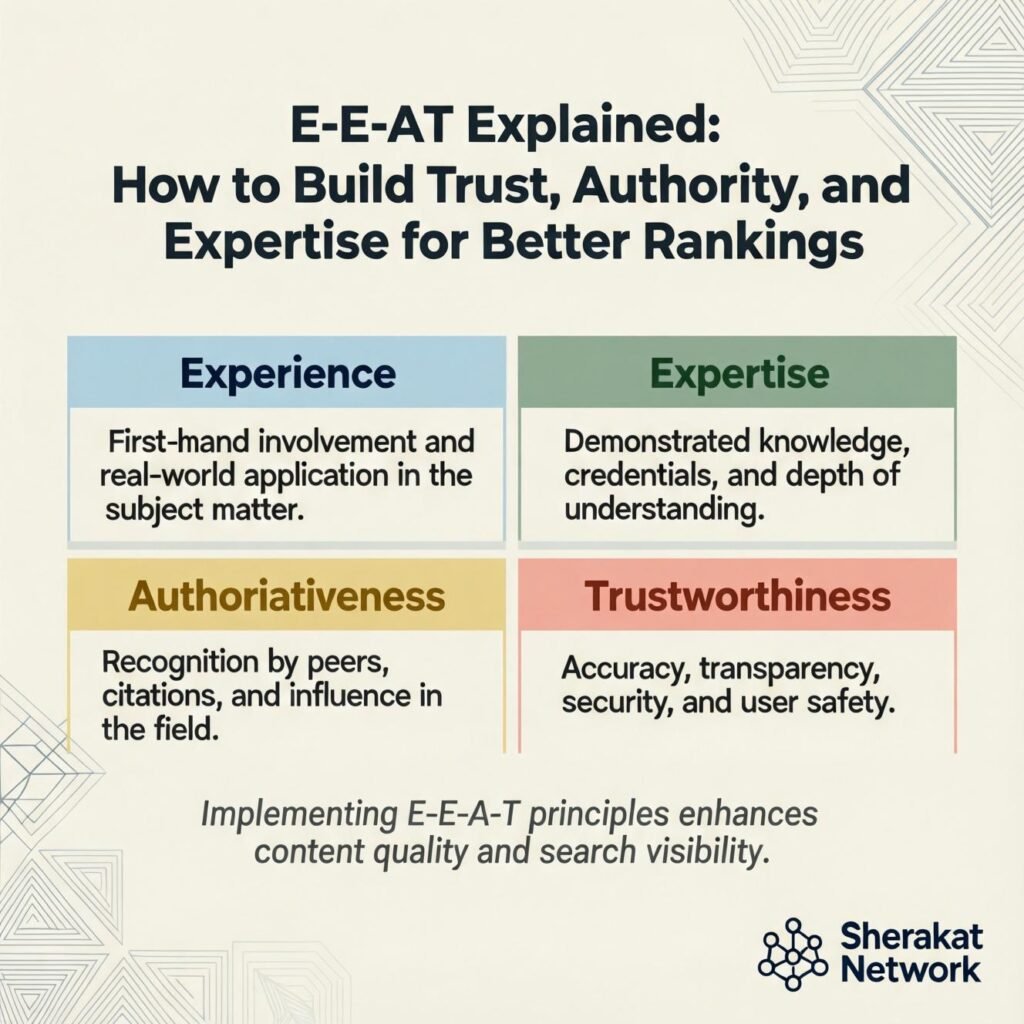
- Experience: Does the content creator have first-hand or life experience with the topic? This is about “having been there” or “having done it yourself.” Examples: A product review from someone who actually used the product, a travel guide from someone who visited the location, a recipe from someone who cooked the dish.
- Expertise: Does the content creator possess the necessary knowledge or skills for the topic? This is about formal or deep knowledge. Examples: Medical advice from a doctor, financial advice from a certified planner, legal analysis from a lawyer, or a detailed tutorial from someone with deep technical knowledge.
- Authoritativeness: Is the content creator, the website, and the content itself considered a go-to source in its field? This is about reputation. Signals include how many other reputable sites link to you, mentions in industry publications, and recognition from peers.
- Trustworthiness: Is the website accurate, honest, safe, and reliable? This is the most important part of the equation. If a page is not trustworthy, it doesn’t matter how much experience or expertise it has. Trust signals include clear information about who runs the site, transparent contact details, secure connections (HTTPS), accurate information, and an honest representation of products or services.
- YMYL (Your Money or Your Life): This is a category of topics that can significantly impact a person’s health, financial stability, or safety. Examples include: medical advice, financial planning, legal information, news about current events, and information about major life decisions (like buying a house or choosing a school). Google holds YMYL content to a much higher E-E-A-T standard.
- Search Quality Rater Guidelines: The publicly available document that Google provides to its team of human quality raters. It’s over 170 pages long and contains detailed instructions on how to evaluate the quality of search results. Reading it (or summaries of it) is one of the best ways to understand what Google considers “high quality.”
How It Works (Step-by-Step Breakdown)
E-E-A-T isn’t something you implement with a single action. It’s built through a combination of content choices, site features, and ongoing reputation management. Here’s a step-by-step breakdown of how to build E-E-A-T into your website.
Step 1: Identify Your YMYL Status
The first step is understanding how strictly your content will be evaluated. Ask yourself: Does my website cover topics that could impact someone’s health, finances, or safety?
- High YMYL: Medical sites, financial advice sites, legal sites, news sites, sites about major life decisions (parenting, education, housing).
- Moderate YMYL: Sites that give advice on hobbies, fitness, career development, or relationships.
- Low YMYL: Personal blogs about non-sensitive topics, entertainment sites, humor sites.
If you fall into the High YMYL category, you must take E-E-A-T extremely seriously. Your content creators need verifiable credentials. Your information must be accurate, current, and cited. Your “About Us” page needs to be transparent and detailed.
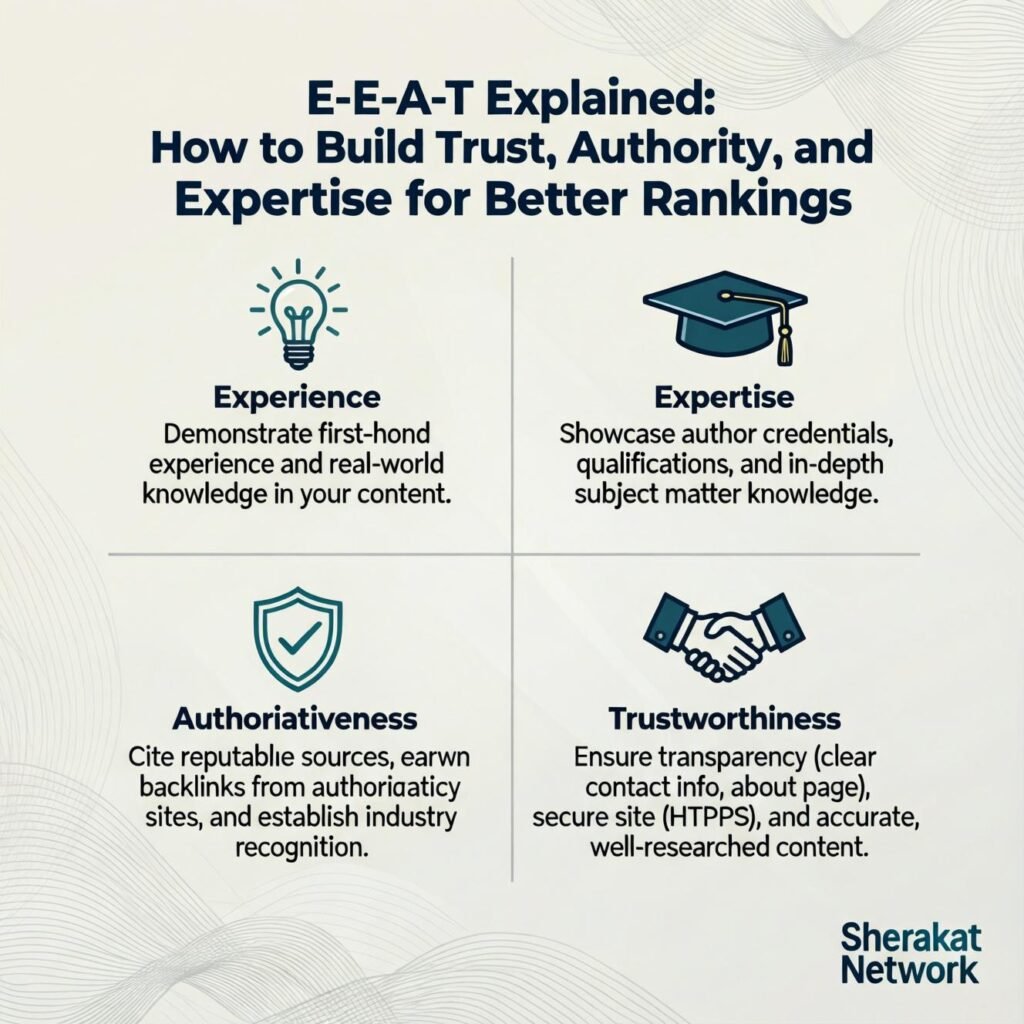
Step 2: Demonstrate Experience
This is the “new” E, and it’s your best defense against the wave of generic AI content. You need to prove that you have first-hand experience with your topic.
How to demonstrate experience:
- Use original photos and videos: Don’t rely on stock photos. If you’re reviewing a product, take your own photos. If you’re writing a travel guide, include your own pictures. If you’re sharing a recipe, show the finished dish.
- Share personal stories and anecdotes: Weave your personal experiences into your content. “When I first tried this yoga pose, I made the mistake of…” or “I tested these five running shoes over the course of a month, and here’s what I found.”
- Include specific, sensory details: Generic content is vague. Experienced content is specific. Instead of “this hotel is nice,” write “the lobby smelled of fresh lavender, and the front desk clerk remembered my name from the booking.”
- Mention timeframes and contexts: “I’ve been using this software for three years” or “I visited Barcelona during the off-season” adds credibility.
- Use “I” and “we”: First-person writing naturally signals that a human with experience is behind the content. (This is why our guides use phrases like “In my experience…”)
Step 3: Establish Expertise
For many topics, you need to demonstrate that you know what you’re talking about. The level of required expertise depends on your topic and YMYL status.
How to establish expertise:
- Create detailed author bios: Every piece of content should have a clear author. The author bio should include relevant credentials, experience, and links to their other work or professional profiles. For YMYL topics, this might mean listing medical degrees, financial certifications, or years of professional experience.
- Cite reputable sources: Link to authoritative sources (.edu, .gov, established industry publications) to back up your claims. This shows you’ve done your research and aren’t just making things up.
- Cover topics comprehensively: Expertise is shown through depth. A superficial 300-word article on a complex topic suggests a lack of expertise. A 2,000-word guide that covers nuances, edge cases, and common questions demonstrates deep knowledge.
- Keep content updated: Outdated information is a sign of neglected expertise. Regularly review and refresh your content, especially for topics that change quickly (like technology or health guidelines).
- Use technical language appropriately: For expert audiences, using correct terminology signals expertise. But always balance this with clarity for beginners. The key is using language accurately, not showing off.
Step 4: Build Authoritativeness
Authority is about your reputation. It’s what others say about you. This is where your link-building efforts from our previous guide come into play, but it’s broader than just links.
How to build authoritativeness:
- Earn backlinks from reputable sites in your niche: When established industry sites link to your content, they’re vouching for your authority. Focus on earning links from sites that are themselves authoritative.
- Get mentioned in industry publications: This could be through digital PR, guest posting on respected sites, or being quoted as an expert (using HARO, for example).
- Build a presence on authoritative platforms: Having a complete, verified profile on platforms like LinkedIn, Google Business Profile, and relevant industry directories adds to your overall authority footprint.
- Engage with your professional community: Comment on other authoritative blogs, participate in industry forums, speak at conferences (virtual or in-person). Being an active community member builds recognition.
- Showcase recognition and achievements: If you’ve won awards, been featured in publications, or have impressive client lists, feature these prominently on your site.
Step 5: Demonstrate Trustworthiness
Trustworthiness is the most important E-E-A-T component. Without trust, experience, expertise, and authority are meaningless.
How to demonstrate trustworthiness:
- Be transparent about who you are: Have a detailed “About Us” page that clearly explains who runs the site, what your mission is, and how you make money. Don’t hide behind anonymity.
- Provide clear contact information: Include a physical address, email address, and preferably a phone number. This shows you’re a real entity that can be held accountable.
- Use HTTPS: This is the bare minimum. A secure connection is essential for user trust.
- Be honest about affiliate relationships: If you earn commissions from links, disclose this clearly and prominently. Transparency builds trust, while hiding it destroys trust.
- Publish accurate, fact-checked information: This seems obvious, but it’s critical. Double-check your facts, correct errors promptly and visibly, and never intentionally mislead readers.
- Showcase genuine reviews and testimonials: Real reviews from real customers (both positive and negative, handled gracefully) build trust. Avoid fake reviews at all costs.
- Have a clear privacy policy and terms of service: These legal pages show you take your users’ data and your business seriously.
- Respond to comments and feedback: Engaging with your audience, answering questions, and addressing concerns shows you care about your readers.
Step 6: Create a Positive Overall User Experience
While not a direct part of E-E-A-T, user experience is deeply connected. A site that is confusing, slow, or full of intrusive ads undermines trust, no matter how good the content is.
- Ensure your site is easy to navigate: Clear menus, logical structure, and internal links help users (and search engines) find what they need.
- Avoid intrusive interstitials and pop-ups: Too many aggressive ads frustrate users and signal low quality.
- Make your site mobile-friendly: With mobile-first indexing, a poor mobile experience is a major trust deficit.
- Prioritize page speed: A slow site suggests poor maintenance and disrespect for the user’s time.
Why It’s Important
You might be thinking: “This seems like a lot of work. Do I really need to worry about all this?” The answer depends on your goals, but for most website owners, the answer is yes.
- It’s the Framework Google Uses: E-E-A-T isn’t a ranking factor you can measure, but it’s the lens through which Google’s algorithms and quality raters evaluate your content. If your site scores poorly on E-E-A-T, you’ll struggle to rank for competitive terms, especially YMYL topics.
- It Differentiates You from AI Content: As AI-generated content becomes more common, the ability to demonstrate genuine human experience and expertise becomes your greatest competitive advantage. Machines can generate words; they can’t generate lived experience.
- It Builds User Trust and Loyalty: E-E-A-T isn’t just about Google. It’s about your readers. A site that demonstrates experience, expertise, authority, and trustworthiness is a site that users will bookmark, share, and return to. This user loyalty translates into direct traffic, social shares, and natural backlinks—all of which help your SEO.
- It Protects You from Algorithm Updates: Google’s algorithms are constantly evolving, but they’re always moving in the direction of rewarding quality and trust. By building your site on a foundation of strong E-E-A-T, you’re future-proofing yourself against future updates. Sites that rely on thin, unoriginal, or untrustworthy content are always at risk of being penalized.
- It’s Essential for YMYL Topics: If your site covers health, finance, or other sensitive topics, E-E-A-T isn’t optional—it’s the price of admission. Without demonstrable expertise and trustworthiness, your site simply will not rank.
Sustainability in the Future
As we move further into 2026 and beyond, E-E-A-T will only become more important. Here’s what the future looks like.
- AI Detection of Experience: Google’s algorithms are getting better at detecting signals of genuine experience. They can analyze language patterns, identify first-person anecdotes, and potentially even cross-reference claims with other sources. The “E” for Experience will become an even stronger differentiator.
- The Growing Importance of Entity Authority: Google’s understanding of entities (people, places, organizations) will continue to deepen. Building authority for yourself as an author or your brand as an entity will be crucial. This means having a strong, consistent presence across the web, with clear connections between your content and your identity.
- Trust as the Ultimate Ranking Factor: As misinformation and low-quality AI content proliferate, trust will become the most precious commodity. Google will prioritize sources it can reliably trust. This means that established brands and recognized experts will have an even greater advantage, but it also means that new, genuinely trustworthy sites have a huge opportunity to stand out by focusing relentlessly on trust signals.
- The Blurring Line Between E-E-A-T and Brand: For many sites, especially commercial ones, building a strong brand is inseparable from building E-E-A-T. A strong brand is, by definition, authoritative and trustworthy. Your brand-building efforts—social media presence, customer service, offline marketing—all contribute to your online authority.
Common Misconceptions
Let’s clear up some myths that can confuse beginners about E-E-A-T.
- Myth: “E-E-A-T is a direct ranking factor.”
- Reality: E-E-A-T is not a specific metric or algorithm. It’s a framework used by human quality raters and reflected in Google’s algorithms. You can’t “optimize” for it with a checklist, but you can build a site that, when evaluated against this framework, would be considered high quality.
- Myth: “Only YMYL sites need to worry about E-E-A-T.”
- Reality: While E-E-A-T is most critical for YMYL topics, it matters for every website. Google wants to show users the most reliable, trustworthy results for every query. Even a site about a hobby benefits from demonstrating experience and expertise.
- Myth: “I need a PhD to have expertise.”
- Reality: Expertise depends on your topic. For a site about stamp collecting, “expertise” means deep knowledge of stamps, not a formal degree. For medical advice, however, expertise does require formal credentials. The level of required expertise scales with the topic’s potential impact on the user.
- Myth: “E-E-A-T is just about content.”
- Reality: Content is central, but E-E-A-T encompasses your entire website and online presence. Your “About Us” page, your author bios, your contact information, your privacy policy, your reputation on other sites, and your user experience all contribute.
- Myth: “Once I have good E-E-A-T, I’m done.”
- Reality: E-E-A-T is not a one-time achievement. It requires ongoing maintenance. Your content needs to stay current. Your author bios need to be updated. Your reputation needs to be managed. Trust is built over time and can be lost in an instant.
- Myth: “I can’t compete with big brands on E-E-A-T.”
- Reality: While big brands have inherent authority, you can compete by focusing on the “E” for Experience. A big brand’s guide to hiking might be generic. Your guide, based on years of personal hiking experience in a specific region, can be more authentic, detailed, and trustworthy. Experience is the great equalizer.
Recent Developments
E-E-A-T continues to evolve. Here are the key developments shaping it in 2026.
- The “Experience” Emphasis is Stronger Than Ever: Since Google added the extra “E” in 2022, the emphasis on first-hand experience has only grown. In Google’s latest updates to the Quality Rater Guidelines, they’ve added more examples and clarifications about what constitutes genuine experience. Content that demonstrates personal, lived experience is consistently rated higher.
- The Fight Against Unhelpful AI Content: Google’s helpful content system, now fully integrated into its core algorithm, is explicitly designed to reward original, helpful, people-first content—which aligns perfectly with E-E-A-T. Content that seems primarily designed to manipulate search rankings (including low-effort AI content) is devalued.
- Author Entity Building: Google is getting better at recognizing individual authors as entities. This means that building a strong reputation for yourself as an author (through consistent bylines, a professional online presence, and links to your work) can help all the content you write rank better.
- Transparency as a Trust Signal: There’s a growing emphasis on transparency. Sites that clearly disclose ownership, funding, and affiliate relationships are seen as more trustworthy. The era of anonymous, faceless content is ending.
Success Stories
The Health Blogger Who Became a Trusted Resource
A few years ago, I worked with a nutritionist who wanted to start a blog. She had a master’s degree in nutrition and years of clinical experience, but her site was new and had no authority. She was competing with massive health sites and generic content mills.
We focused relentlessly on E-E-A-T. Every article had a detailed author bio with her credentials and photo. She cited peer-reviewed studies for every health claim. She included personal anecdotes from her clinical practice (with names changed, of course). She used original photos of the meals she prepared. She created an extensive “About” page detailing her philosophy and approach.
Slowly, the site gained traction. Other health bloggers started linking to her well-researched articles. She was quoted on HARO and appeared in major publications. Within two years, her site became a go-to resource in her niche. She consistently outranked sites with much higher domain authority because her content was demonstrably more trustworthy and expert-driven.
The Local Restaurant That Won Through Experience
A small family restaurant didn’t have a big budget for SEO. They couldn’t compete with big review sites or national chains. But they had something those sites didn’t: real experience.
We helped them create content that showcased their experience: blog posts about family recipes passed down through generations, videos of the owner cooking traditional dishes, stories about sourcing ingredients from local farmers. Their “About Us” page featured photos of the family and their decades of culinary experience.
This authentic, experience-driven content resonated. Local food bloggers linked to their stories. Customers shared their posts. Google began to see them not just as a restaurant, but as an authority on their specific cuisine. They started ranking for terms like “authentic [cuisine] in [city]” and “family recipes,” terms that bigger, generic sites couldn’t compete for.
Real-Life Examples
Example 1: The YMYL Medical Site (High E-E-AAT Required)
Scenario: A website provides advice on managing diabetes.
Strong E-E-A-T Signals:
- All articles are written by registered dietitians or endocrinologists, with detailed author bios including their medical credentials and links to their professional profiles.
- Every health claim is linked to a reputable source (peer-reviewed journal, .gov health site, major medical institution).
- The site has a clear medical disclaimer and editorial policy explaining how content is reviewed and updated.
- Content is regularly reviewed and updated with the latest medical guidelines.
- The site has been mentioned and linked to by major hospitals and diabetes organizations.
Weak E-E-A-T Signals:
- Articles are written by “Admin” or have no clear author.
- Health advice is given without citations.
- The site promotes miracle cures or unproven treatments.
- There’s no information about who runs the site or their qualifications.
- The site has numerous ads for unrelated products, making it feel untrustworthy.
The first site has a chance to rank. The second site will be filtered out by Google’s algorithms, especially for sensitive YMYL queries.
Example 2: The Product Review Site (Demonstrating Experience)
Scenario: A website reviews camping gear.
Strong E-E-A-T Signals (Focus on Experience):
- The reviewer includes photos of themselves using the tent on a multi-day hiking trip.
- The review mentions specific conditions: “I tested this sleeping bag in temperatures down to 20°F, and here’s how it performed.”
- The reviewer compares the product to others they’ve personally used over the years.
- The review includes honest negatives, not just marketing copy: “The zipper snagged a few times, which was frustrating.”
- Affiliate links are clearly disclosed.
Weak E-E-A-T Signals:
- The review uses only stock photos from the manufacturer.
- The text is generic and could apply to any similar product: “This tent is great for camping.”
- There’s no personal experience or specific details.
- Affiliate links are hidden or not disclosed.
The first review is trustworthy and helpful. The second is just thin content designed to make affiliate commissions, and Google is increasingly good at identifying and devaluing it.
Example 3: The Financial Advice Blog (Building Authority)
Scenario: A blog offers advice on budgeting and saving for retirement.
Strong E-E-A-T Signals:
- The main author is a certified financial planner (CFP) with years of industry experience.
- The site features guest posts from other recognized financial experts.
- The content cites data from reputable sources (government statistics, academic research, and established financial institutions).
- The site has been featured in major financial publications and linked to by .edu sites.
- There’s a clear disclaimer that the content is for informational purposes and not personalized financial advice.
Weak E-E-A-T Signals:
- The author has no verifiable financial credentials.
- The advice is generic and sometimes contradicts established financial principles.
- The site aggressively promotes specific products without clear disclosure.
- There are no external citations or links to reputable sources.
For financial topics, users’ life savings are at stake. Google will always prioritize the first site.
Conclusion and Key Takeaways
E-E-A-T is the culmination of everything we’ve covered in this SEO for Beginners series. It’s the framework that ties together fundamentals, keyword research, on-page optimization, technical SEO, and link building. It’s the quality lens through which Google views your site. It’s also, most importantly, the set of principles that will make your site genuinely valuable to real human beings.
Key Takeaways:
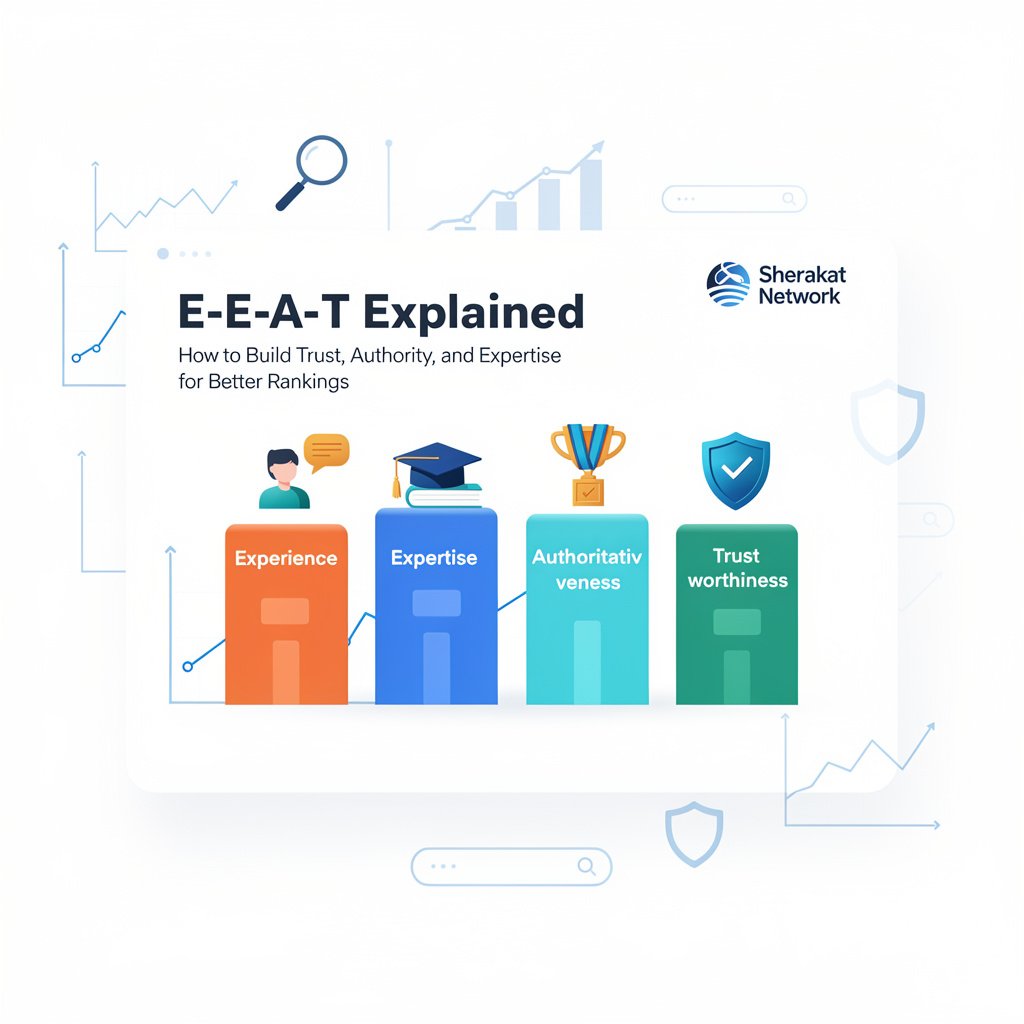
- E-E-A-T stands for Experience, Expertise, Authoritativeness, and Trustworthiness. It’s Google’s framework for evaluating content quality.
- Trustworthiness is the most important component. Without trust, nothing else matters.
- Experience is your best defense against generic AI content. Show, don’t just tell. Use original photos, share personal stories, and include specific, sensory details.
- Expertise depends on your topic. Match the level of expertise to the topic’s potential impact on users. For YMYL topics, formal credentials are essential.
- Authoritativeness is built through reputation. Earn backlinks, get mentioned in industry publications, and engage with your professional community.
- Transparency builds trust. Be clear about who you are, how you make money, and how to contact you.
- E-E-A-T is not a one-time task. It requires ongoing maintenance and a genuine commitment to quality.
- Focus on being helpful, honest, and human. If you build your site around these principles, strong E-E-A-T will follow naturally.
Remember, SEO is ultimately about connecting people with the best possible answers to their questions. E-E-A-T is simply a framework for ensuring that you are, in fact, providing those best possible answers. By focusing on genuine experience, demonstrable expertise, earned authority, and unwavering trustworthiness, you’re not just optimizing for Google—you’re building a website that deserves to be found, trusted, and remembered.
FAQs (Frequently Asked Questions)
1. What does E-E-A-T stand for?
E-E-A-T stands for Experience, Expertise, Authoritativeness, and Trustworthiness. It’s a framework used in Google’s Search Quality Rater Guidelines to evaluate the quality of web content.
2. Is E-E-A-T a Google ranking factor?
No, E-E-A-T itself is not a direct ranking factor. It’s a framework that human quality raters use to assess search results. However, Google’s algorithms are designed to reward content that aligns with high E-E-A-T principles.
3. What’s the difference between the old E-A-T and the new E-E-A-T?
The original E-A-T stood for Expertise, Authoritativeness, and Trustworthiness. In late 2022, Google added an extra “E” for Experience to emphasize the importance of first-hand, lived experience in creating content.
4. What is YMYL?
YMYL stands for “Your Money or Your Life.” It refers to topics that can significantly impact a person’s health, financial stability, safety, or future well-being. Examples include medical advice, financial planning, legal information, and news. Google holds YMYL content to much higher E-E-A-T standards.
5. Do I need to worry about E-E-A-T if my site isn’t YMYL?
Yes, but the required level may be lower. E-E-A-T principles apply to all websites to some degree. Google wants to show users trustworthy, helpful results for every query, not just YMYL ones.
6. How do I demonstrate “Experience” on my website?
Use original photos and videos, share personal stories and anecdotes, include specific sensory details, write in the first person, and mention timeframes and contexts for your experiences.
7. How do I demonstrate “Expertise”?
Create detailed author bios with relevant credentials, cite reputable sources, cover topics comprehensively, keep content updated, and use technical language accurately and appropriately.
8. How do I demonstrate “Authoritativeness”?
Earn backlinks from reputable sites in your niche, get mentioned in industry publications, build a presence on authoritative platforms, engage with your professional community, and showcase recognition and achievements.
9. How do I demonstrate “Trustworthiness”?
Be transparent about who you are, provide clear contact information, use HTTPS, be honest about affiliate relationships, publish accurate information, showcase genuine reviews, have clear privacy and terms pages, and respond to comments.
10. What is the most important part of E-E-A-T?
Trustworthiness is the most critical component. Even if you have immense experience and expertise, if your site isn’t trustworthy, it fails the E-E-A-T test.
11. Can I have good E-E-A-T if I use AI to write my content?
Possibly, but only if you heavily edit and augment the AI output with genuine human experience, expertise, and oversight. Publishing raw, unedited AI content without demonstrating your own involvement will likely result in weak E-E-A-T signals.
12. Do I need a professional degree to have expertise?
It depends on your topic. For medical, financial, or legal topics, formal credentials are essential. For hobbies, crafts, or personal experiences, “expertise” can come from deep, demonstrable knowledge and experience, not necessarily a degree.
13. How important is the “About Us” page for E-E-A-T?
Extremely important. Your “About Us” page is where you tell users (and Google) who you are, why you’re qualified, and what your site is about. A detailed, transparent “About Us” page is a strong trust signal.
14. Do author bios really matter?
Yes, especially for YMYL topics. Every piece of content should have a clear author, and that author should have a bio that explains their relevant experience or expertise. This helps establish accountability and credibility.
15. How do I show expertise if I run a forum or community site?
For user-generated content, the challenge is ensuring quality. You can demonstrate expertise by having clear community guidelines, moderating content, featuring expert contributors, and having authoritative “official” content from site owners alongside user posts.
16. Does having more backlinks improve my E-E-A-T?
Backlinks from authoritative, relevant sites are a key signal of authoritativeness, which is one component of E-E-A-T. So yes, quality backlinks contribute to your overall E-E-A-T profile.
17. How does site speed affect E-E-A-T?
Site speed is not a direct part of E-E-A-T, but it contributes to overall user experience and trust. A slow, frustrating site undermines trust, even if the content is excellent.
18. What are “Quality Rater Guidelines”?
They are a publicly available document from Google (over 170 pages long) that provides instructions to human quality raters on how to evaluate the quality of search results. Reading them (or summaries) is a great way to understand what Google considers “high quality.”
19. How often are the Quality Rater Guidelines updated?
Google updates the guidelines periodically. Major updates are announced and discussed in the SEO community. It’s worth staying informed about changes, especially those related to E-E-A-T.
20. Can a new website have good E-E-A-T?
Yes, but it must be built deliberately from the start. Focus on transparency (clear “About” and author pages), demonstrate any experience you have, create high-quality, well-researched content, and start building your reputation through ethical means. Authority takes time to build, but trust and experience can be demonstrated immediately.
21. What’s the biggest mistake beginners make with E-E-A-T?
Thinking it doesn’t apply to them, or treating it as an afterthought. The biggest mistake is focusing only on keywords and links while ignoring the fundamental quality and trustworthiness of their site.
22. How do I handle affiliate marketing and maintain trust?
Be completely transparent. Disclose affiliate relationships clearly and prominently (not hidden in a footer). Ensure your recommendations are genuine and based on real experience. Never recommend a product just for the commission.
23. Does E-E-A-T apply to local businesses?
Absolutely. For a local business, trust is everything. A complete and verified Google Business Profile, genuine customer reviews, clear contact information, and a professional website all contribute to strong local E-E-A-T.
24. How can I check my own site’s E-E-A-T?
There’s no tool that gives you an “E-E-A-T score.” The best approach is a self-audit using the framework. Go through each component (Experience, Expertise, Authoritativeness, Trustworthiness) and honestly assess your site against the principles in this guide. Ask a friend or colleague for an outside perspective.
25. What’s the future of E-E-A-T?
E-E-A-T will only become more important. As AI-generated content becomes more common, the ability to demonstrate genuine human experience and trust will be the primary differentiator. Google will continue to refine its algorithms to better identify and reward truly helpful, trustworthy content.
About Author
Sana Ullah Kakar is a seasoned digital marketing strategist and SEO consultant with over a decade of experience helping businesses establish and scale their online presence. As the lead content contributor for the Sherakat Network, Sana specializes in translating complex digital marketing concepts into actionable strategies for entrepreneurs and professionals across the Middle East and beyond. His approach is rooted in data-driven decision-making and a deep understanding of how evolving search technologies impact real-world business growth. When he’s not analyzing search trends or mentoring the next generation of marketers, Sana is exploring the intersection of technology and human behavior to build more authentic and effective online experiences.
Free Resources
To help you implement everything we’ve covered, here are valuable free resources:
- Google’s Search Quality Rater Guidelines: Read the official document (or summaries) to understand how Google evaluates quality. (Search for “Google Search Quality Rater Guidelines PDF”)
- Google Search Console: Monitor your site’s performance and identify issues that could affect trust. (https://search.google.com/search-console/)
- HARO (Help a Reporter Out): Build authority by getting quoted as an expert in publications. (https://www.helpareporter.com/)
- LinkedIn: Create a professional profile for yourself and your authors to establish credibility.
- Trustpilot or similar review platforms: Encourage and manage genuine customer reviews.
- Ahrefs / SEMrush Free Tools: Use free backlink checkers to see who’s linking to you and your competitors.
- Google’s “About Us” Page Examples: Search for “best about us pages” for inspiration on how to be transparent and trustworthy.
For more in-depth resources, explore the complete Sherakat Network SEO for Beginners series:
- Start with the SEO Fundamentals in 2026
- Master Keyword Research for Beginners
- Follow the Complete On-Page SEO Checklist
- Get your site healthy with Technical SEO for Beginners
- Build Authority with Link Building for Beginners
Then, continue your journey:
- Browse our Resources page for tools and templates
- Read the latest insights on our Blog
- Learn how to Start an Online Business in 2026
- Explore more SEO articles
- Understand Business Partnership Models
Expand your knowledge with these external resources:
- Mental Health: The Complete Guide to Psychological Wellbeing
- Global Supply Chain Management: The Complete Guide
- Artificial Intelligence & Machine Learning
- Remote Work Productivity
- Climate Policy & Agreements
- Culture & Society
Discussion
Now I’d love to hear from you. How do you approach building trust and demonstrating expertise on your website? Have you ever thought about your site in terms of E-E-A-T before? What’s the biggest challenge you face in making your site more trustworthy?
Share your experiences, questions, and insights in the comments below. Let’s learn from each other’s journeys in building websites that truly deserve to rank.
If you need personalized help with your E-E-A-T strategy or have a specific project in mind, don’t hesitate to contact us. We’re here to help you succeed.