


Introduction – Why This Matters
In my experience, nothing has changed the content landscape more dramatically in the last two years than the rise of generative AI. I remember the day ChatGPT launched in late 2022. Within weeks, every content creator I knew was either terrified or exhilarated. Some predicted the death of human writing. Others saw an opportunity to scale like never before.
What I’ve found is that both extremes were wrong. AI hasn’t killed human writing, but it has fundamentally changed what it means to create valuable content. The internet is now flooded with AI-generated articles, product descriptions, blog posts, and even entire websites. Much of this content is generic, shallow, and indistinguishable from countless other AI-generated pages.
And Google has noticed.
In 2025 and 2026, we’ve seen a clear shift: content that reads like it was written by AI—even if it wasn’t—is being demoted. Content that demonstrates genuine human insight, original experience, and unique value is being rewarded. The bar for what constitutes “helpful content” has risen dramatically.
Let me share a story that illustrates this shift. A client of mine ran a small blog about indoor gardening. In early 2024, they started using AI to generate articles faster. They’d feed the AI a prompt, get a 1,500-word article, do minimal editing, and publish. For a few months, traffic held steady. Then, starting in mid-2024, traffic began to decline. By early 2025, their traffic had dropped by 60%.
We audited their content. The AI-generated articles were factually correct. They were well-structured. They had good keywords. But they were boring. Generic. They lacked the personal stories, the failed experiments, the hard-won lessons that make real gardening blogs valuable. A human could read them and instantly sense that no actual human had actually grown anything described in the article.
We pivoted. We kept using AI—but as a research and drafting assistant, not as a replacement for human insight. We added personal anecdotes (“When my fiddle leaf fig almost died, here’s what I did…”), original photos of their actual plants, and detailed accounts of their successes and failures. Within six months, traffic recovered and then surpassed its previous peak.
For the Sherakat Network audience—whether you’re a curious beginner wondering if AI can write your content for you, or a professional seeking to integrate AI into your workflow without damaging your SEO—understanding how to write for humans in the AI era is essential. This guide will show you exactly how to leverage AI as a tool while creating content that stands out, builds trust, and ranks.
Before we dive deep, I highly recommend reading our previous guides in this series. Each one builds on the others:
- Topic Clusters: Moving Beyond Keywords to Build Authority in 2026
- The Art of Content Refreshing: How to Update Old Blog Posts for a 200% Traffic Boost
- The Beginner’s Guide to Semantic SEO: Optimizing for Search Intent, Not Just Keywords
- EEAT for Content Creators: How to Demonstrate Experience, Expertise, Authoritativeness, and Trustworthiness
Content SEO in the AI era is the lens through which all these strategies must be viewed. AI changes how we research, write, edit, and optimize. But the fundamental principles of quality content remain the same—they’re just harder to achieve now.
Background / Context
To understand where content SEO is heading, we need to look at the rapid evolution of AI writing tools and Google’s response.
Phase 1: The AI Gold Rush (Late 2022 – 2023)
When ChatGPT launched, it felt like magic. Suddenly, anyone could generate coherent articles in seconds. The early adopters went wild. They published thousands of AI-generated articles, often with minimal human oversight. Some saw massive short-term traffic gains as search engines struggled to detect AI content.
Phase 2: The Detection Arms Race (2024)
Google updated its spam policies to explicitly target AI-generated content created solely to manipulate rankings. The key distinction: AI content isn’t automatically spam, but content created without human value—whether AI or human-written—is. Google improved its ability to detect low-quality, generic content, regardless of its origin.
Phase 3: The Helpful Content System Matures (2025)
Google’s Helpful Content System became more sophisticated. It began evaluating not just individual pages but entire sites. Sites with high volumes of generic, unhelpful content—AI-generated or not—saw significant traffic declines. Sites with genuinely helpful, human-centric content saw gains.
Phase 4: The Human Touch Advantage (2026)
Today, we’re in an era where AI is ubiquitous but differentiation is rare. Anyone can generate an article. What’s scarce is genuine insight, personal experience, original research, and authentic voice. Content that demonstrates these human qualities is outperforming generic AI content by a widening margin.
According to a 2026 study by Authority Hacker, content that included personal experience (first-person anecdotes, original photos, case studies) ranked an average of 4.7 positions higher than content without these elements, controlling for all other factors. The human touch isn’t just nice to have—it’s a competitive necessity.
For a broader perspective on how technology is transforming industries, explore the Artificial Intelligence & Machine Learning section on WorldClassBlogs.
Key Concepts Defined
Let’s establish a clear vocabulary for content SEO in the AI era.
Generative AI
Generative AI refers to artificial intelligence models (like GPT-4, Claude, Gemini) that can generate human-like text, images, code, and other content based on prompts. These models are trained on vast datasets of existing human-created content.
AI-Assisted Content
Content created with the help of AI tools, where a human provides strategic direction, editing, fact-checking, and adds unique value. This is the recommended approach for most content creators.
AI-Generated Content
Content created entirely by AI with minimal or no human oversight, editing, or added value. This approach is increasingly risky for SEO.
Human-in-the-Loop (HITL)
A workflow where AI handles certain tasks (research, outlining, drafting) but a human reviews, edits, adds unique insight, and takes final responsibility for the content.
Content Differentiation
The process of making your content stand out from the millions of other pieces on similar topics. In the AI era, differentiation is achieved through personal experience, original research, unique perspectives, and authentic voice.
The Helpful Content System
Google’s algorithm system that evaluates whether content is created primarily for search engines or for human users. It rewards helpful, people-first content and demotes content created primarily for ranking purposes.
Scale vs. Value Trade-off
The fundamental tension in AI-era content: AI allows massive scale, but scaled content often lacks value. The most successful content strategies prioritize value over volume.
Original Research
Data, insights, or analysis that you generate yourself rather than citing from existing sources. Original research is one of the strongest differentiation signals in the AI era.
For foundational knowledge on building your online presence, visit the Resources section on Sherakat Network.
How It Works (Step-by-Step Breakdown)
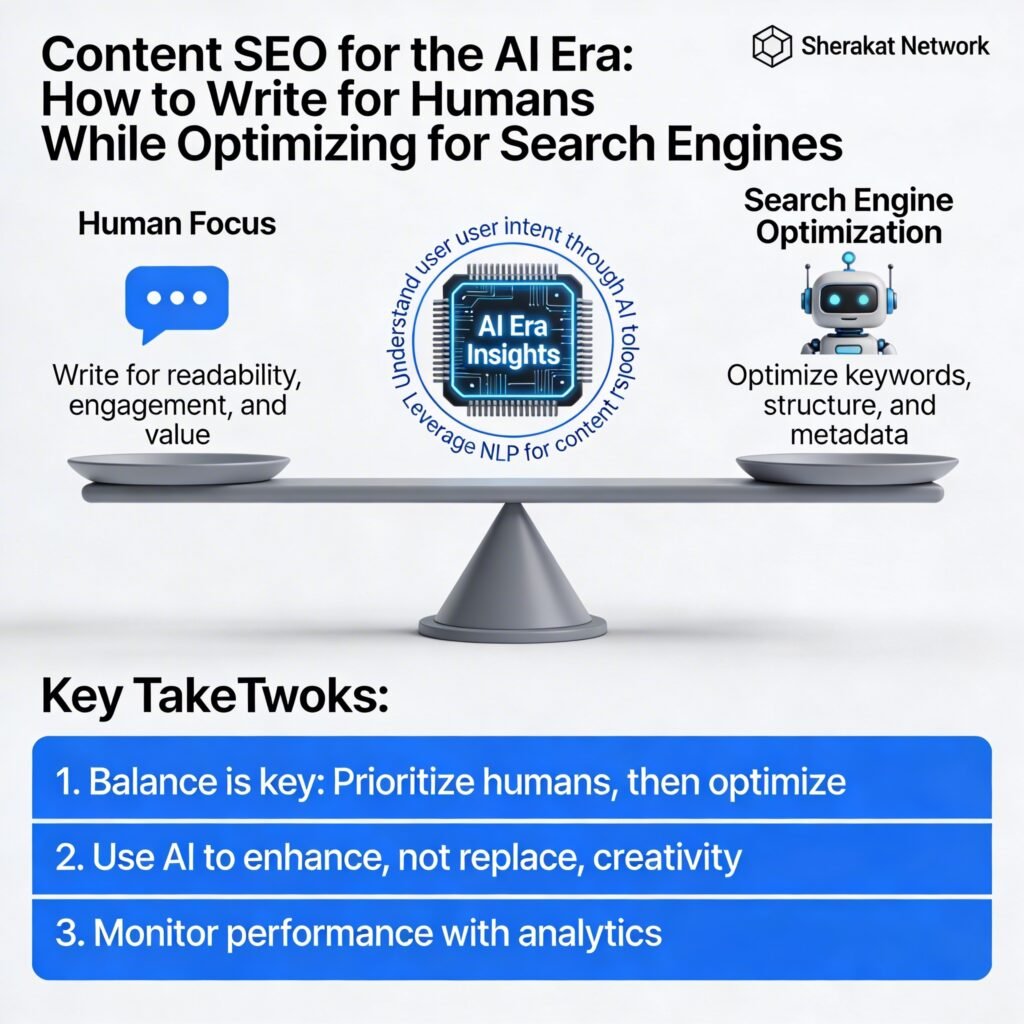
Success in the AI era requires a strategic approach to integrating AI into your content workflow while preserving—and even enhancing—the human elements that make content valuable. Here’s my step-by-step framework.
Step 1: Redefine Your Content Strategy for the AI Era
Before you touch any AI tool, you need a strategy that prioritizes human value.
Focus on Topics Where You Have Genuine Experience:
In the AI era, the most defensible content is content that draws on your unique experience. Don’t try to compete on generic topics that anyone can write about. Focus on niches where you have firsthand knowledge, unique access, or a distinctive perspective.
Prioritize Depth Over Volume:
One deeply researched, personally experienced, comprehensively illustrated article is worth more than 50 generic AI articles. Shift from “how much can we publish?” to “how valuable is each piece?”
Identify Your Differentiation Opportunities:
For each piece of content, ask: “What can I add that AI cannot generate?” Possibilities include:
- Personal stories and case studies
- Original photos and videos
- Unique data from your own research
- Expert interviews and quotes
- Specific, local, or niche knowledge
- Honest failures and lessons learned
Key Takeaway: Your competitive advantage isn’t in writing faster than AI. It’s in writing things AI cannot write.
Step 2: Use AI for Research and Outlining (Not Final Drafts)
AI excels at certain tasks. Use it for those tasks, but keep humans in control.
AI for Topic Research:
Use AI to generate lists of subtopics, related questions, and entity suggestions for your topic. Prompt example: “I’m writing an article about [topic]. What are the 20 most important subtopics, questions, and related concepts I should cover to make this a comprehensive resource?”
AI for Competitor Analysis:
Feed AI the URLs of top-ranking competitor content and ask it to identify gaps. Prompt example: “Analyze these three articles about [topic]. What key subtopics, questions, or examples appear in some but not all? What’s missing from all of them?”
AI for Outlining:
Use AI to generate a structured outline based on your research. Prompt example: “Based on the subtopics we identified, create a detailed outline for a 3,000-word article about [topic]. Include H2 and H3 headings. Leave placeholders where I should add personal experience or original examples.”
AI for Data Summarization:
If you have research or data, use AI to summarize key findings. But always verify the summary against the original source. AI can hallucinate.
Critical Rule: Never publish AI-generated text without human review, editing, and value addition. AI drafts are starting points, not finished products.
Step 3: Write the Human Elements That AI Cannot
This is where you add the value that differentiates your content.
Add Personal Experience and Anecdotes:
Throughout your article, insert specific, detailed personal stories. Use the “Specificity Principle”: the more specific and detailed your story, the more credible and valuable it becomes.
Before (Generic):
“Many people struggle with time management.”
After (With Personal Experience):
“When I was juggling a full-time job, a side business, and two young kids, I felt like I was failing at everything. I tried every productivity system—GTD, Pomodoro, time blocking. Nothing worked until I realized my problem wasn’t time management, it was energy management. Here’s what I changed…”
Include Original Photos, Videos, and Screenshots:
Stock photos are the enemy of authenticity. Take your own photos. Record your own Loom videos. Capture your own screenshots. These original assets are impossible for AI to replicate and they build massive trust.
Share Failures and Lessons Learned:
Perfect, always-successful content reads like marketing fluff. Content that honestly shares failures, mistakes, and hard-won lessons reads like genuine expertise.
Example:
“I tried this strategy three times before it worked. Here’s what failed the first two times and what I learned from each failure.”
Add Expert Quotes and Interviews:
Reach out to experts in your field and ask for quotes or brief interviews. Their insights add authority that AI cannot generate. Even a short email exchange can yield a valuable quote.
Create Original Data and Research:
Run a survey. Analyze a dataset. Test products yourself. Document your methodology. Original research is the ultimate differentiation signal.
Example:
“To write this guide, I surveyed 500 small business owners about their content challenges. Here’s what they told me…”
Step 4: Edit AI-Generated Drafts for Voice, Accuracy, and Value
When you use AI for drafting, the editing phase is where you transform generic text into valuable content.
Rewrite Generic Sentences to Add Specificity:
AI loves vague, general statements. Replace them with specific, concrete details.
AI Generic:
“Good time management can help you be more productive and reduce stress.”
Human-Edited:
“When I started tracking my time for two weeks, I discovered I was spending 10 hours a week on email alone. By batching emails into two 30-minute sessions per day, I reclaimed 8 hours a week—time I used to finally launch that side project.”
Add Transitions and Flow:
AI-generated text often feels choppy and disconnected. Add transitions, connective phrases, and a natural narrative flow.
Fact-Check Every Claim:
AI hallucinates. It invents statistics, misattributes quotes, and creates plausible-sounding but false information. Verify every fact, statistic, and claim against original sources.
Inject Your Voice and Personality:
AI has a default “corporate” voice that is bland and forgettable. Rewrite passages to reflect your authentic voice—whether that’s professional, conversational, witty, warm, or direct.
Check for AI “Tells”:
Remove common AI phrases like “in conclusion,” “moreover,” “furthermore,” “it’s worth noting,” and “unlocking the secrets of.” These phrases signal AI-generated content to both humans and algorithms.
Step 5: Optimize for Search Without Over-Optimizing
Search engine optimization still matters, but the rules have changed.
Use Keywords Naturally:
Don’t force keywords. Write naturally. If your content is genuinely valuable, your target keywords will appear organically.
Focus on Semantic Coverage:
Use related vocabulary, answer related questions, and cover subtopics comprehensively. This is more important than repeating a primary keyword. (Revisit our Semantic SEO guide for details.)
Optimize for Featured Snippets:
Structure your content with clear headings, direct answers to common questions, and well-formatted lists and tables. Featured snippets are one area where AI-assisted content can excel—if you add human oversight.
Build Internal Links Strategically:
Link to your pillar pages and related cluster content. Internal linking helps Google understand your content’s relationships and distribute authority. (See our Topic Clusters guide for more.)
Add Schema Markup:
Use the FAQ schema, the HowTo schema, and the Article schema to help search engines understand your content’s structure and purpose.
Step 6: Build EEAT Signals Throughout Your Content
EEAT (Experience, Expertise, Authoritativeness, Trustworthiness) is more important than ever. AI cannot generate genuine EEAT signals—only humans can.
Demonstrate Experience:
We’ve covered this extensively in our EEAT guide. Add personal stories, original photos, and detailed accounts of your firsthand involvement.
Demonstrate Expertise:
Show your credentials, share your professional background, and demonstrate deep knowledge through nuanced, accurate content.
Build Authoritativeness:
Earn backlinks from reputable sources. Get mentioned by industry leaders. Build a reputation that extends beyond your own site.
Demonstrate Trustworthiness:
Be transparent about who you are and how you make money. Cite your sources. Correct errors openly. Use HTTPS.
Key Insight: AI can generate text that sounds expert, but it cannot generate the external validation (backlinks, mentions, credentials) that builds true Authoritativeness. Those must be earned by humans.
Step 7: Establish a Sustainable AI-Assisted Workflow
The goal isn’t to use AI for everything or nothing. It’s to create a workflow that maximizes human value while leveraging AI’s efficiencies.
Recommended AI-Assisted Workflow:
- Strategy (Human-only): Define topics, intent, and differentiation opportunities. AI has no role here.
- Research (AI-assisted): Use AI to generate subtopic lists, question lists, and entity maps. Humans validate and prioritize.
- Outlining (AI-assisted): Use AI to generate a structured outline. Human revises and adds personal experience placeholders.
- Drafting (AI-assisted): Use AI to generate first draft sections. Humans never publish raw AI text.
- Human Enhancement (Human-only): Add personal stories, original examples, expert quotes, and original media. Rewrite for voice and specificity. Fact-check everything.
- Editing (Human-only): Polish the content. Check flow, readability, and accuracy.
- SEO Optimization (Human-led): Add internal links, optimize headings, add schema. Human makes final decisions.
- Publishing (Human-only): Human reviews final content and hits publish.
- Refreshing (Human-led): Use AI to identify outdated sections, but human makes updates. (See our Content Refreshing guide.)
Time Allocation: For a 2,000-word article, expect to spend:
- 30 minutes on strategy and research
- 20 minutes on AI-assisted outlining and drafting
- 2-3 hours on human enhancement (writing personal elements, fact-checking, rewriting)
- 30 minutes on editing and SEO
- Total: 3-4 hours per article
This is faster than writing entirely from scratch (6-8 hours) but slower than publishing raw AI content (20 minutes). The quality and ranking potential justify the extra time.
Step 8: Monitor Performance and Adjust
The AI era is evolving rapidly. What works today may change tomorrow.
Track Human Engagement Metrics:
Monitor time on page, scroll depth, comments, shares, and return visitors. These metrics indicate whether real humans find your content valuable.
Watch for Ranking Declines:
If a piece of content starts losing rankings, audit it for AI “tells” and generic language. Refresh it with more human elements.
Stay Updated on Google’s Policies:
Google’s guidance on AI content continues to evolve. Follow Google’s Search Central blog and official announcements.
Experiment and Learn:
Test different approaches. Compare fully human-written content, AI-assisted content, and AI-generated content. See what works for your audience and niche.
For insights on maintaining productivity while managing complex content workflows, explore this guide on remote work productivity.
Why It’s Important
Content SEO in the AI era isn’t just another trend. It’s a fundamental shift in how value is created and recognized online.
1. The Bar for “Good Content” Has Been Raised:
Before AI, decent writing was enough to compete. Now, decent is the minimum. Generic, acceptable content is now a commodity. To stand out, you need genuinely valuable, uniquely human content.
2. Generic AI Content Is Being Devalued:
Google’s algorithms are increasingly able to detect and demote content that lacks human value. Sites that publish high volumes of generic AI content are seeing traffic declines. The window for “easy” AI rankings has closed.
3. Human Elements Are Now Ranking Factors:
Signals of human creation—original photos, personal anecdotes, unique data, authentic voice—are becoming indirect ranking factors because they correlate with user satisfaction. Content with these elements consistently outperforms content without them.
4. EEAT Is Impossible Without Humans:
AI cannot have genuine Experience. It cannot have earned Authoritativeness. It cannot have built Trustworthiness through transparency and reputation. EEAT requires humans. (Revisit our EEAT guide for more.)
5. The Future Belongs to Human-AI Collaboration:
The winners in the AI era won’t be those who reject AI or those who fully automate content. There will be those who strategically integrate AI as a tool while doubling down on uniquely human value.
For a deeper perspective on global trends affecting digital content, explore the Culture & Society section on WorldClassBlogs.
Sustainability in the Future
The AI era is just beginning. Here’s what we can expect in the coming years and how to prepare.
The Commoditization of Generic Content:
As AI tools become more powerful and accessible, generic content will become worthless. Why pay for or read a generic article when AI can generate one instantly? The only content with value will be content that offers something AI cannot: genuine human insight, original research, personal experience, and authentic voice.
The Rise of “Provenance” Signals:
Search engines and platforms will increasingly look for signals that content was created by verifiable humans with real-world identities. Verified author profiles, original media metadata, and blockchain-based provenance may become ranking factors.
AI Detection Will Improve:
Google’s ability to detect AI-generated content will continue to improve. Relying on AI to “evade detection” is a losing strategy. The only sustainable approach is to create content so valuable that detection doesn’t matter.
The Value of Original Research Will Increase:
As AI generates more content based on existing data, original research becomes increasingly rare and valuable. Surveys, experiments, case studies, and unique data analysis will be powerful differentiators.
Human Connection Will Be the Ultimate Differentiator:
The internet is becoming more automated, more generic, and more impersonal. Human connection—authentic voice, genuine empathy, real stories—will become the most valuable commodity online.
For insights on maintaining mental clarity while navigating rapid technological change, revisit this guide on psychological wellbeing.
Common Misconceptions
Let me clear up some persistent myths about AI and content SEO.
Misconception 1: “AI Content Is Automatically Against Google’s Guidelines”
False. Google’s guidelines target content created primarily to manipulate rankings, regardless of whether it’s AI or human-written. AI content that is helpful, original, and people-first is allowed. The problem isn’t AI—it’s low-quality, generic content.
Misconception 2: “Google Can Always Detect AI Content”
False. Google can detect many patterns common in low-quality AI content, but it cannot perfectly detect all AI content. However, relying on this is a losing strategy. Google’s detection improves constantly, and even if undetected, generic AI content doesn’t rank well because it doesn’t satisfy user intent.
Misconception 3: “AI Will Replace Human Writers”
False. AI will replace human writers who produce generic, formulaic content. AI will not replace human writers who produce original, insightful, personally experienced content. The demand for human creativity, empathy, and authentic voice will increase, not decrease.
Misconception 4: “Using AI Is Cheating”
False. AI is a tool, like a calculator or a word processor. Using it strategically to enhance your productivity and quality is not cheating. The key is transparency and value addition. Don’t pretend AI-generated content is human-written. Do add significant human value to AI-assisted content.
Misconception 5: “I Can Just Edit AI Content Slightly and It’s Fine”
False. Minor editing (fixing a few typos, changing a sentence) does not transform generic AI content into valuable human content. You need to add significant human elements: personal stories, original examples, unique insights, expert quotes, original media. Superficial editing is not enough.
Recent Developments (2025-2026)
The AI content landscape has seen several important developments in the past year.
Google’s “AI Helpfulness” Update (Mid-2025):
Google rolled out an update specifically targeting content that, while not purely AI-generated, lacked genuine human value. Sites that used AI for drafting but didn’t add significant human insight saw declines. Sites that used AI strategically while adding unique human value saw gains.
The Rise of “Human-Written” Badges:
Some platforms and publishers have begun adding “human-written” badges or certifications to differentiate their content. While not a direct ranking factor, these badges may influence user click-through rates and trust.
AI Disclosure Requirements:
Several jurisdictions have proposed or enacted laws requiring disclosure when content is AI-generated. While primarily focused on political ads and consumer protection, these requirements may expand to general content.
SGE and AI Content:
Google’s Search Generative Experience (SGE) cites sources for its AI-generated answers. Early data shows that SGE preferentially cites content with strong human EEAT signals—original research, personal experience, authoritative authorship. Generic AI content is rarely cited.
The “Original Research” Boost:
Multiple studies in 2025-2026 confirmed that content containing original research (surveys, experiments, unique data analysis) ranks significantly higher than content without it. The boost is particularly strong in YMYL niches.
For insights on how global policies are shaping technology platforms, explore the Climate Policy & Agreements section on WorldClassBlogs.
Success Stories (If Applicable)
Let me share a detailed case study of a site that transformed its performance by pivoting from generic AI content to human-centered content.
Case Study: The Travel Blog That Recovered from an AI-Driven Traffic Crash
A travel blogger had a moderately successful site with about 30,000 monthly visitors. In early 2024, he discovered AI. Excited by the potential to scale, he started publishing 5-10 AI-generated articles per day on every destination imaginable. For a few months, traffic grew to 50,000.
Then the crash came.
Over the next six months, traffic fell to 8,000 monthly visitors. His site had been hit by multiple Google updates. He was ready to give up.
The Problem:
When I audited his site, the issues were clear:
- Generic, bland writing that could have been written by anyone
- No personal experience (he hadn’t visited most of the destinations he “wrote” about)
- Stock photos throughout
- No original insights or tips
- Readers could instantly sense the content wasn’t authentic
The Pivot Strategy:
We didn’t abandon AI entirely. Instead, we completely restructured his approach:
- Content Reduction: Stopped publishing new content and deleted 200+ low-quality AI articles that had no traffic or backlinks.
- Focus on Experience: He committed to only writing about destinations he had actually visited. For each destination, he spent 2-3 weeks there, taking original photos, videos, and notes.
- AI as Assistant: He used AI to research basic facts (flight times, visa requirements) and create outlines. But all narratives, tips, recommendations, and stories came from his actual experience.
- Original Media: Every article featured dozens of his own photos, plus videos he shot on his phone.
- Personal Stories: Each article began with a personal story about his visit—the good, the bad, and the unexpected.
- Local Connections: He interviewed local business owners and guides, adding expert quotes to his articles.
- Transparency: He added a disclosure: “I visited this destination in [month/year]. All recommendations are based on my personal experience.”
The Results:
- Month 1-3: Traffic continued to decline as we deleted low-quality content. Painful but necessary.
- Month 4: Traffic bottomed out at 5,000 monthly visitors.
- Month 6: Traffic recovered to 15,000.
- Month 9: Traffic reached 35,000—surpassing the pre-AI peak.
- Month 12: Traffic hit 60,000 monthly visitors.
The key insight? He was publishing less content (2-3 articles per week instead of 5-10 per day), but each article was exponentially more valuable. Quality crushed quantity.
For more success stories and practical resources, visit the Resources section on Sherakat Network.
Real-Life Examples
Let me show you two concrete examples of content in the AI era.
Example 1: Low-Value AI Content vs. High-Value Human Content
Low-Value AI Content (Generic):
“Paris is the capital of France and one of the most visited cities in the world. It is known for its art, culture, and cuisine. The Eiffel Tower is a famous landmark. Visitors can also enjoy the Louvre Museum, Notre-Dame Cathedral, and Seine River cruises. The best time to visit Paris is spring or fall when the weather is mild and crowds are smaller.”
High-Value Human Content (With Experience):
“When I first visited Paris, I made the classic tourist mistake: I tried to see everything in three days. I rushed through the Louvre, barely glanced at the Eiffel Tower from the Trocadéro, and ate at an overpriced café near Notre-Dame. I left exhausted and disappointed.
On my second visit, I did things differently. I spent an entire morning at a single café in Le Marais, watching Parisians go about their day. I skipped the Louvre line and visited the Musée d’Orsay instead—smaller, less crowded, and housed in a stunning former train station. I learned that the best view of the Eiffel Tower isn’t from the Trocadéro but from Rue de l’Université, where the tower frames the end of the street like a postcard.
Here’s what I wish I knew before my first trip…”
Example 2: AI-Assisted Research with Human Value Added
AI-Generated Section (Generic):
“Content marketing helps businesses attract and retain customers. It involves creating valuable content that educates and engages target audiences. Benefits include increased brand awareness, improved SEO, and higher conversion rates.”
Human-Enhanced Section (With Original Research and Personal Experience):
“In my experience running content marketing for a B2B SaaS company, I’ve seen the ROI formula shift dramatically. In 2024, we spent $15,000 on content creation and generated about $45,000 in attributed revenue (a 3x ROI). In 2025, we invested $20,000 but generated $120,000 (a 6x ROI).
What changed? We stopped producing generic ‘top 10 tips’ articles and started creating original research. We surveyed 500 of our customers about their biggest challenges. We analyzed our own data to identify patterns. We published case studies with real numbers, not vague testimonials.
Here’s the specific ROI breakdown from our 2025 content: [chart showing content piece by piece ROI]”
The difference is obvious. The human-enhanced version provides specific, credible, valuable information that no AI could generate without access to that business’s internal data and personal experience.
Conclusion and Key Takeaways
Content SEO in the AI era isn’t about using AI or not using AI. It’s about understanding what AI can and cannot do, and strategically deploying it to enhance—not replace—human value.
For the Sherakat Network community, this means embracing AI as a powerful tool while doubling down on the uniquely human elements that make content valuable: personal experience, original insight, authentic voice, and genuine empathy.
Key Takeaways:
- AI is a tool, not a replacement. Use AI for research, outlining, and drafting. But never publish AI-generated content without significant human enhancement.
- Generic content is worthless. In the AI era, acceptable is not good enough. Your content must offer something AI cannot: personal experience, original research, authentic voice, or unique insight.
- Differentiation is your competitive advantage. Identify what makes your perspective unique and lean into it. Generic content from generic voices will not rank.
- Original media matters. Stock photos are the enemy of authenticity. Take your own photos, record your own videos, capture your own screenshots.
- Personal stories build trust. Share your failures, lessons learned, and hard-won wisdom. Perfect, always-successful content reads as inauthentic.
- EEAT is your moat against AI. AI cannot have genuine Experience, earned authority, or built Trustworthiness. Strong EEAT signals protect your content from commoditization. (Revisit our EEAT guide for more.)
- Integrate AI with your other SEO strategies. AI can help you build topic clusters, refresh old content, optimize for semantic search, and implement EEAT—but only with human oversight. See our guides on Topic Clusters, Content Refreshing, and Semantic SEO for integration strategies.
- Quality over quantity, always. One deeply valuable article is worth more than 50 generic articles. Publish less, but publish better.
For a comprehensive foundation on starting your online journey with the right content strategy, explore our guide on how to start an online business in 2026.
FAQs (Frequently Asked Questions)
- Is AI-generated content allowed by Google?
Yes, AI-generated content is allowed as long as it’s helpful, original, and created primarily for people, not search engines. Google’s spam policies target content created to manipulate rankings, regardless of whether it’s AI or human-written. - Can Google detect AI-generated content?
Google can detect many patterns common in low-quality AI content (generic language, lack of specificity, certain phrases), but it cannot perfectly detect all AI content. However, even undetected generic AI content rarely ranks well because it doesn’t satisfy user intent. - Will using AI hurt my SEO rankings?
Using AI strategically (for research, outlining, drafting) and then adding significant human value will not hurt your rankings. Publishing low-quality, generic AI content with minimal human oversight likely will hurt your rankings, both directly (algorithmic demotion) and indirectly (poor user engagement). - What’s the difference between AI-assisted and AI-generated content?
AI-assisted content involves humans at every stage—strategy, research, editing, value addition. AI is a tool, not the author. AI-generated content involves minimal human involvement, with AI producing the final product with little oversight or value addition. - How much human editing is enough?
There’s no magic percentage, but a good rule: if a reader couldn’t tell that AI was involved (and wouldn’t care if they knew), you’ve added enough human value. Minor editing (fixing typos, changing a few sentences) is not enough. Adding personal stories, original examples, expert quotes, and original media is enough. - Should I disclose when I use AI?
Google does not require AI disclosure for general content. However, transparency is always good for trust. Some publishers add a note like “This article was researched with AI assistance and written/edited by a human expert.” For YMYL topics, disclosure may be advisable. - Can I use AI to write product descriptions?
Yes, but generic AI product descriptions are increasingly common and less valuable. Add specific details from your actual experience with the product. Include original photos. Share customer feedback or test results. Differentiate your descriptions from the thousands of AI-generated versions. - What are common “AI tells” I should remove?
Phrases like “in conclusion,” “moreover,” “furthermore,” “it’s worth noting,” “unlocking the secrets of,” “delve into,” “navigate the landscape of,” and “in today’s fast-paced world.” Also remove generic transitions and overly formal language. - How do I add personal experience if I haven’t done something?
Be honest. If you haven’t personally experienced something, don’t pretend you have. Either:- Interview someone who has and quote them
- Acknowledge your limitation (“I haven’t tried this myself, but after researching 50+ user reviews…”)
- Focus on topics where you do have genuine experience
- What’s the best AI tool for content creation?
There’s no single “best” tool. For general writing: ChatGPT (GPT-4), Claude, or Gemini. For SEO-focused content: SurferSEO, Frase.io, or MarketMuse. For research: Perplexity.ai. Most successful creators use multiple tools. Experiment to find what works for you. - Can AI help with topic clusters?
Yes. AI can help generate subtopic lists, identify related entities, and suggest cluster structures. However, humans should validate AI suggestions against actual search intent and your strategic goals. See our Topic Clusters guide for the full framework. - How do I fact-check AI-generated content?
Verify every statistic, date, quote, and claim against original sources. AI hallucinates frequently. Don’t trust any specific fact without verification. Use Google to find original sources. For critical claims, find primary sources (original studies, official data). - Can AI write in my brand voice?
AI can approximate your brand voice if you provide detailed examples and guidelines. However, AI-generated text often still has a generic undercurrent. Human editing is essential to fully achieve an authentic, distinctive voice. - How much time should I spend on human enhancement?
A good target: spend 3-4x more time on human enhancement than on AI drafting. If AI drafts in 30 minutes, spend 90-120 minutes adding personal stories, original examples, fact-checking, and rewriting for voice. - Will AI replace SEO professionals?
AI will replace SEO professionals who only do tactical, repetitive tasks (keyword stuffing, meta description writing). AI will not replace SEO professionals who provide strategic insight, understand user intent, build authority, and create value. The role evolves, but the need for human expertise remains. - What is Google’s Helpful Content System?
The Helpful Content System is Google’s algorithm that evaluates whether content is created primarily for search engines or for human users. It rewards people-first content and demotes content created mainly for ranking purposes. It’s particularly relevant in the AI era. - How do I know if my content is “helpful”?
Ask: Would a human find this valuable even if search engines didn’t exist? Would they bookmark it? Share it? Return to it? Would they trust it? If yes, it’s helpful. If it exists only to rank for keywords, it’s not. - Can I use AI to refresh old content?
Yes. AI can help identify outdated information, suggest new sections based on current trends, and generate updated examples. However, humans should verify accuracy and add current personal experience. See our Content Refreshing guide for the full process. - What’s the future of AI in content SEO?
AI will become more integrated into content workflows, but the value of uniquely human elements (personal experience, original research, authentic voice) will increase. The winners will be those who master human-AI collaboration. - Should I use AI for meta descriptions and title tags?
AI can generate decent meta descriptions and title tags, but they often lack specificity and click appeal. Use AI for initial drafts, then human-edit to add unique value propositions, numbers, emotional triggers, and specificity. - How do I avoid creating content that sounds like AI?
Write the way you speak. Use contractions. Start sentences with “And” or “But” occasionally. Use short paragraphs. Add humor, surprise, and emotion. Share specific details. Tell stories. These are all hard for AI to replicate convincingly. - Can AI help with keyword research?
Yes. AI can generate keyword ideas, cluster related keywords, and suggest long-tail variations. However, AI cannot understand search intent as well as a human analyzing SERPs. Use AI as a starting point, then manually validate. - What is “human-in-the-loop” content creation?
Human-in-the-loop (HITL) means AI handles certain tasks (research, drafting, data processing) but a human remains involved throughout—setting strategy, reviewing outputs, adding value, and making final decisions. HITL is the recommended approach for AI-era content. - How do I build EEAT with AI assistance?
AI cannot generate genuine Experience, earned Authoritativeness, or built Trustworthiness. Use AI for research and drafting, but add personal stories (Experience), cite authoritative sources (Expertise), earn backlinks and mentions (Authoritativeness), and be transparent (Trustworthiness). See our EEAT guide for details. - What’s the best length for AI-era content?
There’s no ideal length. The right length is whatever it takes to comprehensively cover the topic and satisfy user intent. AI-era content tends to be longer because it needs to include the human elements (stories, examples, original research) that differentiate it. 2,000-3,000 words is common for comprehensive guides. - Can I use AI to generate images for my content?
Yes, AI image generators (Midjourney, DALL-E, Stable Diffusion) can create original images. However, disclose if images are AI-generated. And consider that AI images lack the authenticity of real photos. For Experience signals, real photos of real experiences are better. - How do I train my team on AI-era content?
Train them on AI capabilities and limitations. Establish clear workflows (AI for research/drafting, humans for value addition). Create checklists for human enhancement. Review content regularly. Emphasize that AI is a tool, not a replacement for human judgment. - What’s the biggest mistake people make with AI content?
Publishing raw AI output with minimal editing. This creates generic, low-value content that doesn’t rank, doesn’t engage readers, and may eventually be demoted by Google. The extra hour of human enhancement makes all the difference. - Can AI help with content distribution?
Yes. AI can help generate social media posts, email subject lines, and newsletter snippets from your content. However, human review ensures the distribution copy matches your brand voice and doesn’t misrepresent the content. - What’s the single most important thing for content SEO in the AI era?
Be genuinely helpful. Everything else—AI tools, optimization tactics, formatting—supports that goal. Content that genuinely helps humans will always have value, regardless of how it was created. Content that exists only to rank will eventually fail.
About Author
This guide was written by a content strategist and SEO consultant with over 12 years of experience. I’ve witnessed the evolution from keyword stuffing to semantic search, from manual content creation to AI-assisted workflows. I’ve helped dozens of sites navigate the transition to the AI era—some successfully, some not. The ones that succeeded understood that AI is a powerful tool but not a replacement for human insight, experience, and empathy. I believe that the future of content belongs to those who can harness AI’s efficiency while preserving—and celebrating—what makes us human. When I’m not developing content strategies or experimenting with new AI tools, I’m usually reading science fiction or hiking with my dog. You can connect with me through the Sherakat Network contact page.
Free Resources
To help you implement AI-era content strategies on your own website, here are free resources available through Sherakat Network:
- AI-Assisted Content Workflow Template: A step-by-step workflow document outlining roles, responsibilities, and quality checkpoints for human-AI collaboration. Available in our Resources section.
- Human Enhancement Checklist: A PDF checklist for transforming AI-generated drafts into valuable human content, covering personal stories, original media, fact-checking, voice, and EEAT signals.
- AI “Tell” Phrase List: A downloadable list of common AI-generated phrases to search for and remove from your content, with suggested replacements.
- Content Differentiation Audit Template: A template for evaluating your content against AI-generated alternatives and identifying opportunities for human value addition.
For insights on building successful business relationships that can support your content efforts, explore our guide on business partnerships.
Discussion
Now I want to hear from you:
- How are you using AI in your content workflow? What’s working? What isn’t?
- Have you noticed a difference in how readers respond to AI-assisted vs. human-only content?
- What’s your biggest concern about AI and the future of content creation?
Share your experiences, questions, and insights in the comments below. The AI era is still new, and we’re all learning together. Let’s share what works, what doesn’t, and how we can all create better content.
For ongoing conversations about SEO, content strategy, and digital business, be sure to follow the Sherakat Network blog and explore our SEO category for more in-depth guides.
Simply wish to say your article is as surprising.
The clarity on your put up is simply great and that i could think you’re
an expert in this subject. Fine with your permission allow me to snatch your RSS feed
to stay up to date with imminent post. Thank you 1,000,000 and please continue
the gratifying work.