


Introduction: Why This Matters
In my experience, the single biggest mistake beginners make with SEO is targeting keywords they have no realistic chance of ranking for. I’ve watched countless new site owners spend months writing content targeting terms like “best CRM software” or “how to lose weight”—keywords dominated by Forbes, Healthline, and billion-dollar companies with entire teams dedicated to SEO. They publish. They wait. Nothing happens. Then they quit, convinced SEO “doesn’t work.”
What I’ve found is that SEO works incredibly well—but only when you target the right keywords. Specifically, high-volume, low-competition keywords: search terms with meaningful monthly traffic where the first page of Google isn’t locked down by mega-brands.This guide exists because finding these opportunities has become simultaneously easier (better tools, more data) and harder (AI Overviews, changing search behavior) in 2026. Whether you’re building your first website or you’re a professional who needs a quick refresher on modern keyword research, this guide will walk you through exactly how to find keywords worth your time.
By the end, you’ll have a repeatable system for uncovering keyword opportunities that most of your competitors are missing.
Background / Context: How Keyword Research Has Changed
Keyword research in 2026 looks nothing like it did five years ago.
In 2019, the process was relatively straightforward: open a keyword tool, find terms with decent volume and low difficulty scores, write content, rank. The game was volume and exact-match optimization.
Today, three major shifts have transformed the landscape:
First, AI Overviews changed the SERP. Semrush’s 2026 analysis of over 600,000 keywords found that AI Overviews now appear on 71% more commercial-intent searches than six months prior . When Google answers a question directly in the search results, fewer people click through to websites. This means keyword selection now requires understanding what type of query triggers an AI Overview—and targeting terms where real clicks still happen.
Second, keyword fragmentation is real. Google’s own data shows AI Mode queries are now three times longer than traditional searches . People aren’t typing “running shoes”—they’re typing “I have flat feet and my knees hurt, can you help me find running shoes that won’t make it worse.” This longer, more conversational style means the old head-term strategies are losing effectiveness while specific, problem-focused queries grow.
Third, the definition of “low competition” has evolved. A keyword isn’t just low competition because a tool assigns it a low difficulty score. It’s low competition when the actual search results page shows weakness—forum posts ranking, outdated content, thin pages, or small sites that you can realistically outperform .
Understanding these shifts is essential before you start hunting for keywords. The techniques in this guide are built for the 2026 reality, not the 2019 playbook.
Key Concepts Defined
Before we dive into the step-by-step process, let’s establish shared language. These definitions matter because misunderstanding them leads to wasted effort.
High-Volume Keyword: A search term receiving a significant number of monthly searches. “High volume” is relative to your niche—10,000 monthly searches is high for a niche B2B service, but low for broad consumer topics.
Low-Competition Keyword: A keyword where the first page of results contains sites you can realistically outrank. Competition isn’t measured solely by difficulty scores; it’s determined by analyzing who’s actually ranking and how strong their content is .
Keyword Difficulty (KD): A metric (usually 0-100) estimating how hard it would be to rank for a keyword. Tools calculate this differently, so treat it as directional, not absolute.
Search Intent: The underlying goal behind a search query. Four primary types exist: informational (“what is SEO”), navigational (“Sherakat Network login”), commercial (“best SEO tools”), and transactional (“buy SEO software”). Matching content type to intent is non-negotiable for ranking .
Long-Tail Keyword: A specific, longer search phrase (usually 4+ words) with lower volume but higher intent and easier competition. “Quietest coffee maker for small office 2026” is long-tail. “Coffee maker” is not .
Head Term: The opposite of long-tail. Short, broad, high-volume keywords like “SEO” or “digital marketing.” These are typically dominated by major brands and not realistic for new sites.
Keyword Gap: Keywords your competitors rank for that you don’t. Analyzing gaps reveals opportunities you might otherwise miss .
How It Works: Step-by-Step Breakdown
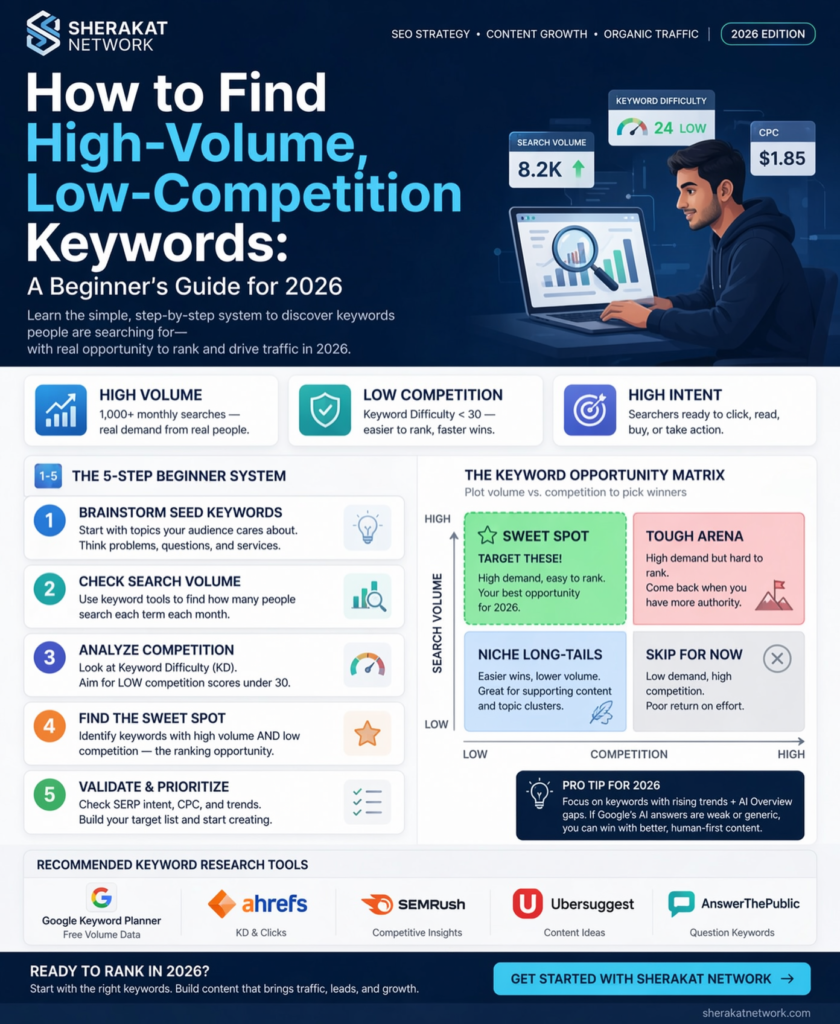
This is the core of the guide. Follow these steps in order. Each builds on the previous one.
Step 1: Brainstorm Seed Topics (Not Keywords)
Before opening any tool, identify broad topics your audience cares about. These aren’t keywords yet—they’re themes.
If you run a personal finance blog for freelancers, your seeds might be:
- Freelance taxes
- Invoicing clients
- Budgeting irregular income
- Retirement planning for self-employed
Notice these are topic clusters, not search phrases. Don’t worry about volume or competition at this stage. You’re building a foundation .
Pro Tip: If you’re stuck, ask yourself: “What questions do my readers ask me most often?” Those questions become seed topics.
Step 2: Expand Seeds with Free Tools
Now take each seed and feed it into keyword research tools. You don’t need paid subscriptions to start.
Google Autocomplete: Type your seed into Google and watch the suggestions appear. These are real queries people type. For more variations, type your seed followed by each letter of the alphabet (seed + “a”, seed + “b”, etc.). This manual approach is tedious but reveals queries no tool will show you.
People Also Ask (PAA): When you search a term, Google displays related questions. Click each one to expand it—Google generates more questions. This is a goldmine of long-tail opportunities with clear intent .
AnswerThePublic: This free tool visualizes questions, prepositions, and comparisons around your seed term. It’s particularly useful for informational content planning .
Google Search Console: If you have an existing site, this is your most valuable free keyword tool. It shows queries you’re already appearing for—including ones where you rank position 5-20. Those are prime opportunities: you’re already visible, and a content optimization push could get you to page one .
Google Keyword Planner: Despite being designed for ads, it provides volume ranges and related keyword suggestions. It’s free with a Google Ads account. The data isn’t perfect for SEO (volume ranges instead of exact numbers), but it helps with directional analysis .
Step 3: Filter for Low Competition (The Right Way)
Here’s where most beginners go wrong. They filter for low difficulty scores in a tool and call it done. That’s insufficient.
Low competition is determined by examining the actual search results page. Before committing to a keyword, Google it and answer these questions :
Who’s ranking? If positions 1-10 are Forbes, Wikipedia, Amazon, and major industry publications, walk away. If you see Reddit threads, Quora answers, small blogs, outdated forum posts, or niche sites, that’s a green light.
What format wins? Is the first page dominated by listicles, tutorials, comparisons, or videos? Match the dominant format or do it better.
What’s missing? Read the top three results. Do they skip a subtopic? Use outdated information (2022 data)? Have poor formatting? That’s your angle.
Is there an AI Overview? If Google answers the query directly in an AI-generated summary, click-through rates drop significantly. Keywords with AI Overviews aren’t necessarily bad—you might get cited—but they require different expectations and strategies .
Real example: I recently targeted “how to reduce WordPress image file size without losing quality.” The first page had: two outdated articles from 2019, one thin YouTube video description, and a Reddit thread. Not a single comprehensive, updated guide. We published a 2,500-word tutorial with fresh screenshots and ranked position 3 within six weeks.
Step 4: Analyze Competitor Keyword Gaps
Your competitors have already done keyword research for you. Their rankings reveal what works in your niche .
Manual method: Pick three competitors. Look at their blog sitemap or use a tool like Ubersuggest (free tier) to see what keywords they rank for. Export the data. Look for keywords where they rank but the competition looks weak—those are your targets.
Tool method: SEO PowerSuite’s Rank Tracker has a “Keyword Gap” module that compares your site against up to five competitors, showing keywords they rank for that you don’t . Similar features exist in paid tools like Ahrefs and Semrush.
The insight most people miss: Your competitors’ weak rankings are often more valuable than their strong ones. A competitor ranking position 8 for a decent-volume keyword signals opportunity—they haven’t fully optimized, and you might leapfrog them.
Step 5: Validate with Search Volume Data
Now you have a list of potentially low-competition keywords. Before writing anything, validate volume.
Free validation tools:
- Google Keyword Planner: Shows volume ranges and 12-month trends
- Google Trends: Reveals seasonality and relative interest over time
- Keyword Surfer (Chrome extension): Displays estimated volume directly in Google search results
- Ubersuggest: Free searches show volume and difficulty
What volume counts as “high”? This is niche-dependent. For a local service business, 200 monthly searches might be high-value. For a broad lifestyle blog, you’d want 1,000+. The key question: does this volume, combined with realistic ranking potential, justify the content investment?
Red flag: Zero-volume keywords. Some SEOs chase these, arguing they’re easy to rank for and convert well. That can be true—but you’ll spend the same time writing content for a zero-volume term as you would for a 500-volume term. Unless the keyword has strategic value (brand building, internal linking hub), prioritize terms with demonstrable demand .
Step 6: Cluster Keywords by Topic
Don’t write one article per keyword. Group related keywords into clusters that share intent.
Example cluster:
- Primary keyword: high volume low competition keywords
- Supporting keywords: how to find low competition keywords, low competition keyword research, high volume keywords for beginners, best low competition keywords 2026
One comprehensive guide (like this one) can rank for all of these. You create topic authority rather than thin content competing with itself .
Clustering rule: If a reader searching Keyword A would be satisfied by the same content that satisfies Keyword B, they belong in the same cluster.
Step 7: Match Content Format to Search Intent
Each keyword has an intent. Your content format must match it .
| Intent Type | Example Query | Content Format |
|---|---|---|
| Informational | “what is keyword research” | Definition guide |
| Informational | “how to find low competition keywords” | Step-by-step tutorial |
| Commercial | “best keyword research tools” | Comparison/list post |
| Commercial | “semrush vs ahrefs” | Comparison review |
| Transactional | “buy seo software” | Product page |
The rule: If the first page shows listicles, write a listicle. If it shows tutorials, write a tutorial. Fighting the dominant format is an uphill battle you don’t need.
Why It’s Important
Targeting high-volume, low-competition keywords isn’t just “good SEO”—it’s the difference between a strategy that compounds and one that wastes months.
For beginners: You cannot out-authority established sites on competitive keywords. You don’t have the domain rating, backlink profile, or brand recognition. Targeting low-competition terms lets you build credibility, traffic, and revenue while you’re still unknown. Every position 1 ranking builds momentum for the next one.
For professionals: Even established sites benefit from low-competition keyword targeting. These keywords often have higher conversion rates (more specific intent), lower content production costs (less need for ongoing optimization battles), and faster time-to-ranking. They’re the “easy wins” that pad your overall SEO performance while you chip away at harder terms.
The compounding effect: Every low-competition keyword you rank for strengthens your site’s topical authority. Google sees you as a legitimate resource on the topic. This makes ranking for the next keyword slightly easier, and the next one after that. Over 12-18 months, this accumulation of small wins creates a site that can eventually compete for moderate-difficulty terms .
What happens if you ignore this: You write ten articles targeting competitive keywords. None rank. Six months pass. You have no traffic, no conversions, no momentum. The psychological impact is brutal—most people quit SEO entirely at this stage, convinced it’s a scam or that only big brands can win.
Sustainability in the Future
Keyword research is not static. What works in 2026 will need adaptation by 2028. Here’s what to watch:
AI Overviews will continue expanding. Semrush’s data shows consistent growth across commercial queries. The keywords that retain click-through value will be those requiring personalization, recent data, or transactional action—things AI can’t fully satisfy in a summary .
Long-tail queries will keep growing. Entertainment searches already show head terms declining at -16% while long-tail grows at +62% year-over-year . As users become comfortable with conversational AI search, this trend accelerates.
Zero-volume keyword tracking will become standard. If you’re only targeting keywords a tool assigns volume to, you’re competing with everyone else using the same tools. The best opportunities often hide in queries too new, too niche, or too conversational for traditional volume estimates .
Brand and entity signals will matter more than exact-match keywords. Google’s systems understand topics, not just phrases. Building topical authority around entities (your brand, key concepts, related people/places) will outperform keyword-focused optimization .
The sustainable approach: Build content around solving real problems, not chasing keyword data. Use keywords as validation that a problem exists, not as the sole driver of your content calendar.
Common Misconceptions
Misconception 1: “Low competition means zero competition.” No keyword worth ranking for has zero competition. Low competition means you can realistically outrank the current results with better content, not that no one else is trying.
Misconception 2: “Low volume keywords aren’t worth targeting.” A keyword with 100 monthly searches that converts at 10% is worth more than a keyword with 10,000 searches that converts at 0.1%. Volume matters, but intent and conversion potential matter more.
Misconception 3: “I need expensive tools to find good keywords.” Free tools (Google Search Console, Autocomplete, PAA, AnswerThePublic, Keyword Planner) can uncover excellent opportunities. Paid tools save time, but they’re not required for the process .
Misconception 4: “Long-tail keywords are always low competition.” Not true. Some long-tail terms are targeted by everyone because they’re obviously valuable. Competition depends on who’s actually ranking, not keyword length .
Misconception 5: “I should target the exact keyword in my title and throughout the content.” Modern SEO rewards semantic coverage and natural language. Keyword stuffing performs below the unoptimized baseline . Write for humans; optimize for clarity and completeness.
Misconception 6: “Once I rank, I’m done.” Rankings decay. Competitors improve. Search intent shifts. Content requires updates. The sites that sustain rankings are those that treat content as a living asset, not a one-time project.
Recent Developments
Three developments in 2025-2026 have reshaped how keyword research works:
1. AI Overviews went mainstream on commercial queries. What began as an informational search feature now appears on 71% more commercial-intent queries than six months ago . This means “best X” and “X vs Y” keywords—traditionally reliable for affiliate and service content—now require strategies for getting cited in AI summaries or targeting queries where AI doesn’t trigger.
2. Google’s AI Mode revealed how users actually search. Google’s own data shows AI Mode queries are triple the length of traditional searches, with follow-up queries growing 40% month-over-month . Users are describing their problems, not just searching keywords. Content that addresses the full problem—not just the keyword—wins.
3. Keyword fragmentation became measurable. Analysis of 1 million keywords showed 40.7% of high-volume terms in decline, but 20.1% growing—with the growing terms carrying enough volume to offset losses . The lesson: search demand isn’t disappearing; it’s redistributing toward more specific, conversational queries.
What this means for your keyword research: Stop looking only at head terms and traditional volume metrics. Start listening to how your audience describes their problems in natural language. Target the specific, conversational queries where AI can’t fully replace the need to visit a website.
Success Stories
Case Study: Local Bakery Blog
A client came to me running a bakery blog with zero traffic after eight months. They’d published 30 recipes targeting keywords like “chocolate cake recipe” and “how to bake bread.” Every post was buried on page 4-8.
What we changed: We stopped targeting recipe keywords and started targeting problem keywords.
- “Why is my bread dense and heavy”
- “How to fix runny cake batter”
- “Bread not rising in cold kitchen”
- “Cake sunk in middle after baking”
These keywords had volumes ranging from 200-1,200 monthly searches. Competition was weak—mostly old forum posts and thin content. We wrote comprehensive troubleshooting guides with photos and videos.
Results after six months:
- 18 of 20 articles ranked page one
- Organic traffic grew from ~50/month to 4,200/month
- Email signups increased 340%
- The bakery’s local delivery orders increased 40% (tracked via a dedicated landing page linked in content)
The key insight: Nobody searches “chocolate cake recipe” looking for troubleshooting help. But someone whose cake just sank searches exactly that—and they’re highly motivated to find an answer.
Case Study: B2B SaaS Content
A project management SaaS company was struggling to rank for competitive terms. We shifted focus to “adjacent problem” keywords:
- “How to manage remote team time zones”
- “Meeting notes template for client projects”
- “How to track billable hours without software”
These terms had lower volume but attracted users with specific pain points the software solved. Content ranked faster, and conversion rates were significantly higher than broad “project management software” traffic.
Real-Life Examples
Example 1: The “Best [Product] Under $X” Opportunity
Search “best standing desk under 300” and examine the results. In many niches, the first page contains outdated reviews, Reddit threads, or thin affiliate sites. A comprehensive, updated buying guide with real photos and testing notes can rank within weeks.
Example 2: The “How to [Specific Task]” Gap
Many “how to” keywords in technical or niche areas have weak results because they require expertise to write well. If you have genuine experience with a topic—whether it’s fixing a specific software error or troubleshooting a craft technique—you have an advantage over generic content writers.
Example 3: The Local Service Niche
“Tax preparer for freelancers” or “dentist for nervous patients” . These local-intent keywords have low competition in most markets, high commercial value, and clear conversion paths. A single well-optimized page can drive consistent leads for years.
Conclusion and Key Takeaways
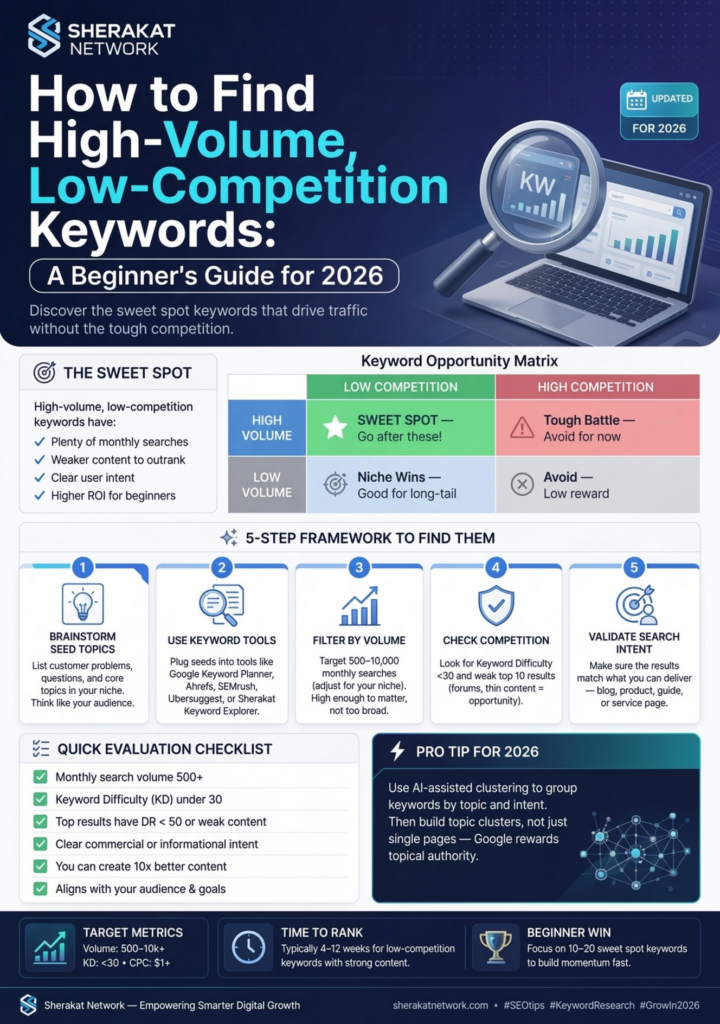
Finding high-volume, low-competition keywords isn’t about secret tools or hacks. It’s about systematic analysis, understanding search intent, and being willing to target the specific, conversational, problem-focused queries that others overlook.
Key Takeaways:
- Low competition means examining actual search results, not just relying on tool difficulty scores
- Google Autocomplete, People Also Ask, and Search Console are free goldmines
- Match content format to search intent—fighting the dominant format wastes effort
- AI Overviews change which keywords drive clicks; target queries requiring personalization, recent data, or action
- Cluster related keywords into comprehensive content rather than thin single-keyword pages
- Validate volume, but don’t ignore zero-volume queries with strategic value
- The compounding effect of small wins beats swinging for home runs
Your next step: Open Google. Type your seed topic. Watch Autocomplete. Click People Also Ask questions. Find one query where the results are weak. Write something better.
That’s how this works—one keyword at a time.
Frequently Asked Questions (FAQs)
Q1: What exactly counts as “low competition” for a keyword?
A: Low competition means the first page of search results contains sites or content types you can realistically outrank—forum posts, outdated articles, thin pages, or small sites. Tool difficulty scores are directional, but the ultimate test is examining who’s actually ranking .
Q2: How many monthly searches should a keyword have to be worth targeting?
A: It depends on your niche and business model. For local services, 100-200 monthly searches can be valuable. For broad content sites, 500+ is a reasonable minimum. The real question: does this volume, combined with conversion potential, justify the content investment?
Q3: Can I find good keywords without paying for Ahrefs or Semrush?
A: Absolutely. Google Search Console, Autocomplete, People Also Ask, AnswerThePublic, Google Keyword Planner, and Google Trends are all free. They require more manual effort but reveal opportunities paid tools often miss .
Q4: What’s the difference between long-tail keywords and low-competition keywords?
A: They overlap but aren’t identical. Long-tail refers to length (usually 4+ words). Low-competition refers to ranking difficulty. Some long-tail keywords are competitive; some short keywords are low competition, especially in niche topics or emerging trends .
Q5: How do I know if a keyword triggers an AI Overview?
A: Just search it. If a generated summary appears above traditional results, that keyword triggers an AI Overview. You can still target these keywords, but set realistic click-through expectations and focus on getting cited as a source .
Q6: What is keyword difficulty, and should I trust it?
A: Keyword difficulty is a calculated score (usually 0-100) estimating ranking difficulty. Trust it as a general guide, but verify by examining actual SERPs. Different tools calculate it differently, and none perfectly predict your specific site’s ability to rank.
Q7: How many keywords should I target per article?
A: One primary keyword (the main topic) and 3-10 supporting keywords (related queries that content naturally covers). This is keyword clustering—it builds topical authority rather than creating competing pages .
Q8: Should I target zero-volume keywords?
A: Sometimes. Zero-volume keywords can convert well because they’re highly specific. But the time investment is the same as targeting a keyword with volume. Prioritize zero-volume terms when they have strategic value (brand building, internal linking, covering a topic gap) .
Q9: How often should I update my keyword research?
A: Review your keyword strategy quarterly. Search behavior shifts, competitors emerge, and AI Overviews expand to new query types. What worked six months ago may need adjustment.
Q10: What’s the biggest mistake beginners make in keyword research?
A: Targeting keywords based solely on what they personally find interesting, without validating that others search for those terms or that the competition is manageable. Passion matters, but demand matters more.
Q11: How do I find keywords my competitors are ranking for?
A: Use tools like Ubersuggest, SEO PowerSuite’s Rank Tracker (Keyword Gap module), or paid alternatives like Ahrefs/Semrush. You can also manually examine competitor sitemaps and blog archives .
Q12: What is search intent, and why does it matter?
A: Search intent is the underlying goal behind a query. Informational intent seeks knowledge; commercial intent compares options; transactional intent wants to buy. Matching your content format to intent is essential—a tutorial won’t rank for a “best products” query .
Q13: Can I rank for competitive keywords with a new site?
A: Realistically, no—not quickly. New sites lack domain authority, backlinks, and brand signals. Target low-competition keywords first to build authority, then gradually pursue more competitive terms as your site strengthens.
Q14: How long does it take to rank for low-competition keywords?
A: Often 4-12 weeks for new content on a site with some existing authority. Brand-new sites may take 3-6 months. Low competition reduces the time required, but indexing, evaluation, and ranking still take time.
Q15: What are seed keywords, and how do I find them?
A: Seed keywords are broad topics that define your niche—not search phrases yet, but themes. Identify them by asking: “What does my audience care about?” Then expand each seed into actual keywords using tools .
Q16: Is keyword density still a ranking factor?
A: No. Keyword stuffing performs below unoptimized content . Modern SEO rewards semantic coverage, natural language, and answering user questions completely—not repeating a phrase a certain number of times.
Q17: How do I research keywords for a local business?
A: Include location modifiers (“[service] in [city]”), target “near me” queries, and focus on specific pain points that local customers have (e.g., “dentist for nervous patients” rather than just “dentist”) .
Q18: What’s a keyword gap analysis?
A: Comparing your site’s rankings against competitors to find keywords they rank for that you don’t. These gaps reveal content opportunities you might have missed .
Q19: Should I use ChatGPT for keyword research?
A: ChatGPT is useful for brainstorming seed topics and content angles, but it lacks real-time search volume and competition data. Use it for ideation, then validate with actual keyword tools .
Q20: How do I know when to give up on a keyword?
A: If you’ve published strong content, waited 3-6 months, built some backlinks, and you’re still not ranking page 1-2, the keyword may be more competitive than initial analysis suggested. Move on—don’t sink more time into a losing battle.
Q21: What’s the relationship between backlinks and keyword targeting?
A: Low-competition keywords often require few or no backlinks to rank—content quality and intent match can be enough. Competitive keywords require backlinks as a prerequisite. This is another reason to start with low-competition terms.
Q22: Can one article rank for multiple keywords?
A: Yes, and it should. A comprehensive article naturally covers related queries. Google understands semantic relationships and will rank one page for multiple phrases if it satisfies the intent behind them .
Q23: How do I find “question” keywords?
A: Use People Also Ask, AnswerThePublic, and search your seed + “how,” “what,” “why,” “when,” “which,” and “can.” Question queries are often informational, low competition, and highly targetable .
Q24: What’s the difference between Google Keyword Planner and a dedicated SEO tool?
A: Keyword Planner is built for ads—it shows volume ranges and CPC data useful for PPC. Dedicated SEO tools show difficulty scores, related keywords, and competitor data more suited to organic strategy. Both have value .
Q25: How do I prioritize which keywords to target first?
A: Rank by: (1) Low competition, (2) Decent volume, (3) Relevance to your business, (4) Your ability to create genuinely better content. Start with the easiest wins to build momentum.
Q26: What role does content length play in ranking for low-competition keywords?
A: Length matters less than completeness. A 1,200-word article that fully answers a question beats a 3,000-word article that rambles. Match the depth to the query—don’t pad for the sake of word count.
Q27: How do I handle seasonal keywords?
A: Plan ahead. Publish and optimize seasonal content 2-3 months before peak season so Google has time to index and evaluate it. Update annually to maintain freshness .
Q28: What are “People Also Ask” keywords, and why are they valuable?
A: PAA questions are queries Google associates with your topic. They represent real user questions, often low competition, and provide clear content structure guidance. Answer them within your article or in dedicated sections.
Q29: Can I do keyword research for YouTube or social media?
A: Yes. YouTube has its own search behavior—target video-specific queries. TikTok’s Creator Search Insights tool shows trending searches. Each platform has unique keyword patterns worth researching separately .
Q30: What’s the one thing I should do differently after reading this guide?
A: Before writing your next article, spend 30 minutes manually examining the search results for your target keyword. Look for weakness. If you see Reddit, forums, or outdated content, you’ve found an opportunity. If you see major brands and perfect content, move on.
About Author
Sana Ullah Khan Kakar, Writer and Article Specialist
This guide was written based on hands-on experience building and ranking websites across multiple niches since 2015, including work with small businesses, SaaS companies, and content publishers. The strategies outlined here have been tested and refined across hundreds of keyword research campaigns.
Free Resources
Keyword Research Tools (Free Tiers Available):
- Google Search Console
- Google Keyword Planner
- AnswerThePublic
- Ubersuggest
- Google Trends
- Keyword Surfer (Chrome extension)
Recommended Reading on Sherakat Network:
Discussion
What’s your biggest challenge with finding low-competition keywords? Have you discovered any techniques that work particularly well in your niche? Share your experiences in the comments below.
If you found this guide helpful, consider sharing it with someone who’s struggling to get their content ranked. The strategies here work—but only if you actually apply them.
Have questions? Reach out via our contact page.