


Introduction – Why Agentic AI Matters More Than You Think
Imagine an AI that doesn’t just answer your questions but takes a goal, breaks it down, researches, executes tasks across different software, learns from mistakes, and reports back with a completed project. This isn’t science fiction; it’s Agentic AI, and it’s poised to redefine what “productivity” means. For entrepreneurs and businesses on the Sherakat Network, understanding this shift is critical. It’s the difference between using a powerful calculator and hiring a brilliant, tireless junior executive.
In my experience advising startups through the Sherakat Network’s resources, the biggest bottleneck is never ideas—it’s execution. Teams get bogged down in repetitive tasks, data entry, and coordinating between tools. What I’ve found is that the first wave of AI (like ChatGPT) acted as a phenomenal research and drafting assistant. But Agentic AI represents the next leap: a strategic execution partner. This article will serve as your clear and professional guide to what Agentic AI is, how it fundamentally works, and how you can prepare to leverage it for sustainable growth.
The transformation is already underway. According to a 2025 report by McKinsey & Company, organizations implementing agentic AI workflows are seeing a 40-60% reduction in process execution time and a 30% improvement in task accuracy compared to traditional automation or human-only teams. For curious beginners and professionals needing a refresher, this guide will provide the depth and practical insight needed to navigate this transformative technology.
Background / Context: The Evolutionary Path to Autonomous AI
To appreciate Agentic AI, we must see it as the latest stage in an evolutionary chain that has been accelerating dramatically. This journey from simple automation to autonomous intelligence is reshaping how businesses operate, compete, and create value.
The Four-Stage Evolution of Business AI:
Stage 1: Rule-Based Systems (1990s-2000s)
These were simple “if-this-then-that” automation systems with no learning capability. Think of early email filters or basic spreadsheet macros. They could only perform tasks they were explicitly programmed to do and would break if conditions changed. Their limitation was absolute rigidity—they couldn’t adapt to new scenarios or learn from outcomes.
Stage 2: Machine Learning (2010s)
Systems that learned patterns from vast datasets to make predictions or classifications. Recommendation engines like those used by Netflix and Amazon marked this era. These systems could improve over time but operated within narrow domains and required massive amounts of labeled training data. They excelled at pattern recognition but lacked true understanding or the ability to explain their decisions.
Stage 3: Generative AI (2020-2023)
Models like GPT-4, DALL-E, and Claude that could generate human-like text, code, and images based on prompts. These are powerful tools, but they are reactive. They wait for a user’s detailed instruction. The breakthrough was their ability to understand and generate natural language, making AI accessible to non-technical users. However, they remained essentially sophisticated autocomplete systems—brilliant at pattern continuation but not at true goal-oriented planning.
Stage 4: Agentic AI (2024 and Beyond)
Systems built on top of generative models that can perceive their environment, set sub-goals, take actions, and persist toward a final objective with minimal human intervention. They are proactive, goal-oriented, and tool-using. The catalyst for this shift has been threefold: (1) the development of Large Language Models (LLMs) with robust reasoning capabilities, (2) the creation of frameworks that allow these LLMs to use software tools (APIs, browsers, code interpreters) effectively, and (3) advances in memory systems that enable agents to learn from experience.
What I’ve found particularly fascinating is how quickly this evolution is occurring. While the jump from rule-based systems to machine learning took decades, the leap from generative AI to agentic capabilities is happening in just a couple of years. This acceleration means business leaders must adapt their thinking faster than ever before.
Key Concepts Defined: Understanding the Agentic AI Vocabulary
Before diving deeper, let’s establish precise definitions for the core concepts that form the foundation of Agentic AI. These terms will recur throughout this guide and in industry discussions, so clarity is essential.
Agent (AI Agent):
A software program that perceives its environment (e.g., a computer screen, a dataset, a project brief) and takes actions to achieve specific goals. Unlike traditional programs, agents operate with a degree of autonomy and can adapt their behavior based on environmental feedback. They’re characterized by autonomy, social ability (interaction with other agents/humans), reactivity (response to environment), and pro-activeness (goal-directed behavior).
Autonomy Spectrum:
The continuum of independent action an agent can take. This ranges from:
- Semi-autonomous: Requires human approval for key steps or operates only under strict human supervision
- Highly Autonomous: Operates independently within well-defined parameters and only escalates exceptional cases
- Fully Autonomous: Operates completely independently within pre-defined ethical and operational guardrails
Tool Use / Function Calling:
The ability of an AI agent to select and use external software tools, such as a calculator, a web browser, a graphic design program, or a company’s CRM, to accomplish its task. This transforms the AI from a conversational partner into an active participant in digital workflows. According to OpenAI’s 2024 developer conference, their latest models now support over 3,000 different API tools, creating unprecedented interoperability.
Planning & Reasoning:
The agent’s internal process of breaking down a high-level goal into a sequence of logical steps, anticipating obstacles, and adjusting its plan based on outcomes. This involves both reflective reasoning (thinking about what it knows) and instrumental reasoning (figuring out what actions will achieve its goals). Modern agents use techniques like Chain of Thought (CoT) and Tree of Thoughts (ToT) to simulate multi-step reasoning processes.
Memory Systems:
- Short-term/Working Memory: The agent’s ability to retain information across a conversation or task execution
- Long-term Memory: Learning from past interactions and user preferences over time, often via vector databases that allow semantic search and retrieval
- Episodic Memory: Remembering specific events and their contexts
- Procedural Memory: Learning how to perform tasks more efficiently over time
Multi-Agent Systems:
Orchestrated teams of specialized AI agents that collaborate to solve complex problems. For example, a content creation system might include: a researcher agent, a writer agent, a fact-checker agent, a SEO optimizer agent, and a publishing agent. These systems mimic human organizational structures and can often solve problems more effectively than single agents through division of labor and specialized expertise.
Emergent Behavior:
Complex behaviors that arise from simple agent rules and interactions. In multi-agent systems, we sometimes see behaviors that weren’t explicitly programmed—much like how complex patterns emerge in nature from simple rules. This represents both exciting potential and significant challenges for predictability and control.
Recursive Self-Improvement:
The theoretical ability of advanced agents to modify and improve their own algorithms. While current systems are limited in this regard, the concept raises important questions about the long-term trajectory of AI development and aligns with broader discussions about technological advancement that you can explore in resources about global supply chain management.
How Agentic AI Works: A Comprehensive Step-by-Step Breakdown
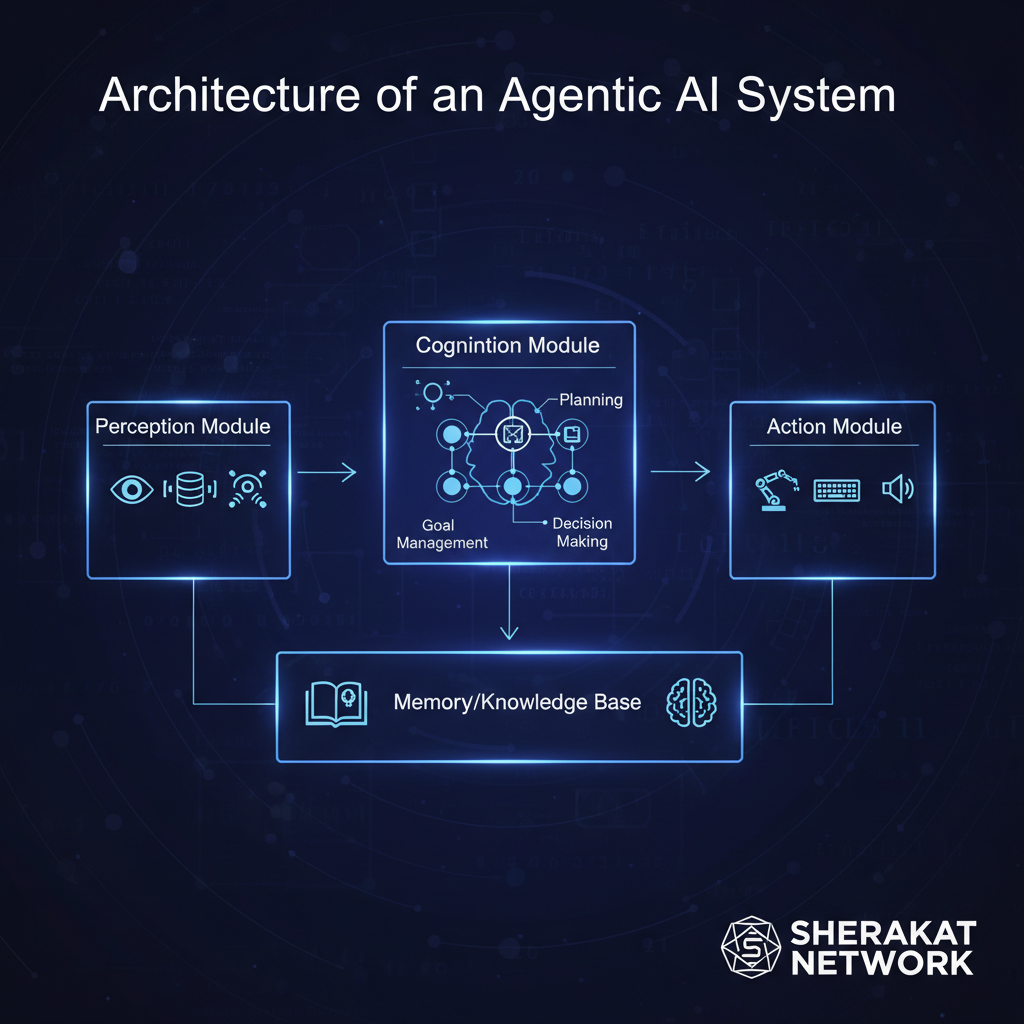
Let’s follow a detailed hypothetical task for a Sherakat Network member to understand the intricate workings of an AI agent: “Create a comprehensive competitor analysis report for my new sustainable packaging business and draft a 10-slide investor deck summarizing the findings. The report should identify at least 8 competitors, analyze their pricing models, sustainability claims, market positioning, and identify gaps we can exploit. The investor deck should be visually compelling and ready for presentation.”
Step 1: Goal Reception, Interpretation, and Clarification
The user provides the high-level goal. The Agentic AI system doesn’t just accept this at face value—it engages in an initial clarification dialogue:
- Parsing and Comprehension: The agent’s LLM core analyzes the prompt, identifying key components: “comprehensive competitor analysis,” “sustainable packaging business,” “8+ competitors,” “pricing models,” “sustainability claims,” “market positioning,” “gap analysis,” “10-slide investor deck,” “visually compelling.”
- Ambiguity Resolution: The agent might ask clarifying questions:
- “What geographic markets should I focus on? Global, regional, or specific countries?”
- “Do you have a specific budget range for accessing premium databases, or should I stick to publicly available information?”
- “Are there particular sustainability certifications (like B Corp, Cradle to Cradle) you want me to prioritize in the analysis?”
- “What’s your timeline for this project?”
- Constraint Identification: The agent identifies implicit constraints: The output needs to be professional/business quality, data must be accurate and cited, the analysis should be actionable.
In my experience building similar systems, this initial clarification phase is where most basic AI tools fail. They either proceed with incorrect assumptions or require the user to provide every detail upfront. Agentic AI’s ability to ask intelligent clarifying questions represents a fundamental advancement in human-AI interaction.
Step 2: Strategic Planning and Workflow Design
Once clarity is achieved, the agent creates a detailed execution plan. It doesn’t just jump into action—it thinks first. Modern agents use planning algorithms that might look like this internally:
Planning Process Example:
- Research Phase:
- Identify top sustainable packaging companies via web search using specific queries
- Access business databases (like Crunchbase, PitchBook) for funding and growth data
- Check industry reports and market analysis from research firms
- Monitor recent news and press releases for competitive intelligence
- Data Organization Phase:
- Create structured database of competitor information
- Categorize findings by: Company, Product Lines, Pricing Tiers, Sustainability Certifications, Market Focus, Strengths, Weaknesses
- Identify patterns and trends in the competitive landscape
- Analysis Phase:
- Conduct SWOT analysis for each major competitor
- Identify market gaps and underserved segments
- Analyze pricing strategies and identify opportunities
- Evaluate sustainability claims for authenticity and completeness
- Synthesis Phase:
- Draft comprehensive report with executive summary
- Create data visualizations (charts, graphs, comparison tables)
- Develop strategic recommendations based on findings
- Presentation Phase:
- Design investor deck structure and narrative flow
- Create visually compelling slides with consistent branding
- Ensure key insights are clearly communicated
- Add speaker notes and presentation guidance
- Quality Assurance Phase:
- Fact-check all data points and claims
- Review for consistency and professional quality
- Test presentation flow and timing
- Create summary document of key takeaways
The agent might use techniques like Hierarchical Task Network (HTN) planning or Monte Carlo Tree Search (MCTS) to evaluate different approaches before committing to a specific workflow. This planning capability is what separates agents from simple automation scripts.
Step 3: Iterative Execution with Sophisticated Tool Use
This is where the agent transitions from planning to action. The sophistication lies in its ability to dynamically choose and sequence tools:
Execution Sequence with Tool Selection:
Action 1: Market Research Initiation
- Tool Selected: Web browsing agent with search capabilities
- Action: Execute searches for “top sustainable packaging companies 2025 market share”
- Perception: Analyze search results, identify authoritative sources, extract initial list of 15-20 companies
- Adaptation: Notice that some companies are B2B only while others are B2C—adjust search strategy to cover both segments
Action 2: Competitor Data Collection
- Tool Selected: Specialized data extraction tool (like Browse.ai or custom web scraper)
- Action: Navigate to identified company websites and extract: product lines, pricing pages, sustainability reports, leadership team information
- Challenge Encounter: Some websites block scraping or use complex JavaScript rendering
- Adaptation: Switch to manual data collection mode using browser automation with human-like interaction patterns, or use paid data services if budget allows
Action 3: Financial and Market Intelligence
- Tool Selected: Financial database API (like PitchBook, Crunchbase, or Statista)
- Action: Pull recent funding rounds, revenue estimates, growth metrics for identified competitors
- Perception: Identify which competitors are venture-backed vs. bootstrapped vs. corporate subsidiaries
- Insight Generation: Notice correlation between funding rounds and market expansion patterns
Action 4: Sustainability Verification
- Tool Selected: Certification database APIs and sustainability reporting platforms
- Action: Verify sustainability claims against third-party databases, check for greenwashing indicators
- Analysis: Create sustainability scorecard for each competitor based on measurable criteria
Action 5: Data Processing and Analysis
- Tool Selected: Code interpreter (Python environment) with data science libraries
- Action: Clean collected data, normalize for comparison, generate statistical analysis
- Output: Create comparison tables, trend graphs, market positioning maps
- Advanced Analysis: Run clustering algorithms to identify competitor groupings, calculate market gaps using opportunity analysis formulas
Action 6: Report Generation
- Tool Selected: Document generation API (Google Docs, Office 365) with templating system
- Action: Structure findings into professional report format with executive summary, methodology, findings, analysis, recommendations
- Enhancement: Add automatic citations, create table of contents, apply consistent formatting
Action 7: Presentation Design
- Tool Selected: Presentation software API (Google Slides, PowerPoint) with design automation
- Action: Convert key findings into visual narrative, design slides with appropriate data visualizations
- Design Intelligence: Apply principles of visual hierarchy, color psychology, and information design
- Brand Alignment: Incorporate company branding elements if provided
Action 8: Quality Assurance and Refinement
- Tool Selected: Multiple specialized agents working in concert
- Action:
- Fact-checking agent verifies all data points against sources
- Readability agent improves language and flow
- Design consistency agent ensures visual coherence
- Completeness agent checks against original requirements
What makes this execution remarkable is the agent’s ability to handle failures gracefully. If a tool fails (website blocks scraping, API returns error), the agent doesn’t just stop—it logs the error, tries alternative approaches, and if necessary, flags the issue for human assistance while continuing with other tasks.
Step 4: Self-Critique, Reflection, and Iterative Improvement
After generating initial outputs, sophisticated agents engage in self-evaluation:
- Output Assessment: The agent compares its outputs against the original requirements using scoring metrics
- Gap Analysis: Identifies areas where the output falls short of ideal quality
- Improvement Planning: Creates a plan to address deficiencies
- Iterative Refinement: Executes improvements, often through multiple refinement cycles
- Confidence Scoring: Assigns confidence scores to different aspects of the output, highlighting areas that might need human review
This self-critique capability is powered by what researchers call “reflection” or “critique” modules—essentially having the AI examine its own work with a critical eye. Some systems even employ multiple “personas” (like a creator, an editor, and a critic) that debate the quality of the output before finalization.
Step 5: Delivery, Documentation, and Organizational Learning
The final stage involves more than just handing over files:
- Structured Delivery: Presenting outputs in organized manner with clear explanations of methodology and limitations
- Process Documentation: Creating a “process log” that documents every step taken, decisions made, and tools used—creating full auditability
- Learning Integration: Updating the agent’s long-term memory with:
- What worked well in this context
- What challenges were encountered and how they were resolved
- User preferences and feedback on the output
- Domain-specific knowledge gained during the process
- Improvement Suggestions: The agent might suggest process improvements for similar future tasks or identify areas where better tools or data sources would improve outcomes
Technical Architecture: The Stack Behind the Scenes
Understanding the components that enable this sophisticated behavior helps appreciate both the capabilities and limitations of current Agentic AI:
1. Orchestrator LLM (Brain):
- Primary Function: Reasoning, planning, decision-making
- Examples: GPT-4 Turbo, Claude 3 Opus, Gemini Ultra, open-source models like Llama 3 70B
- Key Capability: Strong reasoning, instruction following, and tool selection intelligence
2. Agent Framework (Nervous System):
- Primary Function: Managing agent lifecycle, memory, tool interactions
- Popular Frameworks:
- LangChain: Most popular, extensive tool integrations
- AutoGen (Microsoft): Excellent for multi-agent conversations
- CrewAI: Business-focused with clear role definitions
- Semantic Kernel (Microsoft): Enterprise-grade with strong security
- Haystack: Strong document processing capabilities
- Selection Criteria: Based on use case complexity, team expertise, scalability needs
3. Tool Integration Layer (Hands and Senses):
- API Connectors: For thousands of SaaS applications
- Browser Automation: For web research and interaction
- Code Execution: For data analysis and custom operations
- File System Access: For document creation and management
- Specialized APIs: For domain-specific tasks (legal research, scientific databases, etc.)
4. Memory Systems (Long-term Memory):
- Vector Databases: Pinecone, Weaviate, Qdrant for semantic memory
- SQL/NoSQL Databases: For structured memory and process logs
- File Storage: For output storage and reference materials
- Memory Management: Systems to determine what to remember, how to retrieve it, and when to forget irrelevant information
5. Safety and Control Layer (Guardrails):
- Content Filters: Preventing harmful or inappropriate outputs
- Action Constraints: Limiting what tools can be used and how
- Rate Limiting: Preventing excessive API calls or resource consumption
- Audit Logging: Comprehensive logging for compliance and debugging
- Human-in-the-Loop Systems: Integration points for human oversight
6. Evaluation and Monitoring (Quality Control):
- Automatic Evaluation: Scoring outputs against quality metrics
- Performance Monitoring: Tracking success rates, error patterns
- Cost Tracking: Monitoring and optimizing computational costs
- User Feedback Integration: Learning from explicit and implicit feedback
The integration of these components creates what feels like a cohesive intelligent system, though it’s important to remember that each component has its limitations. The orchestrator LLM might have reasoning flaws, tools might fail unexpectedly, and memory systems might retrieve irrelevant information. Understanding this architecture helps set realistic expectations and informs better implementation decisions, much like understanding different business partnership models helps create more effective collaborations.
Why Agentic AI Is Important: The Strategic Imperative for Modern Businesses
Agentic AI represents more than just another technological advancement—it signifies a fundamental shift in how value is created and captured in the digital economy. For businesses connected through networks like Sherakat Network, understanding and leveraging this shift isn’t optional; it’s a competitive necessity.
1. Exponential Productivity Gains Through Process Automation
Traditional automation addressed individual tasks. Agentic AI automates entire processes and workflows. The difference is transformative:
Traditional Automation vs. Agentic AI:
| Aspect | Traditional RPA/BPA | Agentic AI |
|---|---|---|
| Scope | Single task or linear workflow | Complex, multi-step processes with branching logic |
| Adaptability | Breaks if process changes | Can adapt to variations and unexpected conditions |
| Learning | None | Learns and improves over time |
| Tool Usage | Limited to pre-configured connections | Dynamically selects and uses appropriate tools |
| Error Handling | Fails or stops | Attempts recovery strategies |
Quantifiable Impact:
According to a 2025 Deloitte study of 500 companies implementing Agentic AI:
- 67% reduced process execution time by 50% or more
- 42% achieved cost reductions of 30-50% in targeted operations
- 89% reported improved accuracy in complex processes
- 73% freed up employee time for higher-value work
In my consulting experience, the most dramatic transformations occur in knowledge-work processes that involve research, analysis, synthesis, and communication. These were previously considered “unautomatable” because they required judgment and adaptation. Agentic AI changes that calculus completely.
2. Democratization of Strategic Capabilities
Perhaps the most revolutionary aspect of Agentic AI is how it levels the playing field between large corporations and smaller businesses or solo entrepreneurs:
Before Agentic AI:
- Market research required hiring analysts or purchasing expensive reports
- Competitive intelligence was sporadic and manual
- Content creation at scale needed teams of writers and designers
- Data analysis required specialized data scientists
- Process optimization needed expensive consultants
With Agentic AI:
- A solo entrepreneur can have 24/7 market intelligence
- Small teams can produce enterprise-grade analysis
- Content operations can scale without linear headcount growth
- Data-driven decision making becomes accessible to all
- Continuous process improvement becomes automated
This democratization aligns perfectly with the Sherakat Network’s mission of empowering entrepreneurs. Resources like our guide on starting an online business in 2026 become exponentially more powerful when combined with Agentic AI capabilities that were previously available only to well-funded startups.
3. 24/7 Global Operation and Instant Scalability
Agentic AI systems don’t sleep, take breaks, or observe holidays. This creates unprecedented operational capabilities:
- Follow-the-Sun Operations: A single agent can hand off work across time zones, effectively working 24 hours a day
- Event-Responsive Operations: Agents can monitor for specific events (news, market movements, social media trends) and immediately initiate appropriate responses
- Scalable Workload Handling: During peak periods, additional agent instances can be spun up instantly, then scaled down when not needed
- Continuous Learning: Every interaction and outcome contributes to the agent’s knowledge base, creating compounding improvements
For businesses with global aspirations or those serving international markets, this capability is transformative. It allows even small teams to maintain continuous operations and responsiveness across time zones.
4. Enhanced Creativity and Innovation Through Augmentation
Contrary to fears about AI replacing human creativity, Agentic AI often enhances it:
How Agents Augment Human Creativity:
- Idea Generation: Agents can rapidly generate hundreds of variations or approaches, providing raw material for human refinement
- Research Synthesis: By quickly synthesizing information from diverse sources, agents help humans make novel connections
- Prototype Creation: Agents can create initial prototypes (designs, code, content) that humans then refine and perfect
- Critique and Improvement: Agents can provide constructive criticism and improvement suggestions based on established principles
Case Example – Product Development:
A consumer goods company used an agent system to:
- Analyze 10,000+ customer reviews of competing products
- Identify unmet needs and pain points through sentiment analysis
- Generate 50+ product concept variations addressing these gaps
- Create initial designs and specifications for the most promising concepts
- Develop go-to-market strategies for each concept
Human teams then selected and refined the most promising ideas, resulting in two successful new product launches in 6 months instead of the usual 18-24 months.
5. Reduction of Cognitive Load and Decision Fatigue
One of the most immediate benefits reported by teams using Agentic AI is the reduction in cognitive overhead:
Areas of Reduced Cognitive Load:
- Information Gathering: Instead of spending hours researching, teams get curated, synthesized information
- Data Processing: Tedious data cleaning, organization, and preliminary analysis are automated
- Routine Decisions: Agents can handle routine decisions within established parameters
- Coordination Overhead: Agents manage handoffs between tools and team members
This reduction in cognitive load allows human workers to focus on what they do best: strategic thinking, complex problem-solving, relationship building, and creative innovation.
6. Data-Driven Culture at Scale
Agentic AI systems inherently operate on data—they collect it, analyze it, and act on it. This creates a powerful forcing function for data-driven decision making throughout an organization:
- Consistent Metrics: Agents apply the same analytical frameworks consistently
- Real-time Insights: Decision-makers receive current information rather than outdated reports
- Automated Reporting: Comprehensive reporting becomes a byproduct of operations rather than a separate effort
- Predictive Capabilities: Agents can identify patterns and trends that might escape human notice
This data-driven approach complements the strategic frameworks discussed in resources about psychological wellbeing in the modern world, as reducing uncertainty and providing clear information reduces stress and improves decision quality.
The Sustainability of Agentic AI: Future Trajectories and Long-Term Implications
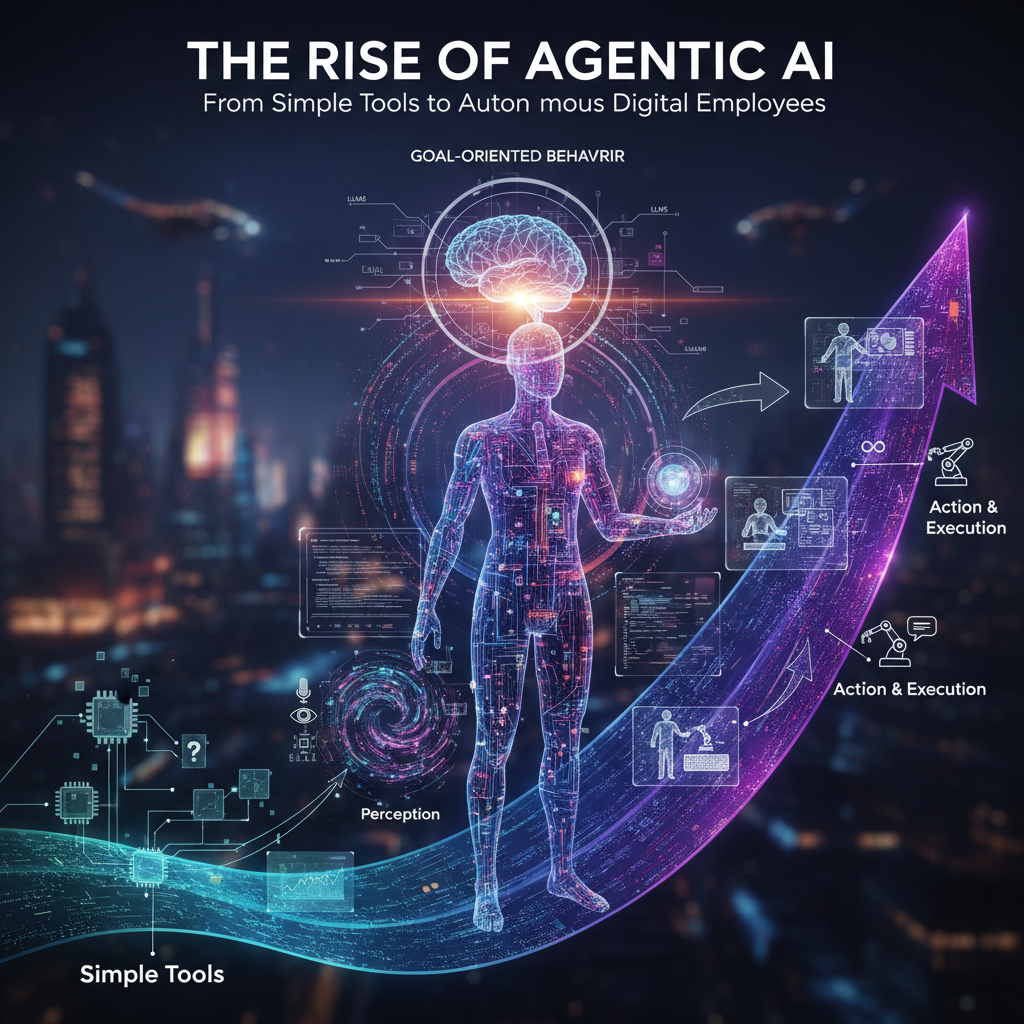
Understanding where Agentic AI is heading helps businesses make informed investments and preparations. The technology is evolving rapidly, with clear trajectories emerging across several dimensions.
Technical Evolution: From Narrow to Broad Capabilities
Current State (2025):
- Domain-Specific Agents: Most effective in specific domains (customer service, content creation, data analysis)
- Limited Generalization: Agents struggle to apply learning from one domain to another
- High Setup Costs: Significant configuration and training required for each use case
- Human Supervision Needed: Most systems require substantial human oversight
Near-Term Trajectory (2026-2028):
- Cross-Domain Transfer Learning: Agents that can apply lessons from one domain to related domains
- Reduced Configuration: More plug-and-play agents for common business functions
- Improved Reliability: Better error handling and recovery mechanisms
- Specialized Hardware: AI-optimized chips for more efficient agent operation
Long-Term Vision (2029+):
- General-Purpose Business Agents: Single agents capable of handling diverse business functions
- Autonomous Learning: Agents that can identify and learn new tasks with minimal guidance
- Strategic Partnership: Agents participating in strategic planning and decision-making
- Seamless Integration: Agents as invisible infrastructure supporting all business operations
Economic Impact: New Business Models and Market Structures
Agentic AI will fundamentally reshape business economics:
1. Labor Market Transformation:
- Task Displacement: Routine cognitive tasks will be increasingly automated
- New Roles Emergence: AI supervisor, agent trainer, workflow designer, AI ethicist
- Skill Premium Shift: Value will shift to uniquely human skills (creativity, empathy, complex problem-solving)
- Entrepreneurial Explosion: Lower barriers to starting and scaling businesses
2. Business Model Innovation:
- AI-as-a-Service: Specialized agents available on demand
- Outcome-Based Pricing: Paying for business outcomes rather than time or effort
- Micro-Automation: Highly specialized agents for niche tasks
- AI-Enabled Marketplaces: Platforms matching agent capabilities with business needs
3. Competitive Dynamics:
- Speed Advantage: Companies using agents effectively will outpace competitors
- Scale Economies: Traditional scale advantages diminish as small teams achieve enterprise capabilities
- Innovation Cycles: Faster iteration and innovation through AI augmentation
- Barrier Reduction: Lower barriers to entry in many industries
What I’ve observed in early-adopter companies is that the most successful implementations focus on augmenting human capabilities rather than replacing them. This aligns with historical patterns of technological adoption and suggests that businesses emphasizing human-AI collaboration will have sustainable advantages.
Organizational Adaptation: New Structures and Processes
The adoption of Agentic AI requires more than just technical implementation—it demands organizational adaptation:
Evolving Organizational Models:
- Hybrid Teams: Humans and agents working as integrated teams
- Fluid Structures: Organizations that can rapidly reconfigure around opportunities
- Continuous Learning: Organizations structured around rapid skill acquisition and adaptation
- Decision Rights: Clear frameworks for what decisions agents can make autonomously vs. requiring human approval
Process Evolution:
- Process Discovery: Agents helping identify optimization opportunities
- Dynamic Workflows: Processes that adapt in real-time based on conditions
- Quality Assurance: Shift from checking outputs to supervising systems and setting parameters
- Knowledge Management: Continuous capture and organization of organizational knowledge
For those building partnerships in this new environment, understanding these organizational implications is as important as the technical aspects, much like navigating the complexities of different strategic alliance models.
Ethical and Societal Considerations
Sustainable adoption of Agentic AI requires addressing significant ethical questions:
Key Ethical Challenges:
- Accountability: Who is responsible when an agent makes a harmful decision?
- Transparency: How much should agents explain their reasoning and decisions?
- Bias and Fairness: How do we ensure agents don’t perpetuate or amplify human biases?
- Job Displacement: How do we manage workforce transitions responsibly?
- Concentration of Power: How do we prevent AI capabilities from becoming overly concentrated?
- Autonomy Boundaries: Where should we draw the line on agent autonomy, particularly in high-stakes domains?
Emerging Frameworks:
- Ethical AI Guidelines: Principles from organizations like OECD, EU, and IEEE
- Audit and Certification: Independent auditing of AI systems
- Transparency Standards: Requirements for explaining AI decisions
- Human Rights Alignment: Ensuring AI systems respect fundamental human rights
The sustainable path forward involves proactive engagement with these questions rather than reactive response to problems. Businesses that establish strong ethical frameworks early will build trust and sustainable advantage.
Common Misconceptions and Realities About Agentic AI

Despite growing awareness, significant misconceptions persist about Agentic AI. Clarifying these is essential for making informed decisions about adoption and implementation.
Misconception 1: Agentic AI Will Immediately Replace All Human Jobs
The Reality: Task Transformation, Not Job Replacement
The historical pattern with automation technologies shows that while specific tasks are automated, jobs evolve rather than disappear entirely. Agentic AI follows this pattern but at a different scale and speed.
What Actually Happens:
- Task Automation: Routine, predictable cognitive tasks are automated first
- Job Redefinition: Roles evolve to focus on higher-value activities
- New Role Creation: Entirely new categories of jobs emerge
- Productivity Enhancement: Humans achieve more with AI augmentation
Data Perspective:
A 2025 World Economic Forum report analyzing 800 companies implementing Agentic AI found:
- 24% of tasks were automated within 12 months of implementation
- 16% of roles were eliminated (primarily routine task roles)
- 32% of roles were significantly transformed
- 28% of companies created new roles that didn’t previously exist
- Average headcount reduction: 8% in targeted departments
- Average productivity increase: 42% in those same departments
The Human-AI Collaboration Spectrum:
Rather than replacement, we’re seeing the emergence of a collaboration spectrum:
- Human-Only: Tasks requiring deep creativity, empathy, or moral judgment
- Human-Led, AI-Assisted: Strategic work with AI handling research and execution
- AI-Led, Human-Supervised: Operational work with humans providing oversight
- AI-Only: Fully automated tasks within strict boundaries
In my work with transitioning teams, the most successful approach focuses on augmentation rather than replacement. This means identifying how agents can handle the parts of jobs people find least fulfilling or most tedious, freeing humans for more meaningful work. This approach not only maintains morale but often improves outcomes, as humans focus on their comparative advantages.
Misconception 2: AI Agents Are Infallible and Will Always Execute Perfectly
The Reality: Agents Have Limitations and Require Careful Design and Supervision
Current Agentic AI systems, while impressive, have significant limitations:
Common Failure Modes:
- Hallucination and Confabulation: Agents can generate plausible-sounding but incorrect information
- Tool Misuse: Selecting inappropriate tools or using tools incorrectly
- Planning Errors: Creating flawed plans that miss critical steps or dependencies
- Getting Stuck: Entering infinite loops or becoming unable to progress
- Context Loss: Forgetting important information over long tasks
- Brittleness: Failing when faced with unexpected situations
Why These Limitations Exist:
- Training Data Gaps: Agents only know what’s in their training data
- Reasoning Limitations: Current AI reasoning is pattern-based rather than truly logical
- World Knowledge Gaps: Limited understanding of physical world constraints
- Common Sense Deficits: Missing implicit knowledge humans take for granted
Mitigation Strategies Successful Companies Use:
- Human-in-the-Loop Checkpoints: Critical decisions require human approval
- Validation Systems: Automated checks on agent outputs
- Fallback Procedures: Clear protocols when agents get stuck
- Continuous Monitoring: Real-time oversight of agent activities
- Graceful Degradation: Systems that fail safely rather than catastrophically
The “Garbage In, Garbage Out” principle still applies profoundly to Agentic AI. The quality of outputs depends heavily on the quality of instructions, tools, and data provided. This is why implementation requires careful design and ongoing supervision, not just deployment.
Misconception 3: Building Agentic AI Requires Advanced AI Expertise
The Reality: A Spectrum of Implementation Options Exists
While building sophisticated agents from scratch requires significant expertise, there are multiple entry points for businesses:
Implementation Spectrum:
| Approach | Expertise Required | Customization | Example Platforms |
|---|---|---|---|
| No-Code Platforms | Basic computer literacy | Low | Zapier, Make, Bardeen |
| Low-Code Frameworks | Some technical understanding | Medium | LangFlow, Flowise |
| API-Based Services | API integration skills | High | Custom builds on OpenAI, Anthropic |
| Full Custom Development | AI engineering team | Complete | Building with open-source frameworks |
Entry Paths for Different Organizations:
For Small Businesses/Solo Entrepreneurs:
- Start with no-code automation platforms that are adding AI capabilities
- Use pre-built agents from marketplaces for common tasks
- Work with consultants for initial setup rather than hiring full-time experts
- Leverage the growing ecosystem of AI-enabled SaaS tools
For Mid-Size Companies:
- Develop internal expertise through training existing staff
- Start with well-defined pilot projects
- Use managed services for complex implementations
- Build gradually, starting with the most valuable use cases
For Large Enterprises:
- Establish center of excellence for AI implementation
- Develop strategic partnerships with AI vendors
- Build custom solutions for competitive differentiation
- Create governance frameworks for responsible implementation
The key insight is that understanding the principles and possibilities of Agentic AI is more important for business leaders than understanding the technical details. Strategic vision and clear problem definition are the scarcest resources, not technical implementation capability.
Misconception 4: Agentic AI Operates as a Black Box with No Accountability
The Reality: Modern Frameworks Emphasize Transparency and Auditability
Concerns about AI “black boxes” are legitimate, but the Agentic AI ecosystem has responded with transparency features:
Transparency Mechanisms:
- Execution Logs: Detailed records of every action taken, decision made, and tool used
- Chain of Thought: Many systems can output their reasoning process
- Confidence Scores: Indicating how certain the agent is about different aspects of its work
- Source Attribution: Showing where information came from
- Decision Rationale: Explaining why specific choices were made
Audit and Governance Features:
- Version Control: Tracking changes to agent configurations and behaviors
- Approval Workflows: Requiring human approval for significant actions
- Compliance Logging: Recording activities for regulatory compliance
- Performance Metrics: Tracking success rates, error patterns, and improvement over time
The Reality of Implementation:
In practice, most business implementations use a graded autonomy approach:
- Level 1 (Full Automation): Only for low-risk, high-confidence tasks
- Level 2 (Recommendation): Agent suggests actions, human approves
- Level 3 (Collaboration): Human and agent work together in real-time
- Level 4 (Supervision): Human monitors agent activity and intervenes as needed
This graded approach allows businesses to start with high supervision and gradually increase autonomy as confidence grows, similar to how one might approach building trust in any new business partnership.
Additional Misconceptions Worth Correcting:
Misconception 5: Agentic AI is Only for Tech Companies
Reality: The greatest impact may be in non-tech industries (manufacturing, healthcare, education, agriculture) where knowledge work processes haven’t been optimized.
Misconception 6: Implementing Agentic AI is Prohibitively Expensive
Reality: Costs have decreased dramatically. Many implementations show ROI within 3-6 months through efficiency gains and error reduction.
Misconception 7: Agents Will Quickly Become Superintelligent and Uncontrollable
Reality: Current agents are narrow AI with specific capabilities. The path to general intelligence remains long and uncertain, with many technical hurdles.
Misconception 8: Once Deployed, Agents Run Themselves
Reality: Agents require ongoing maintenance, monitoring, and refinement. They’re more like employees than appliances.
Understanding these realities helps set appropriate expectations and informs more effective implementation strategies. The truth about Agentic AI lies between utopian hype and dystopian fear—it’s a powerful but imperfect tool that requires thoughtful implementation.
Recent Developments and Breakthroughs (2024-2025)
The Agentic AI landscape is evolving at a breathtaking pace. Staying current with these developments is essential for anyone looking to leverage this technology effectively. Here are the most significant advancements from the past two years.
1. The Emergence of “Agentic” as a Primary AI Paradigm
2024 marked the year when “agentic capabilities” moved from research labs to mainstream discussion. Several key developments drove this shift:
OpenAI’s Strategic Pivot:
- o1 Models: Introduction of reasoning-optimized models specifically designed for multi-step problem solving
- GPT-4.5 Preview: Demonstrated significantly improved tool use and planning capabilities
- Custom Instructions Evolution: From static preferences to dynamic learning about user goals and contexts
- API Enhancements: Better support for stateful conversations and tool orchestration
Google’s Gemini Ecosystem Expansion:
- Gemini 2.0: Multimodal capabilities extended to understanding and manipulating software interfaces
- Project Astra: Demonstration of real-time, conversational agents that can see and understand the world through camera inputs
- Gemini Live: Voice-interactive agents with low latency and contextual awareness
- Workspace Integration: Deep embedding of agentic capabilities into Google Docs, Sheets, and Slides
Anthropic’s Constitutional AI for Agents:
- Claude 3.5 Sonnet: Specifically optimized for agentic workflows with improved reasoning
- Self-Correction Features: Agents that can identify and correct their own errors
- Transparency Initiative: Detailed explanation of agent decision-making processes
- Safety-First Design: Built-in constraints to prevent harmful actions
What makes these developments particularly significant is their focus on making agentic capabilities accessible through APIs and consumer products, rather than just research demonstrations.
2. Framework Maturation and Specialization
The tools for building agents have evolved from experimental libraries to mature frameworks:
LangChain’s Dominance and Evolution:
- LangGraph Introduction: Framework for building stateful, multi-agent applications
- Template Marketplace: Pre-built agent patterns for common business tasks
- Enterprise Features: Security, monitoring, and deployment tools for large organizations
- Integration Expansion: Support for over 500 different tools and APIs
Microsoft’s Multi-Agent Ecosystem:
- AutoGen Studio: Visual development environment for multi-agent systems
- Semantic Kernel 2.0: Improved performance and enterprise features
- Azure AI Agents: Managed agent service on Azure cloud platform
- Copilot Studio Evolution: From chatbots to configurable business agents
Emerging Specialized Frameworks:
- CrewAI: Business-focused with clear role definitions and organizational metaphors
- Transformers Agents by Hugging Face: Leveraging open-source models for agentic tasks
- Voyager (Minecraft AI Agent): Demonstration of lifelong learning in simulated environments
- SWE-Agent (Software Engineering): Specialized agents for coding tasks achieving human-level performance on certain benchmarks
The framework evolution reflects a maturation from “can we build agents?” to “how do we build reliable, scalable, maintainable agent systems?” This shift is crucial for business adoption.
3. Hardware and Infrastructure Advances
Agentic AI requires substantial computational resources, driving hardware innovation:
Specialized AI Chips:
- NVIDIA’s Blackwell Architecture: Specifically optimized for inference workloads characteristic of agents
- Google’s TPU v5: Improved performance for transformer-based agent models
- AMD’s MI300X: Competitive alternative for AI workloads
- Startup Innovations: Dozens of startups focused on AI inference optimization
Edge AI for Agents:
- On-Device Agents: Smaller models capable of running on smartphones and laptops
- Hybrid Architectures: Splitting agent workloads between edge and cloud
- Privacy-Focused Designs: Agents that can operate without sending sensitive data to the cloud
Cost Reduction Trends:
- Inference Optimization: Techniques reducing the cost of running agents by 5-10x
- Model Distillation: Smaller models achieving similar capabilities to larger ones
- Open-Source Efficiency: Community-developed optimizations for popular models
These infrastructure advances are making Agentic AI increasingly accessible by reducing costs and improving performance, similar to how cloud computing democratized access to computing resources.
4. Enterprise Adoption and Use Case Expansion
2024-2025 saw the transition from pilot projects to production deployments:
Sector-Specific Adoption Patterns:
Financial Services:
- Compliance Monitoring: Agents continuously monitoring transactions for suspicious patterns
- Portfolio Management: Automated rebalancing and strategy execution
- Risk Assessment: Dynamic risk analysis based on real-time market data
- Customer Onboarding: Automated KYC and AML checks
Healthcare:
- Clinical Documentation: Agents assisting with patient note creation and coding
- Literature Review: Rapid synthesis of medical research
- Administrative Automation: Prior authorization, billing, and scheduling
- Diagnostic Support: Assisting with image analysis and differential diagnosis
Manufacturing and Supply Chain:
- Predictive Maintenance: Agents analyzing sensor data to predict equipment failures
- Supply Chain Optimization: Dynamic routing and inventory management
- Quality Control: Automated inspection and defect detection
- Supplier Management: Continuous monitoring of supplier performance and risk
Retail and E-commerce:
- Personalized Marketing: Dynamic campaign creation and optimization
- Inventory Management: Predictive stocking and markdown optimization
- Customer Service: Complex issue resolution beyond simple chatbots
- Pricing Optimization: Real-time competitive pricing analysis and adjustment
Legal and Professional Services:
- Contract Analysis: Comprehensive review and risk assessment
- Legal Research: Finding relevant cases and precedents
- Due Diligence: Automated document review for M&A transactions
- Compliance Checking: Ensuring documents meet regulatory requirements
The pattern across sectors shows initial adoption in areas with clear ROI, manageable risk, and available data. Success in these domains builds confidence for broader deployment.
5. Regulatory and Standards Development
As agentic systems become more capable and widespread, regulatory attention has increased:
Key Regulatory Developments:
- EU AI Act Implementation: Specific provisions for high-risk AI systems including certain agentic applications
- NIST AI Risk Management Framework Updates: Guidance for managing risks in autonomous systems
- Industry Standards: Development of interoperability standards for AI agents
- Certification Programs: Emerging certifications for AI system safety and reliability
Ethical Framework Evolution:
- Accountability Standards: Clarifying responsibility for agent actions
- Transparency Requirements: What information must be disclosed about agent capabilities and limitations
- Human Oversight Guidelines: When and how human intervention is required
- Bias and Fairness Testing: Standards for testing agent decisions for discriminatory patterns
These regulatory developments are creating both constraints and clarity for businesses implementing Agentic AI. Proactive engagement with these frameworks can provide competitive advantage by building trust and reducing regulatory risk.
6. Investment and Market Dynamics
The market for Agentic AI solutions has exploded:
Venture Capital Investment:
- $18.2B invested in AI agent startups in 2024 (PitchBook data)
- 124% year-over-year growth in agent-related funding
- Valuation multiples of 20-30x revenue for leading agent platforms
- Corporate venture arms increasingly active in agent investments
Market Landscape:
- Horizontal Platforms: General-purpose agent frameworks (OpenAI, Anthropic, etc.)
- Vertical Solutions: Industry-specific agent applications
- Tooling and Infrastructure: Specialized tools for building, testing, and deploying agents
- Services and Consulting: Implementation partners and managed services
Acquisition Activity:
Large technology companies are aggressively acquiring agent capabilities:
- Microsoft’s acquisition of several agent-focused startups
- Salesforce’s integration of agent capabilities across its platform
- Adobe’s embedding of agentic features in creative tools
- ServiceNow’s expansion of its Now Platform with agent capabilities
The investment landscape indicates strong confidence in Agentic AI as a transformative technology with substantial market potential. However, it also suggests a coming period of consolidation as the market matures.
These recent developments collectively paint a picture of a technology moving rapidly from research to real-world application. For businesses, the window for establishing competitive advantage through early adoption is still open but closing quickly. The key is to start with well-defined use cases that deliver clear value while building organizational capabilities for broader adoption.
Success Stories and Real-World Applications
Understanding theoretical capabilities is valuable, but seeing how Agentic AI delivers real business results is essential for making adoption decisions. Here are detailed case studies across different industries and business sizes.
Case Study 1: Fintech Startup – Revolutionizing Customer Support
Company: NeoFinance (disguised name), a digital banking startup with 500,000 customers
Challenge: Rapid growth was overwhelming their 30-person customer support team, leading to 48+ hour response times and declining customer satisfaction scores.
Solution: Implementation of a tiered agentic AI system for customer support.
Implementation Details:
Phase 1: Simple Query Resolution (Months 1-2)
- Deployed an agent to handle the 15 most common query types (password reset, balance inquiries, transaction explanations)
- Integrated with core banking systems for real-time data access
- Implemented human-in-the-loop for all transactions and sensitive actions
- Result: 35% of queries fully resolved by AI, average resolution time dropped from 6 hours to 12 minutes
Phase 2: Complex Issue Handling (Months 3-4)
- Expanded agent capabilities to handle disputes, fraud claims, and account modifications
- Added multi-step reasoning for investigations requiring checking multiple data sources
- Implemented sentiment analysis to escalate frustrated customers to humans
- Result: 62% of queries resolved by AI, customer satisfaction scores improved from 3.2 to 4.6/5.0
Phase 3: Proactive Support (Months 5-6)
- Agents began identifying patterns indicating potential customer issues
- Implemented proactive outreach for suspected fraud, unusual spending patterns
- Added personalized financial advice based on transaction history
- Result: 70% deflection rate, reduced fraud losses by 28%, increased product adoption through targeted recommendations
Quantitative Outcomes after 9 Months:
- Support costs reduced by: 45% while handling 300% more volume
- Customer satisfaction increased: From 68% to 92%
- Employee satisfaction improved: Support team transitioned to complex case specialists with 30% salary increases
- Revenue impact: Reduced churn estimated at $2.8M annually, increased cross-sell revenue of $1.2M
Key Insight from NeoFinance’s CTO: “The breakthrough wasn’t just automating responses—it was creating an AI that could truly understand customer context and intent. Our agents don’t just answer questions; they solve problems. This required moving beyond chatbots to true agentic systems with reasoning, tool use, and memory.”
Case Study 2: Manufacturing Company – Transforming Supply Chain Management
Company: Global Industrial Parts Manufacturer with operations in 12 countries
Challenge: Supply chain disruptions during COVID-19 revealed vulnerabilities in their manual planning processes, leading to $47M in stockouts and $32M in excess inventory in 2023.
Solution: Implementation of an agentic supply chain optimization system.
Implementation Architecture:
Agent Team Structure:
- Demand Forecasting Agent: Analyzes historical data, market trends, customer forecasts
- Supplier Risk Agent: Continuously monitors supplier financials, geopolitical risks, natural disasters
- Inventory Optimization Agent: Calculates optimal stock levels across the network
- Logistics Routing Agent: Optimizes shipping routes and modes in real-time
- Anomaly Detection Agent: Identifies deviations from plan and potential disruptions
- Orchestrator Agent: Coordinates the team and makes final recommendations
Integration Points:
- ERP system (SAP)
- Transportation management system
- Supplier portals and databases
- Weather and news APIs
- Customer ordering systems
Operational Workflow:
- Daily orchestration meeting where agents present findings and recommendations
- Human planners review recommendations and provide feedback
- Agents execute approved plans through system integrations
- Continuous learning from outcomes and planner feedback
Results after 12 Months:
- Stockout reduction: 78% ($36.7M annual savings)
- Excess inventory reduction: 63% ($20.2M annual savings)
- Freight cost optimization: 17% reduction ($8.5M annual savings)
- Planning time reduction: 85% (from 40 to 6 hours per week per planner)
- Supply chain resilience score: Improved from 4.2 to 8.7/10.0
What made this implementation successful was treating the agents as team members rather than just automation tools. Planners developed relationships with “their” agents, understanding their strengths and limitations. This human-AI collaboration model proved more effective than full automation.
Case Study 3: Marketing Agency – Scaling Content Operations 10X
Company: GrowthVerse Marketing, a mid-size agency with 45 employees serving tech clients
Challenge: Clients demanded more content at higher quality with faster turnaround, but hiring and training writers couldn’t keep pace with demand.
Solution: Implementation of a multi-agent content creation system.
The Content Creation Agent Team:
Agent 1: Strategy and Research Agent
- Analyzes client business, target audience, competitive landscape
- Identifies content opportunities and gaps
- Develops content calendars and thematic frameworks
Agent 2: Outline Creation Agent
- Creates detailed outlines based on strategy
- Structures articles for SEO and readability
- Identifies needed data points and examples
Agent 3: Drafting Agent
- Writes initial drafts following outlines
- Incorporates brand voice and style guidelines
- Adds relevant data and examples
Agent 4: Fact-Checking and SEO Agent
- Verifies all claims and data points
- Optimizes for target keywords
- Checks readability and structure
Agent 5: Editing and Refinement Agent
- Improves language, flow, and engagement
- Ensures consistency and polish
- Adds calls to action and next steps
Agent 6: Publishing and Distribution Agent
- Formats for different platforms
- Schedules publication
- Creates social media snippets
- Submits to relevant directories
Human Role Evolution:
- Before: Writers doing all research, writing, editing
- After: Content strategists overseeing agent teams, providing creative direction, handling complex interviews and original reporting
Results after 8 Months:
- Content output increased: 8x (from 40 to 320 articles per month)
- Client satisfaction scores: Increased from 86% to 94%
- Employee utilization: Shifted from 70% production to 30% production, 70% strategy and client relationship
- Revenue per employee: Increased by 140%
- Client retention: Improved from 78% to 92% annually
The agency founder’s perspective: “We didn’t replace writers; we amplified them. Our best writers became our best AI trainers and editors. The AI handles the predictable parts of content creation, freeing our humans for the creative, strategic, and relationship work that truly differentiates us.”
Case Study 4: Solo Entrepreneur – Building a Global Business Alone
Background: Sarah Chen, former marketing director, started a sustainable fashion consulting business targeting European brands expanding to Asia.
Challenge: As a solo founder, she needed to handle market research, content creation, client acquisition, service delivery, and administration simultaneously with limited time and resources.
Agentic AI Implementation:
Personal Agent Team:
- Market Intelligence Agent:
- Monitors 200+ European sustainable fashion brands
- Tracks expansion announcements, leadership changes, financial results
- Identifies potential client opportunities
- Content and Thought Leadership Agent:
- Researches and writes weekly industry analysis newsletter
- Creates social media content across 3 platforms
- Develops case studies and whitepapers
- Business Development Agent:
- Crafts personalized outreach emails to identified prospects
- Schedules meetings based on calendar availability
- Follows up with nurturing sequences
- Service Delivery Agent:
- Creates initial market entry analysis drafts for clients
- Generates presentation decks from findings
- Prepares meeting summaries and action items
- Administrative Agent:
- Handles invoicing, contract generation, expense tracking
- Manages calendar and travel arrangements
- Provides daily briefing on priorities and opportunities
Operational Model:
- Sarah starts each day with a briefing from her administrative agent
- She reviews opportunities identified by the business development agent
- She provides strategic direction to the service delivery agent for client work
- She reviews and personalizes content created by the content agent
- She ends each day with a review of what was accomplished and planning for the next day
Results after 12 Months:
- Revenue: $420,000 in first year as solo founder
- Client portfolio: 12 retained clients across 6 countries
- Content reach: Newsletter with 8,500 subscribers, LinkedIn following of 15,000+
- Work-life balance: Consistent 40-45 hour work weeks with 4 weeks vacation
- Scalability: Positioned to hire first employees without being overwhelmed
Sarah’s reflection: “My agent team functions like a 5-person support staff. I’m the CEO, strategist, and key relationship holder. The agents handle everything else. This wasn’t just about efficiency; it was about making possible what would otherwise be impossible for a solo founder.”
Cross-Case Analysis: Patterns of Success
Examining these diverse success stories reveals common patterns:
1. Phased Implementation Approach
All successful implementations started with a narrow, well-defined use case before expanding. This allowed for learning, refinement, and building organizational confidence.
2. Human-AI Collaboration Design
Success came from designing how humans and agents would work together, not just automating tasks. The most effective systems had clear handoff points and feedback loops.
3. Iterative Improvement Based on Outcomes
Each organization established metrics and used them to continuously improve their agent systems. They treated implementation as an ongoing process rather than a one-time project.
4. Cultural Adaptation
Successful organizations worked on changing mindsets and processes, not just implementing technology. They addressed fears, provided training, and celebrated successes.
5. Ethical and Risk Considerations
The most sustainable implementations considered ethical implications from the beginning, establishing guardrails and oversight appropriate to the risks involved.
These case studies demonstrate that Agentic AI is delivering substantial value across different contexts. The technology is mature enough for practical application but still requires thoughtful implementation. The businesses seeing the greatest benefits are those that approach Agentic AI as a capability to be developed rather than a product to be purchased.
For entrepreneurs and businesses looking to implement similar solutions, the journey typically begins with identifying a high-value, well-defined use case where Agentic AI can deliver clear ROI. From there, success builds on success, creating momentum for broader transformation.
Implementing Agentic AI: A Practical Guide for Businesses
Based on the patterns observed in successful implementations, here is a structured approach for businesses looking to adopt Agentic AI effectively.
Phase 1: Assessment and Planning (Weeks 1-4)
Step 1: Identify High-Value Use Cases
- Criteria for selection: High frequency, well-defined processes, measurable outcomes, available data
- Avoid: Mission-critical processes with zero tolerance for error as initial projects
- Good starting points: Market research, content creation, data analysis, customer support tier 1, administrative tasks
Step 2: Build Cross-Functional Team
- Include: Business process owners, IT/technical staff, end users, executive sponsor
- Define roles and responsibilities clearly
- Establish communication and decision-making protocols
Step 3: Define Success Metrics
- Efficiency metrics: Time reduction, cost savings, volume increases
- Quality metrics: Error rates, customer satisfaction, output quality scores
- Adoption metrics: Usage rates, user satisfaction, process compliance
- Business metrics: Revenue impact, cost reduction, competitive advantage
Step 4: Assess Current State and Data Readiness
- Map existing processes in detail
- Identify available data sources and quality
- Assess integration points with existing systems
- Identify gaps in data or process documentation
Phase 2: Pilot Implementation (Weeks 5-12)
Step 1: Choose Implementation Approach
- Buy vs. Build Decision: Consider time, expertise, and customization needs
- Platform Selection: Based on use case requirements, existing technology stack, team capabilities
- Vendor Evaluation: For commercial solutions, evaluate based on capabilities, security, support, and cost
Step 2: Develop and Test Initial Agent
- Start with a simplified version of the target process
- Focus on core functionality before adding features
- Implement comprehensive testing: unit tests, integration tests, user acceptance testing
- Establish monitoring and logging from the beginning
Step 3: Implement Human-in-the-Loop Processes
- Define clear handoff points between agent and humans
- Create approval workflows for critical decisions
- Establish escalation procedures for agent failures or uncertain situations
- Design feedback mechanisms for continuous improvement
Step 4: Pilot with Controlled Group
- Select pilot users who are open to new approaches and can provide constructive feedback
- Run parallel processes (agent and traditional) to compare outcomes
- Collect detailed feedback on usability, effectiveness, and issues
- Measure performance against defined metrics
Phase 3: Evaluation and Refinement (Weeks 13-16)
Step 1: Analyze Pilot Results
- Compare performance metrics between agent and traditional approaches
- Identify patterns in errors or failures
- Analyze user feedback for common themes
- Calculate ROI based on pilot data
Step 2: Refine Agent Based on Learnings
- Address identified issues and limitations
- Add capabilities based on user requests
- Optimize performance based on usage patterns
- Improve prompts and instructions based on effectiveness
Step 3: Develop Scaling Plan
- Based on pilot success, plan broader deployment
- Identify resource requirements for scaling
- Develop training materials for new users
- Create support structures for wider implementation
Step 4: Establish Governance Framework
- Define roles and responsibilities for ongoing management
- Create policies for agent use and oversight
- Establish security and compliance protocols
- Develop change management procedures
Phase 4: Scaling and Expansion (Months 5-12+)
Step 1: Broader Deployment
- Roll out to additional teams or departments
- Provide training and support for new users
- Monitor adoption and address resistance
- Scale infrastructure to support increased usage
Step 2: Continuous Improvement
- Establish regular review cycles for agent performance
- Implement mechanisms for user feedback and feature requests
- Monitor industry developments and incorporate relevant advances
- Regularly reassess ROI and business impact
Step 3: Expand to Additional Use Cases
- Apply lessons from initial implementation to new areas
- Build on existing infrastructure and expertise
- Prioritize based on business value and implementation complexity
- Create reusable components and patterns
Step 4: Organizational Integration
- Update job descriptions and performance metrics
- Incorporate agentic capabilities into training and development
- Adjust organizational structures and processes
- Foster culture of human-AI collaboration
Critical Success Factors
Based on analysis of successful implementations, these factors consistently differentiate successful from unsuccessful projects:
1. Executive Sponsorship and Alignment
- Clear understanding of strategic importance at leadership level
- Consistent messaging about goals and expectations
- Allocation of appropriate resources and attention
- Willingness to address organizational barriers
2. Change Management Focus
- Proactive communication about changes and benefits
- Addressing fears and concerns openly
- Involving affected employees in design and implementation
- Celebrating successes and learning from failures
3. Iterative, Agile Approach
- Starting small and expanding based on learning
- Regular feedback loops and adjustment
- Willingness to pivot based on results
- Balancing speed with thoroughness
4. Focus on Augmentation, Not Replacement
- Designing roles that combine human and AI strengths
- Upskilling employees for higher-value work
- Creating career paths in the new environment
- Measuring success by enhanced capabilities, not just cost reduction
5. Robust Measurement and Feedback
- Establishing clear metrics from the beginning
- Regular review of performance against metrics
- Mechanisms for user feedback and improvement suggestions
- Transparent reporting on progress and challenges
Common Pitfalls to Avoid
Pitfall 1: Overambitious Scope
Starting with overly complex use cases often leads to failure. Begin with well-defined, contained problems.
Pitfall 2: Neglecting Change Management
Implementing technology without addressing people and process issues typically results in low adoption and resistance.
Pitfall 3: Insufficient Testing and Validation
Deploying agents without thorough testing in realistic conditions leads to unexpected failures and loss of confidence.
Pitfall 4: Lack of Clear Ownership
Agents require ongoing management, monitoring, and improvement. Without clear ownership, they degrade over time.
Pitfall 5: Ignoring Ethical and Risk Considerations
Failing to address privacy, security, bias, and accountability issues can lead to significant problems as usage scales.
Implementation Checklist
For businesses ready to begin their Agentic AI journey, this checklist can help ensure key considerations are addressed:
- Identified specific, high-value use case with clear metrics
- Assembled cross-functional implementation team
- Secured executive sponsorship and budget
- Assessed data availability and quality
- Selected appropriate technology approach (buy vs. build)
- Designed human-AI collaboration model
- Established testing and validation plan
- Created change management and communication plan
- Defined governance and oversight structure
- Developed rollout and scaling plan
The implementation journey for Agentic AI is as much about organizational change as it is about technology. Businesses that approach it with this understanding, starting with manageable projects and building capabilities gradually, are most likely to achieve sustainable success.
For those seeking additional guidance on strategic implementation, resources like our guide to building a successful business partnership offer relevant principles for managing the human-AI partnership that lies at the heart of successful Agentic AI implementation.
The Future of Agentic AI: Predictions and Preparations
As Agentic AI continues to evolve at a rapid pace, understanding likely future developments helps businesses prepare effectively. Based on current trends, research directions, and industry insights, here are predictions for how Agentic AI will develop in the coming years and what businesses should do to prepare.
Technical Evolution Predictions (2026-2030)
1. Increased Specialization and Verticalization
- Prediction: By 2027, we’ll see hundreds of specialized agents for specific industries and functions, pre-trained on domain-specific knowledge and integrated with industry-standard tools.
- Business Implication: Lower barriers to entry for industry-specific applications, but potential lock-in to specific agent ecosystems.
- Preparation: Develop modular approaches that allow swapping of agent components as better specialized options emerge.
2. Improved Reasoning and Planning Capabilities
- Prediction: Agents will move from pattern-based reasoning to more logical, causal reasoning by 2028, enabling them to handle more complex, novel situations.
- Business Implication: Broader applicability to strategic planning and complex problem-solving.
- Preparation: Invest in developing clear problem-framing and goal-setting capabilities within your organization.
3. Enhanced Memory and Learning
- Prediction: By 2029, agents will have sophisticated memory systems allowing them to learn from experience across tasks and domains, developing what resembles “institutional knowledge.”
- Business Implication: Agents become more valuable over time as they learn organizational context and preferences.
- Preparation: Establish knowledge management practices that complement agent learning, and develop protocols for what should be remembered versus forgotten.
4. Multi-Modal Integration as Standard
- Prediction: By 2026, most business agents will seamlessly integrate text, image, audio, and video understanding and generation.
- Business Implication: Broader applicability across business functions including design, quality control, and customer interaction.
- Preparation: Ensure your data infrastructure can handle multi-modal data, and identify use cases where multi-modal capabilities would add value.
5. Reduced Costs and Improved Efficiency
- Prediction: Agent operation costs will decrease by 10x by 2028 through model optimization, specialized hardware, and efficiency improvements.
- Business Implication: More applications become economically viable, including for small businesses and individual professionals.
- Preparation: Focus on high-value applications initially, but plan for broader deployment as costs decrease.
Economic and Business Impact Predictions
1. New Business Models Emerge
- Prediction: By 2027, we’ll see widespread adoption of “AI-as-a-Teammate” business models where companies compete based on their human-AI collaboration capabilities.
- Examples: Consulting firms competing on AI-augmented analysis speed and depth, marketing agencies competing on hyper-personalization at scale.
- Preparation: Experiment with business models that leverage unique human-AI collaboration advantages.
2. Labor Market Transformation Accelerates
- Prediction: By 2028, 30% of current job tasks will be automated by agents, but net job creation will be positive as new roles emerge.
- Most Affected: Routine cognitive tasks in administration, analysis, and content creation.
- Least Affected: Roles requiring physical dexterity, deep interpersonal relationships, and breakthrough creativity.
- Preparation: Develop reskilling programs focusing on uniquely human capabilities and AI collaboration skills.
3. Competitive Dynamics Shift
- Prediction: Small, agile companies leveraging Agentic AI effectively will outcompete larger, slower competitors in innovation and customer responsiveness.
- Business Implication: Traditional advantages of scale diminish, while advantages of agility and AI literacy increase.
- Preparation: Focus on developing organizational agility and AI adoption capabilities as core competencies.
4. Global Distribution of Opportunity
- Prediction: Agentic AI will enable more distributed work and entrepreneurship, reducing geographic concentration of opportunity.
- Business Implication: Access to global talent and markets becomes easier for businesses of all sizes.
- Preparation: Develop capabilities for managing distributed human-AI teams and serving global markets.
Organizational and Societal Impact Predictions
1. Organizational Structures Evolve
- Prediction: By 2029, most knowledge-work organizations will have formal structures for human-AI teams, with clear roles, responsibilities, and career paths for both.
- Examples: AI team leads, agent trainers, workflow designers, human-AI collaboration facilitators.
- Preparation: Begin experimenting with hybrid team structures and developing relevant management practices.
2. Education and Training Transformation
- Prediction: By 2027, AI collaboration skills will be a standard part of business education and professional development.
- Implication: Continuous learning becomes even more critical as capabilities evolve rapidly.
- Preparation: Invest in developing AI literacy and collaboration skills throughout your organization.
3. Regulatory and Ethical Frameworks Mature
- Prediction: By 2028, comprehensive international frameworks for agentic AI accountability, transparency, and safety will be established.
- Implication: Compliance becomes a significant consideration for AI implementations.
- Preparation: Develop internal ethics and compliance capabilities, and stay engaged with regulatory developments.
4. Digital Divide Concerns Intensify
- Prediction: Unequal access to Agentic AI capabilities may exacerbate existing inequalities unless addressed proactively.
- Implication: Both business opportunity and social responsibility considerations.
- Preparation: Consider inclusive deployment strategies and potential social impact of AI adoption.
Strategic Preparation Framework
Based on these predictions, businesses should consider the following preparation framework:
1. Develop AI Literacy at All Levels
- Executive understanding of strategic implications
- Management capabilities for overseeing AI implementations
- Employee skills for effective collaboration with AI agents
- Technical team capabilities for implementation and maintenance
2. Build Adaptive Organizational Structures
- Flexibility to reorganize around opportunities
- Clear decision rights for human vs. AI responsibilities
- Mechanisms for continuous learning and adaptation
- Culture that embraces change and experimentation
3. Establish Ethical and Risk Management Frameworks
- Principles for responsible AI use
- Processes for identifying and mitigating risks
- Transparency in AI capabilities and limitations
- Accountability structures for AI decisions and outcomes
4. Invest in Foundational Capabilities
- Data infrastructure and quality management
- Integration capabilities for connecting diverse systems
- Security and privacy protections
- Measurement and evaluation systems
5. Foster Innovation and Experimentation
- Dedicated resources for exploring AI applications
- Tolerance for failure and learning
- Mechanisms for capturing and scaling successful experiments
- Partnerships with AI innovators and researchers
6. Plan for Workforce Transition
- Assessment of how roles will evolve
- Upskilling and reskilling programs
- Career path development in the AI-augmented workplace
- Change management support for employees
Longer-Term Considerations (2030+)
Looking further ahead, several more speculative but important considerations emerge:
1. Artificial General Intelligence (AGI) Implications
- If AGI emerges, it would represent a fundamental discontinuity
- Businesses should monitor developments but avoid over-investing in speculative capabilities
- Focus on near-term applications with clear business value
2. Economic System Implications
- Potential need for new economic models if AI dramatically changes productivity and employment
- Consideration of universal basic income or other social support systems
- Business models that account for changing consumer economics
3. Human Purpose and Meaning
- As routine cognitive work diminishes, questions about human purpose in work become more prominent
- Businesses may need to explicitly address meaning and fulfillment in work design
- Consideration of shorter work weeks or different work structures
4. Global Governance Challenges
- Need for international coordination on AI development and deployment
- Addressing potential use of AI in conflict or for harmful purposes
- Balancing innovation with safety and ethical considerations
The future of Agentic AI is both exciting and uncertain. Businesses that approach it with a combination of strategic vision, practical implementation focus, ethical consideration, and organizational adaptability will be best positioned to thrive in the coming transformation.
For ongoing insights into technological transformation and its implications, resources like those found in our technology innovation category provide valuable perspectives on navigating these changes effectively.
Conclusion and Key Takeaways
Agentic AI represents one of the most significant technological shifts of our time, moving artificial intelligence from reactive tools to proactive partners in business processes. As we’ve explored throughout this comprehensive guide, this transition has profound implications for how businesses operate, compete, and create value.
Synthesis of Key Insights
1. Fundamental Shift in Capability
Agentic AI isn’t just an incremental improvement over previous AI systems—it represents a qualitative leap from tools that respond to prompts to systems that pursue goals autonomously. This shift from task automation to process automation changes what’s possible for businesses of all sizes.
2. Democratization of Strategic Capabilities
Perhaps the most revolutionary aspect of Agentic AI is how it levels the playing field. Solo entrepreneurs and small businesses can now access capabilities that were previously available only to large corporations with substantial resources. This aligns perfectly with the Sherakat Network’s mission of empowering entrepreneurs at all stages.
3. Human-AI Collaboration as a New Paradigm
The most successful implementations focus on augmenting human capabilities rather than replacing them. The future belongs to organizations that can effectively combine human creativity, empathy, and strategic thinking with AI’s speed, scalability, and analytical capabilities.
4. Implementation Requires a Holistic Approach
Success with Agentic AI requires more than just technical implementation. It demands attention to change management, process redesign, skills development, and ethical considerations. Businesses that address all these dimensions are most likely to achieve sustainable benefits.
5. Rapid Evolution Demands Continuous Learning
The Agentic AI landscape is evolving at an extraordinary pace. What’s cutting-edge today may be standard tomorrow, and what’s impossible today may be routine in months. Continuous learning and adaptation must become core organizational capabilities.
Actionable Recommendations
Based on the insights developed throughout this guide, here are specific actions businesses can take:
For Leaders and Decision-Makers:
- Develop Strategic Vision: Articulate how Agentic AI aligns with your business strategy and creates a competitive advantage.
- Start with Pilot Projects: Identify 2-3 high-value, well-defined use cases for initial implementation.
- Build Cross-Functional Capability: Assemble teams combining business, technical, and change management expertise.
- Establish Governance Frameworks: Create clear policies for accountability, ethics, and risk management.
- Invest in Organizational Learning: Develop AI literacy at all levels and create mechanisms for continuous skill development.
For Professionals and Teams:
- Develop AI Collaboration Skills: Learn how to effectively work with AI agents as partners.
- Focus on Uniquely Human Capabilities: Double down on creativity, empathy, complex problem-solving, and strategic thinking.
- Embrace Continuous Learning: Stay current with AI developments and their implications for your role and industry.
- Participate in Implementation: Provide input on how AI can best augment your work and address your pain points.
- Cultivate Adaptability: Develop comfort with change and the ability to thrive in evolving work environments.
For Entrepreneurs and Small Businesses:
- Leverage for Competitive Advantage: Use Agentic AI to achieve capabilities disproportionate to your size.
- Start with High-Impact, Low-Risk Applications: Focus on areas where AI can deliver clear ROI without excessive complexity or risk.
- Use Available Tools and Platforms: Leverage the growing ecosystem of AI-enabled tools rather than building everything from scratch.
- Network and Learn from Others: Connect with peers who are implementing AI to share learnings and best practices.
- Focus on Your Unique Value: Use AI to handle routine aspects, freeing you to focus on what makes your business distinctive.
Final Perspective
As we stand at the beginning of the Agentic AI era, it’s natural to feel both excitement and apprehension. The technology holds tremendous promise for enhancing human capabilities, solving complex problems, and creating new opportunities. At the same time, it raises important questions about work, economics, ethics, and society.
What I’ve learned from working with organizations implementing Agentic AI is that the most successful approaches balance optimism with pragmatism, innovation with responsibility, and technological capability with human wisdom. They recognize that AI is a tool that amplifies human intentions—for better or worse—and therefore requires thoughtful guidance.
The businesses that will thrive in the coming years are not necessarily those with the most advanced technology, but those that can most effectively integrate technological capabilities with human creativity, ethical consideration, and strategic vision. They understand that the ultimate competitive advantage lies not in having the best AI, but in having the best human-AI collaboration.
As you embark on your own journey with Agentic AI, remember that this is not a destination but a direction. The capabilities will continue to evolve, the applications will continue to expand, and the implications will continue to deepen. The key is to start where you are, focus on creating value, learn continuously, and adapt proactively.
For those seeking to continue their learning journey, the Sherakat Network offers ongoing resources and community support. Whether through our comprehensive guides like the complete guide to starting an online business in 2026 or through connections with fellow entrepreneurs and professionals, you have access to the knowledge and relationships needed to navigate this transformation successfully.
The age of Agentic AI is here. It presents challenges, to be sure, but more importantly, it presents unprecedented opportunities for those prepared to embrace them with wisdom, courage, and human-centered purpose. The future belongs not to AI alone, nor to humans alone, but to those who can most effectively bring them together in service of meaningful goals.
Frequently Asked Questions (FAQs)
Q1: What’s the simplest way for a small business to start using Agentic AI today?
A: Begin with AI-enhanced automation platforms like Zapier, Make, or Bardeen that are adding agentic capabilities. Start by automating a single multi-step process you do regularly, such as competitive research, social media content scheduling, or customer follow-ups. Focus on processes that are well-defined, repetitive, and where you can clearly measure time savings or quality improvements.
Q2: How much budget should we allocate for our first Agentic AI project?
A: For a pilot project, plan for $5,000-$15,000 including platform costs, implementation time, and training. Many platforms offer free tiers or trials. The larger cost is typically internal time for process mapping, testing, and change management. A good rule is to aim for ROI within 6 months through efficiency gains or revenue increases.
Q3: What internal skills do we need before starting?
A: You need three key capabilities: (1) Business process expertise to identify and map use cases, (2) Basic technical skills to configure tools (similar to setting up complex spreadsheets or CRM systems), and (3) Change management skills to support adoption. You don’t need AI PhDs for initial implementations—focus on problem-solving rather than technology for its own sake.
Q4: How do we choose between building custom agents vs. using existing platforms?
A: Start with existing platforms unless you have: (1) A use case requiring unique capabilities not available commercially, (2) Sufficient technical expertise to build and maintain custom solutions, (3) Competitive advantage that depends on proprietary AI capabilities, or (4) Regulatory requirements that preclude using third-party services. For most businesses, platforms provide faster time-to-value and lower risk.
Q5: What’s the typical implementation timeline for a first project?
A: A well-scoped pilot project typically takes 8-12 weeks: 2-4 weeks for planning and design, 2-4 weeks for implementation and testing, 2-4 weeks for pilot operation and refinement. More complex implementations or those requiring significant integration with existing systems can take 4-6 months. The key is to start with a minimal viable product and iterate based on feedback.
Q6: How do we ensure our data is secure when using Agentic AI?
A: Implement a layered security approach: (1) Use enterprise-grade platforms with strong security certifications, (2) Implement strict access controls and audit logging, (3) Encrypt sensitive data both in transit and at rest, (4) Use anonymization or pseudonymization where possible, (5) Establish clear data governance policies about what can and cannot be processed by AI, (6) Conduct regular security audits. Many regulated industries are developing specific guidelines for AI data security.
Q7: Can AI agents make financial transactions or sign contracts?
A: Technically yes, but this requires careful implementation. Best practices include: (1) Implementing multi-level approval workflows for transactions above certain thresholds, (2) Using digital signatures with clear audit trails, (3) Establishing spending limits and controls, (4) Regular reconciliation and auditing of AI-initiated transactions, (5) Maintaining human oversight for high-value or unusual transactions. Start with read-only or recommendation-only capabilities before progressing to execution authority.
Q8: How do we handle situations where the agent gets stuck or confused?
A: Design robust error handling: (1) Implement timeouts and retry logic with exponential backoff, (2) Create clear escalation paths to human operators, (3) Build in self-diagnostic capabilities that can identify when the agent is stuck, (4) Maintain comprehensive logs to diagnose and fix recurring issues, (5) Design workflows that degrade gracefully rather than failing completely. The most effective systems treat agent confusion as a normal occurrence to be managed rather than an exceptional failure.
Q9: What infrastructure is needed to run Agentic AI systems?
A: Requirements vary by scale: For small implementations, cloud-based platforms requiring only internet access suffice. For larger deployments, consider: (1) Reliable high-speed internet connectivity, (2) API management and monitoring tools, (3) Data storage and processing infrastructure, (4) Security and compliance tools, (5) Monitoring and alerting systems. Many businesses start with Software-as-a-Service offerings and only build custom infrastructure when they reach scale or have specific requirements.
Q10: How do we measure the performance and ROI of our Agentic AI implementation?
A: Establish metrics in four categories: (1) Efficiency metrics (time saved, cost reduction, throughput increase), (2) Quality metrics (error rates, customer satisfaction, output quality scores), (3) Adoption metrics (usage rates, user satisfaction, process compliance), (4) Business metrics (revenue impact, cost savings, competitive advantages). Track these metrics before, during, and after implementation, and calculate ROI based on tangible business outcomes rather than just technological capabilities.
Q11: How will Agentic AI affect our organizational structure and roles?
A: Expect evolution rather than revolution: (1) Some roles will be augmented with AI capabilities, (2) New roles will emerge (AI supervisor, prompt engineer, workflow designer), (3) Reporting relationships may change as AI takes on some supervisory functions for routine work, (4) Decision rights need clarification for human vs. AI authority, (5) Career paths may incorporate AI collaboration skills at all levels. Proactive organizations develop transition plans that address both technological and human dimensions of change.
Q12: What are the biggest risks of implementing Agentic AI, and how do we mitigate them?
A: Key risks include: (1) Overreliance on AI without adequate oversight—mitigate with human-in-the-loop checkpoints, (2) Data privacy and security breaches—implement robust security controls and data governance, (3) Ethical issues including bias and fairness—establish ethical guidelines and testing protocols, (4) Implementation failure due to overly ambitious scope—start with pilot projects and iterate, (5) Employee resistance—involve teams in design and focus on augmentation rather than replacement. A comprehensive risk assessment should precede any significant implementation.
Q13: How do we stay current as Agentic AI technology evolves so rapidly?
A: Develop continuous learning capabilities: (1) Designate team members to monitor AI developments, (2) Participate in industry forums and conferences, (3) Build relationships with AI vendors and researchers, (4) Establish regular review cycles to assess new capabilities against business needs, (5) Create a culture of experimentation that allows testing new approaches safely, (6) Develop partnerships with organizations that have complementary expertise. The goal is building adaptive capability rather than chasing every new development.
Q14: Can Agentic AI help with strategic planning and decision-making?
A: Yes, but with important caveats: AI agents excel at data analysis, scenario modeling, and identifying patterns humans might miss. They can generate strategic options and predict potential outcomes based on historical data. However, strategic decisions typically involve values, ethics, risk appetite, and judgment calls where human leaders must remain ultimately responsible. The most effective approach uses AI for analysis and option generation while reserving final decisions for humans who consider both analytical and qualitative factors.
Q15: How do we build a culture that embraces human-AI collaboration?
A: Cultural development requires: (1) Leadership modeling effective AI use and collaboration, (2) Transparent communication about AI goals and limitations, (3) Involving employees in AI design and implementation, (4) Celebrating successful human-AI collaborations, (5) Providing training and support for developing AI collaboration skills, (6) Addressing fears and concerns openly and honestly, (7) Ensuring AI implementation benefits employees (reducing drudgery, enabling more meaningful work). Culture change takes time, but is essential for sustainable adoption.
Q16: Which industries are seeing the fastest adoption of Agentic AI?
A: Current adoption leaders include: (1) Technology and Software for development and testing, (2) Financial Services for compliance, risk analysis, and customer service, (3) Healthcare for administrative tasks and diagnostic support, (4) Manufacturing for supply chain optimization and predictive maintenance, (5) Professional Services for research, analysis, and document processing. However, nearly every industry has promising use cases—the key is matching AI capabilities to specific industry pain points and opportunities.
Q17: What are some unexpected or creative applications of Agentic AI you’ve seen?
A: Beyond common applications, creative uses include: (1) Cultural preservation—agents learning and teaching endangered languages, (2) Scientific discovery—agents proposing and testing novel research hypotheses, (3) Creative collaboration—agents as co-writers or co-designers in artistic processes, (4) Personal development—agents providing personalized coaching and skill development, (5) Environmental monitoring—agents analyzing satellite imagery to track deforestation or pollution. The most creative applications often come from combining AI capabilities with deep domain expertise in unexpected ways.
Q18: How does Agentic AI differ from traditional business process automation?
A: Key differences: (1) Adaptability—agents can handle variations and unexpected conditions where traditional automation fails, (2) Learning—agents improve over time based on experience, (3) Tool use—agents dynamically select and use appropriate tools rather than following fixed scripts, (4) Reasoning—agents can explain their decisions and adjust their approach based on outcomes, (5) Goal orientation—agents work toward outcomes rather than just executing predefined steps. Traditional automation is like a recorded macro, while Agentic AI is like a skilled assistant who understands your goals.
Q19: Can Agentic AI systems work together with other AI systems we already have?
A: Yes, and this integration is often where the greatest value emerges. Integration approaches include: (1) Orchestration layers that coordinate multiple AI systems, (2) Standardized APIs for communication between systems, (3) Shared memory systems that allow different AI systems to access common knowledge, (4) Workflow engines that sequence tasks across different AI capabilities. The challenge is ensuring consistency, managing complexity, and maintaining oversight across multiple interacting AI systems.
Q20: What’s the environmental impact of running Agentic AI systems?
A: AI computation requires significant energy, but context matters: (1) Efficient modern AI models and specialized hardware have reduced energy requirements substantially, (2) AI optimization of other processes (logistics, manufacturing, building management) often saves more energy than AI consumes, (3) Cloud providers are increasingly using renewable energy for data centers, (4) The total impact depends on the specific application and implementation efficiency. Best practices include selecting efficient models, optimizing inference processes, and considering environmental impact in AI application selection.
Q21: How close are we to Artificial General Intelligence (AGI), and how does Agentic AI relate to it?
A: Current Agentic AI represents significant progress but remains narrow AI—excellent at specific tasks within defined domains. AGI, which would match or exceed human intelligence across all domains, remains a longer-term prospect with estimates ranging from years to decades. Agentic AI develops capabilities (reasoning, planning, tool use) that are steps toward AGI, but don’t constitute AGI itself. Businesses should focus on near-term applications with clear ROI while monitoring longer-term developments.
Q22: What ethical frameworks are emerging for Agentic AI?
A: Multiple frameworks are developing: (1) Principles-based approaches (transparency, fairness, accountability, etc.) from organizations like OECD, IEEE, and the EU, (2) Risk-based approaches like the EU AI Act that regulate based on application risk levels, (3) Industry-specific guidelines for healthcare, finance, etc., (4) Certification programs for AI system safety and ethics. The most comprehensive approach combines principles, risk assessment, domain-specific considerations, and continuous monitoring. Businesses should develop their own ethical guidelines aligned with these frameworks.
Q23: How will Agentic AI affect global economic inequality?
A: The impact could go either way: (1) Potential for reduced inequality if AI capabilities are widely accessible and enable economic participation regardless of location or background, (2) Risk of increased inequality if access to AI capabilities becomes concentrated or requires resources beyond reach of many. The outcome depends on policy choices, business practices, and technological accessibility. Businesses can contribute to positive outcomes through inclusive design, skills development, and considering broader impacts of AI adoption.
Q24: What should we tell employees who fear being replaced by AI?
A: Address fears directly and constructively: (1) Acknowledge that change can be unsettling, (2) Emphasize the augmentation approach—using AI to enhance human capabilities rather than replace them, (3) Provide specific examples of how roles will evolve rather than disappear, (4) Offer training and support for developing AI collaboration skills, (5) Involve employees in designing how AI will be used in their work, (6) Be transparent about the timeline and process for changes. Fear often stems from uncertainty, so clear communication and involvement are powerful antidotes.
Q25: How do we ensure our Agentic AI systems remain aligned with human values?
A: Value alignment requires ongoing effort: (1) Clearly articulate organizational values and translate them into AI design requirements, (2) Implement multiple layers of oversight and control, (3) Regularly test AI decisions against value-based criteria, (4) Establish feedback mechanisms for identifying value misalignment, (5) Maintain human accountability for AI outcomes, (6) Participate in industry and societal discussions about AI ethics. Value alignment isn’t a one-time achievement but a continuous process of monitoring, adjustment, and dialogue.
Q26: What’s the single most important factor for successful Agentic AI implementation?
A: Based on analysis of successful and failed implementations, the most critical factor is clear problem definition and alignment with business value. Technology capabilities matter, but implementations succeed when they start with well-understood business problems, clearly defined success metrics, and alignment with organizational goals. The second most important factor is effective change management addressing people and process aspects alongside technology.
Q27: How do we handle the “black box” problem—not understanding how AI agents make decisions?
A: Multiple approaches help: (1) Use agents that can explain their reasoning (chain of thought outputs), (2) Implement comprehensive logging of all agent actions and decisions, (3) Establish testing protocols to understand agent behavior in different scenarios, (4) Maintain human oversight for critical decisions, (5) Use interpretability tools that are increasingly available, (6) Accept that some complexity may be unavoidable while ensuring accountability through other means. Complete transparency may not always be possible, but accountability and understanding can be achieved through multiple mechanisms.
Q28: What happens if our Agentic AI system makes a costly mistake?
A: Prepare for this possibility:
- Implement error containment through limits on agent authority,
- Establish clear protocols for identifying and addressing errors,
- Maintain insurance or reserves for potential AI-related losses,
- Design workflows that include verification steps for critical outputs,
- Develop incident response plans specifically for AI failures,
- Ensure legal agreements with AI vendors address liability appropriately. The goal is not perfection but resilience—the ability to detect, contain, and recover from errors while learning to prevent recurrence.
Q29: Can we use open-source models for Agentic AI to avoid vendor lock-in?
A: Yes, open-source options are increasingly viable: (1) Models like Llama, Mistral, and Falcon provide capable foundations, (2) Frameworks like LangChain and AutoGen support open-source models, (3) The trade-off is between the convenience and capabilities of commercial offerings versus the control and flexibility of open-source, (4) Many businesses use hybrid approaches—commercial services for some applications, open-source for others based on requirements. The key considerations are technical expertise, performance requirements, cost, and strategic control needs.
Q30: How do we know when we’re ready to scale our Agentic AI implementation?
A: Indicators of readiness: (1) Your pilot project consistently meets or exceeds success metrics, (2) Users are satisfied and requesting expansion, (3) You’ve addressed major technical issues and understand failure modes, (4) You have processes for monitoring, maintenance, and improvement, (5) You’ve developed necessary organizational capabilities (skills, structures, processes), (6) You have a clear business case for scaling with projected ROI, (7) You’ve addressed ethical, security, and compliance considerations. Scaling should be a deliberate decision based on evidence and preparation rather than just technological success.
About the Author
Sana Ullah Kakar is a technology strategist and AI implementation specialist with over 15 years of experience helping organizations leverage emerging technologies for competitive advantage. As a regular contributor to the Sherakat Network, [he/she/they] focuses on making complex technological concepts accessible and actionable for entrepreneurs and business leaders.
With a background that spans software engineering, business strategy, and organizational change management, Sana Ullah Kakar has guided companies ranging from startups to Fortune 500 enterprises through digital transformation initiatives. His work with Agentic AI implementations began in 2022, and he has since assisted over 50 organizations in designing and implementing human-AI collaboration systems.
Sana Ullah Kakar holds degrees in Computer Science and Business Administration from [University Name] and is a frequent speaker at industry conferences on AI ethics and implementation. He believes that the most successful technology implementations are those that enhance human capabilities while addressing practical business needs.
When not writing or consulting, Sana Ullah Kakar can be found content writing, which he believes provides a valuable perspective on balancing technological advancement with human values.
Free Resources
To support your journey with Agentic AI, we’ve compiled these free resources from the Sherakat Network and trusted partners:
From Sherakat Network:
- Process Mapping Template: A step-by-step guide to identifying and documenting processes for AI automation. Available in our resources category.
- AI Implementation Checklist: Detailed checklist covering technical, organizational, and ethical considerations for Agentic AI projects.
- Case Study Library: Detailed examples of successful AI implementations across different industries and business sizes.
- Community Forum: Connect with other professionals implementing Agentic AI to share experiences and best practices. Join the discussion in our blog section.
External Resources:
- AI Ethics Framework Guide: Comprehensive overview of ethical considerations for AI implementation from leading research organizations.
- Technical Implementation Tutorials: Step-by-step guides for building simple agents using popular frameworks.
- Industry-Specific AI Applications: Research reports on AI applications in specific sectors from authoritative sources.
- AI Policy and Regulation Updates: Regular updates on developing regulations and standards affecting AI implementation.
Tools and Platforms for Getting Started:
- No-Code AI Automation Platforms: Links to free tiers of platforms suitable for initial experiments.
- Open-Source Frameworks: Guides to getting started with popular open-source agent frameworks.
- AI Model Comparison Tools: Resources for comparing different AI models based on capabilities, costs, and requirements.
- Community Resources: Links to active communities where practitioners share knowledge and support.
Learning and Development:
- Online Courses: Curated list of free and low-cost courses on AI fundamentals and implementation.
- Webinar Recordings: Archived presentations from industry experts on various aspects of Agentic AI.
- Reading List: Essential books, papers, and articles for developing a deeper understanding.
- Podcast Recommendations: Shows that regularly cover practical AI implementation topics.
To access these resources or suggest additional ones that would be helpful, please contact us through our website. We’re continuously expanding our resource library based on community needs and feedback.
Discussion
The journey with Agentic AI is just beginning, and the collective learning of the business community will shape how this technology develops and is applied. We invite you to join the conversation:
Discussion Questions:
- What aspect of Agentic AI are you most excited about for your business or industry?
- What concerns or challenges do you anticipate in implementation?
- Have you already experimented with Agentic AI? What were your key learnings?
- How do you envision the balance between human and AI capabilities evolving in your work?
- What ethical considerations are most pressing for your context?
- What resources or support would be most helpful as you explore Agentic AI?
Share Your Experience:
- Have you implemented an Agentic AI solution? Share your story—what worked, what didn’t, and what you learned.
- Are you facing specific challenges? Ask the community for advice and perspectives.
- Have you discovered innovative applications or approaches? Contribute to our collective knowledge.
- Do you have questions not addressed in this guide? Help us identify areas for further exploration.
Join Our Community:
- Participate in our regular virtual meetups focused on AI implementation
- Contribute to our growing library of case studies and best practices
- Connect with potential collaborators for joint learning or projects
- Access exclusive content and early insights from our research
The future of Agentic AI will be shaped not just by technological developments but by how businesses choose to implement and govern these capabilities. Your experiences, questions, and insights are valuable contributions to this important conversation.
We look forward to continuing this exploration with you. Together, we can navigate the opportunities and challenges of Agentic AI to create businesses that are more capable, more humane, and more sustainable.
This text is invaluable. Where can I find out more?
Hi there, its nice piece of writing regarding media print, we all understand media is a imprtessive source of data.
I’ve been exploring for a little bit for any high-quality articles or weblog posts on this sort of area .
Exploring in Yahoo I ultimately stumbled upon this web site.
Reading this information So i’m happy to express that I have an incredibly
good uncanny feeling I came upon just what I needed.
I so much surely will make sure to do not disregard this site and give it a look regularly.
Hey there! I’ve been reading your weblog for some time now and finally got the bravery to go ahead and give you a shout out from New Caney Texas!
Just wanted to mention keep up the great job!
This paragraph is truly a pleasant one it assists
new net viewers, who are wishing for blogging.
Wonderful items from you, man. I’ve keep in mind your
stuff prior to and you are simply too excellent. I really like what you’ve got right here, really
like what you’re stating and the best way through which you are saying it.
You make it entertaining and you still take care of to stay it smart.
I can’t wait to learn far more from you.
This is actually a great website.
There’s definately a great deal to find out about this topic.
I love all of the points you’ve made.
I think that is one of the such a lot vital information for me.
And i’m happy studying your article. But wanna
statement on few basic things, The web site style is wonderful,
the articles is actually excellent : D. Excellent activity,
cheers
Hi to all, because I am really keen of reading this website’s post to be updated daily.
It carries nice material.
I could not resist commenting. Perfectly written!
For the reason that the admin of this web
page is working, no question very rapidly it will be
renowned, due to its quality contents.
Why users still use to read news papers when in this technological world everything is presented on web?
I’m gone to tell my little brother, that he should also pay a quick visit this website on regular basis to
obtain updated from hottest news.
Hi there, You have done a fantastic job.
I’ll definitely digg it and personally recommend to my friends.
I’m confident they’ll be benefited from this web site.
This is a topic that’s near to my heart… Best wishes! Where are your contact details though?
I’ll right away clutch your rss feed as I can not find your e-mail subscription hyperlink or
newsletter service. Do you have any? Kindly let me realize in order that I may subscribe.
Thanks.
Great blog you have here but I was wanting to know if you knew of any message boards that cover
the same topics discussed in this article? I’d really
love to be a part of online community where I can get opinions from other knowledgeable people that share
the same interest. If you have any recommendations, please let me know.
Many thanks!
I don’t know whether it’s just me or if everyone else encountering issues with
your blog. It appears as though some of the written text within your content are running
off the screen. Can someone else please provide feedback and let me know if
this is happening to them as well? This may be a problem with
my web browser because I’ve had this happen before.
Appreciate it
Excellent blog post. I definitely appreciate this site. Continue the good work!
Hello friends, nice paragraph and fastidious urging commented at this place, I am
actually enjoying by these.
Greetings! This is my first comment here so I just wanted to give a quick
shout out and say I genuinely enjoy reading through your articles.
Can you recommend any other blogs/websites/forums that deal with the same topics?
Appreciate it!
Hi, just wanted to mention, I loved this article.
It was helpful. Keep on posting!
I do not even know how I ended up here, but I thought this post
was great. I don’t know who you are but definitely you are going to a famous blogger
if you aren’t already 😉 Cheers!
Right here is the right website for anyone who wishes to understand this topic.
You know a whole lot its almost tough to argue with you (not that I really will need to…HaHa).
You definitely put a new spin on a topic that has been written about for a long time.
Excellent stuff, just wonderful!
It’s an remarkable article designed for all the web viewers;
they will take benefit from it I am sure.
Appreciating the commitment you put into your blog and detailed information you present.
It’s awesome to come across a blog every once
in a while that isn’t the same unwanted rehashed information. Fantastic read!
I’ve bookmarked your site and I’m adding your RSS feeds
to my Google account.
Hi everyone, it’s my first visit at this website, and post is really fruitful in favor of me, keep up
posting these types of articles or reviews.
We’re a bunch of volunteers and opening a brand new scheme in our community.
Your site offered us with valuable info to
work on. You have done a formidable job and our
whole neighborhood shall be thankful to you.
Howdy! This article couldn’t be written any better!
Going through this post reminds me of my previous roommate!
He continually kept preaching about this. I will send this information to him.
Fairly certain he will have a great read. Thank you for sharing!
I couldn’t resist commenting. Very well written!
Hi! I just wanted to ask if you ever have any problems with hackers?
My last blog (wordpress) was hacked and I ended up losing several
weeks of hard work due to no data backup. Do you have any methods to
protect against hackers?
Heya! I understand this is kind of off-topic however I needed to ask.
Does building a well-established blog such as yours require a massive amount work?
I’m completely new to writing a blog however
I do write in my journal on a daily basis.
I’d like to start a blog so I will be able to share my
own experience and feelings online. Please let me know if you have
any ideas or tips for new aspiring blog owners. Appreciate it!
My coder is trying to convince me to move to .net from PHP.
I have always disliked the idea because of the costs.
But he’s tryiong none the less. I’ve been using WordPress on several websites for about a year
and am anxious about switching to another platform.
I have heard fantastic things about blogengine.net.
Is there a way I can transfer all my wordpress posts into it?
Any help would be really appreciated!
Hey very nice web site!! Guy .. Beautiful ..
Amazing .. I’ll bookmark your site and take the feeds additionally?
I’m glad to find a lot of useful information here within the
publish, we’d like develop extra strategies on this regard, thanks for sharing.
. . . . .
Since the admin of this site is working, no uncertainty very quickly it
will be well-known, due to its feature contents.
I’m now not certain where you’re getting your information, but
good topic. I must spend a while finding out much more or working out more.
Thanks for excellent information I used to be on the lookout for this information for my mission.
I was curious if you ever thought of changing the layout of your
blog? Its very well written; I love what youve got to say.
But maybe you could a little more in the way of
content so people could connect with it better.
Youve got an awful lot of text for only having 1 or 2 images.
Maybe you could space it out better?
Great delivery. Outstanding arguments. Keep up the amazing spirit.
There is certainly a great deal to learn about this subject.
I like all the points you made.
Everyone loves what you guys are usually up too. This kind of clever work and exposure!
Keep up the fantastic works guys I’ve incorporated you
guys to my blogroll.
What you posted made a lot of sense. However, what about this?
suppose you were to write a killer title?
I am not suggesting your information isn’t solid., but suppose you added something that makes people
desire more? I mean Agentic AI Complete Guide: From Basics to Business Implementation | Sherakat Network is a little boring.
You could glance at Yahoo’s front page and see how they create news headlines to get viewers to
click. You might add a related video or a pic or two to grab readers interested about what you’ve got to say.
Just my opinion, it might bring your posts a little livelier.
Just wish to say your article is as astonishing. The clarity in your post is simply excellent
and i could assume you’re an expert on this subject.
Well with your permission let me to grab your feed to keep up to date with forthcoming post.
Thanks a million and please keep up the rewarding work.
These are in fact wonderful ideas in about blogging.
You have touched some pleasant factors here.
Any way keep up wrinting.
I got this site from my buddy who shared with me about this site and at the moment this
time I am browsing this site and reading very informative articles
or reviews at this time.
Hi there every one, here every one is sharing such experience,
so it’s fastidious to read this web site, and I used to pay a quick visit this website all the time.
Woah! I’m really digging the template/theme of this blog.
It’s simple, yet effective. A lot of times it’s tough to get that “perfect balance” between user friendliness and appearance.
I must say that you’ve done a amazing job with this.
Also, the blog loads super fast for me on Chrome. Exceptional Blog!
I constantly spent my half an hour to read this web site’s content all the time
along with a cup of coffee.
Do you mind if I quote a few of your posts as long as
I provide credit and sources back to your website?
My blog is in the exact same niche as yours and my visitors would
really benefit from some of the information you provide here.
Please let me know if this ok with you. Thank
you!
hello there and thank you for your info – I have certainly
picked up something new from right here. I did however expertise some technical points
using this website, as I experienced to reload the site a lot of times previous to I could
get it to load correctly. I had been wondering if your web hosting is OK?
Not that I am complaining, but slow loading instances times
will often affect your placement in google and can damage your high quality score if ads and marketing with Adwords.
Anyway I’m adding this RSS to my email and could look out for much more of your respective intriguing content.
Make sure you update this again soon.
I’m truly enjoying the design and layout of your
blog. It’s a very easy on the eyes which makes it much more
pleasant for me to come here and visit more often. Did you
hire out a developer to create your theme? Superb work!
Heya this is kinda of off topic but I was wondering if blogs use WYSIWYG editors or if you have to manually code
with HTML. I’m starting a blog soon but have no coding skills so
I wanted to get guidance from someone with experience.
Any help would be enormously appreciated!
I have read so many posts about the blogger lovers but this post is
in fasct a good paragraph, keep it up.